
Self-esteem
Strengths list worksheet: 60 positive character traits to find your own
Updated 11 October 2026 · 7 min read · Free to print
A strengths list helps you name what's genuinely good in you, which can be surprisingly hard alone. Tick the positive traits that fit from 60 plain-English examples, back up your top five with real moments, ask one person what they'd add, then use one strength on purpose this week. It's free to fill in or print.
By the Self Growth team · drawn from character strengths research in positive psychology · how we make these
Fill it in here (it saves in this browser, but not in a private window), print it, or download the PDF. Free, no sign-up.
If someone asked you to list your strengths, you might go quiet. It's often far easier to rattle off what's wrong with you than what's right. That isn't because there's nothing there. Noticing faults can come automatically, while noticing what you do well can feel like boasting, especially if you were taught not to blow your own trumpet or your confidence has taken a knock.
This worksheet gives you a starting point so you don't have to find the words from scratch. There are 60 positive traits and strengths, in five groups: heart, mind, courage, with others, and inner. Tick the ones that sound like you on a reasonable day, not your best day. Then you test your top five against real moments, ask one person what they see, and pick one to use on purpose this week.
The last step looks at the other side: how a strength can tip over when you lean on it too hard. Kindness can slide into people-pleasing, and determination into stubbornness. That's not a flaw in the strength. It's a sign it needs a bit of balance.
This is a self-reflection tool, not therapy or a test. Nothing here is scored, and nobody is ranked against anyone else.
How to use this worksheet
- 1Skim each group and tick what fits you more often than not. If you hesitate, ask whether a friend would tick it for you.
- 2Aim for honesty, not modesty. A strength you only show sometimes still counts.
- 3For your top five, write one real, specific moment for each. A small one is fine.
- 4Pick one strength to use in a new way this week, then come back and note how it went.
The worksheet
selfgrowth.org
My Strengths List Worksheet
Five steps: tick the strengths that fit, back up your top five, hear from someone else, use one on purpose, and spot where one might be overdone.
01Tick the strengths that sound like you
Sixty positive traits in five groups. Tick anything that fits you more often than not. There's no right number, and you don't need to be the best at it.
Heart
Mind
Courage
With others
Inner
Any strengths of mine that aren't on the list:
02Evidence for my top 5
Pick the five ticks that feel most like you. For each one, write a real moment you showed it. Specific beats impressive: 'I sat with my sister in A&E all night' counts.
Entry 1
Entry 2
Entry 3
Entry 4
Entry 5
03What others would say
Ask one person you trust: 'What do you think I'm good at, as a person?' Write down what they say before you argue with it.
Who I asked, and what they said:
Did they name something I didn't tick? What do I make of that?
04A strength I'll use on purpose this week
Choose one of your top five and use it in a way you don't normally. If you're curious, try a new café or a podcast on a subject you know nothing about. If you're kind, do one thing for a stranger.
The strength I'll use:
The new way I'll use it, and when:
Afterwards: how did it go, and how did it feel?
05Strengths that can overdo it
Any strength can tip over when you lean on it too hard. Kind can become people-pleasing (if that one rings true, the people-pleasing worksheet goes further). Honest can become blunt, determined can become stubborn, hard-working can become burnt out, organised can become controlling, and funny can become a way to dodge hard feelings. Pick one or two of yours.
Entry 1
Entry 2
06Looking back
Reading back over this page, what do I want to remember about myself on a hard day?
When you're done, a moment to reflect
- Which strength did you hesitate to tick, and what made you hesitate?
- Which strength do you show easily with others but rarely with yourself?
- Who in your life brings out your best qualities, and what do they do?
- Which strength has carried you through something hard?
- What would change this week if you trusted one of your strengths a little more?
Does focusing on your strengths actually help?
The idea of naming your strengths comes from positive psychology, the branch of psychology that studies what goes right in people as well as what goes wrong. Its best-known framework is the VIA classification, set out by Christopher Peterson and Martin Seligman in their 2004 handbook Character Strengths and Virtues. It describes 24 character strengths grouped under six broad virtues, such as courage and wisdom. The 60 traits on this page are our own everyday wording, chosen to be easy to recognise. They are not the VIA list and not a measure of anything.
The 'use one strength on purpose' step is based on an exercise called using your signature strengths in a new way. It was one of five exercises tested in an online study by Seligman and three colleagues, published in 2005. People were randomly put into groups, including a placebo group (a comparison exercise not expected to help). The authors reported that three of the exercises lastingly increased happiness and decreased symptoms of depression. A later study that repeated it confirms the strengths exercise was one of those three, done over a single week.
Later studies are more mixed, and it's fair to say so. A 2012 study by Mongrain and Anselmo-Matthews that repeated the experiment found happiness rose and stayed up, but a pleasant comparison exercise did about as well, and none of the exercises helped depression more than the comparison did. A 2017 web-based study by Woodworth and colleagues found that every group improved, including the placebo, and the exercises were no better than it. So the honest summary is that spending time on what's good in you may lift your mood, but the special power of any one exercise is not settled.
The 'overdone strengths' step is a common idea in strengths writing rather than the result of a specific study. It's here because a strength you can't turn down is harder to live with than one you can choose to use.
These are educational self-reflection tools, not therapy. See our editorial standards.
If you want to go deeper
- Peterson, C. & Seligman, M. E. P. (2004). Character Strengths and Virtues: A Handbook and Classification. Oxford University Press / American Psychological Association.
- Seligman, M. E. P., Steen, T. A., Park, N. & Peterson, C. (2005). Positive psychology progress: Empirical validation of interventions. American Psychologist, 60(5), 410-421.
- Mongrain, M. & Anselmo-Matthews, T. (2012). Do positive psychology exercises work? A replication of Seligman et al. (2005). Journal of Clinical Psychology, 68(4), 382-389.
- Woodworth, R. J., O'Brien-Malone, A., Diamond, M. R. & Schüz, B. (2017). Web-based positive psychology interventions: A reexamination of effectiveness. Journal of Clinical Psychology, 73(3), 218-232.
Your questions, answered
- What are positive character traits?
- Positive character traits are the good qualities that show up in how you think, feel and treat people, like being kind, honest, curious, patient or funny. They're not about skills or achievements. They're about who you are on an ordinary day. This page lists 60 in plain English, grouped as heart, mind, courage, with others, and inner.
- What are some examples of personal strengths?
- A few examples: kind, loyal, curious, creative, honest, determined, reliable, a good listener, fair, calm, hopeful and grateful. Practical ones count too, like being organised or good at solving problems. The best way to find yours is to tick what fits from a list, then check each one against a real moment you showed it.
- How do I know what my strengths are?
- Look for signs in your everyday life. Notice what comes easily to you, what people thank you for or come to you for, what you do without being asked, and when you feel most like yourself. Then ask one person you trust what they think you're good at. If the same strength keeps coming up, it's probably yours.
- Why is it so hard to name my own strengths?
- Common causes include being taught that talking about yourself is boasting, comparing yourself with people who seem better at everything, and low self-esteem, which makes the bad easier to see than the good. Strengths can also be invisible to you because they come naturally. A ready-made list helps, because recognising a word is easier than finding it.
- What are the 24 character strengths?
- That's the VIA classification from psychologists Christopher Peterson and Martin Seligman's 2004 handbook, which groups 24 strengths under six virtues: wisdom, courage, humanity, justice, temperance and transcendence. The list on this page is our own plain-English wording, not the VIA list. If you want the official version and its survey, look up the VIA Institute on Character.
- Can a strength also be a weakness?
- Yes, when it's overdone. Kindness can turn into people-pleasing, honesty into bluntness, and determination into stubbornness. That doesn't make the strength bad. It means it needs balance. The last step of this worksheet helps you spot where one of yours might be running too hot, and what 'just right' would look like.
- Is this strengths list free, and is it a substitute for therapy?
- It's free to fill in on screen or print as a PDF, with no email needed. It's a self-reflection tool, not therapy or a test. If low self-worth is weighing on you most days, talk to a GP or a qualified therapist. If you're in crisis, find a local line at findahelpline.com, call Samaritans on 116 123 (UK) or call or text 988 (US).
Keep going, related worksheets
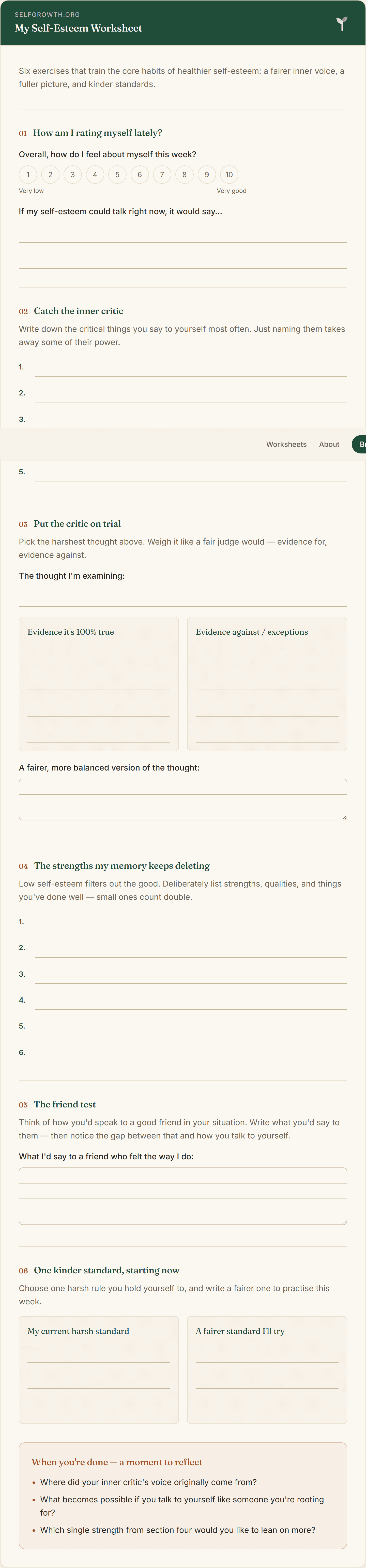
Self-Esteem Worksheet
Free printable self-esteem worksheets (PDF) for adults and older teens: catch your inner critic, test it against evidence, and list the strengths you overlook.
Open worksheet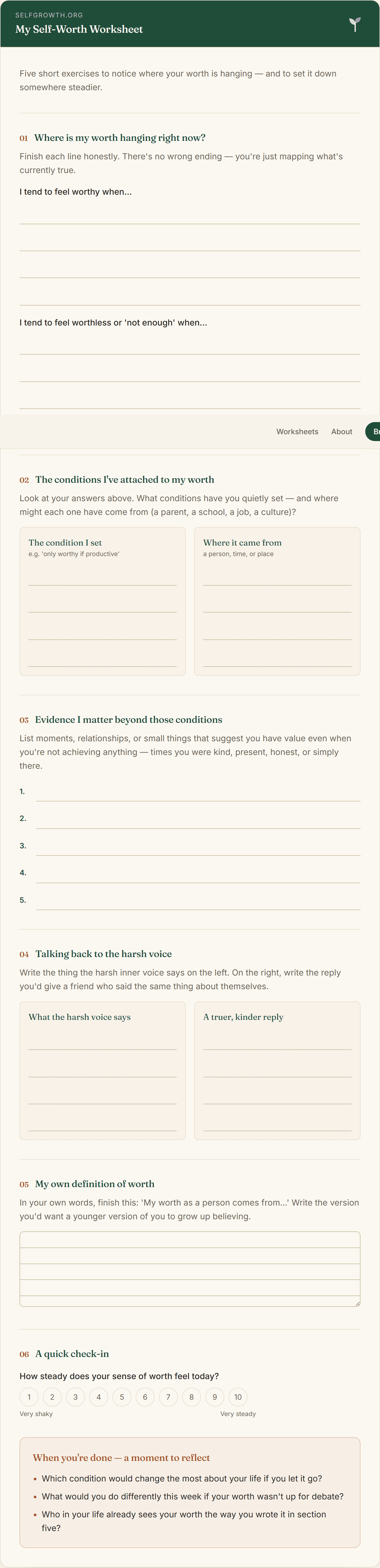
Self-Worth Worksheet
Free printable self-worth worksheets (PDF): find the conditions you've tied your worth to, see where they came from, and write a steadier definition of worth.
Open worksheet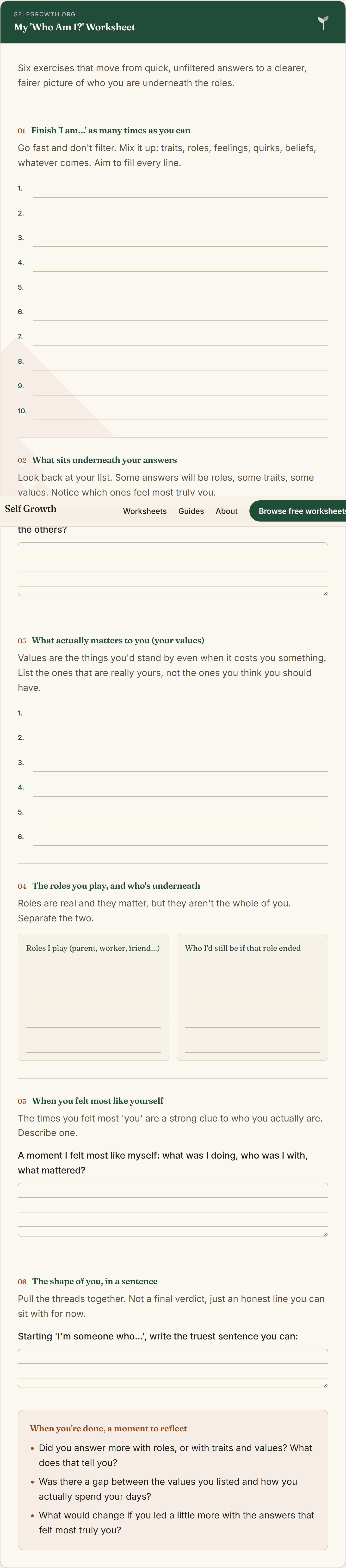
Who Am I? Worksheet
A free, printable 'Who am I?' worksheet to explore your identity, values and the person underneath your roles, with the classic twenty-statements exercise and guided prompts.
Open worksheetNew worksheets, straight to your inbox
An occasional new worksheet or tool, sent only when there's something genuinely worth your time. No spam, no pressure, unsubscribe any time.