
Shadow work
Shadow Work Journal Prompts: A Free, Printable Set That Goes From Gentle to Deep
Updated October 4, 2026 · 8 min read · Free to print
Shadow work journal prompts are questions that help you write honestly about the parts of yourself you usually keep hidden: your triggers, the feelings you were taught to bury, and strengths you gave up on. This free, printable set starts gentle and gets deeper step by step, with pacing tips and a plan for when it gets heavy.
By the Self Growth team · drawn from Jungian psychology & expressive-writing research · how we make these
A clean, print-ready PDF, properly formatted, free, no email needed.
A blank page is a hard place to start shadow work. You know there's something under the surface, the flash of envy or the overreaction you can't explain, but 'write about your shadow' gives you nothing to hold on to. A good prompt does. It points at one real, answerable thing, so you can write something true instead of going round in circles.
The order matters as much as the questions. Jumping straight to your childhood or your darkest feelings is an easy way to end up overwhelmed. These prompts start with everyday things, like how you come across and what gets under your skin, and only then move on to where those patterns came from, the parts you hide, and the good qualities you buried. Every session ends the same way: coming back up, with a kind word to yourself and one small step.
Carl Jung, who gave the shadow its name, wrote in 1938 that 'everyone carries a shadow', and that the less of it you're aware of, the 'blacker and denser it is'. Writing is one of the gentlest ways to start noticing it. In James Pennebaker's first, small expressive-writing study (1986), students who wrote about the facts and feelings of an upsetting experience, 15 minutes a day for four days, felt worse straight afterwards, yet went to the health centre less over the next six months. So feeling a bit stirred up after a session is normal. Feeling worse for days is a sign to slow down.
The self you show
The shadow, pushed out of sight
Not only the difficult parts, good traits get pushed down here too.
How to use this worksheet
- 1Do one section per sitting, not the whole sheet. 15 to 20 minutes is plenty.
- 2Start at the top, even if the later prompts look more interesting. The early ones get you used to being honest on paper before the harder ones arrive.
- 3Write without editing or judging. Nobody else needs to read it, and you can throw it away afterwards.
- 4If a prompt pulls you somewhere too painful, stop. Skip it and use the plan you wrote in section 2. Skipping isn't failing, it's pacing.
- 5Finish every session with the 'Coming back up' section, even if you only answered one prompt.
The worksheet
selfgrowth.org
My Shadow Work Journal
Prompts that go from gentle to deeper. Work through one section per sitting, skip anything that feels like too much, and always finish with 'Coming back up'.
01Check in before you start
How steady do I feel right now?
If I scored 3 or lower, I'll stay with the gentle prompts today, or stop and go to 'Coming back up'. Today I'll do:
02When to stop and get more support
Stop and reach out if a prompt brings up memories of abuse or trauma, if you feel panicky, numb or unsafe, or if you still feel worse days later. These prompts are for self-reflection, not therapy. A GP or family doctor, or a therapist, can help with what a journal can't hold. If you have any thoughts of harming yourself, please reach out now: call or text 988 in the US, call Samaritans on 116 123 in the UK and Ireland, or find a free helpline at findahelpline.com.
If this gets heavy, the person I'll talk to is:
Something that helps me feel calmer (a walk, music, a shower, a call):
03Start gentle: how you come across
Easy questions first. These get you used to being honest on paper before anything harder.
When do I feel most like myself, and when do I feel like I'm playing a part?
What do I most want people to think about me? What would I hate them to think?
Which compliment do I brush off, and which criticism stays with me for days?
04What gets under your skin
Strong reactions are the easiest way in. Pick real, recent moments, not your whole life story.
Who annoyed me recently, more than the moment deserved? What exactly did they do or say?
What trait in other people do I judge fastest? Where might a small, quiet version of it live in me?
When did I last get defensive? What was I trying to protect?
05Rules you learned growing up
A little deeper. Many hidden parts started as rules you picked up as a child. Look for the rule, not someone to blame.
Growing up, which feelings were fine to show at home, and which weren't?
What did I get praised for as a child? What got me told off, or ignored?
Finish the sentence 'Good people don't…', then ask: who taught me that?
06The parts you keep hidden
Go slowly here. If a question hits something raw, skip it. You can come back another day, or bring it to a therapist.
What do I envy in someone else's life? What does that tell me about what I want?
What part of me do I keep apologising for, or trying to make smaller?
What would I do, say or wear if I knew no one would judge me?
07The good you buried
Your shadow isn't only the difficult stuff. People also hide strengths that once felt like too much, such as ambition, confidence or playfulness.
Who do I admire so much it feels slightly uncomfortable? What quality do they have that I don't let myself show?
What did I love doing, or want to be, before I decided it 'wasn't me'?
08Coming back up (end every session here)
Don't stop on the hardest question. Finish here, even if you only answered one prompt today.
If a friend had written what I wrote today, what would I say to them?
One small, kind thing I'll do for myself in the next hour:
One prompt I want to come back to, and when:
09More prompts for another day: relationships
Tick one off each time you use it. One prompt is plenty for a sitting.
10More prompts for another day: self-worth
11More prompts for another day: your younger self
These can stir up old memories. Go gently, and leave anything that feels like trauma for a therapist rather than a journal.
When you're done, a moment to reflect
- Which prompt was hardest to answer honestly, and what might that be telling you?
- Did anything surprise you about where a reaction came from?
- How do you feel now compared with when you started? If it's much worse, use your plan from section 2.
Where these prompts come from
The idea of the shadow comes from the Swiss psychiatrist Carl Jung. In his 1937 lectures at Yale, published as Psychology and Religion in 1938, he wrote that everyone carries a shadow, and that a flaw you're aware of can be worked on, while one that's 'repressed and isolated from consciousness' never gets corrected. That's the hope behind every prompt here: noticing a hidden part gives you a chance to do something kinder with it.
The journaling side leans on expressive-writing research, which began with James Pennebaker and Sandra Beall's 1986 study and has since been tested in well over a hundred trials. Joanne Frattaroli's 2006 review of 146 randomised studies found a real but small average benefit. That research is about writing through difficult experiences in general, not shadow work in particular, so we treat it as support for the method, not proof that shadow work 'works'.
The order (gentle first, deeper later, always closing on something kind) and the advice to stop rather than push through are our own choices for doing this safely on your own. They're not a clinical method, and we've deliberately left out prompts that go straight at trauma, which is work for a therapist.
These are educational self-reflection tools, not therapy, see our editorial standards.
If you want to go deeper
- C. G. Jung — Psychology and Religion (Yale University Press, 1938), the Terry Lectures, where he writes that 'everyone carries a shadow'.
- C. G. Jung — Aion (1951), Collected Works vol. 9ii, where the shadow is described as 'a moral problem that challenges the whole ego-personality'.
- Pennebaker, J. W. & Beall, S. K. (1986). Confronting a traumatic event: Toward an understanding of inhibition and disease. Journal of Abnormal Psychology, 95(3), 274–281.
- Frattaroli, J. (2006). Experimental disclosure and its moderators: A meta-analysis. Psychological Bulletin, 132(6), 823–865.
- James W. Pennebaker — Writing to Heal (New Harbinger, 2004), a practical guide to expressive writing.
Questions people ask
- What are some good questions to ask yourself in shadow work?
- Good shadow work questions point at something specific rather than asking you to 'find your shadow'. For example: Who annoyed me recently, more than the moment deserved? What trait in others do I judge fastest, and where might a small version of it live in me? Which feelings weren't allowed in my home growing up? What do I envy, and what does that say about what I want? Start with the gentler questions and only move to the deeper ones when you feel steady.
- How do I start a shadow work journal?
- Pick a notebook, or print these prompts, and set aside 15 to 20 minutes somewhere private. Begin with one gentle question about everyday life, not your childhood or your hardest memories. Write without editing, then close the session with something kind: what you'd say to a friend who wrote what you just wrote, and one small thing you'll do for yourself. One section per sitting is plenty.
- Can you give me an example of shadow work?
- Say a colleague's confidence in meetings really irritates you. A prompt asks what trait you judge fastest, and you write that they 'show off'. Another asks what got you told off as a child, and you remember being called 'too much' when you spoke up. The irritation starts to look less like a fact about them and more like a part of you that learned to stay quiet. A small step might be sharing one idea in your next meeting.
- Do shadow work journals actually work?
- The most relevant research is on expressive writing: writing honestly about difficult thoughts and feelings. A 2006 review of 146 randomised studies by Joanne Frattaroli found it helps on average, though the effect is small. That research covers expressive writing in general, not shadow work in particular, so treat shadow journaling as a way to understand your reactions better, not as a treatment.
- Can I do shadow work by myself?
- For everyday material like irritation, envy or self-criticism, gentle journaling on your own is usually fine. If prompts bring up trauma or abuse, leave you feeling panicky or numb, or you feel worse for days afterwards, stop and do this work with a therapist instead. These prompts are a self-reflection tool, not therapy. If you're ever in crisis, call or text 988 in the US or Samaritans on 116 123 in the UK and Ireland.
- Can I get a shadow work journal for free?
- Yes. These prompts are free to fill in online or print, with no payment and no email needed. Use the Download PDF button for a clean, printable copy, or just copy the questions into any notebook.
- How is this different from the shadow work worksheet?
- The shadow work worksheet takes one strong reaction and walks it through six steps in a single sitting. These prompts are a journal: a bigger set of questions, from gentle to deeper, that you dip into over days or weeks. Many people use the worksheet when something specific has rattled them, and the prompts as a regular habit.
Keep going, related worksheets
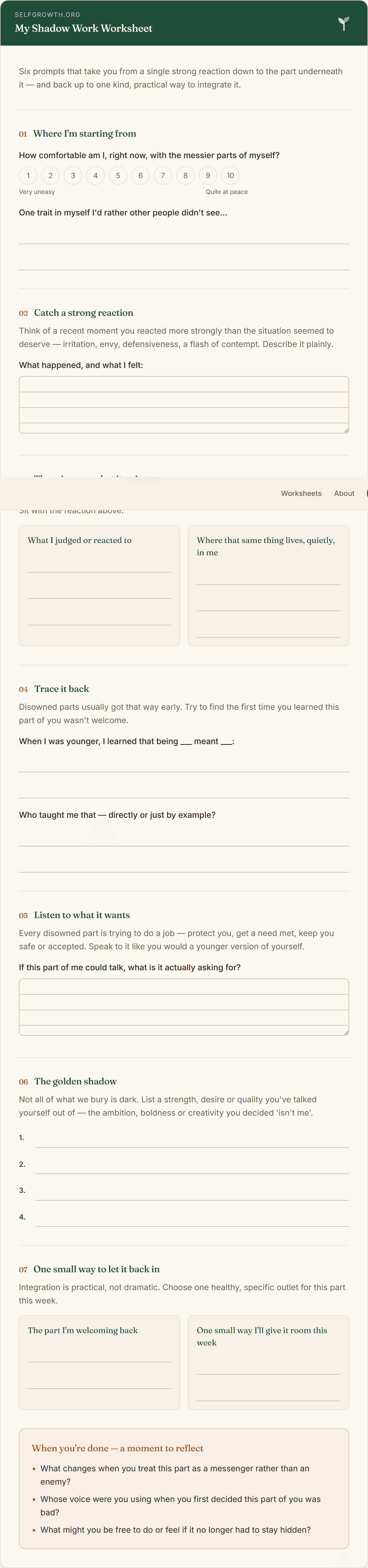
Shadow Work Worksheet
A free, printable shadow work worksheet: guided prompts to spot your triggers and projections, trace them to their roots, and meet the parts you hide.
Open worksheet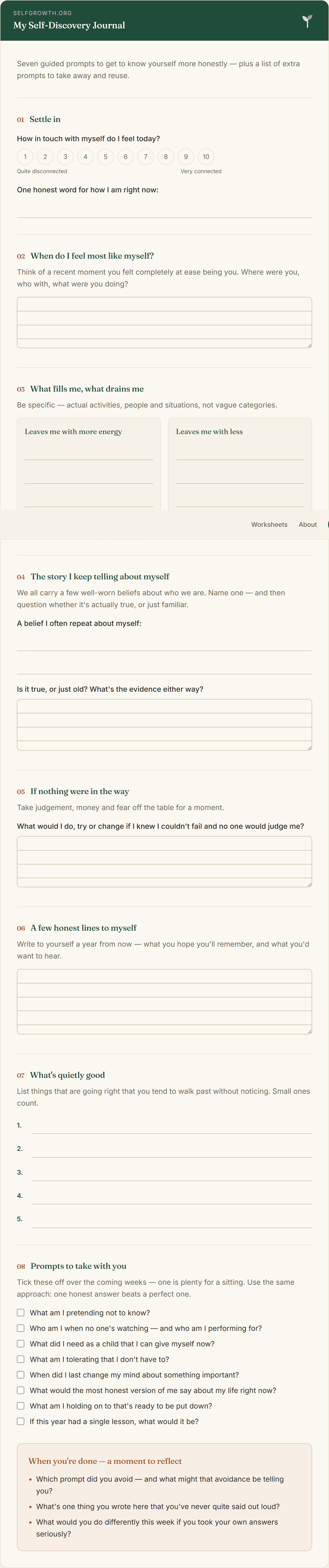
Self-Discovery Journal Prompts
Free, printable self-discovery journal prompts, guided questions with space to write, to explore your values, patterns and what you really want.
Open worksheet
Negative Self-Talk Worksheet
A free, printable negative self-talk worksheet: catch a harsh inner-critic thought, check whether it's fair, and answer it with something true and kinder.
Open worksheetNew worksheets, straight to your inbox
An occasional new worksheet or tool, sent only when there's something genuinely worth your time. No spam, no pressure, unsubscribe any time.