
Self-awareness
Feelings wheel printable: a free emotion wheel to name what you feel
Updated 11 October 2026 · 6 min read · Free to print
A feelings wheel is a circle of emotion words that helps you name what you feel more precisely. Start in the middle with a broad feeling, like sad or angry, then move out to a sharper word, like lonely or let down. This free printable gives you the wheel, a daily check-in and a week log.
By the Self Growth team · drawn from emotion research and the feeling wheel tradition · how we make these
Fill it in here (it saves in this browser, but not in a private window), print it, or download the PDF. Free, no sign-up.
Some days the only words you can find for how you feel are 'fine', 'bad' or 'stressed'. They're not wrong, they're just blurry. 'Bad' could mean lonely, ashamed, worn out or quietly furious, and each of those asks for something different from you.
A feelings wheel gives you more words to choose from. The middle has six broad feelings: happy, calm, sad, hurt, angry and scared. Around the edge, each one opens out into six more precise words. You start with whichever broad feeling is closest, then look outwards until one word makes you think, 'yes, that's it'.
The wheel is on the printable sheet below, so you can stick it on the fridge or keep it in a notebook. The sheet also has a short daily check-in, a 'find the more precise word' exercise and a week log, so naming your feelings can become a small habit rather than a one-off.
How to use this worksheet
- 1Start in the middle. Pick the broad feeling that's closest, even if it's only roughly right.
- 2Move outwards. Read the words in that slice and pick the one that fits best. If none of them do, write your own.
- 3More than one is normal. You can feel relieved and sad at the same time. Write them all down.
- 4Keep it light. There are no right answers and no good or bad feelings here, only more accurate ones. A minute a day is enough.
The worksheet
selfgrowth.org
My Feelings Wheel
Use the wheel to find a more precise word for what you feel, then take it through a short check-in. Keep the week log going for seven days and see what you notice.
Start in the middle with the broad feeling, then move out to the word that fits best. No word fits? Write your own.
01Today's check-in
Take a minute. Pause, notice what's there, and find it on the wheel.
The broad feeling (from the middle of the wheel):
The more precise word (from the edge, or my own):
How strong is it right now?
Where do I feel it in my body? (a tight chest, a heavy head, restless legs, nowhere in particular)
What happened just before, or what's been on my mind?
What might I need right now? (rest, company, space, to say something, to do one small thing)
02Find the more precise word
Think of a time recently when you used a vague word for how you felt: 'fine', 'bad', 'stressed', 'off'. Go back to that moment and use the wheel to sharpen it.
Entry 1
Entry 2
Entry 3
Did the more precise word change anything? What does it point to that the vague one didn't?
03When there's more than one feeling
Feelings often come in mixtures, and some sit underneath others. Anger can sit on top of hurt. Calm can sit next to sadness. Write down everything that's there, without picking a winner.
All the feelings I can find right now:
Is one of them easier to show than another? What might be underneath the loudest one?
04A week of check-ins
One line a day, at roughly the same time if you can. At the end of the week, read it back and look for patterns, not verdicts.
Entry 1
Entry 2
Entry 3
Entry 4
Entry 5
Entry 6
Entry 7
05Looking back at the week
Which feelings came up most? Which ones were missing?
Did certain people, places or times of day go with certain feelings?
One new feeling word I want to keep using:
When you're done, a moment to reflect
- Which feelings do you find easiest to name, and which ones do you tend to skip over?
- Which feeling did you grow up thinking you weren't allowed to have?
- When you say 'I'm fine', what are you usually feeling underneath?
- What helps most when you're hurt, compared with when you're angry or scared?
- Who could you tell, in one precise word, how you're really doing this week?
Who created the feelings wheel, and does naming feelings help?
The best-known feelings wheel is Gloria Willcox's Feeling Wheel, published in the Transactional Analysis Journal in 1982 as a tool for expanding awareness of emotions. It moves from six core feelings in the middle to more specific words around the edge. Before that, psychologist Robert Plutchik had arranged eight basic emotions in a circle (summarised in his 2001 American Scientist article), with opposites facing each other, such as joy across from sadness. The wheel on this worksheet follows the same broad-to-specific idea, but the six core feelings, the 36 words and the layout are our own, in everyday language.
Why bother finding the precise word? In a small brain-scanning study, Matthew Lieberman and colleagues (2007) asked 30 adults to look at photos of faces showing strong emotion. When people picked a word for the emotion on a face, a part of the brain linked to strong feelings (the amygdala) calmed down. It calmed less when they did other tasks, like matching the faces by gender. That study was about labelling other people's faces in a scanner, not writing down your own feelings, so it's a hint rather than proof.
Lisa Feldman Barrett and colleagues call the skill of telling feelings apart 'emotion differentiation' or 'emotional granularity'. A 2015 review by Todd Kashdan, Barrett and Patrick McKnight found that people who describe their unpleasant feelings in finer detail tend to cope better under intense stress, and are less likely to turn to things like binge drinking or aggression. Much of that evidence shows a link rather than cause and effect, and the authors describe the evidence for training the skill as preliminary. At its heart is the same thing this worksheet does: growing the number of feeling words you can reach for.
These are educational self-reflection tools, not therapy. See our editorial standards.
If you want to go deeper
- Willcox, G. (1982). The Feeling Wheel: A tool for expanding awareness of emotions and increasing spontaneity and intimacy. Transactional Analysis Journal, 12(4), 274-276.
- Plutchik, R. (2001). The nature of emotions. American Scientist, 89(4), 344-350.
- Lieberman, M. D., Eisenberger, N. I., Crockett, M. J., Tom, S. M., Pfeifer, J. H. & Way, B. M. (2007). Putting feelings into words: Affect labeling disrupts amygdala activity in response to affective stimuli. Psychological Science, 18(5), 421-428.
- Kashdan, T. B., Barrett, L. F. & McKnight, P. E. (2015). Unpacking emotion differentiation: Transforming unpleasant experience by perceiving distinctions in negativity. Current Directions in Psychological Science, 24(1), 10-16.
Your questions, answered
- What is a feelings wheel?
- A feelings wheel (also called an emotion wheel) is a circle of emotion words, arranged from broad feelings in the middle to more precise ones around the edge. It helps you move from a blurry 'I feel bad' to something clearer, like 'I feel left out' or 'I feel let down'. The one on this page has six core feelings and 36 more specific words, and it prints on one sheet.
- How do you use a feelings wheel?
- Start in the middle and pick the broad feeling that's closest to how you feel. Then look at the words in that slice and choose the one that fits best, or write your own. Notice where you feel it in your body and what happened just before. The check-in on this worksheet walks you through those steps, and the week log helps you spot patterns over a few days.
- Who created the feelings wheel?
- The best-known version is Gloria Willcox's Feeling Wheel, published in the Transactional Analysis Journal in 1982. It starts from six core feelings (mad, sad, scared, joyful, powerful and peaceful) and spreads outwards into more specific words. Psychologist Robert Plutchik's wheel of emotions is a different model, with eight basic emotions arranged in a circle. Many versions exist today. The wheel on this page is our own, with its own words.
- What are the core emotions on a feelings wheel?
- It depends on the wheel. Willcox's version uses six (mad, sad, scared, joyful, powerful and peaceful) and Plutchik's uses eight, including joy, trust, fear and surprise. There's no single agreed list. This wheel uses six everyday words: happy, calm, sad, hurt, angry and scared. What matters most isn't the exact set, it's having enough words to find the one that fits you today.
- Does naming your feelings actually help?
- There's some good reason to think so, with honest limits. In a small brain-scanning study, Lieberman and colleagues (2007) found that picking a word for the emotion in a photo of a face dampened activity in the amygdala, a part of the brain involved in emotional reactions. A 2015 review by Kashdan, Barrett and McKnight found that people who describe their feelings more precisely tend to cope better under stress, with early evidence that this skill can be learned. It isn't a cure for anything, but it's a useful first step.
- Is there a free feelings wheel PDF?
- Yes. Use the Download PDF button for a print-ready copy with the wheel at the top, or Print to print straight from the page. It works in black and white. It's completely free, with no payment and no email needed. You can also fill in the check-in on screen, and your answers save in your browser.
- Is a feelings wheel a substitute for therapy?
- No. It's an educational self-reflection tool, not therapy or medical advice. If a feeling is very strong, won't lift, or is getting in the way of daily life, please talk to a GP or family doctor or a qualified mental health professional. If you're in crisis or thinking about harming yourself, call Samaritans on 116 123 (UK and Ireland), call or text 988 (US), or find a helpline in your country at findahelpline.com. You deserve real support, not just a worksheet.
Keep going, related worksheets
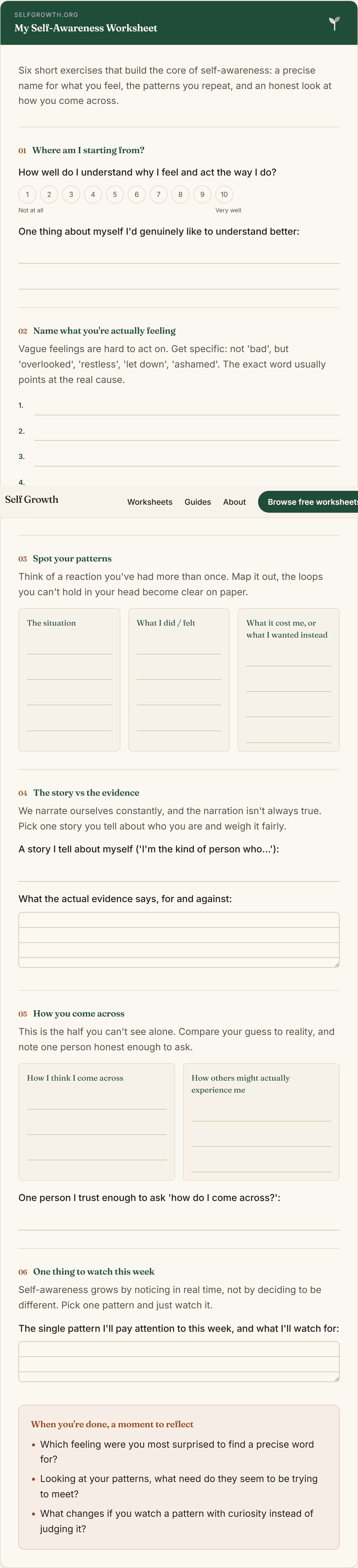
Self-Awareness Worksheet
A free, printable self-awareness worksheet with guided exercises to name your feelings, spot your patterns, and see how you come across, so you understand yourself better.
Open worksheet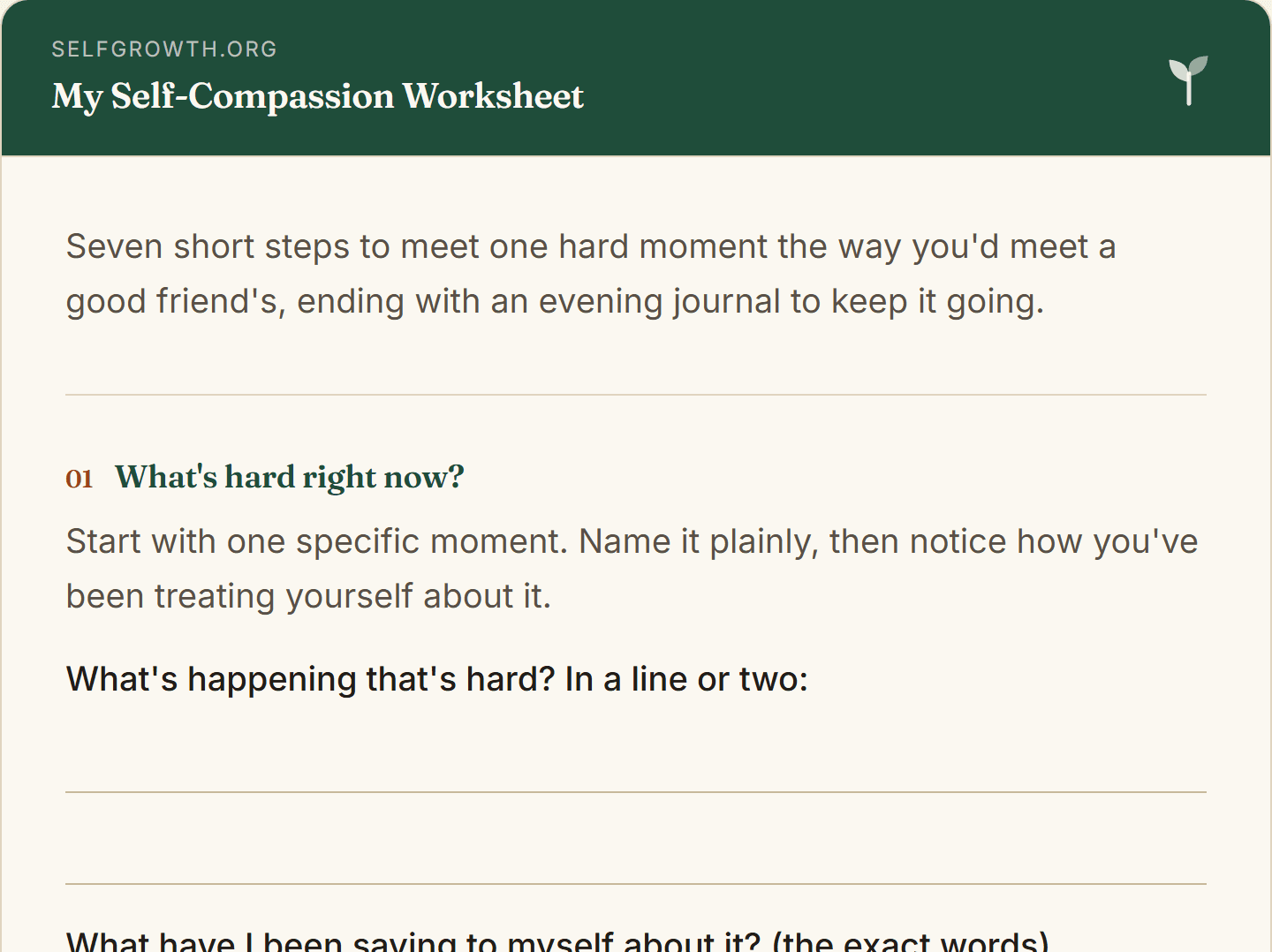
Self-Compassion Worksheet
A free, printable self-compassion worksheet: the self-compassion break, the friend test, a kind letter and journal prompts, based on Kristin Neff's research.
Open worksheet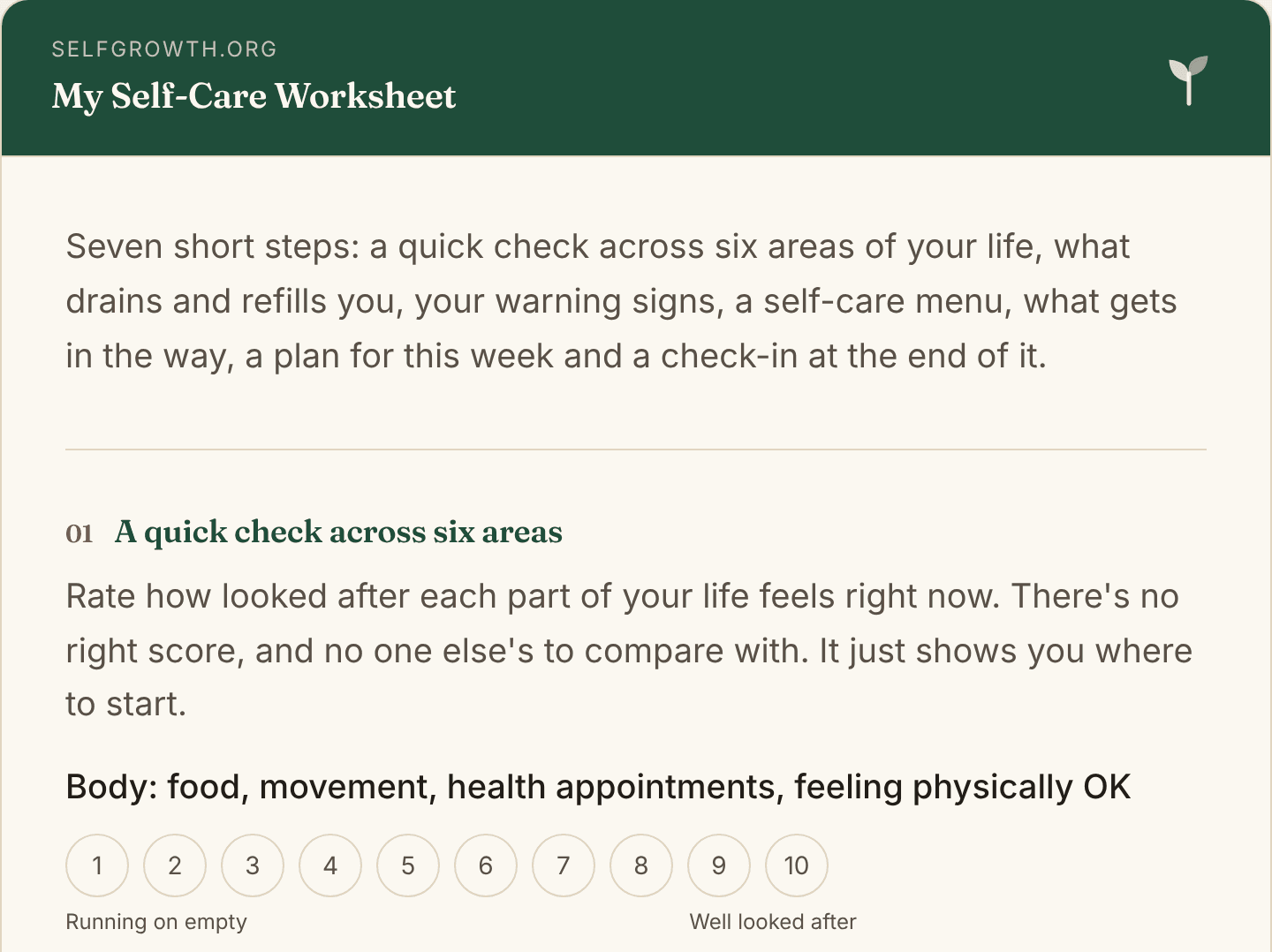
Self-Care Worksheet
A free, printable self-care worksheet for adults: check six areas of your life, see what drains and refills you, and plan small self-care that costs nothing.
Open worksheetNew worksheets, straight to your inbox
An occasional new worksheet or tool, sent only when there's something genuinely worth your time. No spam, no pressure, unsubscribe any time.