
Self-care
Self-care worksheet: a free, printable plan for looking after yourself
Updated 11 October 2026 · 6 min read · Free to print
A self-care worksheet helps you see how well you're looking after yourself across body, rest, mind, feelings, people and meaning, then plan a few small things you'll actually do. This free, printable one walks you through what drains and refills you, your warning signs, a menu of options and a simple weekly plan.
By the Self Growth team · drawn from the Five Ways to Wellbeing and research on habits and planning · how we make these
Fill it in here (it saves in this browser, but not in a private window), print it, or download the PDF. Free, no sign-up.
Self-care has picked up a reputation for being about bubble baths, face masks and treating yourself. Real self-care is plainer than that. It's the ordinary things that keep you going: enough sleep, a proper meal, a walk, a call with a friend, saying no to one more thing. Most of it is free, and a lot of it is a bit boring.
This worksheet starts with what you already do, because you're probably doing more than you think. Then it helps you spot what's missing, notice your own early signs of running low, and pick a few small things you'd genuinely do this week. Not a routine for a different, better-rested person. One that fits the life you've got.
If you feel too tired or stretched to even think about this, that's often a sign it's needed. Fill in what you can. A few honest lines are enough to start.
How to use this worksheet
- 1Give yourself 15 to 20 minutes. You don't need to do it all in one go.
- 2Be honest rather than impressive. Nobody else needs to see your answers.
- 3Keep the options small and free. If it needs money, a booking or a whole free day, it probably won't happen on a hard week.
- 4Pin your weekly plan somewhere you'll see it, and come back at the end of the week to check in.
The worksheet
selfgrowth.org
My Self-Care Worksheet
Seven short steps: a quick check across six areas of your life, what drains and refills you, your warning signs, a self-care menu, what gets in the way, a plan for this week and a check-in at the end of it.
01A quick check across six areas
Rate how looked after each part of your life feels right now. There's no right score, and no one else's to compare with. It just shows you where to start.
Body: food, movement, health appointments, feeling physically OK
Rest: sleep, breaks, time when nothing is asked of me
Mind: room to think, learning something, less mental clutter
Feelings: noticing how I feel and letting it out somewhere safe
People: time with people who are good for me, and help when I need it
Meaning and space: things that matter to me, time outdoors, quiet
Things I already do that help, even small ones:
02What drains me, and what refills me
Think about a normal week. On the left, write the things that leave you tired, tense or flat. Next to each one, write something small that helps you recover from it.
Entry 1
Entry 2
Entry 3
Entry 4
03My warning signs that I'm running low
Most of us have our own early signals before we hit empty. Tick the ones you recognise, then add your own. Catching them early means a smaller fix.
My own early warning signs:
04My self-care menu
A list of options you'd actually do, sorted by how much time they take. When you're low, you won't have the energy to think of ideas, so write them now. Keep them free or nearly free.
5 minutes
e.g. a glass of water, stepping outside, stretching, one song
30 minutes
e.g. a walk, cooking something simple, a call with a friend
Bigger
e.g. a free afternoon, a day out, sorting a health appointment
05What gets in the way, and a kinder reply
Guilt, no time, 'other people have it worse'. Write down the thoughts that stop you, then answer each one the way you would if a friend said it.
Entry 1
Entry 2
Entry 3
06My self-care plan for this week
Pick two or three things from your menu, not ten. Then decide exactly when and where, for example 'After I drop the kids off, I'll walk the long way home'. A plan tied to a moment is usually easier to keep than a good intention.
Entry 1
Entry 2
Entry 3
If I miss a day, what I'll tell myself (and when I'll pick it back up):
07End-of-week check-in
Come back to this in a week. You're not grading yourself, just noticing what helped so next week's plan can be a little better.
Overall, how looked after do I feel this week?
What helped most, and what I'll keep:
What didn't fit, and what I'll try instead:
When you're done, a moment to reflect
- When did you last feel properly rested? What was different about that time?
- Who in your life makes you feel more like yourself, and when did you last see them?
- What do you do for other people that you never let yourself have?
- What would you tell a friend who was as tired as you are right now?
- If you could protect just one small thing in your week, what would it be?
Why these steps, and where they come from
'Self-care' means different things in different places. The World Health Organization uses it in a broad, health-system sense: people, families and communities promoting and maintaining their own health, preventing disease and coping with illness, with or without a health worker's help. That's wider and more medical than this worksheet. Here, self-care means the everyday things you do to keep yourself going.
The six areas in the quick check are a practical way to cover the main parts of everyday wellbeing, not a scientific scale. They overlap with the Five Ways to Wellbeing (connect, be active, take notice, keep learning and give), drawn up by the New Economics Foundation in 2008 for the UK government's Foresight project and used today in the NHS's 5 steps to mental wellbeing.
The weekly plan uses what psychologist Peter Gollwitzer calls implementation intentions: tying an action to a specific moment ('when X happens, I'll do Y'). His research suggests plans like this help people get started on things they already intend to do. And habit research by Phillippa Lally and colleagues at UCL (2010) found that how long a new habit took to feel automatic varied hugely from person to person, and that a single missed day made little difference. That's why the plan asks for two or three small things, and what you'll say to yourself if you miss a day.
These are educational self-reflection tools, not therapy. See our editorial standards.
If you want to go deeper
- World Health Organization. Self-care (health topic page). who.int/health-topics/self-care.
- Aked, J., Marks, N., Cordon, C. & Thompson, S. (2008). Five Ways to Wellbeing. New Economics Foundation, for the Government Office for Science Foresight project.
- NHS. 5 steps to mental wellbeing. nhs.uk.
- Gollwitzer, P. M. (1999). Implementation intentions: Strong effects of simple plans. American Psychologist, 54(7), 493-503.
- Lally, P., van Jaarsveld, C. H. M., Potts, H. W. W. & Wardle, J. (2010). How are habits formed: Modelling habit formation in the real world. European Journal of Social Psychology, 40(6), 998-1009.
Your questions, answered
- What is a self-care worksheet?
- It's a guided page that helps you look at how well you're looking after yourself and plan a few small improvements. This one checks six areas of your life (body, rest, mind, feelings, people, and meaning and space), then helps you list what drains and refills you, spot your warning signs, build a menu of options and make a simple plan for the week.
- What are some examples of self-care?
- Most good examples are ordinary and free: going to bed at a sensible time, eating a proper meal, drinking water, a short walk outside, stretching, calling a friend, saying no to something you don't have room for, booking a GP appointment you've been putting off, tidying one small space, or ten quiet minutes with no screen. Good self-care is whatever you'd actually do on a tired day.
- Is self-care selfish?
- No. Looking after your basic needs is what lets you keep showing up for work, family and friends. Self-care can tip into avoidance if you use it to dodge everything hard, but resting, eating well and asking for help aren't selfish. If guilt is the main thing stopping you, the 'what gets in the way' step helps you answer it, and it may also be worth looking at people-pleasing or boundaries.
- What does self-care look like for adults?
- For most adults it's less about treats and more about maintenance: sleep, food, movement, keeping on top of health appointments, protecting some time that's yours, staying in touch with people and saying no when you're stretched. It has to fit around work, money and caring for others, which is why this worksheet keeps every option small and asks you to tie each one to a real moment in your week.
- Is this self-care worksheet free, and is there a PDF?
- Yes, it's completely free, with no payment and no email needed. Use the Download PDF button for a clean printable copy, or Print to print straight from the page. You can also fill it in on screen, and your answers save in your browser. None of the self-care ideas on it cost money either.
- How often should I do self-care?
- Little and often works better than a big reset once in a while. A few minutes most days, plus something bigger now and then, is a sensible place to start. Research on habits suggests that missing the odd day doesn't undo your progress, so if a plan slips, just pick it back up rather than starting over.
- When is self-care not enough?
- This worksheet is a self-reflection tool, not therapy or medical advice. If you've felt low, anxious or exhausted for more than a couple of weeks, if you can't manage day-to-day things, or if you're struggling to cope, please talk to a GP or a qualified mental health professional. If you ever think about harming yourself, contact a crisis line now: Samaritans on 116 123 (UK), 988 (US), or find a helpline in your country at findahelpline.com.
Keep going, related worksheets
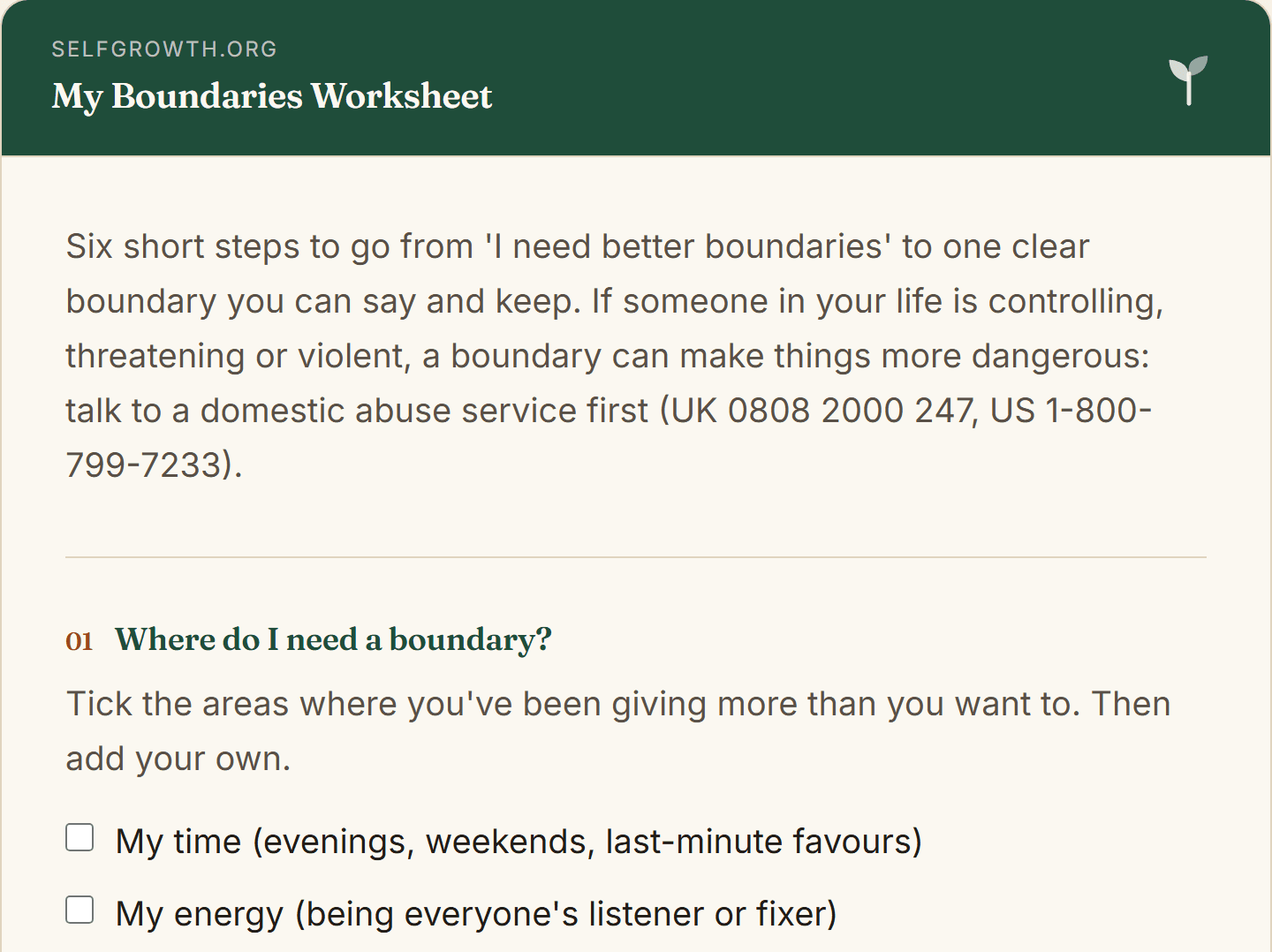
Boundaries Worksheet
A free, printable boundaries worksheet: spot where you need a limit, write it as something you'll do, plan the exact words, and decide what you'll do if it's crossed.
Open worksheet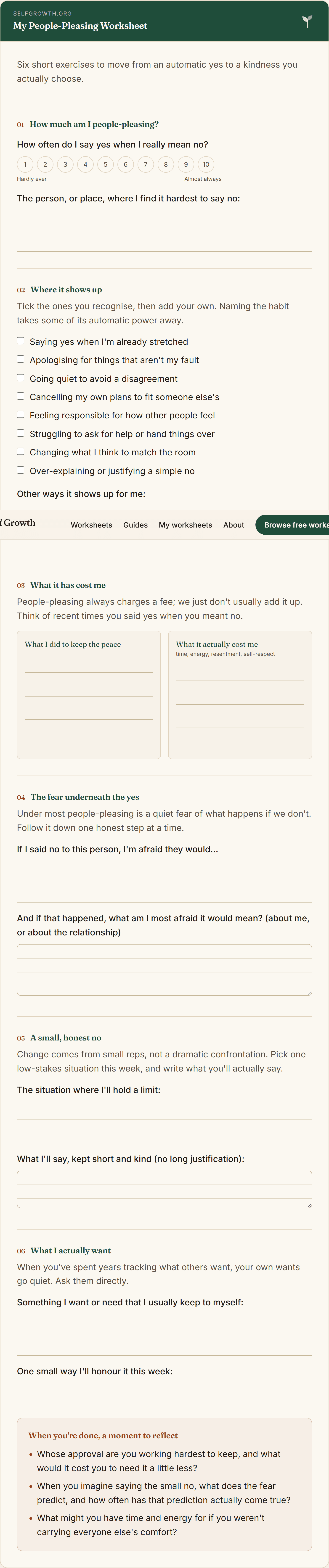
People-Pleasing Worksheet
A free, printable people-pleasing worksheet: see where you over-give, name the fear underneath, count the real cost, and practise one small, honest no.
Open worksheet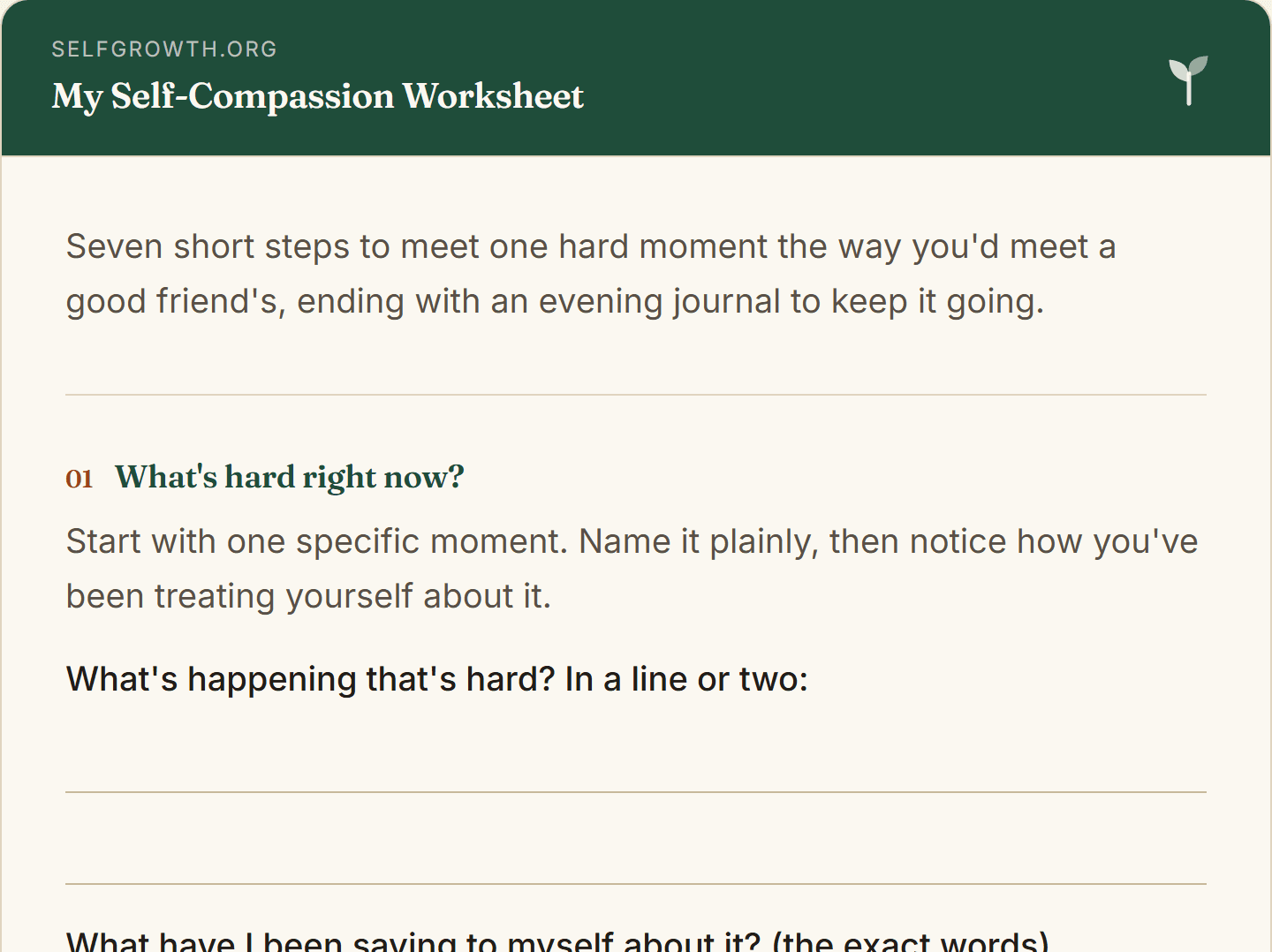
Self-Compassion Worksheet
A free, printable self-compassion worksheet: the self-compassion break, the friend test, a kind letter and journal prompts, based on Kristin Neff's research.
Open worksheetNew worksheets, straight to your inbox
An occasional new worksheet or tool, sent only when there's something genuinely worth your time. No spam, no pressure, unsubscribe any time.