
Self-awareness
Self-reflection worksheet: a free, printable way to learn from what happened
Updated 11 October 2026 · 7 min read · Free to print
A self-reflection worksheet helps you learn from something that happened instead of just replaying it. Pick one experience, like a hard week, a project or a difficult conversation, and take it through Gibbs' reflective cycle: what happened, how you felt, what went well and badly, why, what you learned and your next step. It's free to print.
By the Self Growth team · drawn from reflective practice models used in education and nursing · how we make these
Fill it in here (it saves in this browser, but not in a private window), print it, or download the PDF. Free, no sign-up.
It's easy to replay things. The meeting that went sideways, the argument on the way home, the week that got away from you. Replaying feels like thinking it through, but it often just goes round in a loop. Reflection is different: it has a start, a middle and an end, and the end is something you'll actually do.
This worksheet takes one real experience through a well-known structure called Gibbs' reflective cycle. You describe what happened, notice how you felt, weigh up what went well and what didn't, ask why, and finish with what you've learned and one next step. A short weekly log at the end lets you keep the habit going in about ten minutes.
It's not about marking yourself out of ten or proving you got it wrong. The aim is a fair look at one experience, so the next one goes a little better.
How to use this worksheet
- 1Pick one specific experience from the last few weeks. A single conversation, a project or one hard day works better than 'my whole year'.
- 2Allow about 20 minutes. Work through the steps in order, because each one builds on the last.
- 3Stick to what you actually know in the first step. Save the 'why' for later, so you don't jump to conclusions.
- 4If you notice you're going round in circles, or feeling worse with every line, stop. Skip ahead to the next step box, or put the page down and come back another day.
The worksheet
selfgrowth.org
My Self-Reflection Worksheet
Six steps to take one experience from 'what happened?' to 'what will I do next?', plus a weekly log to keep it going. Reflection should leave you clearer, not heavier. If you find yourself going in circles, stop and skip to your next step.
01What happened?
Pick one experience and describe it as plainly as you can, like a fair witness would. Facts first: where, when, who was there, what was said and done. No judgements yet.
The experience I'm reflecting on (a week, a project, a conversation):
What actually happened, step by step:
What was I hoping would happen?
02How did I feel?
Feelings at the time and feelings now are often different, and the gap is useful. Use specific words if you can: not just 'bad', but 'embarrassed', 'rushed', 'let down', 'relieved'.
Entry 1
Entry 2
Entry 3
03What went well, and what didn't?
Be even-handed. Most experiences have both, even the ones that felt like a disaster. Try to find at least one thing for the first column.
Entry 1
Entry 2
Entry 3
Entry 4
04Why did it go that way?
Now look for reasons, not culprits. What helped, what got in the way, and which parts were yours to change? If this turns into going over the same point again and again, that's your cue to move on to the next step.
What made the difference? (timing, how I was feeling, what I knew or didn't, other people, the situation itself)
Entry 1
Entry 2
Entry 3
05What have I learned?
Pull it together. Not a verdict on you as a person, just what this experience taught you.
The main thing I've learned from this:
If the same thing happened again, what would I do differently?
06My next step
Reflection pays off when it ends in action. Make it small and specific enough that you'll know whether you did it.
One thing I'll do differently next time, or do this week:
When or where I'll do it, and anyone who could help:
07A weekly 10-minute reflection log
A lighter version for the end of each week, using three questions: What? So what? Now what? One row per week, one moment from it.
Entry 1
Entry 2
Entry 3
Entry 4
When you're done, a moment to reflect
- What do you tend to notice first when you look back: what went wrong, or what went well?
- Was the 'why' mostly about you, mostly about the situation, or a mix?
- Which feeling from the time looks different now you've written it down?
- What would you tell a friend who'd had this exact experience?
- What's one thing that went well this week that you'd like more of?
Does self-reflection actually help?
There's little trial evidence on reflection worksheets themselves. What research does show is that looking inward comes in two kinds, one helpful and one not (more on that below), so this worksheet gives your reflection a clear structure and an end point. It follows Gibbs' reflective cycle. Graham Gibbs, then an education researcher at Oxford Polytechnic, set it out in a 1988 guide called Learning by Doing. The cycle has six stages: description, feelings, evaluation, analysis, conclusion and action plan. Taking them in order slows you down. You describe what happened before you judge it, and you look at your feelings before you decide what they mean. It's widely used in education and nursing to help people learn from experience.
The weekly log uses an even shorter model: three questions, What? So what? Now what? It's set out by Gary Rolfe, Dawn Freshwater and Melanie Jasper in their 2001 book on critical reflection for nursing and the helping professions, building on earlier work by the educator Terry Borton (1970). 'What?' describes the moment, 'So what?' asks what it means, and 'Now what?' asks what you'll do about it.
Looking inward isn't automatically good for you, though. Psychologists Paul Trapnell and Jennifer Campbell (1999) found that what had been measured as one habit of self-focus was really two separate ones: reflection and rumination (going over the same worries again and again). Their work suggested this mix-up helps explain why people who look inward a lot can know themselves well and still feel more distressed. That's why every step here points towards action, and why the worksheet tells you to stop if you're going in circles.
We've reworded these models in plain English for everyday life rather than professional practice.
These are educational self-reflection tools, not therapy. See our editorial standards.
If you want to go deeper
- Gibbs, G. (1988). Learning by Doing: A guide to teaching and learning methods. Further Education Unit, Oxford Polytechnic (now Oxford Brookes University).
- Rolfe, G., Freshwater, D. & Jasper, M. (2001). Critical Reflection for Nursing and the Helping Professions: A User's Guide. Palgrave Macmillan.
- Borton, T. (1970). Reach, Touch, and Teach: Student Concerns and Process Education. McGraw-Hill.
- Trapnell, P. D. & Campbell, J. D. (1999). Private self-consciousness and the five-factor model of personality: Distinguishing rumination from reflection. Journal of Personality and Social Psychology, 76(2), 284-304.
Your questions, answered
- What is a self-reflection worksheet?
- It's a structured page that helps you look back at something that happened and learn from it. This one takes one experience, like a hard week, a project or a difficult conversation, through Gibbs' reflective cycle: what happened, how you felt, what went well and what didn't, why, what you learned and your next step. It ends with a short weekly log you can keep using.
- What are good self-reflection questions?
- The most useful ones follow an order. What actually happened? How did I feel then, and how do I feel now? What went well, and what didn't? Why did it go that way, and which parts were in my control? What have I learned? What will I do differently next time? For a quick weekly check-in, try three: What? So what? Now what?
- What are the six stages of Gibbs' reflective cycle?
- Description (what happened), feelings (how you felt), evaluation (what was good and bad about it), analysis (what sense you can make of it), conclusion (what you learned and what else you could have done) and action plan (what you'll do next time). Graham Gibbs set it out in 1988. Steps 1 to 6 of this worksheet follow it in plain English.
- Is this self-reflection worksheet suitable for students?
- Yes, for older students. It's written for adults, but the structure works well for sixth form, college or university, and Gibbs' cycle is often taught on courses that ask for reflective writing. It's a good way to look back on an exam, a group project or a placement. Younger children will usually get more from doing it alongside a parent or teacher.
- What's the difference between reflection and overthinking?
- Reflection moves forward and ends in something you'll do. Overthinking, or rumination, goes round in circles. Signs you've slipped into it: you keep going over the same moment without anything new, you feel worse each time, you're asking 'why am I like this?' instead of 'what happened?', or you can't get to a next step. If that happens, stop and skip to the last step, or put the page down.
- How often should I do self-reflection?
- There's no proven ideal. Do the full worksheet when something is worth learning from, like a big conversation, the end of a project or a week that didn't go to plan. For a lighter habit, the weekly log takes about ten minutes. A rhythm you'll actually keep is better than an ambitious one you drop.
- Is this free, and is there a PDF?
- Yes. Use the Download PDF button for a clean, print-ready copy, or Print to print straight from the page. It's completely free, with no payment and no email needed. You can also fill it in on screen, and your answers save in your browser.
- Is this worksheet a substitute for therapy?
- No. It's an educational self-reflection tool for everyday experiences, not therapy or medical advice. If looking back keeps pulling you into low mood, if an experience was traumatic, or if you ever have thoughts of harming yourself, please talk to a GP or a qualified professional. You can find a free helpline at findahelpline.com, call Samaritans on 116 123 in the UK, or call or text 988 in the US.
Keep going, related worksheets
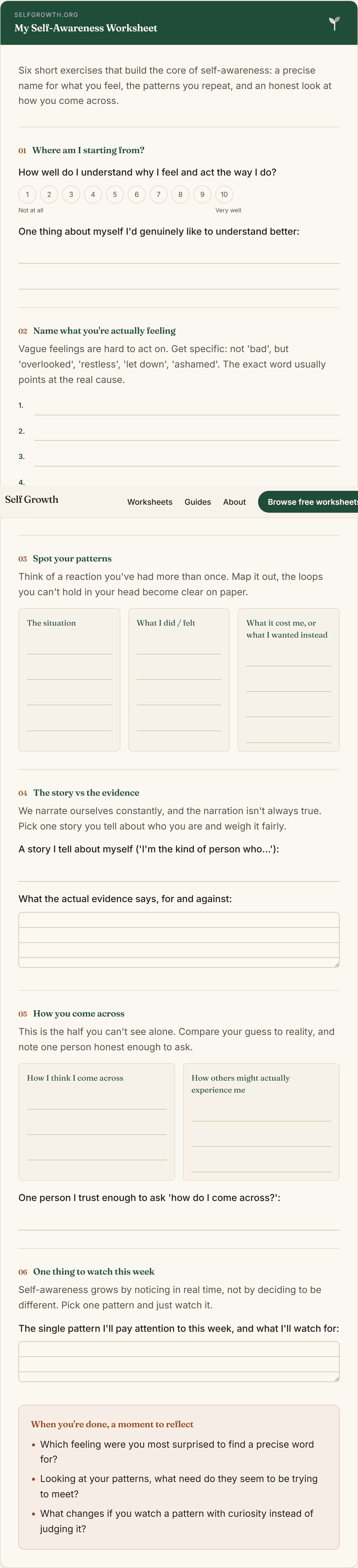
Self-Awareness Worksheet
A free, printable self-awareness worksheet with guided exercises to name your feelings, spot your patterns, and see how you come across, so you understand yourself better.
Open worksheet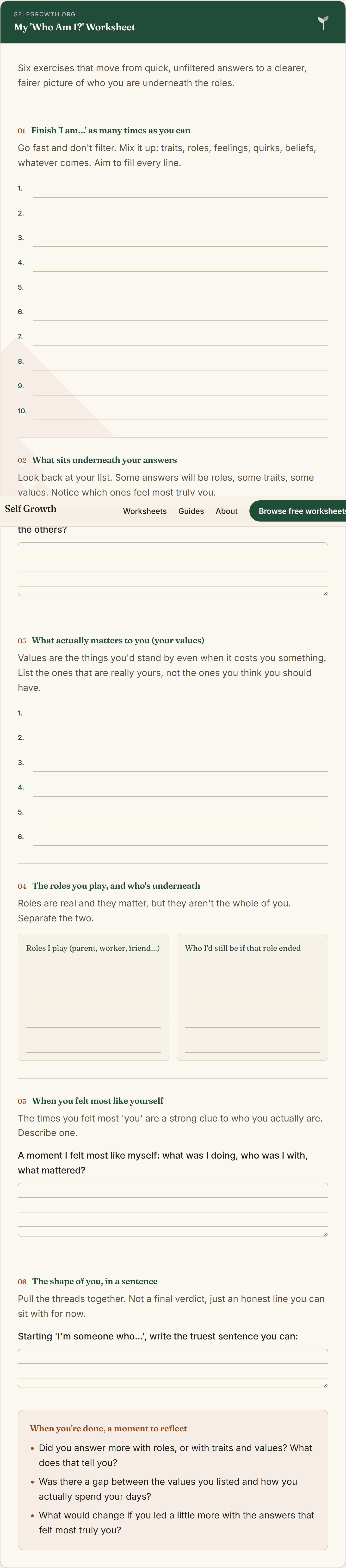
Who Am I? Worksheet
A free, printable 'Who am I?' worksheet to explore your identity, values and the person underneath your roles, with the classic twenty-statements exercise and guided prompts.
Open worksheet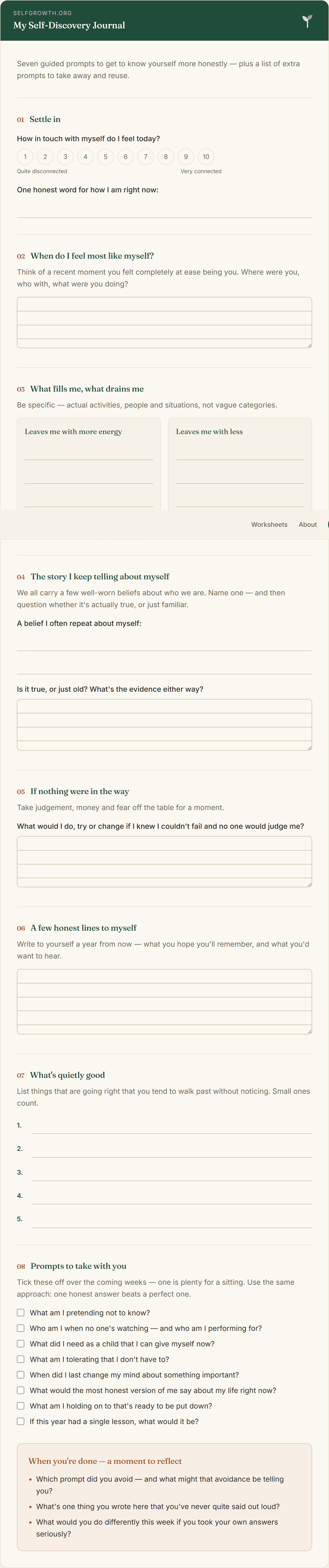
Self-Discovery Journal Prompts
Free, printable self-discovery journal prompts, guided questions with space to write, to explore your values, patterns and what you really want.
Open worksheetNew worksheets, straight to your inbox
An occasional new worksheet or tool, sent only when there's something genuinely worth your time. No spam, no pressure, unsubscribe any time.