
Inner critic
Self-sabotage worksheet: a free, printable way to understand why you get in your own way
Updated 11 October 2026 · 7 min read · Free to print
A self-sabotage worksheet helps you see why you get in your own way. Tick the signs that fit, pick one pattern, then look at what it protects you from and what it costs. Find the belief underneath, write an if-then plan for next time and try one small experiment. It's free to fill in or print.
By the Self Growth team · drawn from self-handicapping research, procrastination research and implementation intentions · how we make these
Fill it in here (it saves in this browser, but not in a private window), print it, or download the PDF. Free, no sign-up.
Self-sabotage is when part of you wants something and another part quietly makes sure it doesn't happen. You put off the application until it's too late. You pick a fight just as things get close. You keep polishing the work so you never have to hand it in. Afterwards it can feel baffling, or like proof that something is wrong with you.
It usually isn't. 'Self-sabotage' is an everyday phrase, not a diagnosis, and the habits it describes often make sense once you see what they're doing for you. Putting something off brings relief right now. Not trying properly means a failure doesn't have to say anything about you. Pulling away first means you can't be left. The habit protects you from something, and it charges you for it later.
This worksheet takes one pattern and looks at it fairly, without blame. You'll weigh what it protects you from against what it costs, find the belief underneath, and plan one different move for next time. Nobody else has to see what you write.
How to use this worksheet
- 1Set aside about 20 minutes somewhere you won't be interrupted.
- 2Work on one pattern only. A recent, specific example is far easier to look at than your whole life.
- 3Be curious, not cross. The aim is to understand the habit, not to tell yourself off for it.
- 4Keep the page. Come back after you've tried your experiment and fill in the review at the end.
The worksheet
selfgrowth.org
My Self-Sabotage Worksheet
Seven short steps to understand one way you get in your own way, and to try something different next time.
01Signs of self-sabotage: which sound like me?
Tick any that you recognise, even if only sometimes. Recognising a few is normal. Add your own if yours isn't here.
Any others I notice in myself:
02Pick one pattern
Choose the one that costs you most right now, or the one you're most ready to look at. Name it plainly.
The pattern I'm going to look at:
A recent time it happened. What was going on, and what did I want?
How much is this pattern getting in my way at the moment?
03What it protects me from, and what it costs
Take two or three times this happened. For each, note what you did, what it saved you from feeling or facing in the moment, and what it cost you afterwards. Both columns are real.
Entry 1
Entry 2
Entry 3
04The belief underneath
Patterns like this often rest on an old belief about yourself, other people or what happens if you really try. Tick any that ring true, then put yours in your own words.
In my own words, the belief this pattern protects:
Where might I have learned it? And is it as true now as it felt then?
05My if-then plan for next time
Pick the moment the pattern usually starts, and decide now what you'll do instead. Keep the 'then' small enough to do on a bad day.
Entry 1
Entry 2
Entry 3
What I'll say to myself in that moment (kind, not harsh):
06A small experiment
Choose one low-stakes chance this week to do the opposite of the pattern, then see what actually happens. Treat it as a test, not a pass or fail.
My experiment (what, when, where):
What I predict will happen if I don't protect myself this time:
How strongly do I believe that prediction right now?
07Review: what happened?
Come back after your experiment. Whatever happened, you've learned something about the pattern.
What actually happened? Was it what I predicted?
How strongly do I believe the prediction now?
One thing I'll keep doing, or change, next time:
When you're done, a moment to reflect
- When did this pattern first show up in my life, and what was it helping me cope with then?
- What would I have to feel or face if I stopped doing it?
- If a friend did exactly this, what would I understand about them that I'm not giving myself?
- What's one goal I've quietly stopped going for, and what made me stop?
- What would it look like to be on my own side next time, rather than in my own way?
Why you might get in your own way: what the research suggests
'Self-sabotage' isn't a clinical term, but psychologists have studied some of the habits behind it. The best known is self-handicapping: putting an obstacle in your own way before a test, so that if you fail, the obstacle gets the blame instead of you. The term comes from a 1978 study by Steven Berglas and Edward Jones. College students took a test and were told they'd done well, though for some the questions were so hard that their success felt like luck. Before a retest, they could choose a drug they were told would help their performance or one they were told would hurt it. Only the men whose success felt like luck tended to pick the one that would hurt. The researchers' reading was that it gave them an excuse in advance. The effect didn't hold for the women in the study. That's one experiment, not proof of how everyone works, but it's why step 3 asks what a habit protects you from.
Procrastination is one of the most familiar forms. In a 2013 review, Fuschia Sirois and Timothy Pychyl argue that it's less about laziness or poor time management and more about mood. Putting off a task you dread makes you feel better now, and the cost lands on your future self. That's the trade the paired columns in step 3 make visible.
The if-then plan in step 5 comes from Peter Gollwitzer's work on implementation intentions: deciding in advance 'when this happens, I'll do that' so the moment itself prompts the new action, rather than relying on willpower when you're already anxious. The belief and experiment steps borrow a simple idea from cognitive behavioural therapy (CBT, a talking therapy that looks at links between thoughts, feelings and actions): test a fearful prediction in real life and see what actually happens. If the harsh voice in your head is a big part of the pattern, the guide to quieting your inner critic goes deeper.
These are educational self-reflection tools, not therapy. See our editorial standards.
If you want to go deeper
- Berglas, S. & Jones, E. E. (1978). Drug choice as a self-handicapping strategy in response to noncontingent success. Journal of Personality and Social Psychology, 36(4), 405-417.
- Sirois, F. & Pychyl, T. (2013). Procrastination and the priority of short-term mood regulation: Consequences for future self. Social and Personality Psychology Compass, 7(2), 115-127.
- Gollwitzer, P. M. (1999). Implementation intentions: Strong effects of simple plans. American Psychologist, 54(7), 493-503.
Your questions, answered
- What are signs of self-sabotage?
- Common signs include putting things off until it's too late, picking fights or pulling away just as you get close to someone, perfectionism that stops you finishing, quitting just before the finish line, talking yourself down before you start, and numbing out with scrolling, food or drink instead of doing the thing. Step 1 of this worksheet is a checklist of these so you can see which fit you.
- Why do I self-sabotage?
- Often because the habit protects you from something in the moment. It might be the fear of failing, or of succeeding and having more expected of you. It might be protecting your sense of being good enough, or an old belief such as 'people leave once they know me'. None of this means you're broken. It means a coping move that once made sense is now costing you more than it saves.
- Is self-sabotage a mental illness?
- No. 'Self-sabotage' is an everyday term, not a diagnosis. It describes common habits, not a condition. But some of these patterns can overlap with things that deserve proper support, such as depression, anxiety, ADHD, past trauma or drinking to cope. If the pattern is serious, or you're numbing out a lot, talk to a GP or a qualified therapist.
- How do I stop self-sabotaging?
- Start with one pattern, not all of them. Get clear on what it protects you from and what it costs, and name the belief underneath. Then decide in advance what you'll do in the moment it usually starts (an if-then plan), and test it with one small, low-stakes experiment. Expect to slip sometimes. Noticing the pattern sooner each time is real progress.
- Is there a self-sabotage worksheet PDF?
- Yes. Use the Download PDF button for a clean, print-ready copy, or Print to print straight from the page. It's completely free, with no payment and no email needed. You can also fill it in on screen, and your answers save in your browser.
- Is this worksheet a substitute for therapy?
- No. It's an educational self-reflection tool, not therapy or medical advice. If a pattern is hurting your health, work or relationships, if you're using alcohol or drugs to cope, or if you feel hopeless or have thoughts of harming yourself, please reach out to a GP or family doctor, a qualified mental health professional or a crisis line (Samaritans on 116 123 in the UK, 988 in the US, or findahelpline.com elsewhere). You deserve real support, not just a worksheet.
Keep going, related worksheets
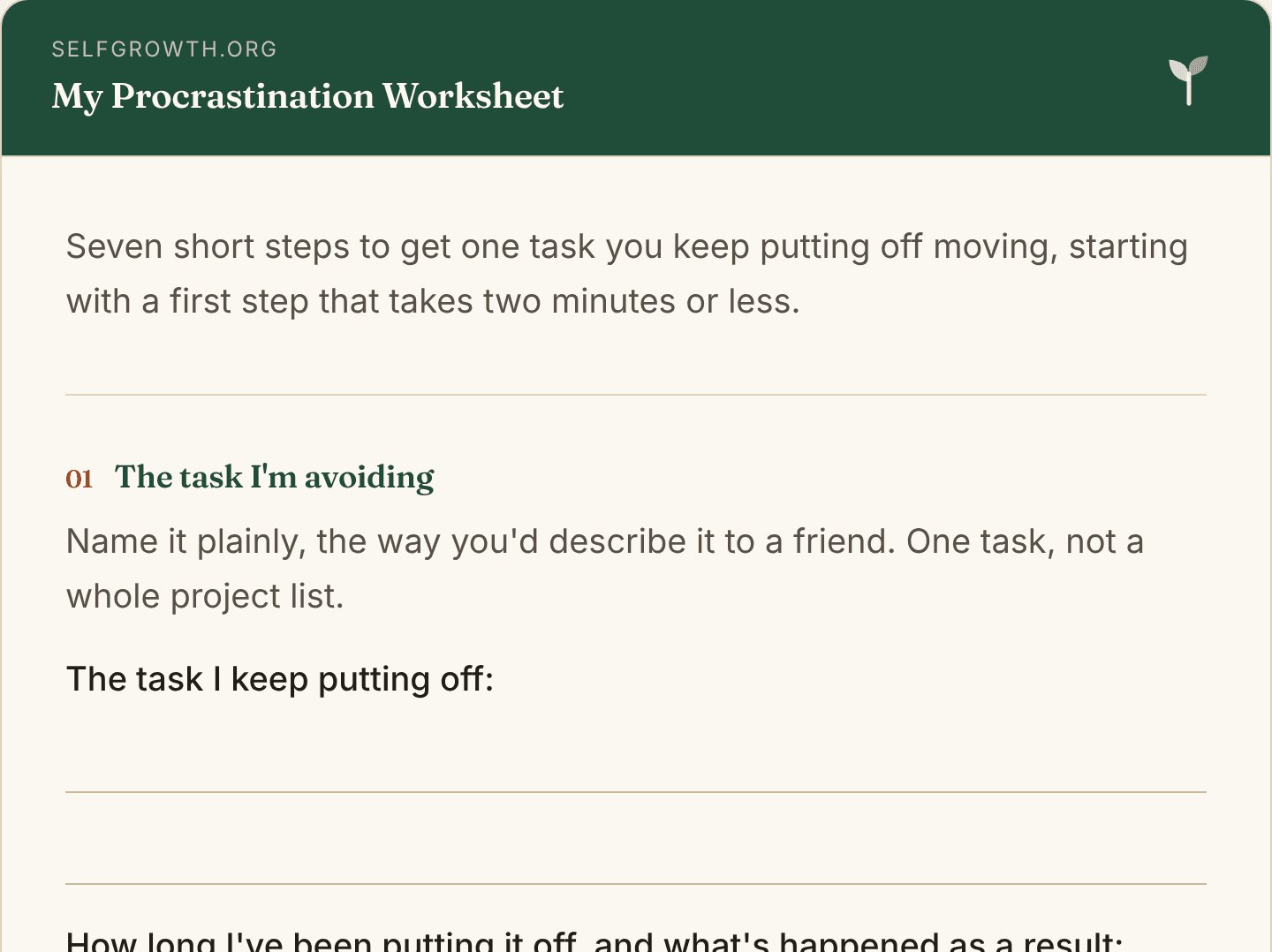
Procrastination Worksheet
A free, printable procrastination worksheet: name the feeling you're avoiding, find a two-minute first step, make an if-then plan and log seven days of starts.
Open worksheet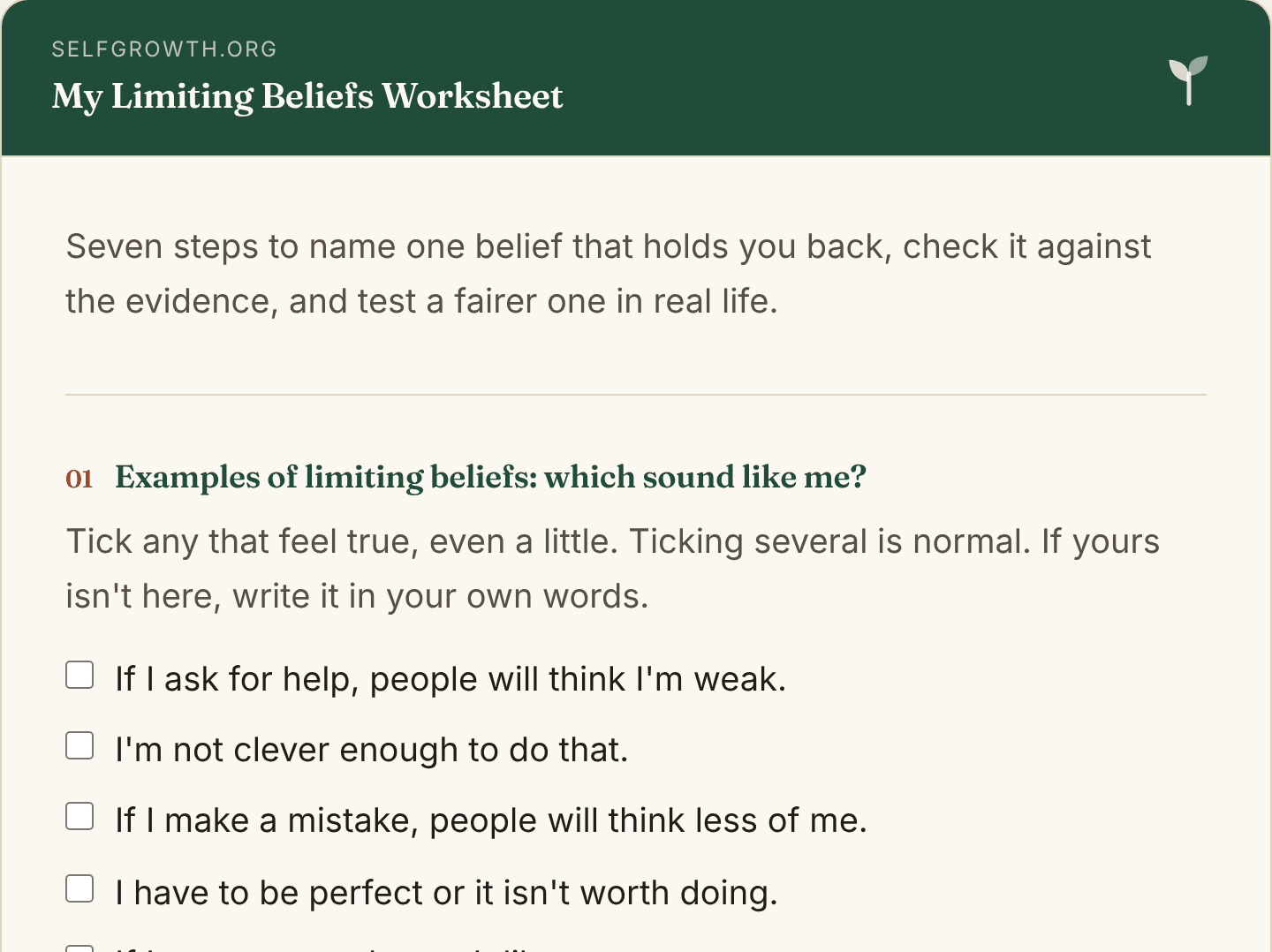
Limiting Beliefs Worksheet
A free, printable limiting beliefs worksheet: 12 examples of limiting beliefs, where yours came from, evidence for and against, a fairer belief and a real test.
Open worksheet
Negative Self-Talk Worksheet
A free, printable negative self-talk worksheet: catch a harsh inner-critic thought, check whether it's fair, and answer it with something true and kinder.
Open worksheetNew worksheets, straight to your inbox
An occasional new worksheet or tool, sent only when there's something genuinely worth your time. No spam, no pressure, unsubscribe any time.