
Inner critic
Limiting beliefs worksheet: a free, printable way to test the rules that hold you back
Updated 11 October 2026 · 7 min read · Free to print
Limiting beliefs are long-held rules about yourself, other people or the world that keep you playing small, like 'If I ask for help, people will think I'm weak'. This worksheet helps you name one, see where it came from, weigh the evidence for and against, write a fairer version and test it with a small experiment.
By the Self Growth team · drawn from CBT's work on core beliefs and behavioural experiments · how we make these
Fill it in here (it saves in this browser, but not in a private window), print it, or download the PDF. Free, no sign-up.
A limiting belief is an old rule you live by without noticing it. 'If I ask for help, people will think I'm weak.' 'If I say what I want, I'll be too much.' 'People like me don't get to do things like that.' It doesn't feel like a belief. It feels like how things are, so you plan around it, and the things you'd love to try quietly stay off the list.
'Limiting belief' is a coaching phrase, not a research term. The closest idea in psychology comes from cognitive behavioural therapy (CBT, a talking therapy that looks at links between thoughts, feelings and actions). CBT describes deep beliefs about yourself, other people and the world, and the rules and 'if this, then that' assumptions you build on top of them. They often take shape early, and they made sense at the time. They just may not fit your life now.
This isn't the same as a passing harsh thought ('I messed that up'), or a habit such as putting things off. It's the steady rule underneath both. Common causes are what you were told growing up, how people reacted when you tried or failed, and hard experiences that seemed to prove the rule. A sign one is at work is that you avoid the same kind of thing again and again, and the reason always sounds like a fact. This worksheet takes one belief, checks it fairly, and then tests it in real life.
How to use this worksheet
- 1Give yourself about 20 to 30 minutes, then a few days to try the experiment in step 6.
- 2Work on one belief only. Pick the one that gets in your way most, or the one you feel most ready to look at.
- 3Be fair, not falsely positive. The aim is a belief that's more accurate, not one that sounds nice but you don't buy.
- 4Keep the page. The review in step 7 is where the belief actually starts to shift.
The worksheet
selfgrowth.org
My Limiting Beliefs Worksheet
Seven steps to name one belief that holds you back, check it against the evidence, and test a fairer one in real life.
01Examples of limiting beliefs: which sound like me?
Tick any that feel true, even a little. Ticking several is normal. If yours isn't here, write it in your own words.
Any others I notice in myself:
02Name the belief
Pick one and write it as plainly as you can. Many limiting beliefs can be written as 'If..., then...'. Saying it out loud in that shape makes it easier to test.
The belief, in my own words:
As an if-then rule (for example, 'If I ask for help, then people will think I'm weak'):
If that were true, what would it say about me? (the deeper belief underneath, such as 'I'm not good enough')
How strongly do I believe it right now?
03Where did it come from?
Beliefs like this are often learned, not chosen. Looking at where yours started can show you it was a fair conclusion back then, which isn't the same as being true now.
When do I first remember feeling this way? What was happening, and who was around?
What did this belief protect me from back then?
How does it show up now? What do I do, or avoid, because of it?
04Evidence for and against
List what you could actually show someone, not just what feels true. For each piece of evidence for the belief, look for a fact that complicates it or points the other way. Both columns count.
Entry 1
Entry 2
Entry 3
Entry 4
If a friend held this belief about themselves, what would I point out to them?
05A more balanced belief
Write a version that fits all the evidence, not just the half the old belief notices. It doesn't have to be glowing. 'Sometimes people help gladly, and asking is how I get things done well' beats 'Everyone loves helping me'.
My more balanced belief:
How much do I believe the new version right now?
06A small behavioural experiment
Pick one small, low-stakes way to act as if the balanced belief were true this week, and see what really happens. If the old belief is about asking for help, ask one person for one small thing. Keep it safe and doable on an ordinary day.
My experiment (what, when, with whom):
What the old belief predicts will happen:
How strongly do I believe that prediction?
How will I know whether the prediction came true? (what I'll look for)
07Review: what actually happened?
Come back once you've done the experiment. Whatever happened is useful. Even if it went badly, ask whether it went as badly as the belief said it would.
Entry 1
Entry 2
How strongly do I believe the old belief now?
How strongly do I believe the balanced belief now?
What I learned, and the next small experiment I could try:
When you're done, a moment to reflect
- What would I try this year if I didn't hold this belief?
- Whose voice does this belief sound like, and would I say it to someone I love?
- What has this belief cost me over the years, and what has it saved me from?
- When have I already acted against this belief, even once? What happened?
- What's a slightly kinder rule I'd be happy to live by instead?
How do you overcome limiting beliefs? Where these steps come from
'Limiting belief' comes from coaching and self-help, not from research, so there are no studies of 'limiting beliefs' as such. The method here comes from cognitive behavioural therapy instead. Aaron Beck's model, which Judith Beck explains for therapists in her book Cognitive Behavior Therapy: Basics and Beyond, says your thinking comes in layers. At the bottom are core beliefs: broad, long-held ideas about yourself, other people and the world. On top of those sit rules you live by, often in an 'if..., then...' shape. At the surface are the quick automatic thoughts you notice day to day. What coaches call a limiting belief often sits in those middle and bottom layers. That's why step 2 asks for an if-then rule, and then for what it would say about you.
Psychologist Melanie Fennell built on Beck's model to explain low self-esteem. In her account, early experiences leave a 'bottom line', a broad negative belief about yourself, and you develop rules for living to protect yourself from it. The rules can help you cope, but in her model they can also keep the bottom line going, because living by them means you rarely get to find out whether it's true. Steps 3 to 5 draw on this: see where the belief came from, weigh the evidence fairly, and write a more balanced version.
Step 6 is a behavioural experiment: a planned, small real-life test of a prediction your belief makes. The Oxford Guide to Behavioural Experiments in Cognitive Therapy (Bennett-Levy and colleagues, 2004) sets out how therapists design them. In a 2003 study by James Bennett-Levy, cognitive therapy trainees tried both thought records (writing down and challenging a thought) and behavioural experiments on themselves. They rated the experiments as more powerful for changing beliefs and behaviour. Those were trainee therapists testing both on themselves, so it isn't proof for everyone, but it's why this worksheet doesn't stop at the written evidence. If a single harsh thought is the problem, the negative self-talk worksheet fits better. If it's a habit, try the self-sabotage worksheet.
These are educational self-reflection tools, not therapy. See our editorial standards.
If you want to go deeper
- Beck, J. S. (2020). Cognitive Behavior Therapy: Basics and Beyond (3rd ed.). Guilford Press.
- Fennell, M. J. V. (1997). Low self-esteem: A cognitive perspective. Behavioural and Cognitive Psychotherapy, 25(1), 1-26.
- Fennell, M. (1999). Overcoming Low Self-Esteem: A Self-Help Guide Using Cognitive Behavioural Techniques. Robinson.
- Bennett-Levy, J. et al. (Eds.) (2004). Oxford Guide to Behavioural Experiments in Cognitive Therapy. Oxford University Press.
- Bennett-Levy, J. (2003). Mechanisms of change in cognitive therapy: The case of automatic thought records and behavioural experiments. Behavioural and Cognitive Psychotherapy, 31(3), 261-277.
Your questions, answered
- What are limiting beliefs?
- Limiting beliefs are long-held ideas about yourself, other people or the world that hold you back, often without you noticing. They tend to sound like facts or rules: 'I'm not clever enough', 'If I say no, people won't like me'. 'Limiting belief' is a coaching phrase rather than a clinical one. In CBT, the closest ideas are core beliefs and the rules and assumptions built on them.
- What are some examples of limiting beliefs?
- Familiar ones include 'If I ask for help, people will think I'm weak', 'I have to be perfect or it isn't worth doing', 'It's too late for me to change', 'If people really knew me, they'd leave', 'My needs matter less than other people's' and 'Good things never last for me'. Step 1 of this worksheet has 12 examples of limiting beliefs to tick, with space to add your own.
- What causes limiting beliefs?
- Often, experience. What you were told as a child, how people reacted when you tried, failed or showed feelings, and painful events that seemed to prove a rule can all leave a belief behind. Melanie Fennell's CBT model of low self-esteem describes this: early experiences shape a 'bottom line' about yourself, and you build rules for living to cope with it. The belief made sense then, which is why it's worth checking now.
- How do you overcome limiting beliefs?
- Name one belief clearly, look at where it came from, and weigh the real evidence for and against it. Then write a fairer version and test it with a small real-life experiment: make a prediction, try it and see what happens. In CBT this is called a behavioural experiment. Beliefs this old tend to shift slowly, over several small tests, rather than all at once.
- Is there a limiting beliefs worksheet PDF?
- Yes. Use the Download PDF button for a clean, print-ready copy, or Print to print straight from the page. It's completely free, with no payment and no email needed. You can also fill it in on screen, and your answers save in your browser.
- Is this worksheet a substitute for therapy?
- No. It's an educational self-reflection tool, not therapy or medical advice. If a belief is tied to abuse, trauma, depression or anxiety, or it's making daily life hard, talk to a GP or family doctor or a qualified therapist. If you're being hurt by someone now, contact a domestic abuse service: in the UK, 0808 2000 247; in the US, 1-800-799-7233. If you have thoughts of harming yourself, contact a crisis line: Samaritans on 116 123 in the UK and Ireland, 988 in the US, or findahelpline.com elsewhere. You deserve real support, not just a worksheet.
Keep going, related worksheets

Negative Self-Talk Worksheet
A free, printable negative self-talk worksheet: catch a harsh inner-critic thought, check whether it's fair, and answer it with something true and kinder.
Open worksheet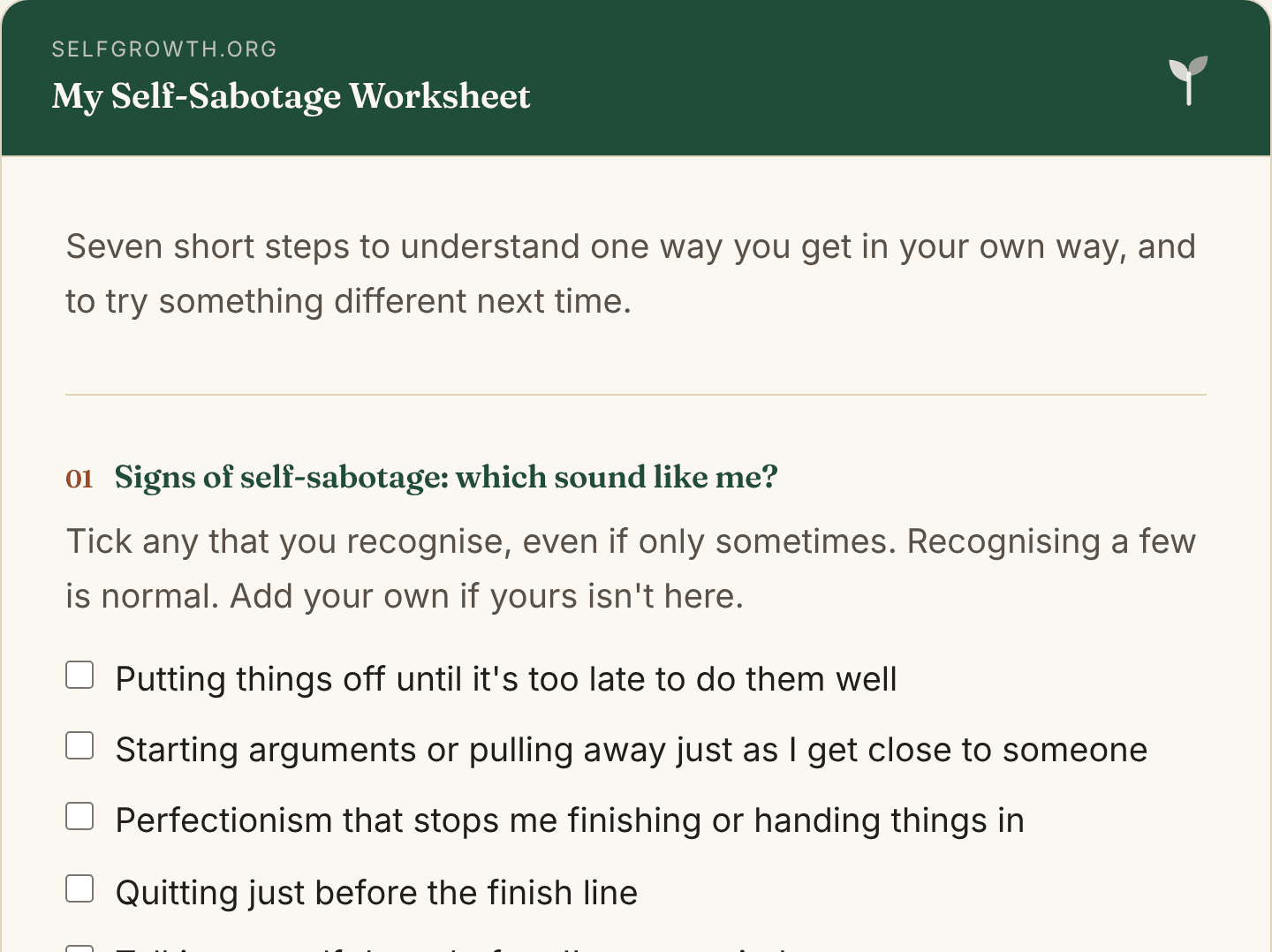
Self-Sabotage Worksheet
A free, printable self-sabotage worksheet: spot the signs, see what the habit protects you from and what it costs, find the belief under it, and plan next time.
Open worksheet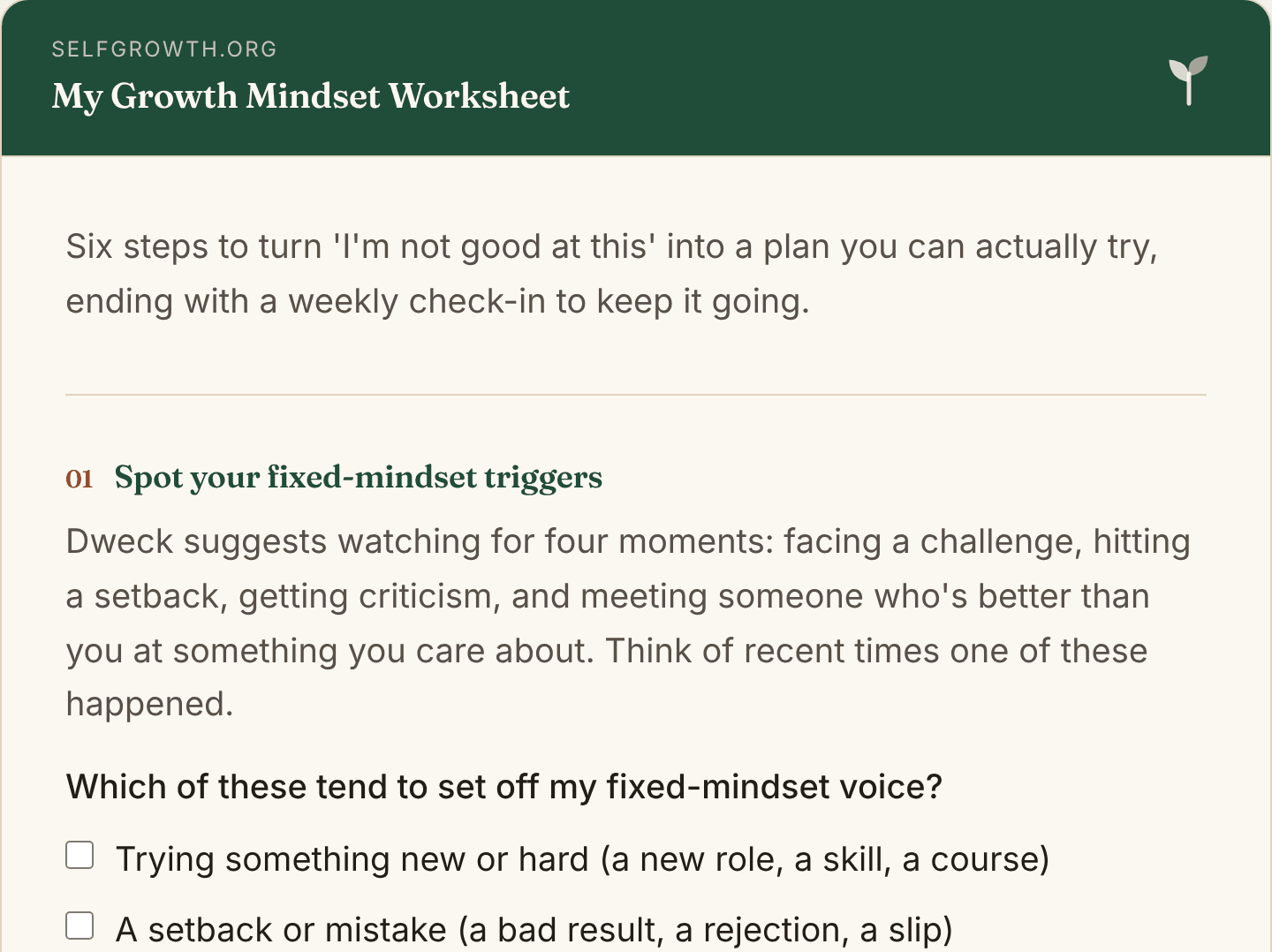
Growth Mindset Worksheet
A free, printable growth mindset worksheet for adults: spot your fixed-mindset triggers, rewrite them, plan practice, review a setback and use the power of yet.
Open worksheetNew worksheets, straight to your inbox
An occasional new worksheet or tool, sent only when there's something genuinely worth your time. No spam, no pressure, unsubscribe any time.