
Growth mindset
Growth mindset worksheet for adults: a free, printable way to keep learning after a setback
Updated 11 October 2026 · 7 min read · Free to print
A growth mindset worksheet helps you catch the moments you write yourself off ('I'm just not good at this') and turn them into a plan to learn. This free, printable worksheet for adults walks you through your triggers, a rewrite, a practice plan, a setback review and the word 'yet'. It's a useful habit, not a cure.
By the Self Growth team · drawn from Carol Dweck's mindset research · how we make these
Fill it in here (it saves in this browser, but not in a private window), print it, or download the PDF. Free, no sign-up.
Most of us have a voice that pipes up when something is hard: 'I'm not a numbers person', 'I'm too old to learn this', 'everyone else finds this easy'. Psychologist Carol Dweck calls that a fixed mindset, the belief that your abilities are set. A growth mindset is the belief that they can be developed with practice, good strategies and help from others.
Dweck is clear that nobody has one or the other. In her own words, 'we're all a mixture of fixed and growth mindsets'. So this worksheet doesn't ask you to banish the fixed voice. It asks you to notice when it shows up, answer it more usefully, and then do something concrete: plan some practice, learn from a setback, try again.
It's written for adults (work, hobbies, health, relationships, going back to study), and it works just as well for older teens. One honest note before you start: the research on growth mindset is more mixed than the posters suggest. There's more on that below. Think of this as a helpful way to think about effort and learning, not a fix for everything.
How to use this worksheet
- 1Pick one area of your life where you tend to give up or avoid trying. A small, specific one is the best place to start.
- 2Be honest in the first section. The fixed-mindset thoughts are the useful raw material, so write them exactly as they sound in your head.
- 3Keep your rewrites believable. 'I can't do this yet, and here's what I'll try next' beats 'I can do anything'.
- 4Come back to the weekly reflection for a few weeks. Shifting how you react to setbacks takes repetition, not one good session.
The worksheet
selfgrowth.org
My Growth Mindset Worksheet
Six steps to turn 'I'm not good at this' into a plan you can actually try, ending with a weekly check-in to keep it going.
01Spot your fixed-mindset triggers
Dweck suggests watching for four moments: facing a challenge, hitting a setback, getting criticism, and meeting someone who's better than you at something you care about. Think of recent times one of these happened.
Which of these tend to set off my fixed-mindset voice?
Entry 1
Entry 2
Entry 3
02Rewrite it as a learning statement
Take each thought from step 1 and answer it with something that's true and points to a next step. You're not pretending it's easy. You're swapping a verdict for a plan.
Entry 1
Entry 2
Entry 3
How believable does my learning statement feel right now?
If it doesn't feel believable, what would make it a little more honest?
03A skill I'd like to grow
Dweck stresses that a growth mindset isn't just effort. It's also trying new strategies and asking others for input when you're stuck. Plan all three.
The skill or ability I'd like to grow:
Where I am with it now, said plainly (no judging):
Practice
What I'll do, when and for how long
Strategy
A different way of trying I haven't used
Input
Who or what could help me (a person, a class, a book)
How I'll know I'm making progress (something I can notice, not a feeling):
04Setback review
Pick one recent setback. Look at it the way a coach would look at a match: what happened, what it teaches you, and what you'll do differently.
Entry 1
Entry 2
What would I say to a friend who'd had this same setback?
05The power of 'yet'
Dweck popularised the idea of 'not yet': you haven't failed at something, you just haven't got there yet. Finish each line with the word 'yet', then add one small step.
Entry 1
Entry 2
Entry 3
Entry 4
06Weekly reflection
Once a week, take five minutes to look back. Keep it to a few honest lines. The aim is to notice patterns, not to grade yourself.
Something I found hard this week, and how I responded:
A time my fixed-mindset voice showed up, and what I said back:
One thing I practised or tried differently:
What I'll try next week:
When you're done, a moment to reflect
- Which area of your life do you most often decide you're 'just not' good at? Where did that idea come from?
- Think of something you can do well now that you couldn't once. How did you actually get there?
- How do you usually react to criticism? What would being curious about it look like instead?
- Whose success makes you feel threatened rather than inspired? What could you learn from them?
- Where might you be telling yourself to 'just try harder' when what you need is a new strategy or some help?
Does growth mindset actually work? What the research really says
The worksheet follows Stanford psychologist Carol Dweck's own advice for people trying to move towards a growth mindset. In a 2015 Education Week commentary she wrote that we're all a mixture of fixed and growth mindsets, and that the way forward is to watch for your fixed-mindset triggers (a challenge, a setback, criticism, someone better than you) rather than pretend that voice isn't there. Step 1 is built on those four moments. She also warned that a growth mindset 'isn't just about effort': it means trying new strategies and seeking input from others when you're stuck. That's why step 3 asks for a strategy and a source of help, not just more hours. The 'yet' idea in step 5 is one she popularised in her 2014 TED talk.
Now the honest part. Growth mindset became hugely popular, and the evidence hasn't kept pace with the hype. The biggest well-run study, a 2019 national experiment in Nature by David Yeager, Dweck and colleagues, gave about 12,500 US ninth-graders a short online session (under an hour). Lower-achieving students' grades rose by about 0.10 of a grade point on average, a small effect that varied by school. Two meta-analyses by Victoria Sisk, Brooke Macnamara and colleagues (2018) found that overall effects were weak, with some hint of benefit for students from poorer backgrounds or who were struggling. In 2023, Macnamara and Alexander Burgoyne reviewed the intervention studies again and argued that apparent benefits may be down to weak study design and bias. Other researchers (Burnette and colleagues, and Tipton and colleagues, both 2023) read the same field as showing real benefits for some groups. The debate is ongoing.
Almost all of that research is about school students and grades, not adults. So we don't claim this worksheet will change your life or your results. What it can do is give you a more useful way to respond in the moment you'd normally give up: name the thought, answer it honestly, and plan a next try. Treat it as one helpful habit alongside practice, good teaching and support from other people.
These are educational self-reflection tools, not therapy. See our editorial standards.
If you want to go deeper
- Dweck, C. S. (2006). Mindset: The New Psychology of Success. Random House.
- Dweck, C. S. (2015). Carol Dweck revisits the 'growth mindset'. Education Week, 23 September 2015.
- Dweck, C. S. (2014). The power of believing that you can improve. TEDxNorrkoping talk, ted.com.
- Yeager, D. S., Hanselman, P., Walton, G. M., et al. (2019). A national experiment reveals where a growth mindset improves achievement. Nature, 573(7774), 364-369.
- Sisk, V. F., Burgoyne, A. P., Sun, J., Butler, J. L. & Macnamara, B. N. (2018). To what extent and under which circumstances are growth mind-sets important to academic achievement? Two meta-analyses. Psychological Science, 29(4), 549-571.
- Macnamara, B. N. & Burgoyne, A. P. (2023). Do growth mindset interventions impact students' academic achievement? A systematic review and meta-analysis with recommendations for best practices. Psychological Bulletin, 149(3-4), 133-173.
- Burnette, J. L., Billingsley, J., Banks, G. C., et al. (2023). A systematic review and meta-analysis of growth mindset interventions: For whom, how, and why might such interventions work? Psychological Bulletin, 149(3-4), 174-205.
- Tipton, E., Bryan, C., Murray, J., McDaniel, M., Schneider, B. & Yeager, D. S. (2023). Why meta-analyses of growth mindset and other interventions should follow best practices for examining heterogeneity. Psychological Bulletin, 149(3-4), 229-241.
Your questions, answered
- What is a growth mindset?
- A growth mindset is the belief that your abilities can be developed through practice, good strategies and help from others. A fixed mindset is the belief that they're set, so a struggle means you're simply not cut out for something. The idea comes from psychologist Carol Dweck, who stresses that everyone is a mixture of both, and that the fixed-mindset voice never fully goes away.
- Does growth mindset actually work?
- The honest answer is: a little, for some people, and it's debated. A 2019 national study in Nature found a short online growth mindset session raised lower-achieving US ninth-graders' grades by about a tenth of a grade point. Two 2018 meta-analyses called the overall effects weak, and a 2023 review argued many studies had design flaws. It's a useful way to think about learning, not a cure.
- What are examples of fixed mindset vs growth mindset thoughts?
- Fixed: 'I'm not a maths person.' Growth: 'I haven't learned this kind of maths yet, so I'll try a different method.' Fixed: 'They're naturally better than me.' Growth: 'What are they doing that I could learn from?' Fixed: 'That feedback means I'm bad at this.' Growth: 'That feedback shows me what to work on.' The second version isn't more positive, it's more useful.
- Is this a growth mindset worksheet for adults or students?
- It's written for adults, with examples from work, hobbies, health and going back to study, rather than a classroom. It works for older teens too, and much of the research was done with secondary school students. If you're a parent or teacher, you could use the 'yet' and setback sections with a teenager.
- Is there a growth mindset worksheet PDF?
- Yes. Use the Download PDF button for a clean, print-ready copy, or Print to print straight from the page. It's completely free, with no payment and no email needed. You can also fill it in on screen, and your answers save in your browser.
- Is this worksheet a substitute for therapy?
- No. It's an educational self-reflection tool for everyday setbacks and self-doubt, not therapy or medical advice. If harsh thoughts about yourself feel constant, if you've stopped enjoying things or feel hopeless, please talk to a GP or family doctor or a qualified mental health professional. If you're in crisis, call 116 123 (Samaritans, UK) or 988 (US), or find a local line at findahelpline.com.
Keep going, related worksheets
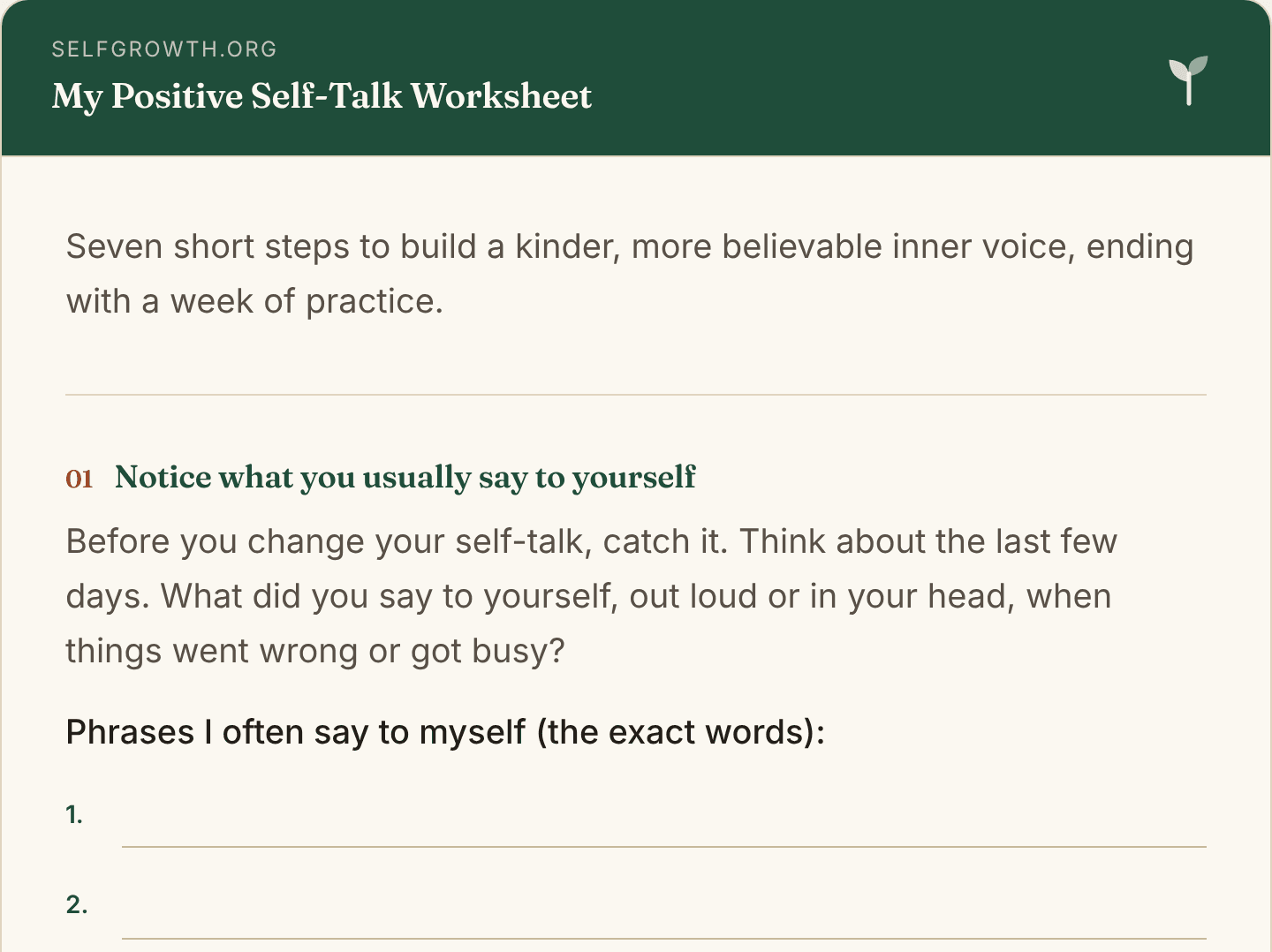
Positive Self-Talk Worksheet
A free, printable positive self-talk worksheet for adults: turn your usual phrases into kind, believable ones, write a pep talk and keep a 7-day practice log.
Open worksheet
Negative Self-Talk Worksheet
A free, printable negative self-talk worksheet: catch a harsh inner-critic thought, check whether it's fair, and answer it with something true and kinder.
Open worksheet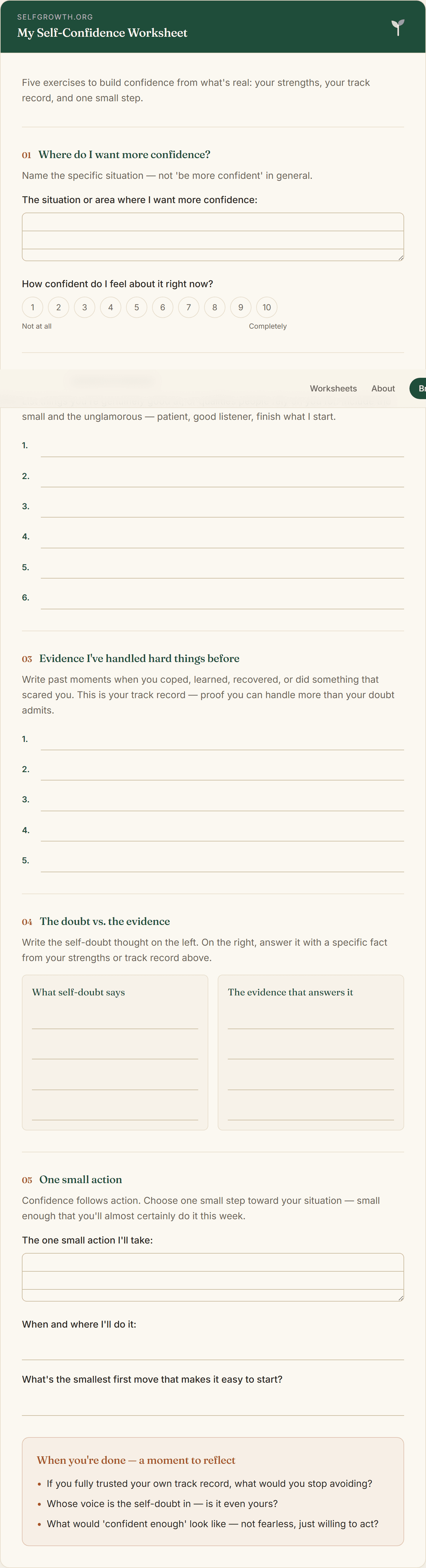
Self-Confidence Worksheet
Free printable self-confidence worksheets (PDF) for one situation you dread: list your strengths and past wins, answer self-doubt, and take one small step.
Open worksheetNew worksheets, straight to your inbox
An occasional new worksheet or tool, sent only when there's something genuinely worth your time. No spam, no pressure, unsubscribe any time.