
Guide
Cognitive distortions: what they are, with 10 examples
Updated 17 October 2026 · 11 min read
Cognitive distortions are habits of thinking that twist how you read a situation, such as assuming the worst or seeing things as all good or all bad. Aaron Beck's cognitive therapy described them, and later lists grew to ten or more. They are a teaching idea from CBT, not a diagnosis. This guide explains ten.
By the Self Growth team · drawn from Aaron Beck's cognitive model and published CBT research · how we make these
A friend doesn't reply to your message, and by the evening you're sure they're angry with you. You make one mistake at work and your mind jumps to being fired. You hear nine kind comments and one critical one, and only the critical one stays.
Thoughts like these feel like facts. Cognitive behavioural therapy (CBT, a talking therapy) has a name for some of the ways thinking can slip: cognitive distortions. This guide is a self-help version of an idea used in CBT. It is not therapy, and it can't tell you what is wrong or right with your thinking. It can give you names for ten patterns, plain examples, and a short way to test a thought before you believe it.
What are cognitive distortions?
In plain words: a cognitive distortion is a way of thinking that bends the facts. The thought might be partly true, but it leaves out part of the picture. In CBT language, it is a pattern that makes a situation look worse (or yourself look smaller) than a fair look at the evidence would.
The idea comes from the psychiatrist Aaron Beck. A 1963 paper of his is titled 'Thinking and depression. I. Idiosyncratic content and cognitive distortions'. In 2008, Beck looked back on the cognitive model of depression and wrote that, over time, its expansions had added automatic thoughts, cognitive distortions, dysfunctional beliefs and information-processing biases. 'Automatic thoughts' just means the thoughts that pop into your head without you choosing them.
Two things are worth knowing straight away. This is a teaching idea from therapy, not a diagnosis, and you can't be 'diagnosed' with a distortion. And the research we read on it comes from work on depression, so treat it as a way to look at your own thinking, not as a verdict on it.
Where does the list of cognitive distortions come from?
There is no single official list. Two papers that built questionnaires describe the history in slightly different ways. Both papers say Beck first described a short list of six types, and that David Burns later expanded and renamed them. They cite different editions of the books, so we won't give years, and we haven't read the books themselves.
The ten below are the ones measured by the Cognitive Distortion Scale in a 2023 Japanese study by Takeda and colleagues. Other lists differ. A 15-item questionnaire described in a 2015 paper adds things like 'what if?' statements, unfair comparisons and blaming. The two papers give the names only. The definitions and examples here are our own wording, so if you see them put differently elsewhere, that is normal.
The 10 cognitive distortions, with examples
Read them as a menu of things to notice. One thought can fit more than one, and some thoughts fit none.
- Mind reading: deciding what someone else thinks without checking. 'She hasn't replied, so she must be annoyed with me.'
- Catastrophising: jumping to the worst possible outcome. 'If this presentation goes badly, my career is over.'
- All-or-nothing thinking: seeing only two boxes, with nothing in between. 'If it isn't perfect, it's a failure.'
- Emotional reasoning: treating a feeling as proof. 'I feel stupid, so I must be stupid.'
- Labelling: pinning a fixed label on yourself or someone else after one event. 'I forgot the meeting, so I'm useless.'
- Mental filter: picking out one negative detail and letting it colour everything. Nine kind comments and one correction, and the correction is all you can think about.
- Overgeneralising: turning one event into a rule. 'I didn't get the job. I never get anything.'
- Personalising: taking the blame for something that wasn't only down to you. 'My friend seems quiet, I must have upset her.'
- Should statements: rigid rules about how you or others must behave. 'I should be coping better by now.'
- Minimising the positive: waving good things away. 'That compliment doesn't count. She was only being nice.'
Notice that every example sounds like something a tired, worried mind would say. Having one of these thoughts doesn't mean something is wrong with you. If you want to try this on a thought of your own, the cognitive distortions worksheet has all ten in a checklist.
Open the Cognitive Distortions WorksheetDo cognitive distortions cause depression or anxiety?
We can't say they do. The research we read is about depression. We found nothing on anxiety. What the research we read shows is a link, not a cause. In the 2023 Japanese study, 237 people from the general population (not attending a medical service, though 46% of them reported at least mild depressive symptoms) and 39 people with a psychiatrist-confirmed diagnosis of major depression filled in the scale. Scores on it were linked to dysfunctional attitudes, negative automatic thoughts and depression, and total scores differed between the general-population group and the group with major depression. That is a snapshot at one point in time, so it can't show which came first.
The paper is also honest about limits. The authors also say the statistics don't show clearly how many separate types there are, and that this 'requires further investigation'. The 2015 paper lists its own limits too, including a limited number of participants and relying only on self-report measures. In plain terms, the list is a useful way to describe thoughts, and the science of how neatly it divides them up is not settled.
We found nothing in what we read that tests whether naming distortions on a worksheet changes how anyone feels. We know of no trial of this guide or the worksheets that go with it.
How to test a distorted thought, step by step
This is a short, self-help version of an idea used in CBT. It is for everyday thoughts, such as a worry about a message or a mistake. Use it on a thought that feels manageable. If the thought is about harming yourself, or it is tied to something painful that happened to you, set this page aside and see 'When to get more support' below.
- 1Catch the thought. Write it down in one sentence, as it sounds in your head: 'She hasn't replied, so she's angry with me.'
- 2Ask which trap it might be. Look down the list of ten. It might be one, several, or none, and 'none' is a fair answer.
- 3Look at the evidence. Write what supports the thought and what doesn't, sticking to facts you could point to rather than guesses.
- 4Write a fairer sentence. Not a cheerful one, a fairer one: 'I don't know why she hasn't replied. She might be busy.' It only needs to be something you could believe.
- 5Check in with yourself. Notice whether anything has shifted, even slightly, and leave it there if not. The goal is to look at the thought, not to win an argument with yourself.
That last point matters. The psychologist Christine Padesky, who trains cognitive therapists, wrote in 1993 that the aim of cognitive therapy is 'not simply to make our clients think differently or feel better today', but to teach a way of weighing up thoughts, behaviours and moods. If you'd like a set of questions for step 3, the Socratic questioning worksheet has them, and the thought record worksheet puts all five steps into one table.
Mistakes to avoid when spotting thinking traps
- Treating every painful thought as a distortion. Sometimes a thought is accurate and the situation is hard. Naming a trap is for thoughts that don't hold up when you look at the facts.
- Using the list to dismiss real problems. A thought like 'my job is not safe' can be true. The list helps you check the thought, not argue away what is real.
- Using the list on other people. Calling someone else's view a 'distortion' in an argument is not what it is for.
- Criticising yourself for having thoughts like these. That just adds another harsh thought. The guide to quieting your inner critic can help if that is happening.
- Testing a thought that is a warning. If you are afraid of someone, or you are not safe where you are, a thought like 'something bad is going to happen' may be accurate. The next step is safety, not a fairer sentence. In the UK, the National Domestic Abuse Helpline is free on 0808 2000 247, 24 hours; in the US, call 1-800-799-7233. Our helplines page lists more.
- Expecting the thought to vanish. Padesky describes the aim as learning a way to weigh thoughts up, not winning once.
Does this kind of CBT self-help work?
Honestly, the evidence is about CBT done in a particular way, and not about worksheets like ours. A 2012 review by Stefan Hofmann and colleagues looked at a representative sample of 106 earlier research summaries (meta-analyses) of CBT for a wide range of problems, and concluded that, in general, its evidence base is very strong, while calling for more randomised research (studies where people are randomly assigned to groups). Those are reviews of CBT as a treatment, and none of them is a trial of this worksheet.
Self-guided programmes are a closer comparison, but still not the same thing. A 2011 meta-analysis by Pim Cuijpers and colleagues pooled seven trials with 1,362 people who had raised depressive symptoms and used self-guided treatment with no contact with a therapist or coach. It found a small but significant effect straight after treatment, and a similar small effect at follow-up four to twelve months later. 'Small' is the word the authors use. A single worksheet is a lighter thing than a structured programme, so please don't read these results as promising that this page will work for you.
The NHS describes CBT as a talking therapy in which a therapist helps you change how you think and act, and lists 'questioning unhelpful thoughts and beliefs' among the approaches. It also says guided self-help, with the help of a therapist, is one way to receive it. If you want CBT itself, see the next section.
When to get more support
This guide is a self-help tool, not therapy, and it doesn't treat anxiety, depression or anything else. It's worth talking to your GP or another qualified professional if the thoughts feel constant or too heavy to look at on your own, if they affect your sleep, work or relationships, if feeling low or hopeless is getting in the way of your life, or if you're worried about how long it has lasted. In England you can also refer yourself to NHS Talking Therapies for anxiety and depression support without seeing a GP first (you need to be registered with a GP and aged 18 or over, or 16 or over in some areas). Our helplines and therapist directory lists routes in other countries too.
If a thought involves harming yourself or ending your life, please don't test it on a worksheet. Reach out now: in the UK and Ireland, call Samaritans on 116 123; in the US, call or text 988; elsewhere, findahelpline.com lists free, confidential lines. If you are in immediate danger, call your local emergency number. You deserve real support, not just a page to read.
How we put this together
How we put this together: the list and its history come from two questionnaire papers and Aaron Beck's own abstract, the evidence on CBT from published reviews, and the five steps are our own self-help version, not a clinical protocol. We know of no trial of this guide or its worksheets. It's an educational self-reflection resource, not therapy or medical advice, see our editorial standards.
If you want to go deeper
- Beck, A. T. (1963). Thinking and depression. I. Idiosyncratic content and cognitive distortions. Archives of General Psychiatry, 324-333.
- Beck, A. T. (2008). The evolution of the cognitive model of depression and its neurobiological correlates. American Journal of Psychiatry, 969-977.
- Takeda, T., Fukudome, K., Nakano, M., Umehara, H. & Nakamura, K. (2023). Reliability and validation of the Japanese version of the cognitive distortion scale. Frontiers in Psychology, 14, 1261166.
- Batmaz, S., Kocbiyik, S. & Yuncu, O. A. (2015). Turkish version of the Cognitive Distortions Questionnaire: psychometric properties. Depression Research and Treatment, 2015.
- Padesky, C. A. (1993). Socratic questioning: changing minds or guiding discovery? Keynote address, European Congress of Behavioural and Cognitive Therapies, London. padesky.com.
- Hofmann, S. G., Asnaani, A., Vonk, I. J. J., Sawyer, A. T. & Fang, A. (2012). The efficacy of cognitive behavioral therapy: a review of meta-analyses. Cognitive Therapy and Research, 36(5), 427-440.
- Cuijpers, P., Donker, T., Johansson, R., Mohr, D. C., van Straten, A. & Andersson, G. (2011). Self-guided psychological treatment for depressive symptoms: a meta-analysis. PLoS ONE, 6(6), e21274.
- NHS. Overview: Cognitive behavioural therapy (CBT), last reviewed 28 March 2025; NHS Talking Therapies, last reviewed 5 November 2025. nhs.uk.
Your questions, answered
- What are cognitive distortions?
- They are patterns of thinking that bend the facts, such as assuming the worst or seeing things as all good or all bad. The idea comes from the psychiatrist Aaron Beck's cognitive therapy. It's a teaching idea used in CBT, not a diagnosis, and there is no single agreed list.
- What are the 10 cognitive distortions?
- One list of ten, measured by a 2023 scale, is mind reading, catastrophising, all-or-nothing thinking, emotional reasoning, labelling, mental filter, overgeneralising, personalising, should statements and minimising the positive. Other lists name more or fewer, and the definitions on this page are our own wording.
- Are cognitive distortions a mental illness?
- No. They are a way of describing thoughts. In the 2023 study we read, the scale was filled in by people from the general population as well as people with depression, and scores were higher in the group with depression. That shows a link, not a cause or a diagnosis. If your thoughts feel heavy or constant, talk to your GP.
- How do I stop cognitive distortions?
- You can't switch thoughts off, and this page can't promise to change them. What you can do is catch a thought, check it against the facts and write a fairer sentence. The five steps in this guide are one way to do that: catch it, name the trap, check the evidence, write a fairer sentence, check in. If it's hard to do alone, a therapist can guide you, and CBT is one option.
- What is the difference between a cognitive distortion and a negative thought?
- A negative thought can be accurate, such as 'this is a hard week'. A distortion is a pattern that bends the facts, like 'this week proves I'm a failure'. You find out which it is by checking the evidence, not by how bad the thought feels.
- Is there a cognitive distortions worksheet?
- Yes. Our free cognitive distortions worksheet has the ten traps as a checklist, a space to test one thought and a place to write a fairer sentence. You can fill it in on screen or download the PDF. There's no payment and no email needed.
- Is this guide free, and is it therapy?
- It's free, with no payment and no email needed. It's a self-help version of an idea used in CBT, not therapy, and it doesn't treat anxiety, depression or any other condition. If you're struggling, speak to your GP. If you ever have thoughts of harming yourself, contact a crisis line straight away.
Worksheets to do the work
Free to fill in online or print. No email needed.
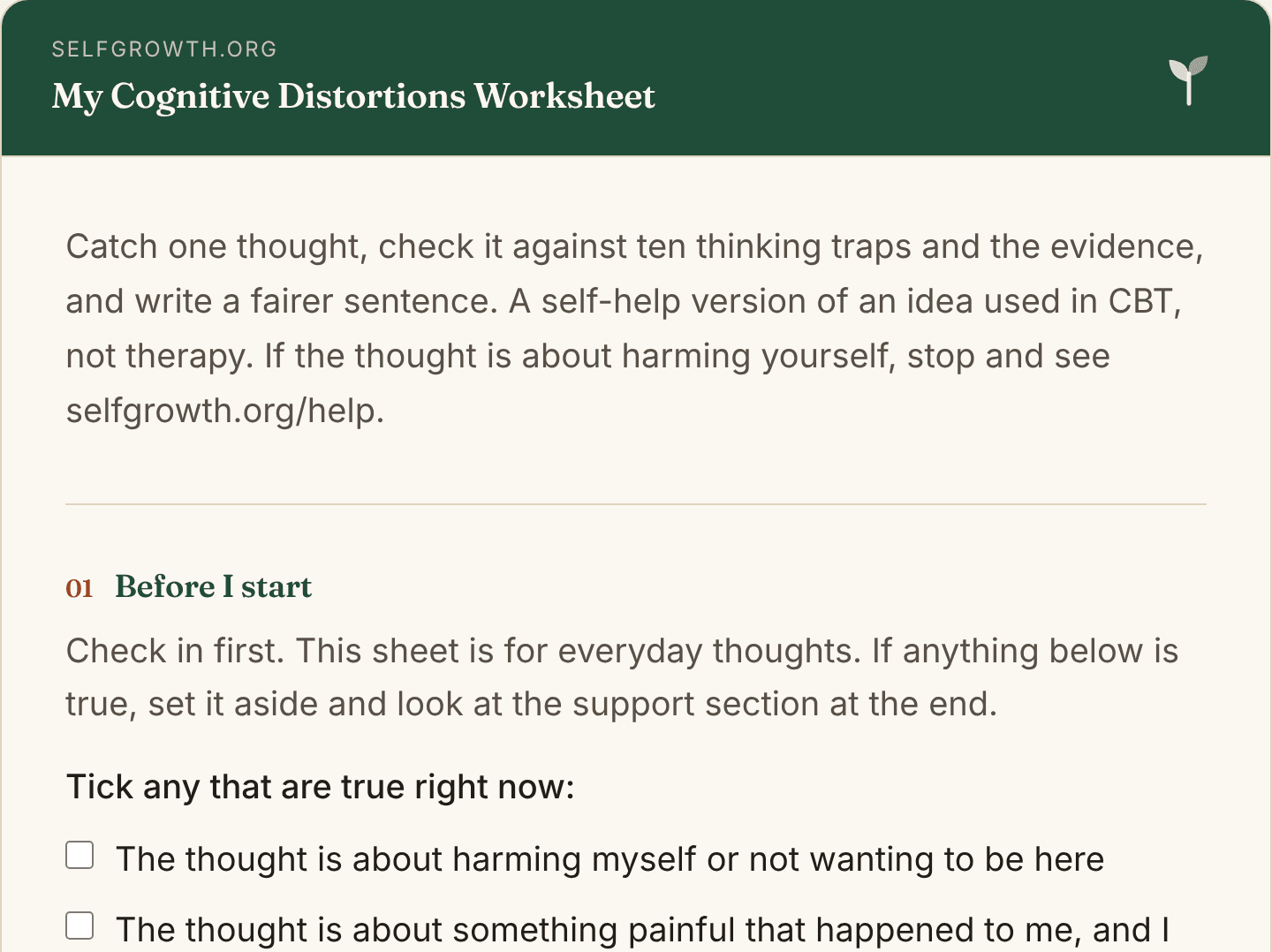
Cognitive Distortions Worksheet
Free cognitive distortions worksheet: check one thought against ten thinking traps, test the evidence and write a fairer sentence. Not therapy. Free PDF.
Open worksheet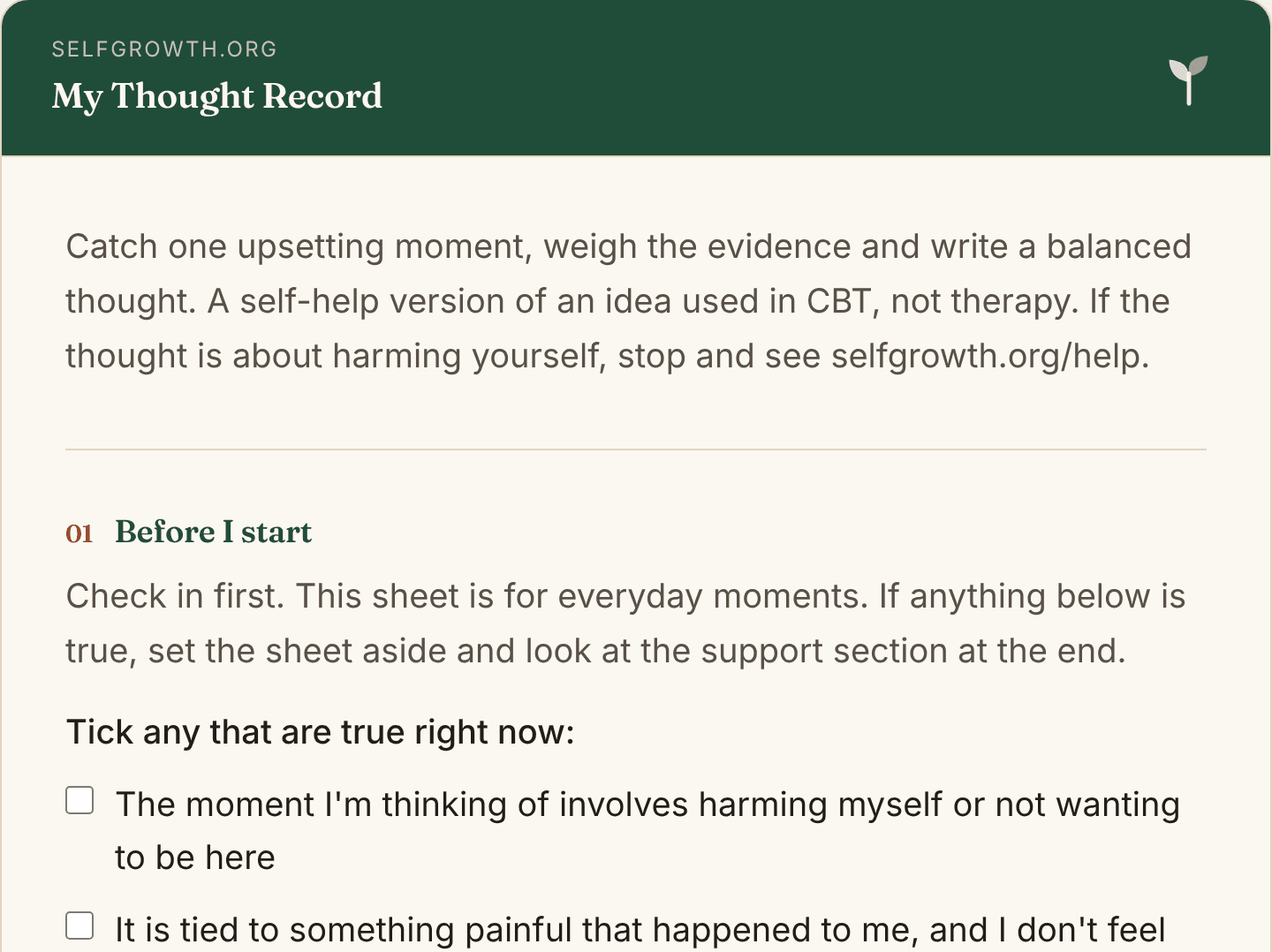
Thought Record Worksheet
Free thought record worksheet: note the situation, feeling and thought, weigh the evidence and write a balanced thought. Self-help, not therapy. Free PDF.
Open worksheet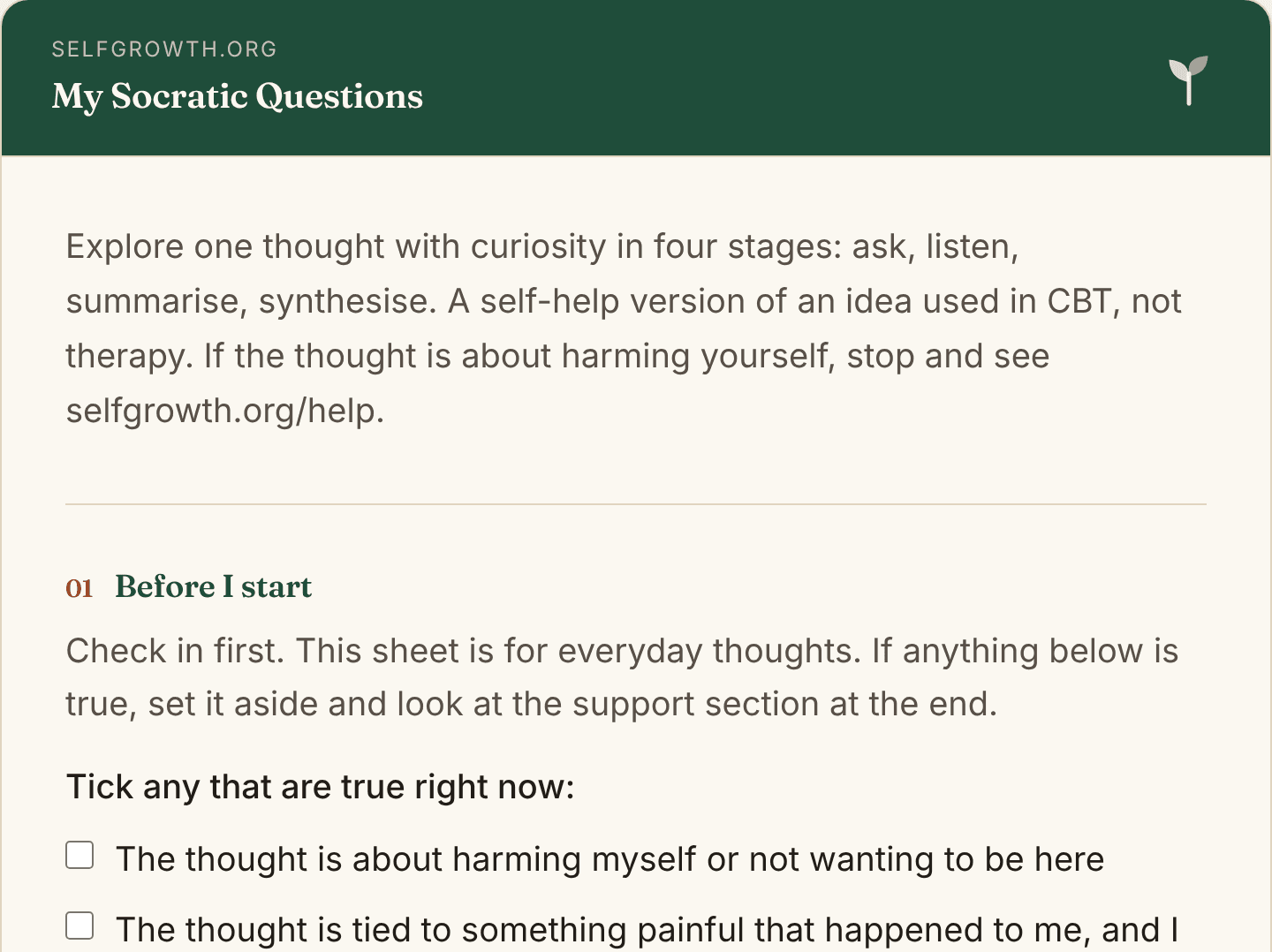
Socratic Questioning Worksheet
Free Socratic questioning worksheet: questions to explore one worrying thought in four steps, from Christine Padesky's guided discovery. Not therapy. Free PDF.
Open worksheet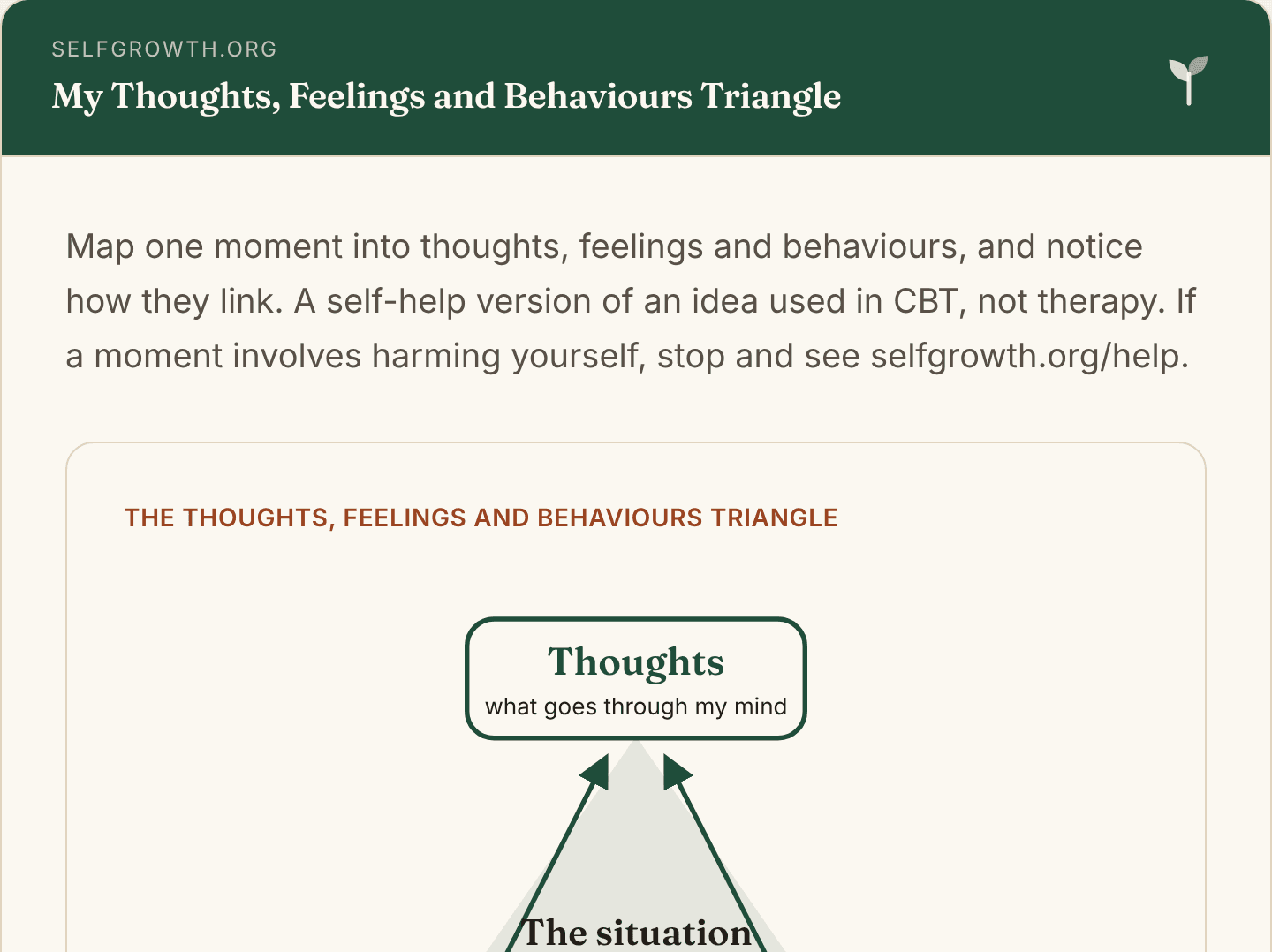
CBT Triangle Worksheet
Free CBT triangle worksheet: map one moment into thoughts, feelings and behaviours and see how they link. Self-help, not therapy. Free printable PDF.
Open worksheet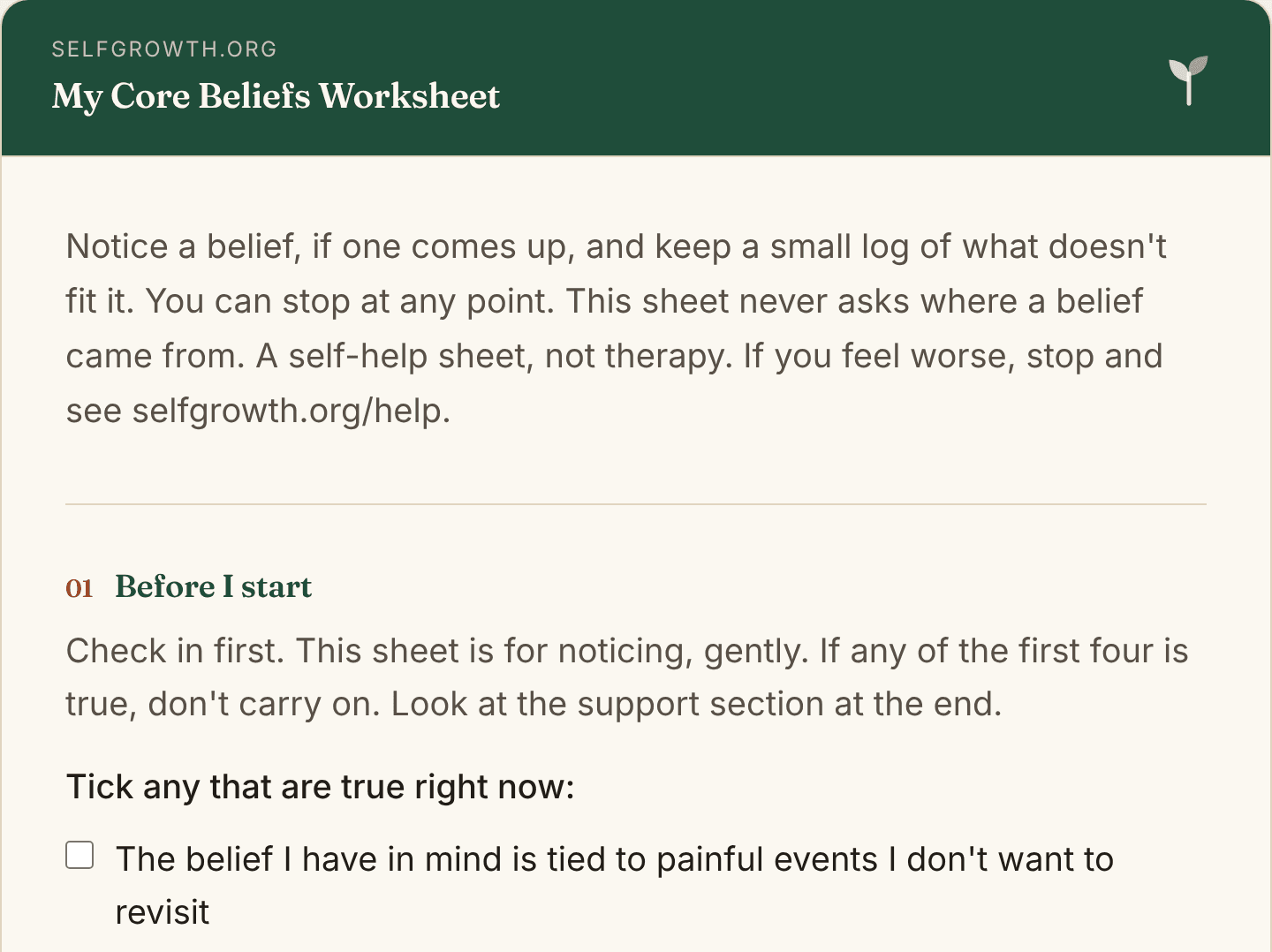
Core Beliefs Worksheet
A gentle, free core beliefs worksheet: notice one belief about yourself, keep a small log of what doesn't fit it, and know when to stop. Not therapy. Free PDF.
Open worksheetRelated guides
New worksheets, straight to your inbox
An occasional new worksheet or tool, sent only when there's something genuinely worth your time. No spam, no pressure, unsubscribe any time.