
Self-awareness
CBT triangle worksheet: a free printable to link thoughts, feelings and behaviours
Updated 17 October 2026 · 8 min read · Free to print
A CBT triangle worksheet helps you map one moment into three corners: what you thought, what you felt and what you did, then see how they link. The Beck Institute describes the cognitive model as how thoughts and perceptions influence how people feel and behave. This free printable is a self-help version of that idea, not therapy.
By the Self Growth team · a self-help version of an idea used in CBT, not therapy · how we make these
Fill it in here (it saves in this browser, but not in a private window), print it, or download the PDF. Free, no sign-up.
Take an ordinary moment: a friend cancels plans. You think 'they don't really want to see me'. You feel sad, with a tight chest. You don't reply and stay in. Each of the three can feed the others. The thought shapes the feeling, the feeling shapes what you do, and staying in means nothing tests the thought. That small loop is what the thoughts, feelings and behaviours triangle is a picture of.
The picture is a teaching version of what cognitive behavioural therapy (CBT, a talking therapy) calls the cognitive model. The Beck Institute, which trains CBT therapists, describes it as how people's thoughts and perceptions influence the way they feel and behave. We couldn't find a source we could read that credits the triangle drawing itself to one person, so we don't name anyone for it. It's also a simplification. The NHS lists physical feelings alongside emotions, so there is a space for those too.
This worksheet is a self-help version of an idea used in CBT. It is not therapy and it doesn't treat anxiety, depression or anything else. You'll map one moment into the triangle, look at the links, and think about whether one corner could shift a little. You don't need to change all three, or any.
Please read this first. Use the sheet for an everyday moment you can look at calmly. If a behaviour you notice involves harming yourself, or the moment connects to something painful that happened to you, don't work on it here. Call Samaritans on 116 123 (UK and Ireland), call or text 988 (US), or find a helpline at findahelpline.com. Our helplines page (selfgrowth.org/help) lists more, including routes to a therapist. If feelings like this are getting in the way of your life, or you're worried about how long they have lasted, please talk to your GP.
How to use this worksheet
- 1Pick one recent moment you can think about without being overwhelmed. Not the hardest one.
- 2Write the situation, then fill each corner of the triangle. There are no right answers, and you can leave a corner blank.
- 3Look at how the corners link. Then, if you want to, choose one corner and one small change. Choosing 'none' is fine.
- 4Allow around 15 minutes, and stop whenever you like. If it stirs up more than you can handle, use the support section.
The worksheet
selfgrowth.org
My Thoughts, Feelings and Behaviours Triangle
Map one moment into thoughts, feelings and behaviours, and notice how they link. A self-help version of an idea used in CBT, not therapy. If a moment involves harming yourself, stop and see selfgrowth.org/help.
Each corner can nudge the others. Write what you notice in each corner below, then, if you want to, look for one corner you could change a little.
01Before I start
Check in first. This sheet is for everyday moments. If anything below is true, set it aside and look at the support section at the end.
Tick any that are true right now:
If I ticked any of the first three, the person or line I'll turn to first (a friend, my GP, Samaritans 116 123, 988 in the US) is:
02The situation
What happened, as a camera would have seen it. Facts only: who, where, when.
The situation:
03Corner 1: Thoughts
What went through your mind? Write it the way it sounded in your head, including any pictures or memories that came up.
My thoughts:
How much did I believe the main thought at the time?
04Corner 2: Feelings
Name the emotions in a word or two, and anything you noticed in your body, such as a tight chest, tired legs or a knot in your stomach.
The emotions I felt:
What I noticed in my body:
How strong was the strongest feeling?
05Corner 3: Behaviours
What did you do, or not do? Include things you avoided, put off or stopped doing, and anything you did to feel better in the moment.
What I did, or didn't do:
06How do the corners link?
Look at what you've written. You're looking for links you can see, not proving anything. Leave a line blank if you don't see one.
How did my thoughts seem to shape what I felt?
How did what I felt seem to shape what I did?
How did what I did seem to affect my thoughts or feelings afterwards?
07One corner I could shift a little
You don't have to change anything. If you'd like to try, pick one corner and one small change. These three are the kinds of approach the NHS lists for CBT. Choose a step that feels safe. Don't push yourself towards something that frightens you a lot without support.
A small change could be:
The corner I'd choose, and the small change I'd try:
Who or what could help me with it (a friend, a plan, my GP):
08Looking back
Come back to this after you've tried it. There is no right outcome.
What happened when I tried it, and what I noticed in each corner:
What I'd do the same, or differently, next time:
09Another moment
For later moments. One row per moment. It's for noticing, not scoring.
Entry 1
Entry 2
Entry 3
10If this is bringing things up
A worksheet is a small tool. Some feelings need a person. Tick anything that fits and decide who you'll tell.
When you're done, a moment to reflect
- Which corner did I find easiest to write, and which was hardest?
- Did I see a link I hadn't noticed before?
- Is there a corner I'd like to leave as it is, and that's fine?
- What would I say to a friend who described this same moment?
Is there research behind a CBT triangle worksheet?
Honestly, we know of no trial of this worksheet, and a worksheet isn't a treatment. This is what we could check.
The Beck Institute's page 'Understanding CBT' says the cognitive model describes how people's thoughts and perceptions influence the way they feel and behave, and calls it the core of CBT. It's the institute's own description of the approach it trains people in, and the page doesn't set out limits. The NHS describes CBT as a talking therapy in which a therapist helps you change how you think and act, using approaches such as questioning unhelpful thoughts, noticing emotions and physical feelings without reacting to them, and changing what you do. Neither page describes a triangle, so the drawing is our own teaching picture of the idea.
The research on CBT is about CBT as a treatment, with or without a therapist; we know of no study of this diagram on its own.
To go further on the thoughts corner, try the thought record worksheet or the cognitive distortions worksheet. For feelings, the feelings wheel helps with naming them, and if the behaviour corner is about avoiding things that worry you, take it to your GP or a therapist rather than pushing alone.
These are educational self-reflection tools, not therapy. See our editorial standards.
If you want to go deeper
- Beck Institute. Understanding CBT. beckinstitute.org/about/understanding-cbt/ (read 17 October 2026; no named author or date).
- NHS. Overview: Cognitive behavioural therapy (CBT), last reviewed 28 March 2025; NHS Talking Therapies, last reviewed 5 November 2025. nhs.uk.
Your questions, answered
- What is the CBT triangle?
- It's a simple picture of three connected parts of a moment: your thoughts, your feelings and your behaviours. It's a teaching version of what CBT calls the cognitive model, which the Beck Institute describes as how people's thoughts and perceptions influence the way they feel and behave. We found no readable source that credits the triangle drawing to one person.
- How do I use a CBT triangle worksheet?
- Pick one everyday moment, write the situation, then fill each corner: what you thought, what you felt (including in your body) and what you did. Look at how they link, and, if you want to, choose one small change. Stop if it brings up more than you can handle.
- Is the CBT triangle only about thoughts?
- No. Thoughts are one corner. The NHS describes CBT as including questioning unhelpful thoughts, noticing emotions and physical feelings without reacting to them, and changing what you do. The triangle shows all three, and this sheet also has a space for body sensations.
- Does the CBT triangle worksheet work?
- We know of no trial of this worksheet. The research on CBT is about CBT as a treatment, with or without a therapist; we know of no study of this diagram on its own.
- Can I use it if I'm anxious or low?
- It's a self-help tool, not a treatment, so we can't say it will help with anxiety or low mood. If worry or low mood is getting in the way of your life, affects your sleep, work or relationships, or you're worried about how long it has lasted, talk to your GP. In England you can also refer yourself to NHS Talking Therapies for anxiety and depression support.
- Is this CBT triangle worksheet free, and is it a substitute for therapy?
- It's free, with no payment and no email needed. Use Download PDF for a print-ready copy, or fill it in on screen (answers save in your browser on that device). It's not a substitute for therapy. If you're struggling, speak to your GP. In a crisis, call Samaritans on 116 123 (UK and Ireland), call or text 988 (US), or find a helpline at findahelpline.com.
Keep going, related worksheets
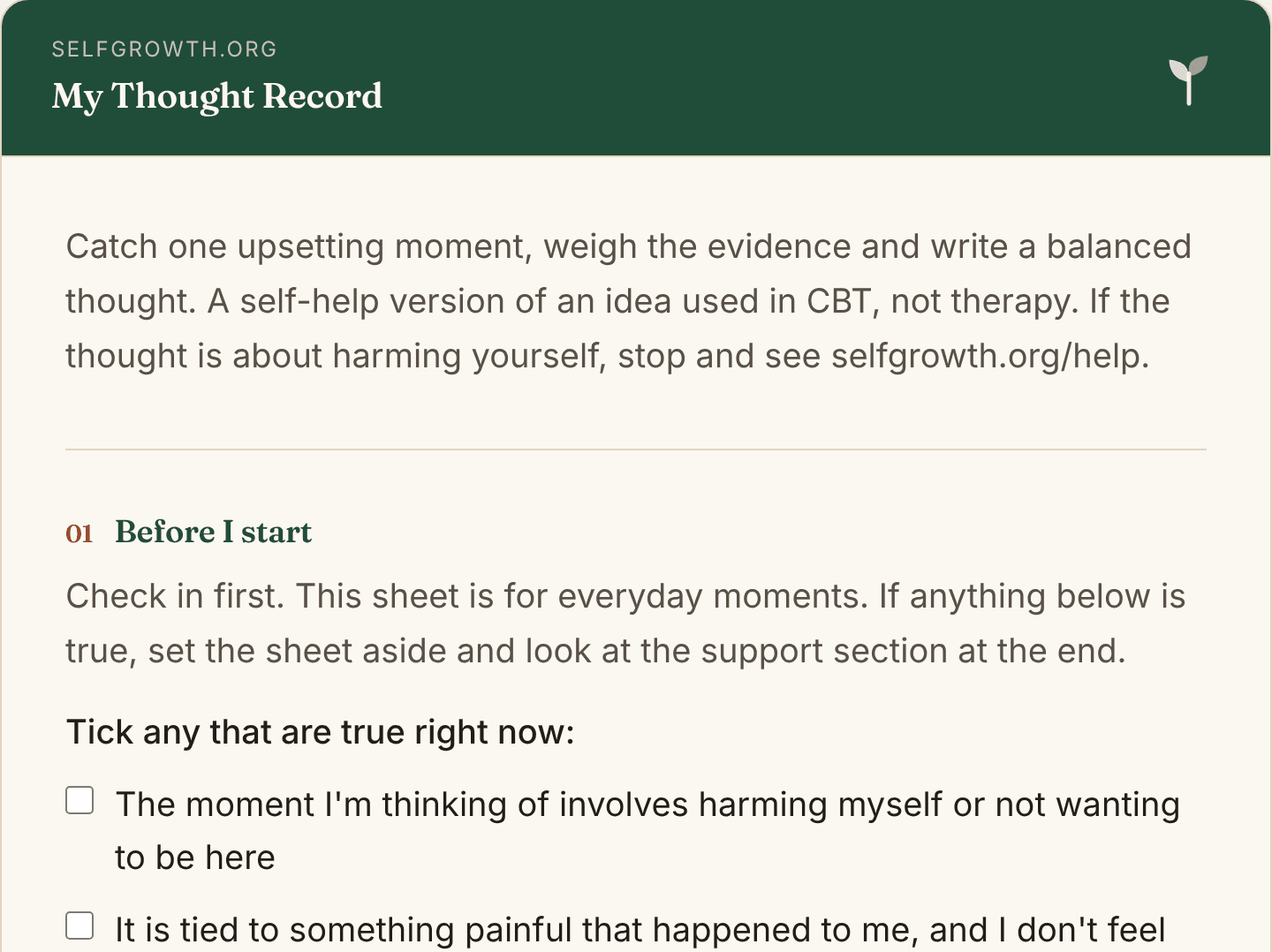
Thought Record Worksheet
Free thought record worksheet: note the situation, feeling and thought, weigh the evidence and write a balanced thought. Self-help, not therapy. Free PDF.
Open worksheet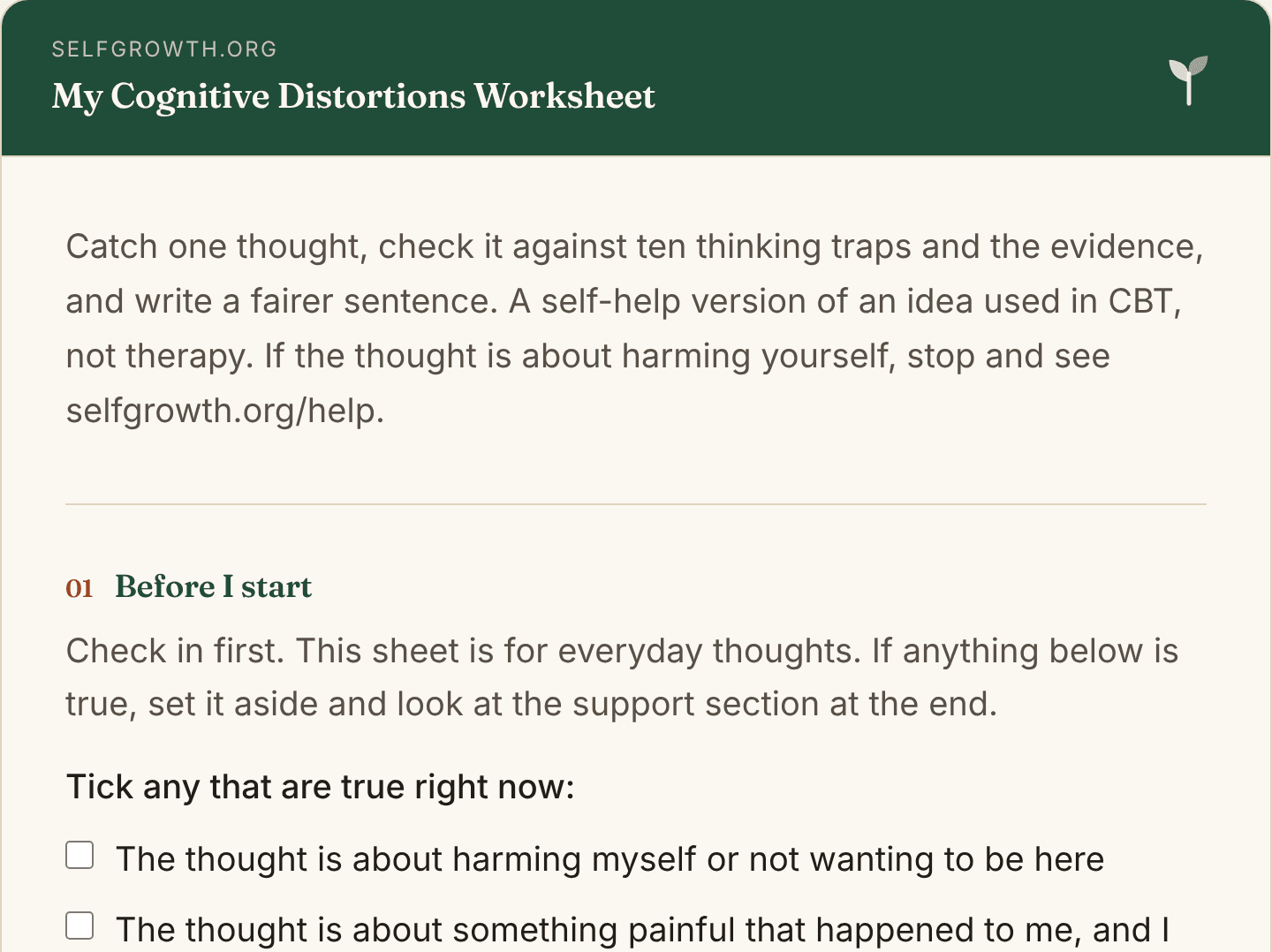
Cognitive Distortions Worksheet
Free cognitive distortions worksheet: check one thought against ten thinking traps, test the evidence and write a fairer sentence. Not therapy. Free PDF.
Open worksheet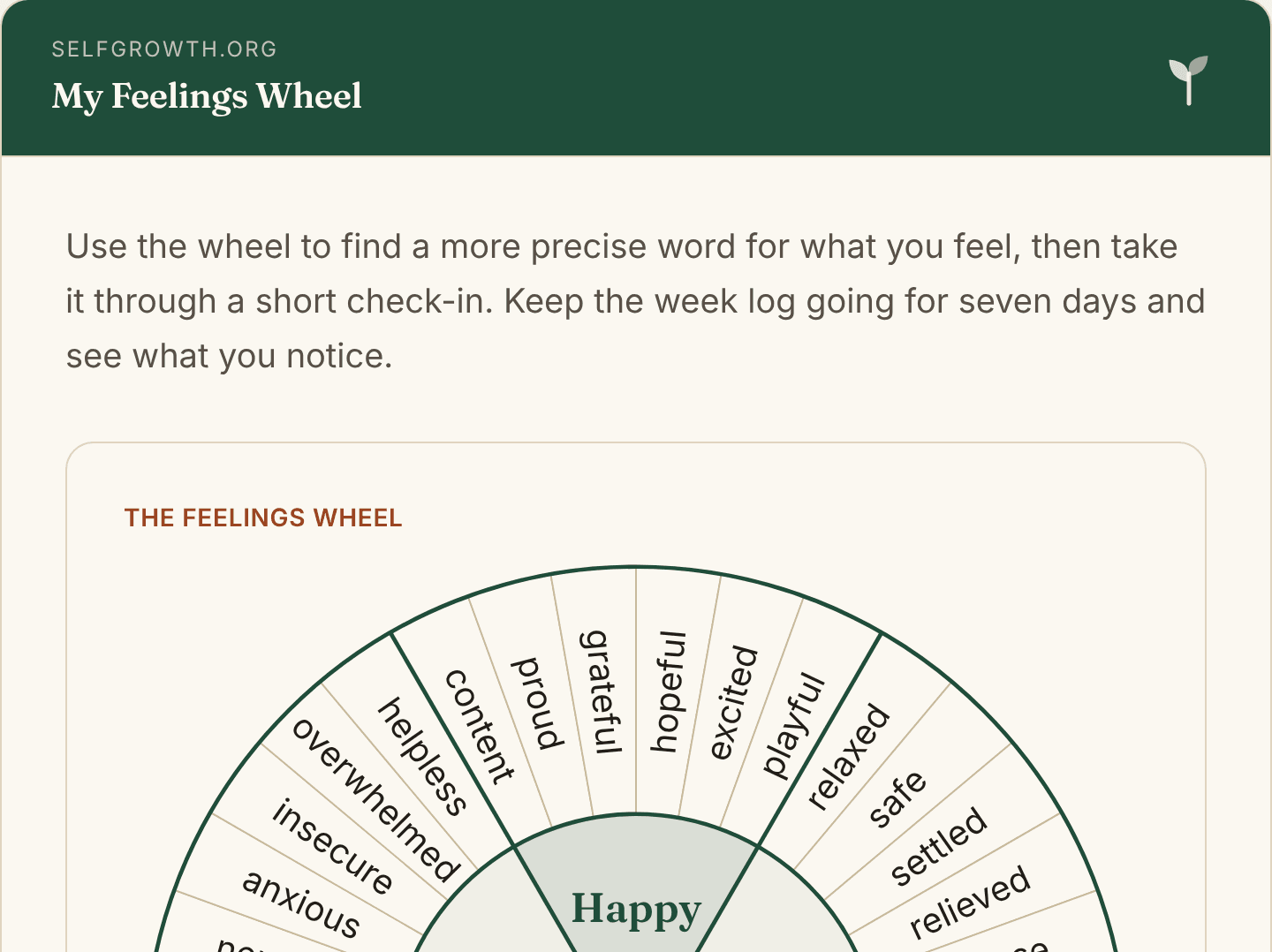
Feelings Wheel
A free printable feelings wheel (emotion wheel) PDF: six core feelings and 36 more precise words, with a daily check-in and a week log to name what you feel.
Open worksheetNew worksheets, straight to your inbox
An occasional new worksheet or tool, sent only when there's something genuinely worth your time. No spam, no pressure, unsubscribe any time.