
Inner critic
Cognitive distortions worksheet: a free printable to spot thinking traps
Updated 17 October 2026 · 8 min read · Free to print
A cognitive distortions worksheet helps you check one worrying thought against a list of ten thinking traps, such as mind reading or catastrophising, then test it against the facts. This free printable is a self-help version of an idea used in CBT, not therapy, and it does not treat anxiety, depression or anything else.
By the Self Growth team · a self-help version of an idea used in CBT, not therapy · how we make these
Fill it in here (it saves in this browser, but not in a private window), print it, or download the PDF. Free, no sign-up.
Some thoughts arrive sounding like facts. 'They're annoyed with me.' 'I always get this wrong.' 'It's going to go badly.' Cognitive behavioural therapy (CBT, a talking therapy) has a name for patterns that bend the facts like this: cognitive distortions. This worksheet is a self-help version of an idea used in CBT. It is not therapy.
You'll pick one everyday thought, tick any of ten thinking traps that it fits, look at the evidence for and against, and write a fairer sentence. 'None of them' is a fair answer, because some painful thoughts are simply accurate. You can't be diagnosed with a distortion, and ticking a box doesn't mean anything is wrong with you.
Please read this first. This sheet is for everyday thoughts about a message, a mistake or a worry. If the thought is about harming yourself or not wanting to be here, don't test it here. Reach out now: call Samaritans on 116 123 (UK and Ireland), call or text 988 (US), or find a helpline at findahelpline.com. If the thought is tied to something painful that happened to you, you can stop at any point and talk to your GP or someone you trust. Our helplines page (selfgrowth.org/help) lists more, including routes to a therapist.
This is a self-help tool. If your thoughts feel constant or too heavy to look at alone, or they affect your sleep, work or relationships, please speak to your GP. You deserve real support, not just a worksheet.
How to use this worksheet
- 1Choose a thought that feels manageable, not the heaviest one on your mind. Small ones are good practice.
- 2Work through the sections in order. Allow around 15 to 20 minutes, and you can stop whenever you like.
- 3Stop and skip ahead to the support section if a section stirs up something painful. Nothing here needs finishing.
- 4Use the log at the end over a week or two if you want to see which traps turn up for you, without turning it into a score.
The worksheet
selfgrowth.org
My Cognitive Distortions Worksheet
Catch one thought, check it against ten thinking traps and the evidence, and write a fairer sentence. A self-help version of an idea used in CBT, not therapy. If the thought is about harming yourself, stop and see selfgrowth.org/help.
01Before I start
Check in first. This sheet is for everyday thoughts. If anything below is true, set it aside and look at the support section at the end.
Tick any that are true right now:
If I ticked any of the first four, the person or line I'll turn to first (a friend, my GP, Samaritans 116 123, 988 in the US) is:
02Catch the thought
Write one thought, in the words it uses in your head. It can help to say what was happening when it showed up.
What was happening (where, who, what):
The thought, as it sounds in my head:
How much do I believe it right now?
How I feel (a word or two):
03Is it one of the ten thinking traps?
These ten are the ones measured by one cognitive distortions scale. Lists differ, and the descriptions are ours. A thought can fit more than one trap, or none. If you are afraid of someone or not safe, skip the traps: a worried thought can be accurate.
The trap that fits best (or 'none'), and why:
04Test it against the evidence
Stick to facts you could point to, not guesses or feelings. If you can't think of any evidence on one side, leave it blank.
Entry 1
Entry 2
Entry 3
Entry 4
If a friend told me this thought, what would I say to them?
05A fairer sentence
You're not looking for a cheerful thought, just a fairer one that you could actually believe. It can include the hard parts.
A fairer way to say it:
How much do I believe the original thought now?
Did anything shift, even slightly? (It's fine if nothing did.)
One small thing I could do next (or 'nothing, that's fine'):
06A short log, if you want one
Over a week or two, jot down thoughts you tested. It's for noticing, not scoring. There's no number that means anything.
Entry 1
Entry 2
Entry 3
Entry 4
07If this is bringing things up
A worksheet is a small tool. Some thoughts need a person. Tick anything that fits and decide who you'll tell.
When you're done, a moment to reflect
- Which thoughts were easiest to test, and which felt too close to test?
- Was there a thought I wanted to write a 'fairer' version of but couldn't believe it? What would a smaller step look like?
- Did any thought turn out to be accurate? What would I want to do about it?
- What would I say to a friend who had this thought?
Is there research behind a cognitive distortions worksheet?
Honestly, we know of no trial of this worksheet, and a worksheet isn't a treatment: the ten traps come from one 2023 questionnaire study, lists differ between papers, and the research behind them is set out, with its limits, in the research sections of our cognitive distortions guide (selfgrowth.org/guides/cognitive-distortions).
These are educational self-reflection tools, not therapy. See our editorial standards.
If you want to go deeper
- Takeda, T., Fukudome, K., Nakano, M., Umehara, H. & Nakamura, K. (2023). Reliability and validation of the Japanese version of the cognitive distortion scale. Frontiers in Psychology, 14, 1261166.
- Batmaz, S., Kocbiyik, S. & Yuncu, O. A. (2015). Turkish version of the Cognitive Distortions Questionnaire: psychometric properties. Depression Research and Treatment, 2015.
- NHS. Overview: Cognitive behavioural therapy (CBT), last reviewed 28 March 2025; NHS Talking Therapies, last reviewed 5 November 2025. nhs.uk.
Your questions, answered
- What are cognitive distortions?
- They are patterns of thinking that bend the facts, such as assuming the worst or seeing things as all good or all bad. The idea comes from the psychiatrist Aaron Beck's cognitive therapy. It's a teaching idea used in CBT, not a diagnosis, and different lists name different patterns.
- What are the 10 cognitive distortions on this worksheet?
- Mind reading, catastrophising, all-or-nothing thinking, emotional reasoning, labelling, mental filter, overgeneralising, personalising, should statements and minimising the positive. They're the ten measured by one cognitive distortions scale in a 2023 study. The one-line descriptions on the sheet are our own wording.
- How do I use a cognitive distortions worksheet?
- Pick one everyday thought, write it down, tick any trap that fits (or none), list the evidence for and against, then write a fairer sentence. Allow around 15 to 20 minutes. Skip it if the thought is about harming yourself or about something painful that happened to you, and reach out for support instead.
- Does a cognitive distortions worksheet treat anxiety or depression?
- No. It's a self-help version of an idea used in CBT, not a treatment. The research on CBT is about CBT as a treatment, and the research on self-guided programmes is about structured programmes, which a single worksheet is not. We know of no trial of this worksheet. If worry or low mood is getting in the way of your life, or you're worried about how long it has lasted, talk to your GP.
- What if I can't find any evidence against my thought?
- Then the thought may be accurate, and that's allowed. The worksheet has a 'none of these' option for that reason. If the thought points to a real problem, the useful next step may be a small action or asking someone for help, not a fairer sentence.
- Is this cognitive distortions worksheet free, and is it a substitute for therapy?
- It's free, with no payment and no email needed. Use Download PDF for a print-ready copy, or fill it in on screen (answers save in your browser on that device). It's not a substitute for therapy. If you're struggling, speak to your GP. In a crisis, call Samaritans on 116 123 (UK and Ireland), call or text 988 (US), or find a helpline at findahelpline.com.
Keep going, related worksheets
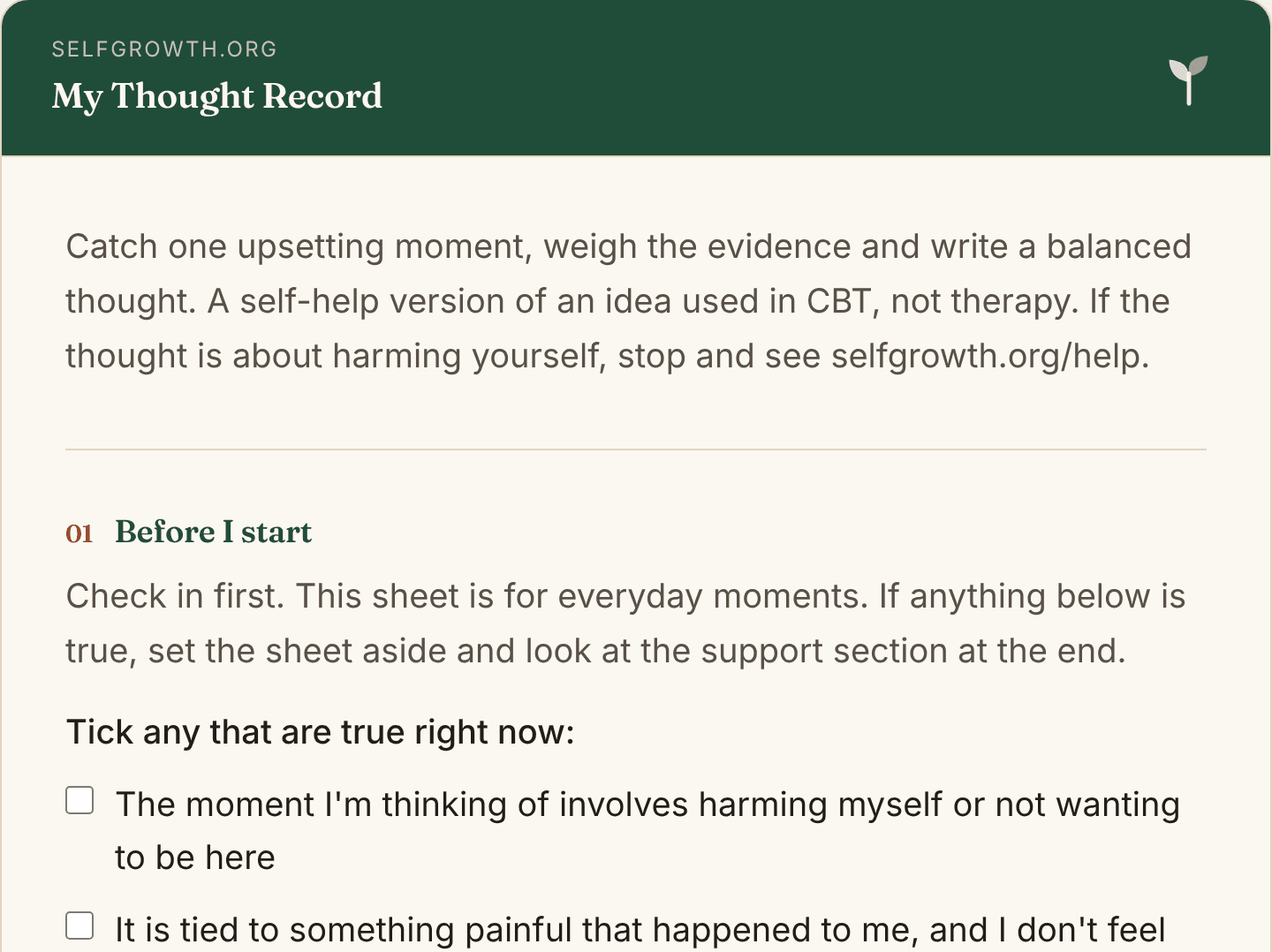
Thought Record Worksheet
Free thought record worksheet: note the situation, feeling and thought, weigh the evidence and write a balanced thought. Self-help, not therapy. Free PDF.
Open worksheet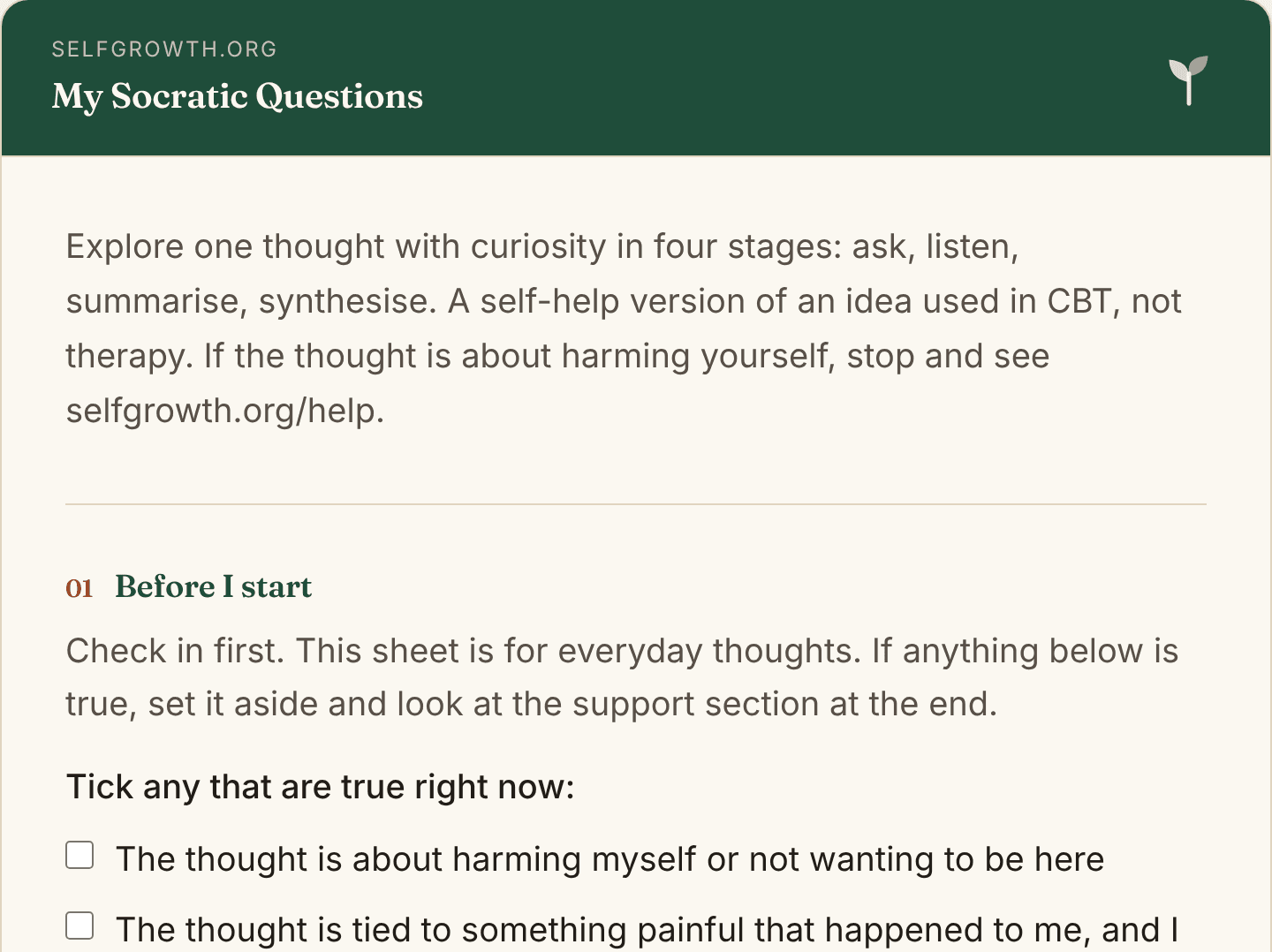
Socratic Questioning Worksheet
Free Socratic questioning worksheet: questions to explore one worrying thought in four steps, from Christine Padesky's guided discovery. Not therapy. Free PDF.
Open worksheet
Negative Self-Talk Worksheet
A free, printable negative self-talk worksheet: catch a harsh inner-critic thought, check whether it's fair, and answer it with something true and kinder.
Open worksheetNew worksheets, straight to your inbox
An occasional new worksheet or tool, sent only when there's something genuinely worth your time. No spam, no pressure, unsubscribe any time.