
Inner critic
Socratic questioning worksheet: a free printable set of questions to explore a thought
Updated 17 October 2026 · 8 min read · Free to print
A Socratic questioning worksheet gives you questions to explore one worrying thought out of curiosity, instead of arguing with it. It follows four stages described by the CBT trainer Christine Padesky: ask, listen, summarise and synthesise. This free printable is a self-help version of an idea used in CBT, not therapy.
By the Self Growth team · a self-help version of Christine Padesky's guided discovery, not therapy · how we make these
Fill it in here (it saves in this browser, but not in a private window), print it, or download the PDF. Free, no sign-up.
When a worrying thought turns up, there are two ways to meet it. You can argue with it ('that's silly, stop it'), or you can get curious about it. Socratic questioning is the curious way: asking a series of questions to find out what is actually going on, and what you might learn from the answers.
The idea is from cognitive behavioural therapy (CBT, a talking therapy). The CBT trainer Christine Padesky wrote that the aim is guided discovery rather than changing someone's mind. She described good questions as ones the person has the knowledge to answer, that draw attention to relevant information outside their current focus, and that move from the concrete to the more abstract, so the answers can be used to re-examine a conclusion or form a new idea. This sheet follows the four stages she set out. It is a self-help version of the idea, in which you ask yourself. It is not therapy.
That's an important difference. Her work, and the two studies we found of Socratic questioning (both in CBT for depression), are about therapists asking clients. We know of no study of asking yourself these questions from a worksheet. Treat it as a way to be curious about a thought, not a technique that will fix it.
Please read this first. Use the sheet on an everyday thought. If the thought is about harming yourself or not wanting to be here, don't question it alone on a page. Call Samaritans on 116 123 (UK and Ireland), call or text 988 (US), or find a helpline at findahelpline.com. If a question stirs up a painful memory, stop and put the sheet away. Our helplines page (selfgrowth.org/help) lists more, including routes to a therapist. If your thoughts are getting in the way of your life, or you're worried about how long they have lasted, please talk to your GP.
How to use this worksheet
- 1Pick one everyday thought that is bothering you. Not the heaviest one on your mind.
- 2Go through the four stages in order. Leave out any question that doesn't fit, and add your own.
- 3Answer from curiosity. Padesky wrote, 'If you are not truly curious to know the answer, don't ask the question.' You're looking for what you can learn, not for a win.
- 4Allow around 15 minutes. Stop if it brings up more than you can handle, and use the support section.
The worksheet
selfgrowth.org
My Socratic Questions
Explore one thought with curiosity in four stages: ask, listen, summarise, synthesise. A self-help version of an idea used in CBT, not therapy. If the thought is about harming yourself, stop and see selfgrowth.org/help.
01Before I start
Check in first. This sheet is for everyday thoughts. If anything below is true, set it aside and look at the support section at the end.
Tick any that are true right now:
If I ticked any of the first four, the person or line I'll turn to first (a friend, my GP, Samaritans 116 123, 988 in the US) is:
02The thought
Write the thought as it sounds in your head.
The thought:
How much do I believe it right now?
How I feel (a word or two):
03Stage 1: Ask informational questions
Start concrete and factual. Ask questions you actually have the answers to. The three marked (Padesky) are from her 1993 talk, adapted to 'I'. The others are ours. Skip any question that takes you somewhere painful. Leaving it blank is fine.
What exactly do I mean by this? What's a specific time it showed up?
What are the facts here, and what am I guessing?
Have I been in similar circumstances before? What did I do? How did that turn out? (Padesky)
What do I know now that I didn't know then? (Padesky)
What would I advise a friend who told me something similar? (Padesky)
What else is true about this that I'm not looking at right now?
04Stage 2: Listen to my own answers
Read back what you wrote, as if a friend had said it. Padesky tells therapists to listen for unusual words and emotional reactions, and to stay open to being surprised. Try that with your own answers.
Which answer surprised me, or which word stands out?
Is there anything I wrote that I'd want to ask a follow-up question about?
05Stage 3: Summarise
Pull the pieces together in a few sentences. Putting the new information side by side can show you more than each answer did alone.
In two or three sentences, what have I found out so far?
06Stage 4: Synthesise
Now bring it back to the thought you started with. Padesky's simplest version of this question is, 'How does all this information fit with your idea?'
How does all this fit with my original thought?
If the thought changed at all, how would I put it now? (It's fine if it didn't.)
How much do I believe the original thought now?
One small thing I could try or watch for, to find out more (or 'nothing, that's fine'):
07If this is bringing things up
A worksheet is a small tool. Some thoughts need a person. Tick anything that fits and decide who you'll tell.
When you're done, a moment to reflect
- Did I ask the questions out of curiosity, or was I hoping for a particular answer? What did I notice?
- Which question gave me the most to think about?
- What did I learn that I might not have seen if I'd just argued with the thought?
- Is there a question I'd rather put to a trusted person than to myself?
Is there research behind a Socratic questioning worksheet?
Honestly, we know of no trial of this worksheet, and a worksheet isn't a treatment. This is what we could check.
The four stages and the three quoted questions come from a keynote Christine Padesky gave in 1993 to the European Congress of Behavioural and Cognitive Therapies, which she has published on her website. It was written for therapists. She argues that the point of Socratic questioning is to guide discovery, not to change a client's mind, and that the final goal is to teach a way of weighing up thoughts, behaviours and moods. She writes that a list of generic 'good questions', developed with her students, helped clients write alternative responses on thought records, and that she came to see such generic questions as not enough on their own. The other questions on our sheet are our own.
We found two studies of therapists' Socratic questioning and outcomes, both in CBT for depression. In 2015, Braun and colleagues followed 55 depressed adults through a 16-week course of cognitive therapy. Observers rated therapists' Socratic questioning in the first three sessions, and when it rose for a client, it was followed by a bigger fall in that client's depressive symptoms by the next session. The authors say it can't show cause, it looks only at early sessions, and it covers cognitive therapy for depression, so it may not apply to other treatments or groups. It is about therapists asking clients, not about someone asking themselves on a page. A 2022 study of 123 clients found evidence consistent with cognitive change carrying part of the link between Socratic questioning and symptom change.
The wider evidence is about CBT as a treatment. A 2012 review of a representative sample of 106 earlier research summaries (meta-analyses) concluded that its evidence base is very strong in general, and a 2011 meta-analysis of seven trials found a small but significant effect for self-guided treatment. A single worksheet is lighter than either. For a table that fixes the order of the steps, try the thought record worksheet, and the cognitive distortions worksheet names the thinking traps first.
These are educational self-reflection tools, not therapy. See our editorial standards.
If you want to go deeper
- Padesky, C. A. (1993). Socratic questioning: changing minds or guiding discovery? Keynote address, European Congress of Behavioural and Cognitive Therapies, London, 24 September 1993. padesky.com.
- Braun, J. D., Strunk, D. R., Sasso, K. E. & Cooper, A. A. (2015). Therapist use of Socratic questioning predicts session-to-session symptom change in cognitive therapy for depression. Behaviour Research and Therapy, 70, 32-37.
- Vittorio, L. N. and colleagues (2022). Using Socratic Questioning to promote cognitive change and achieve depressive symptom reduction: Evidence of cognitive change as a mediator. Behaviour Research and Therapy, 150.
- Hofmann, S. G., Asnaani, A., Vonk, I. J. J., Sawyer, A. T. & Fang, A. (2012). The efficacy of cognitive behavioral therapy: a review of meta-analyses. Cognitive Therapy and Research, 36(5), 427-440.
- Cuijpers, P., Donker, T., Johansson, R., Mohr, D. C., van Straten, A. & Andersson, G. (2011). Self-guided psychological treatment for depressive symptoms: a meta-analysis. PLoS ONE, 6(6), e21274.
Your questions, answered
- What is Socratic questioning?
- It's a way of exploring a thought by asking a series of questions, instead of arguing with it. In CBT, the trainer Christine Padesky described it as guided discovery: questions the person has the knowledge to answer, that point to relevant information outside their current focus, and that move from concrete to more abstract. This sheet is a self-help version of the idea.
- What are examples of Socratic questions?
- Three from Padesky's 1993 talk are 'Have you ever been in similar circumstances before? What did you do? How did that turn out?', 'What do you know now that you didn't know then?' and 'What would you advise a friend who told you something similar?' On the sheet, they're adapted to 'I'. The other questions on the sheet are our own.
- What are the stages of Socratic questioning?
- Padesky described four: asking informational questions, listening, summarising, and asking a synthesising or analytical question that applies what you found to your original thought. The worksheet follows those four stages in order.
- Does Socratic questioning work?
- We know of no study of asking yourself these questions from a worksheet. In one study of 55 depressed adults in a 16-week course of cognitive therapy, sessions in which therapists used more Socratic questioning were followed by bigger drops in depressive symptoms the next session. It was observational (it compared what happened, it didn't test the questioning) and included 55 people, so it can't show that the questioning caused the drops, and it was therapists asking, not a worksheet.
- How is this different from the thought record worksheet?
- The thought record is a fixed table: situation, feeling, thought, evidence, balanced thought. This worksheet is a set of questions you can use on any thought, including on the evidence step of a thought record. Padesky says a list of generic questions like these helped clients write alternative responses on thought records.
- Is this Socratic questioning worksheet free, and is it a substitute for therapy?
- It's free, with no payment and no email needed. Use Download PDF for a print-ready copy, or fill it in on screen (answers save in your browser on that device). It's not a substitute for therapy. If you're struggling, speak to your GP. In a crisis, call Samaritans on 116 123 (UK and Ireland), call or text 988 (US), or find a helpline at findahelpline.com.
Keep going, related worksheets
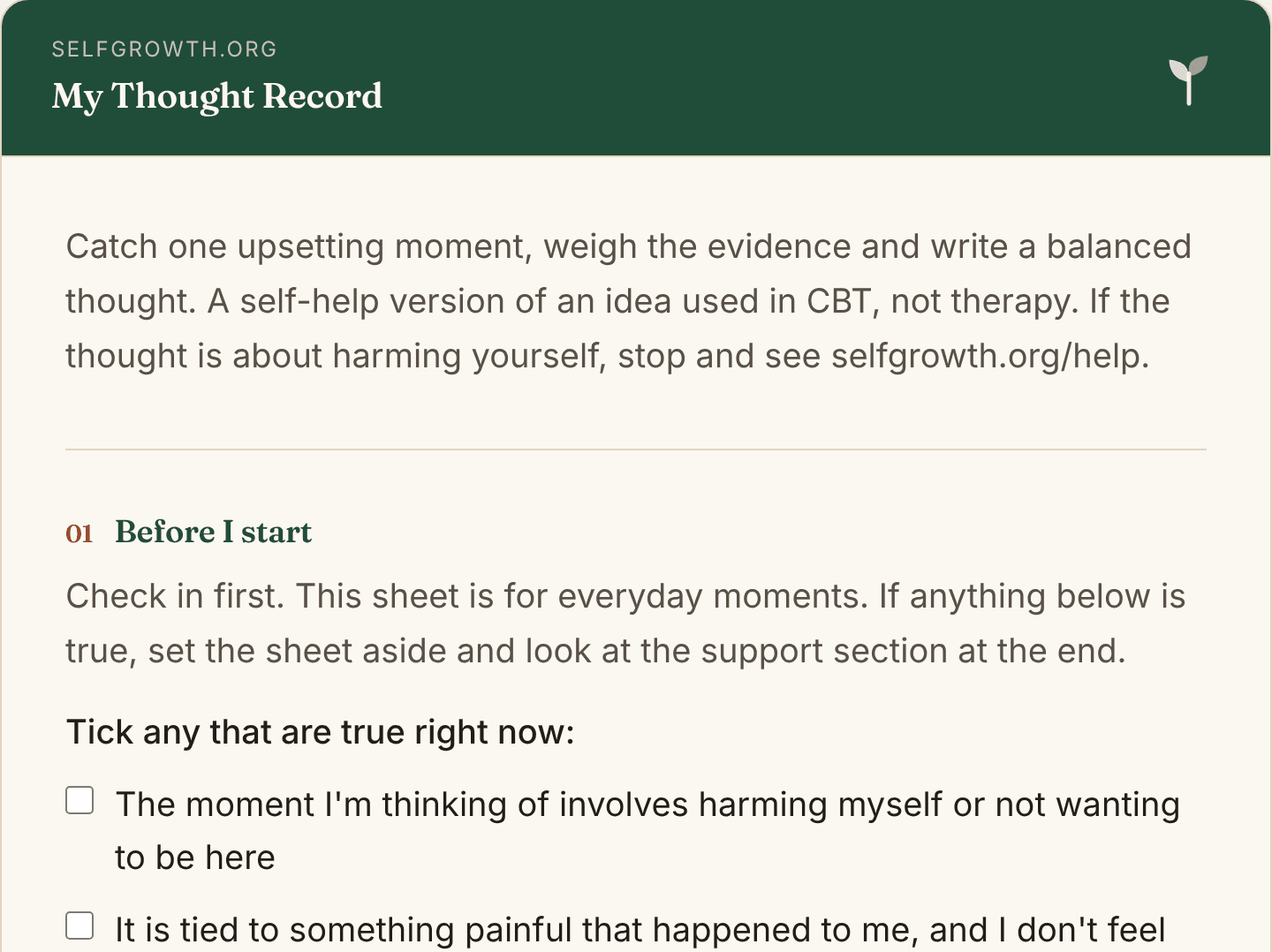
Thought Record Worksheet
Free thought record worksheet: note the situation, feeling and thought, weigh the evidence and write a balanced thought. Self-help, not therapy. Free PDF.
Open worksheet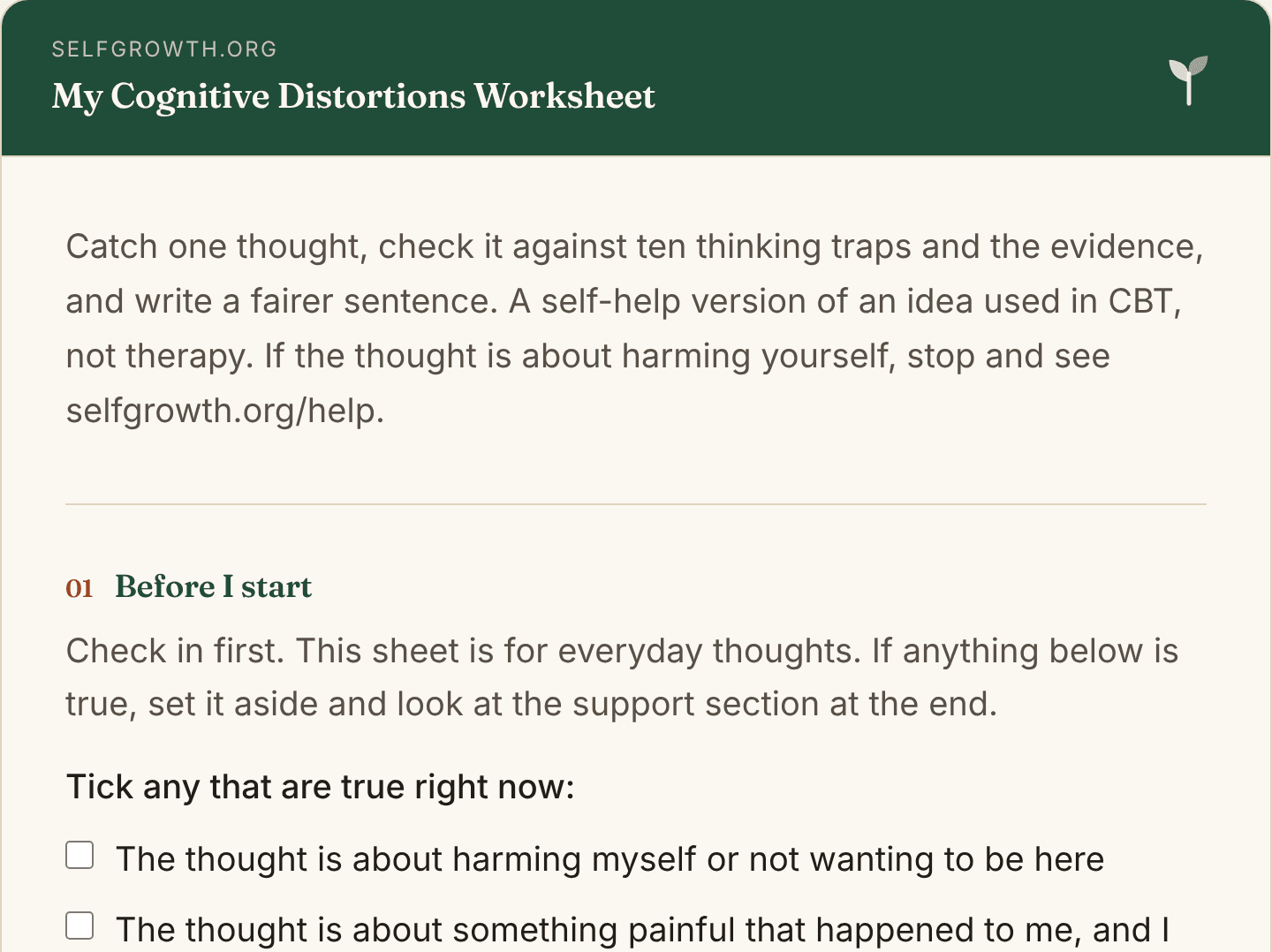
Cognitive Distortions Worksheet
Free cognitive distortions worksheet: check one thought against ten thinking traps, test the evidence and write a fairer sentence. Not therapy. Free PDF.
Open worksheet
Negative Self-Talk Worksheet
A free, printable negative self-talk worksheet: catch a harsh inner-critic thought, check whether it's fair, and answer it with something true and kinder.
Open worksheetNew worksheets, straight to your inbox
An occasional new worksheet or tool, sent only when there's something genuinely worth your time. No spam, no pressure, unsubscribe any time.