
Inner critic
Thought record worksheet: a free printable to check a worrying thought
Updated 17 October 2026 · 9 min read · Free to print
A thought record worksheet is a table for slowing down one upsetting moment: you write the situation, how you felt, the thought that came, the evidence for and against it, and a more balanced thought. This free printable is a self-help version of an idea used in CBT, not therapy, and it does not treat anxiety or depression.
By the Self Growth team · a self-help version of a CBT thought record, not therapy; not affiliated with Christine Padesky or Mind Over Mood · how we make these
Fill it in here (it saves in this browser, but not in a private window), print it, or download the PDF. Free, no sign-up.
When something upsets you, the thought that follows can arrive so fast you hardly notice it. A thought record is a way of catching that thought on paper: what happened, what you felt, what went through your mind, and what the evidence says. Then you write a more balanced version. It's an idea from cognitive behavioural therapy (CBT, a talking therapy), and this sheet is a self-help version of it. It isn't therapy.
The thought record in its familiar form was developed by the psychologist Christine Padesky in the late 1970s, and her version has seven columns. Ours is a simpler five-step layout in our own words, so it isn't her form. This sheet is not made, checked or endorsed by Christine Padesky or Mind Over Mood. If you want the original, the Mind Over Mood worksheets are on mindovermood.com.
A thought record is not a good fit for everything. Padesky writes, for therapists, that she rarely recommends them in the treatment of anxiety disorders, and puts behavioural experiments (trying something out to test a worry) first, though she adds that some anxious clients find them helpful. In the same note she says that early in therapy and when depression is more severe, behavioural activation (planning activities that lift mood) is often the better tool, and the thought record comes once someone is more engaged in such activities. Her note is for therapists, so this part is our reading, not hers: if you are struggling a lot, a worksheet may not be the right place to start, and your GP is.
Please read this first. Use the sheet for an everyday moment you can think about without being overwhelmed. If the thought is about harming yourself, or about something painful that happened to you, don't work on it here. Call Samaritans on 116 123 (UK and Ireland), call or text 988 (US), or find a helpline at findahelpline.com. Our helplines page (selfgrowth.org/help) lists more, including routes to a therapist. If your worries are getting in the way of your life, or you're worried about how long they have lasted, please talk to your GP.
How to use this worksheet
- 1Pick one recent moment that bothered you and that you can think about calmly. Not the worst one.
- 2Fill it in soon after the moment if you can, while you remember the exact words of the thought.
- 3Work through the five steps in order. Facts first, then feelings about the facts. Allow around 15 minutes.
- 4Stop if it stirs up more than you can handle, and look at the support section. Nothing here needs finishing.
- 5Use the blank record at the end for later moments, on a page you can copy or print again.
The worksheet
selfgrowth.org
My Thought Record
Catch one upsetting moment, weigh the evidence and write a balanced thought. A self-help version of an idea used in CBT, not therapy. If the thought is about harming yourself, stop and see selfgrowth.org/help.
01Before I start
Check in first. This sheet is for everyday moments. If anything below is true, set the sheet aside and look at the support section at the end.
Tick any that are true right now:
If I ticked any of the first four, the person or line I'll turn to first (a friend, my GP, Samaritans 116 123, 988 in the US) is:
021. The situation
What happened, as a camera would have seen it. What actually happened, not what it might mean: who, where, when, what was said or done. Leave out what you made of it.
The situation:
032. How I felt
Name the feeling in a word or two, such as nervous, embarrassed or low. If you can, rate how strong it was. The number is only for you, and there's no score that means anything.
The feeling(s):
How strong was the strongest feeling?
043. The thought
What went through your mind just before or as the feeling began? Write it as a sentence, the way it sounded in your head. If there are several, pick the one that carried the most feeling and write it out again. If this thought is about harming yourself, stop here and see selfgrowth.org/help.
The thought(s):
How much do I believe the main thought right now?
054. The evidence
Take the main thought and look at what is on each side. Stick to facts you could point to. Feelings and guesses go in the thought box, not here. If one side is empty, leave it empty.
Entry 1
Entry 2
Entry 3
Entry 4
Some questions that can help: Have I been in a situation like this before, and what happened? What would I say to a friend who had this thought? Is there another way to read it?
065. A balanced thought
Put both sides together in a sentence that is fair, not cheerful. It should include the hard parts if they're real. If you can't believe a balanced thought yet, write a smaller one you can.
A balanced thought:
How much do I believe this balanced thought?
How strong is the feeling now? (It's fine if it hasn't changed.)
One small thing I could do next, or 'nothing, that's fine':
07My blank thought record
For later moments. Use one row per moment. It's for noticing, not scoring.
Entry 1
Entry 2
Entry 3
08If this is bringing things up
A worksheet is a small tool. Some thoughts need a person. Tick anything that fits and decide who you'll tell.
When you're done, a moment to reflect
- Was it easier to write the situation, the thought or the balanced thought? What does that tell me?
- Did the evidence on one side surprise me?
- Did anything change after the balanced thought, or nothing at all? Can I be okay with either?
- Is there a moment this week that a thought record would help with, and one that it wouldn't?
Is there research behind a thought record worksheet?
Honestly, we know of no trial of this worksheet, and a worksheet isn't a treatment. This is what we could check.
The seven-column thought record was developed by Christine Padesky in the late 1970s and carries a 1983 copyright. The Mind Over Mood site calls it the first thought record to include evidence columns and a balanced-thought column. Our five-step layout is simpler and in our own words. For the original, see Worksheet 9.2 on mindovermood.com.
Two lab studies tested a thought record in single sessions. In a 2012 randomised study (people were randomly assigned to groups) of 91 people without a clinical diagnosis, a single-session thought record and a single-session behavioural experiment both did better than a control task on beliefs, anxiety, behaviour and a symptom measure, with the experiment slightly ahead. In a 2018 randomised study of 100 participants given a stress test, the group who completed a thought record had a bigger spike in the stress hormone cortisol, and the study found no significant differences on the other body-stress or mood measures. Both studies are small and short, and neither tested a worksheet you fill in at home.
The wider evidence is about CBT as a treatment. A 2012 review of a representative sample of 106 earlier research summaries (meta-analyses) concluded that its evidence base is very strong in general, and a 2011 meta-analysis of seven trials found a small but significant effect for self-guided treatment. A single worksheet is lighter than either. Padesky herself writes, in a note for therapists, that she rarely recommends thought records in the treatment of anxiety disorders, and that when depression is more severe, behavioural activation is often the better starting point, with thought records coming once someone is more engaged in mood-lifting activities. For a set of questions to use on the evidence step, try the Socratic questioning worksheet, and the cognitive distortions worksheet helps name thinking traps first.
These are educational self-reflection tools, not therapy. See our editorial standards.
If you want to go deeper
- Padesky, C. A. (1983). 7-Column Thought Record. Huntington Beach, CA: Center for Cognitive Therapy. Reprinted in Greenberger, D. & Padesky, C. A. (2016). Mind Over Mood, 2nd edition (Worksheet 9.2). mindovermood.com.
- Padesky, C. A. (2013, 22 November). Use the sharpest tool in the box. padesky.com.
- McManus, F., Van Doorn, K. & Yiend, J. (2012). Examining the effects of thought records and behavioral experiments in instigating belief change. Journal of Behavior Therapy and Experimental Psychiatry, 540-547.
- Rozek, D. C., Smith, N. B. & Simons, A. D. (2018). Experimentally unpacking cognitive behavioral therapy: the effects of completing a thought record on affect and neuroendocrine responses to stress. Biological Psychology, 138, 104-109.
- Hofmann, S. G., Asnaani, A., Vonk, I. J. J., Sawyer, A. T. & Fang, A. (2012). The efficacy of cognitive behavioral therapy: a review of meta-analyses. Cognitive Therapy and Research, 36(5), 427-440.
- Cuijpers, P., Donker, T., Johansson, R., Mohr, D. C., van Straten, A. & Andersson, G. (2011). Self-guided psychological treatment for depressive symptoms: a meta-analysis. PLoS ONE, 6(6), e21274.
Your questions, answered
- What is a thought record?
- It's a table used in CBT for looking at one upsetting moment: the situation, how you felt, the thought you had, the evidence for and against it, and a more balanced thought. The familiar version was developed by Christine Padesky in the late 1970s and has seven columns. Ours is a simpler five-step layout in our own words.
- How do I fill in a thought record?
- Write the facts of the situation, name the feeling, write the thought as a sentence, then list evidence for and against it. Finish with a balanced thought that is fair, not just cheerful. Use it on an everyday moment, and stop if it brings up more than you can handle.
- Does a thought record work?
- We know of no trial of this worksheet. In one lab study of 91 people without a clinical diagnosis, a single-session thought record did better than a control task on beliefs, anxiety, behaviour and symptoms, with behavioural experiments slightly ahead. In another lab study of 100 participants under stress, the thought record group had a bigger spike in the stress hormone cortisol and no differences on the other measures. These are small, single-session studies, not trials of a worksheet.
- What is the difference between a thought record and journaling?
- Journaling is open-ended. A thought record has a fixed order: situation, feeling, thought, evidence, balanced thought. The structure is the point, since it keeps you on the facts. If you'd rather write freely, our journaling guide and prompts are there for that.
- Is a thought record good for anxiety?
- We can't say it helps with anxiety, and its developer rarely recommends it for anxiety disorders. Padesky writes, for therapists, that anxiety is kept going by underlying assumptions more than by automatic thoughts, and she puts behavioural experiments first. If worry is getting in the way of your life, or you're worried about how long it has lasted, talk to your GP.
- Is this thought record free, and is it a substitute for therapy?
- It's free, with no payment and no email needed. Use Download PDF for a print-ready copy, or fill it in on screen (answers save in your browser on that device). It's not a substitute for therapy. If you're struggling, speak to your GP. In a crisis, call Samaritans on 116 123 (UK and Ireland), call or text 988 (US), or find a helpline at findahelpline.com.
Keep going, related worksheets
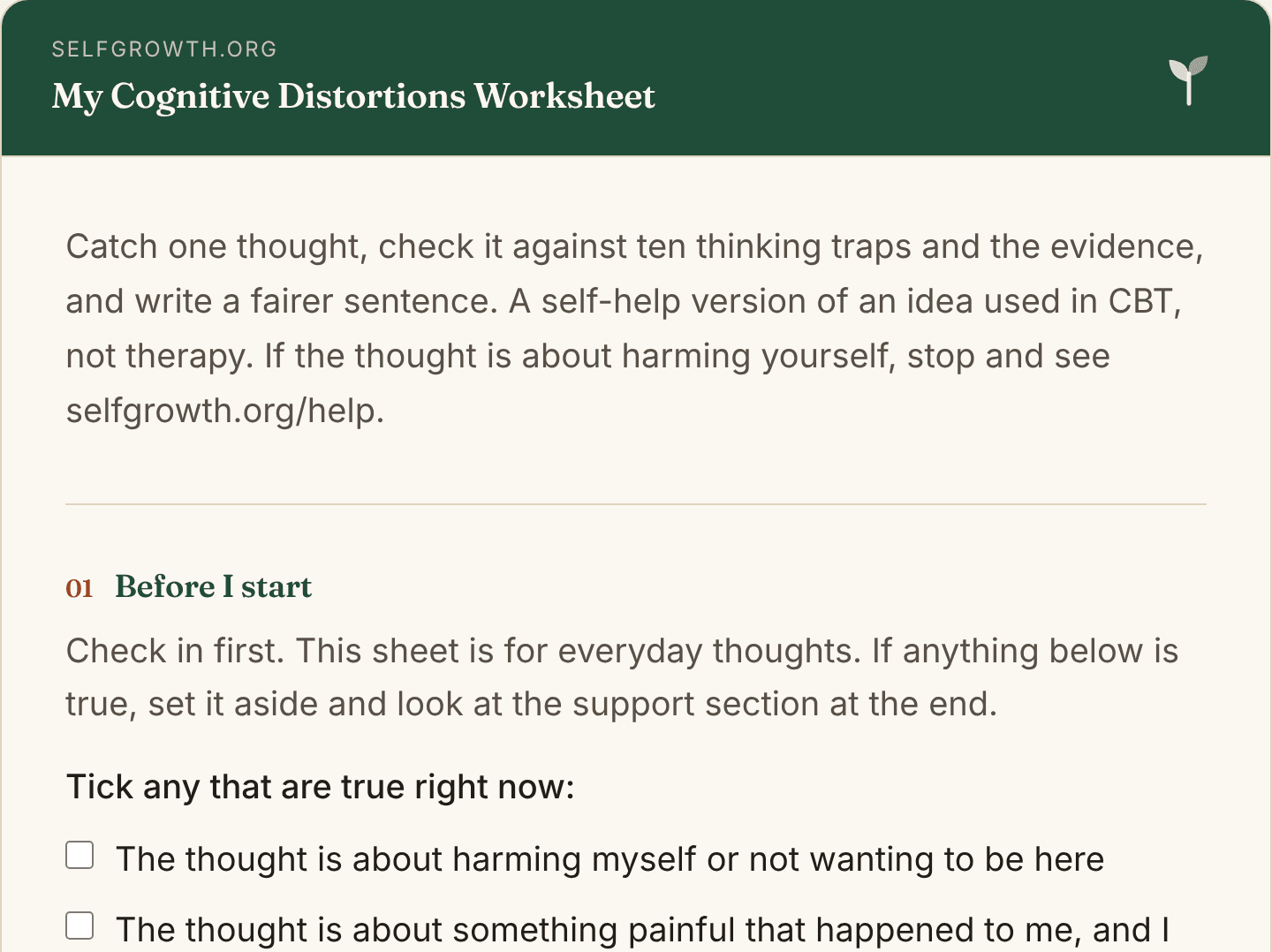
Cognitive Distortions Worksheet
Free cognitive distortions worksheet: check one thought against ten thinking traps, test the evidence and write a fairer sentence. Not therapy. Free PDF.
Open worksheet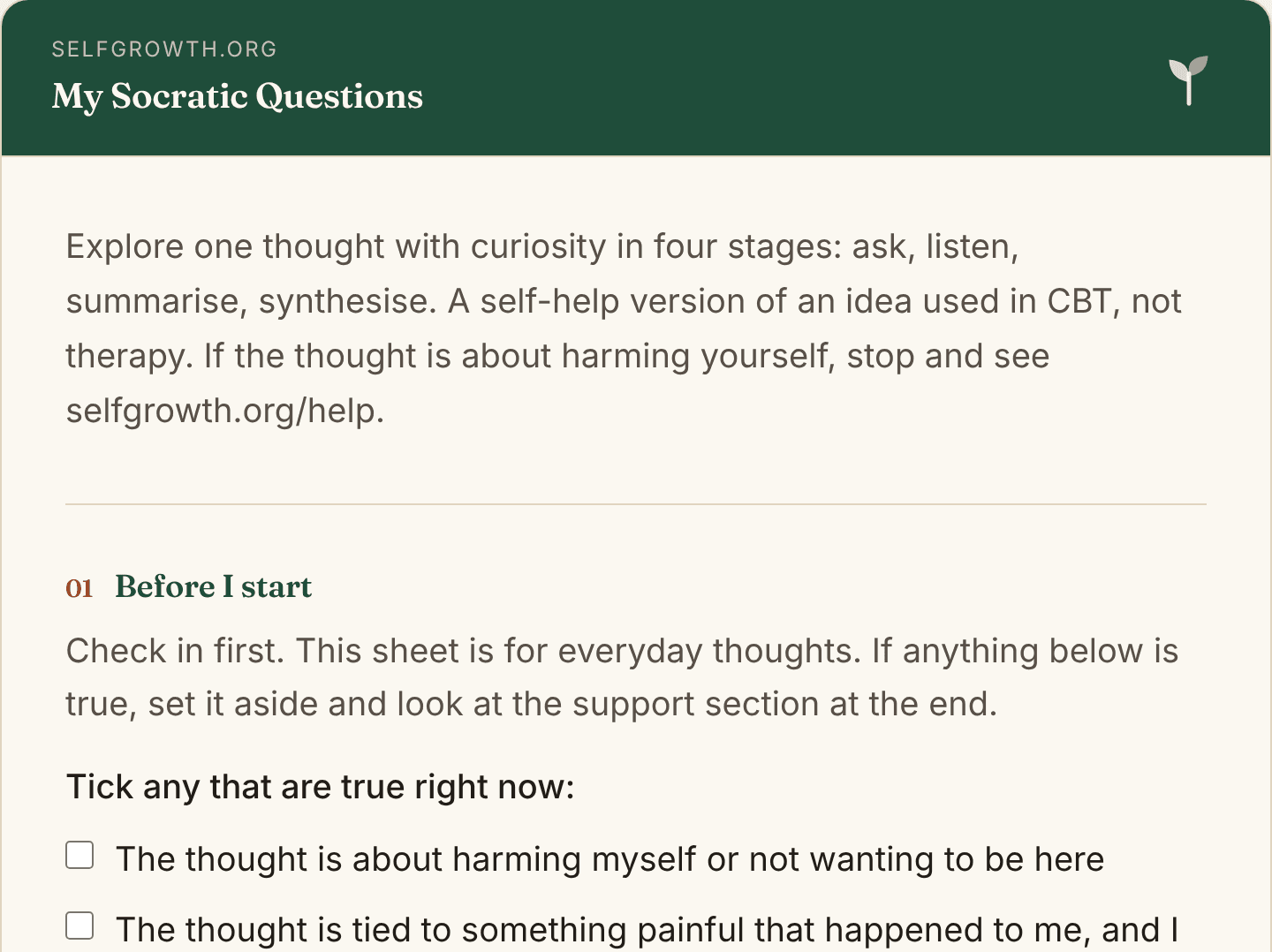
Socratic Questioning Worksheet
Free Socratic questioning worksheet: questions to explore one worrying thought in four steps, from Christine Padesky's guided discovery. Not therapy. Free PDF.
Open worksheet
Negative Self-Talk Worksheet
A free, printable negative self-talk worksheet: catch a harsh inner-critic thought, check whether it's fair, and answer it with something true and kinder.
Open worksheetNew worksheets, straight to your inbox
An occasional new worksheet or tool, sent only when there's something genuinely worth your time. No spam, no pressure, unsubscribe any time.