
Self-awareness
Core beliefs worksheet: a gentle free printable to notice a belief about yourself
Updated 17 October 2026 · 8 min read · Free to print
A core beliefs worksheet helps you notice a deep, fixed-sounding belief about yourself, such as 'I'm no good', and keep a small log of what doesn't fit it. The CBT trainer Christine Padesky describes core beliefs as shifting very slowly. This gentle printable never asks where a belief came from. It is a self-help sheet, not therapy.
By the Self Growth team · a gentle self-help version of an idea used in CBT, not therapy · how we make these
Fill it in here (it saves in this browser, but not in a private window), print it, or download the PDF. Free, no sign-up.
Some beliefs about ourselves sit so deep they hardly sound like thoughts. 'I'm not good enough.' 'People can't be trusted.' 'Nothing I do makes a difference.' Cognitive therapists call these core beliefs. Christine Padesky, a CBT trainer, describes them as beliefs about yourself, other people and the world, and as deeper than the passing thoughts that flit through your mind.
This sheet is gentler than our other worksheets on purpose. Padesky writes that core beliefs 'shift very slowly', that she discourages therapists from working at the core belief level early in therapy, and that core belief methods should stay 'at the bottom of the tool box unless they are absolutely needed'. In one 2017 study of 356 adults in a group CBT programme for depression, higher use of core belief strategies in a week was followed by an increase in depressive symptoms afterwards. That was an association, not proof that the work caused it, and the study was of a therapy programme, not a worksheet. But it is a reason to go slowly.
So this worksheet only asks you to notice a belief, if one comes up, and to start a small, optional log of things that don't fit it. It does not ask where the belief came from, and it does not ask you to go back over painful events. Core beliefs can be tied to hard experiences, and that is work for a therapist, not a printable.
Please read this first. If the belief connects to painful events, or you feel worse when you think about it, stop here and talk to your GP or a therapist. You can skip any part of this sheet. If you ever think about harming yourself, call Samaritans on 116 123 (UK and Ireland), call or text 988 (US), or find a helpline at findahelpline.com. Our helplines page (selfgrowth.org/help) lists more, including routes to a therapist. If you are already seeing a therapist, bring this sheet to them first.
This is a self-help version of an idea used in CBT. It is not therapy, and it does not treat anxiety, depression or anything else. You deserve real support, not just a worksheet.
How to use this worksheet
- 1Read 'Before I start' and check in with yourself. If any of it fits, stop and use the support section instead.
- 2Skip any section that doesn't feel right. 'Nothing comes up' is a fair answer and a fine place to finish.
- 3Keep it short. Allow around 15 minutes, and putting it down halfway is allowed.
- 4If you feel worse, panicky, numb or very low at any point, stop. Put the sheet away, do something steadying (a walk, a call, the 5-4-3-2-1 grounding worksheet) and tell someone you trust.
- 5If you want to keep the log, come back to it over weeks, not days.
The worksheet
selfgrowth.org
My Core Beliefs Worksheet
Notice a belief, if one comes up, and keep a small log of what doesn't fit it. You can stop at any point. This sheet never asks where a belief came from. A self-help sheet, not therapy. If you feel worse, stop and see selfgrowth.org/help.
01Before I start
Check in first. This sheet is for noticing, gently. If any of the first four is true, don't carry on. Look at the support section at the end.
Tick any that are true right now:
If I ticked any of the first five, the person or line I'll turn to first (a friend, my GP, my therapist, Samaritans 116 123, 988 in the US) is:
02Notice, don't dig
Think of a recent time something went wrong, a small one. Is there a sentence about yourself, other people or the world that sounds like it sits underneath? In Padesky's papers, examples include 'I'm no good', 'I'm inadequate', 'Others can't be trusted' and 'effort does not pay off'. You don't have to find one. A belief about other people can come from things that really happened to you. This sheet is not asking you to talk yourself out of it, and you can skip that line. 'Nothing comes up' is fine.
About me, a sentence that sometimes shows up (or 'nothing'):
About other people, a sentence that sometimes shows up (or 'nothing'):
About the world or my life, a sentence that sometimes shows up (or 'nothing'):
How heavy does it feel to look at this right now? (If it's very heavy, stop here.)
03One belief, kept in view
Pick just one sentence, only if it feels okay. Padesky describes core beliefs as shifting slowly, so the aim is not to argue it away today.
The sentence I'm choosing:
How strongly does it feel true today?
What this belief asks of me day to day (what I do, or avoid, because of it):
04A small log of what doesn't fit
Padesky describes a 'positive data log': a daily record of small things that fit a kinder belief. She says it is hard at first, and that someone with a long-held belief can look at the evidence and still say 'Yes, I see this evidence, but I am still bad'. That is why this is a log kept over weeks, not a verdict. Skip it if it feels like pressure. Small and ordinary things count.
Entry 1
Entry 2
Entry 3
Entry 4
Entry 5
Something I'd like to keep an eye out for this week:
05A kinder sentence to try on
You don't have to believe it. A belief about other people can come from things that really happened to you. This sheet is not asking you to talk yourself out of it, and you can skip that line. Try writing a sentence a little fairer than the first, the way you might speak to a friend.
If a friend believed this about themselves, I'd say:
A fairer sentence I could try on, even slightly:
How much do I believe it right now? (Low is fine.)
06Looking after myself afterwards
Do one steadying thing, however small.
07If this is bringing things up
A worksheet is a small tool. Some beliefs need a person. Tick anything that fits and decide who you'll tell.
When you're done, a moment to reflect
- What was it like to look at that belief for a few minutes, and was it more or less heavy than I expected?
- Is there a part of this I'd rather talk about with someone than write down?
- What would I want a friend to do if they held this belief?
- What is one small, ordinary thing I did this week that I don't usually count?
Is there research behind a core beliefs worksheet?
Honestly, we know of no trial of this worksheet, and a worksheet isn't a treatment. We kept it gentle because of what we found.
Christine Padesky's 1994 paper describes core beliefs as the beliefs about self, others and the world that cognitive therapists hypothesise help keep long-term problems going. It also describes clinical methods that therapists use, including a daily log of observations that fit a new belief. She says the log is hard to start and has to be kept for a long time, and that for people whose only view of themselves has been negative, no amount of contradicting evidence may shift it. Our log borrows that idea in a much lighter form.
In a 2013 note for therapists she writes that core beliefs shift very slowly, and that she discourages working at the core belief level in the first 20 sessions of therapy. In the 2017 study of 356 adults in a 14-session group CBT programme for depression (Padesky is one of its authors), higher use of core belief strategies was followed by an increase in depressive symptoms, while cognitive restructuring (testing a thought against the evidence), the kind of work in the thought record, was linked to a decrease. These are associations in a group therapy programme, so they can't show that core belief work caused the rise. But they are why this sheet skips the digging.
Where a belief came from can involve painful events, which is one reason this sheet doesn't ask where a belief came from. If you want to look at that, a qualified therapist is the right company. For the thoughts that sit above core beliefs, try the thought record worksheet, and for evidence of what you're good at, the strengths list worksheet is a gentle place to start.
These are educational self-reflection tools, not therapy. See our editorial standards.
If you want to go deeper
- Padesky, C. A. (1994). Schema change processes in cognitive therapy. Clinical Psychology and Psychotherapy, 267-278.
- Padesky, C. A. (2013, 22 November). Use the sharpest tool in the box. padesky.com.
- Hawley, L. L., Padesky, C. A., Hollon, S. D., Mancuso, E., Laposa, J. M., Brozina, K. & Segal, Z. V. (2017). Cognitive-behavioral therapy for depression using Mind Over Mood: CBT skill use and differential symptom alleviation. Behavior Therapy, 29-44.
- Beck, A. T. (2008). The evolution of the cognitive model of depression and its neurobiological correlates. American Journal of Psychiatry, 969-977.
- NHS. NHS Talking Therapies, last reviewed 5 November 2025. nhs.uk.
Your questions, answered
- What are core beliefs?
- In CBT, core beliefs are deep beliefs about yourself, other people and the world, such as 'I'm no good' or 'Others can't be trusted'. Christine Padesky describes them as deeper than automatic thoughts, which are the thoughts that pass through your mind. She says cognitive therapists hypothesise that they play a central role in keeping long-term problems going.
- How do I find my core beliefs?
- You don't have to. This sheet only asks whether a sentence about you, others or the world sometimes shows up when something goes wrong, and 'nothing comes up' is a fine answer. It never asks where a belief came from. If a belief is tied to painful events, a therapist is the right person to explore it with.
- Can I change a core belief with a worksheet?
- We can't promise that. Padesky writes that core beliefs 'shift very slowly', and that someone with a long-held belief can see the evidence and still say 'Yes, I see this evidence, but I am still bad'. This sheet offers a small log kept over weeks, not a fix. We know of no trial of this worksheet.
- Is it safe to work on core beliefs on my own?
- Go gently. In one 2017 study of 356 adults in a group CBT programme for depression, higher use of core belief strategies in a week was followed by an increase in depressive symptoms. It was an association, in a therapy programme, so it doesn't prove anything about this sheet. If it makes you feel worse, stop and talk to your GP or a therapist.
- What is the difference between a core belief and a thought?
- Padesky describes automatic thoughts as the thoughts that automatically and temporarily flow through your mind, and core beliefs as deeper and more stable. 'She hasn't replied, so she's angry with me' is a thought. 'I'm unlikeable' could be a belief underneath it. The thought record worksheet is the better tool for the first kind.
- Is this core beliefs worksheet free, and is it a substitute for therapy?
- It's free, with no payment and no email needed. Use Download PDF for a print-ready copy, or fill it in on screen (answers save in your browser on that device). It's not a substitute for therapy. If you're struggling, speak to your GP. In a crisis, call Samaritans on 116 123 (UK and Ireland), call or text 988 (US), or find a helpline at findahelpline.com.
Keep going, related worksheets
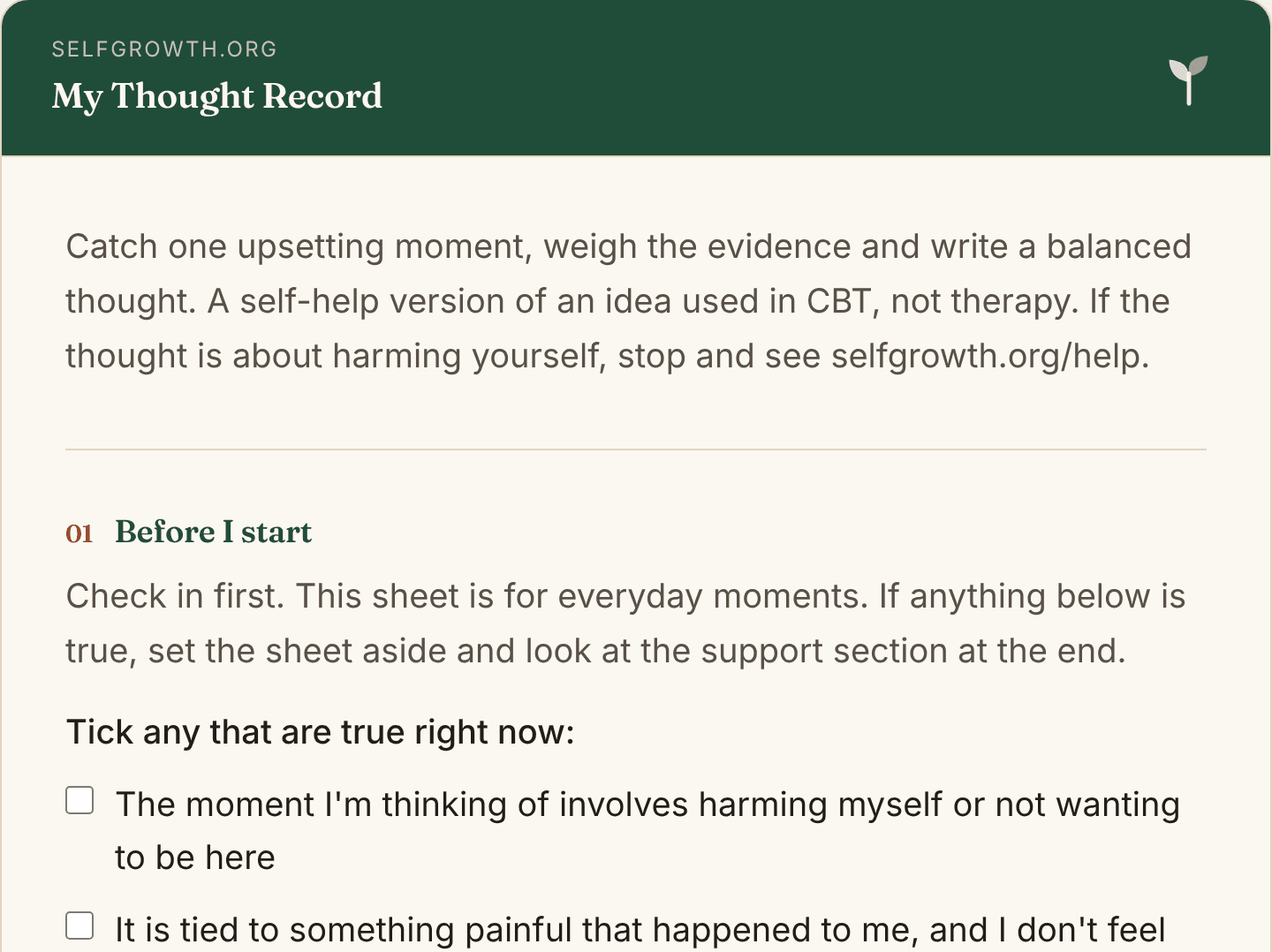
Thought Record Worksheet
Free thought record worksheet: note the situation, feeling and thought, weigh the evidence and write a balanced thought. Self-help, not therapy. Free PDF.
Open worksheet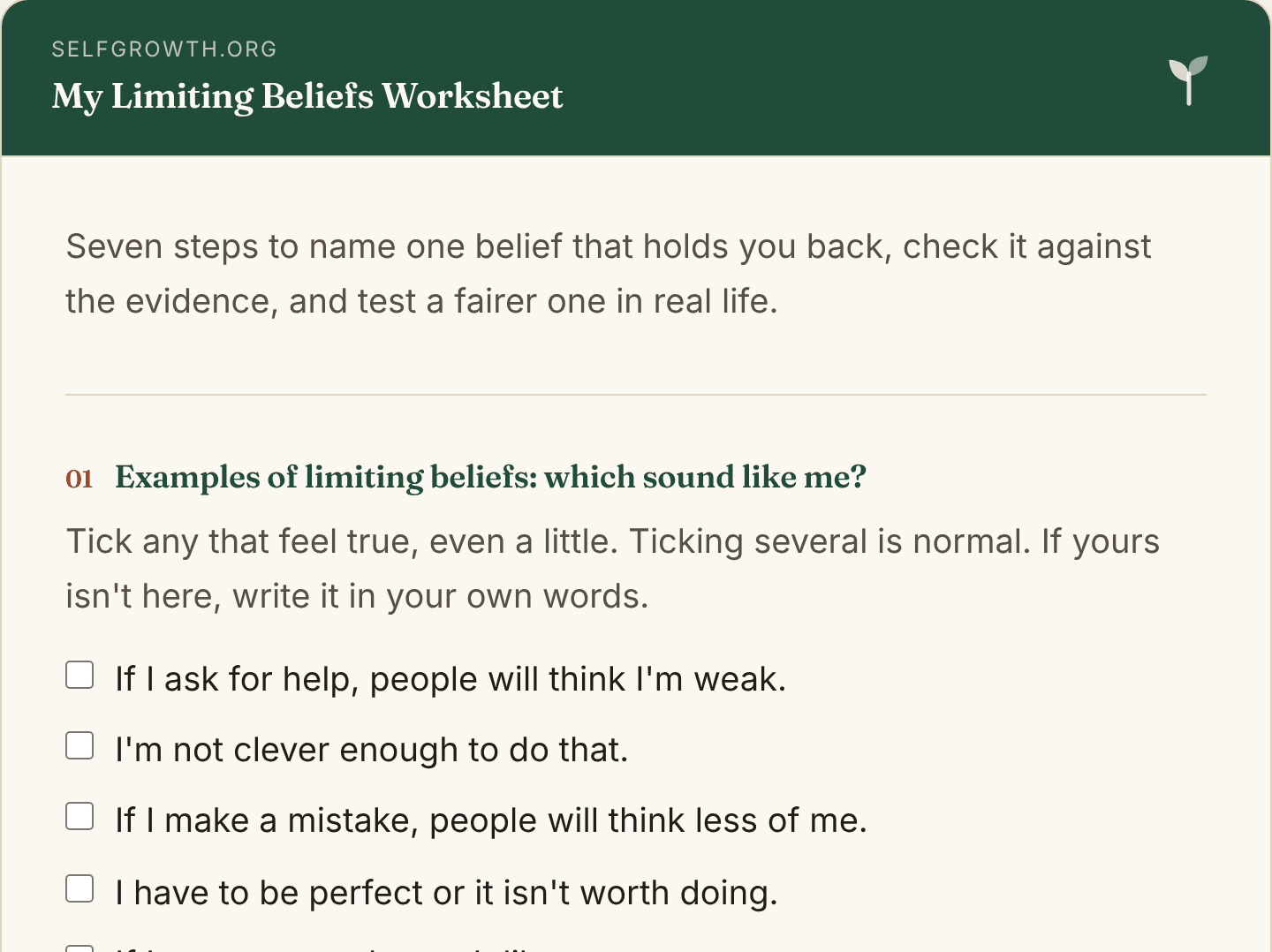
Limiting Beliefs Worksheet
A free, printable limiting beliefs worksheet: 12 examples of limiting beliefs, where yours came from, evidence for and against, a fairer belief and a real test.
Open worksheet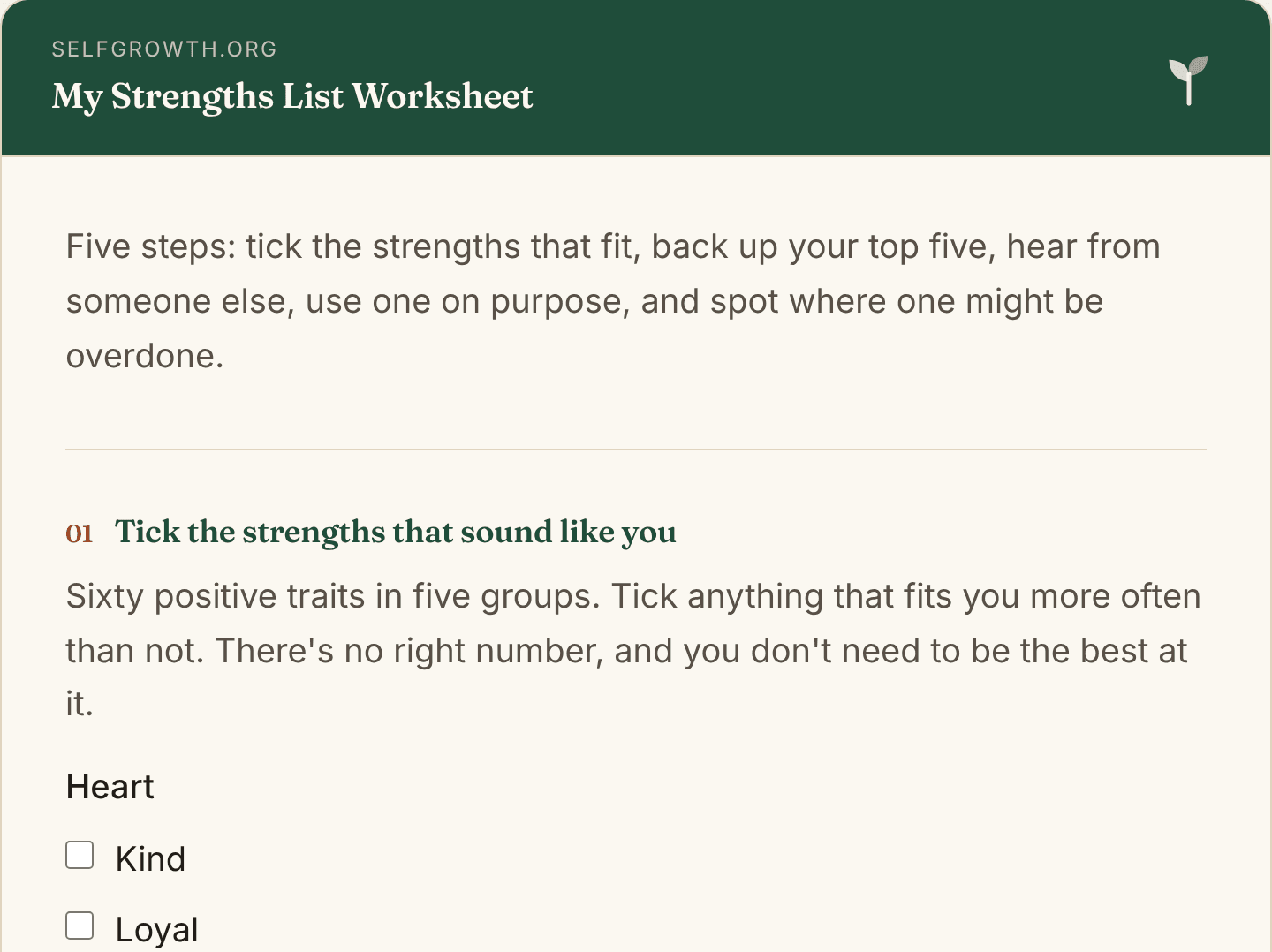
Strengths List Worksheet
A free list of 60 positive character traits and strengths to tick, with space for evidence, what others see in you and one strength to use on purpose this week.
Open worksheetNew worksheets, straight to your inbox
An occasional new worksheet or tool, sent only when there's something genuinely worth your time. No spam, no pressure, unsubscribe any time.