
Relaxation
Loving-kindness meditation script: a free, printable metta practice
Updated 23 October 2026 · 8 min read · Free to print
Loving-kindness (metta) meditation means silently repeating kind wishes, such as 'may you be well', first for yourself, then for someone you love, a neutral person, someone difficult if you choose, and finally everyone. This free script takes about ten minutes, with phrases you can change and a short before-and-after note.
Drawn from the Buddhist practice of metta · Part of feelings and calm
Fill it in here (it saves in this browser, but not in a private window), print it, or download the PDF. Free, no sign-up.
It's easy to notice what's wrong faster than to wish ourselves or anyone else well. Loving-kindness meditation is a way of practising the second thing. You sit quietly and repeat a few short, kind wishes, silently, one person at a time. You are not trying to feel a particular way. You are saying the words and noticing what happens.
It starts with you, then widens: someone you love, someone you hardly know, someone you find hard if you want to, and then everyone. You can read the script slowly from the page, or record yourself reading it and play it back. The phrases are yours to change. If a line sounds false, swap it for words you could say and mean.
It is a self-guided practice, not therapy, and it isn't a treatment for anxiety, depression or trauma. Some days the words will feel warm. Some days they will feel flat or awkward. Both are normal, and both count as practising.
How to use this worksheet
- 1Find ten minutes where you won't be interrupted. Sit comfortably or lie down. Close your eyes or rest your gaze on one spot.
- 2Read one stage, then pause and repeat the phrases silently, slowly, with a breath between each. Let the words land, without forcing a feeling.
- 3Change any phrase that doesn't ring true. 'May I be safe' can become 'May I get through today'. Use words you could say to a friend.
- 4Skip any stage that feels like too much, including the whole 'someone difficult' stage. Missing it out is a sensible choice, not a failure. Pick someone mildly annoying rather than someone who hurt you badly, if you try it at all.
- 5If the practice stirs up painful feelings, stop. Open your eyes, look around the room and feel your feet on the floor. Come back another day, or not at all.
The worksheet
selfgrowth.org
My Loving-Kindness Meditation Script
Five stages, a place to adapt the phrases, and a short note before and after. Read slowly, with a breath between each line. If it stirs up painful feelings, stop and ground yourself.
01Before you start
Settle in. Take three slow breaths, a little longer on the way out than the way in. Rest one hand on your chest or your lap, if that feels okay. Notice how you feel right now, without trying to change it.
How warm or kind do I feel towards myself right now?
In a few words, how am I feeling today?
02My phrases
Write three or four short wishes you could say to yourself and to others, in your own words. Common starting points are 'May you be safe', 'May you be well', 'May you be at ease' and 'May you be happy'. Keep them simple. You will use the same ones through every stage, changing 'I' or 'you' as you go.
My wishes
For example: May I be safe. May I be well. May I be at ease. May I be kind to myself.
- 1.
- 2.
- 3.
- 4.
03Stage 1: yourself
Bring yourself to mind. You can picture your face, or yourself sitting here, or just say your own name silently. Repeat your phrases slowly, with a breath between each: 'May I be safe. May I be well. May I be at ease.' Let each line land before the next. If you notice a sceptical or critical voice, you needn't argue with it. Say the words again, gently. If saying these to yourself feels uncomfortable or false, that is worth noticing, and you can move straight on to Stage 2 and come back to this one later.
What did I notice while wishing myself well?
04Stage 2: someone you love
Bring to mind someone you care about and who is easy to care about: a friend, a child, a pet, a grandparent. Picture them, or recall a moment when they made you smile. Repeat the phrases for them: 'May you be safe. May you be well. May you be at ease.' Take your time. Notice any warmth, or any other feeling that arrives, and let it be there.
Who did I choose, and what did I notice?
05Stage 3: a neutral person
Now think of someone you neither like nor dislike: a person you see at the shop, on your commute or in your street, whose name you may not even know. They have a life as full as yours, with worries and hopes you know nothing about. Repeat the phrases for them: 'May you be safe. May you be well. May you be at ease.' It may feel strange to wish well to someone you barely know. That is part of the practice.
Who did I choose, and what did I notice?
06Stage 4: someone difficult (optional)
This stage is optional, and skipping it is fine. Skip it if it's too much. If you want to try, choose someone who is mildly difficult for you, such as a colleague who irritates you. Do not choose someone who has abused or seriously hurt you. You are not saying that what they did was okay, and you are not obliged to forgive anyone. You are only offering the same short wishes: 'May you be safe. May you be well. May you be at ease.' If it brings up anger, fear or distress, stop, open your eyes and come back to the room. Go straight to Stage 5 or end the session.
For this stage I:
Anything I noticed, if I tried it:
07Stage 5: everyone
Let your attention widen: the people in your home, your street, your town, then everyone, everywhere, and all living things. Repeat the phrases, changing them to fit: 'May all beings be safe. May all beings be well. May all beings be at ease.' Stay with that for a few breaths. If you like, finish by coming back to yourself and repeating the first wishes once more. Then open your eyes slowly and take your time before you get up.
What did I notice as I widened out?
08Afterwards
There is no right result. If it felt flat or awkward, that tells you something too.
How warm or kind do I feel towards myself now?
What came up? (tick any)
Notes: which stage was easiest, which was hardest, and anything I'd change in my phrases:
When you're done, a moment to reflect
- Which stage came most easily, and which was hardest? What might that say about where you are right now?
- How did it feel to wish yourself well, compared with wishing someone else well?
- Whose face stayed with you after you finished?
- Which of your phrases felt true, and which sounded false? What would you say instead?
- If something painful came up, what would help you look after yourself tonight?
Done for now?
Save today's answers as a dated entry. You can come back, fill it in again and compare the two side by side.
Does loving-kindness meditation actually work?
Loving-kindness meditation comes from Buddhism. The Pali word is metta, usually translated as loving-kindness or friendliness, and it is one of four qualities cultivated in an old Buddhist tradition. A short text called the Metta Sutta is the best-known teaching on it. The traditional practice starts with yourself and then widens to loved ones, strangers, people you find difficult, and all beings. In the West it was popularised by teachers such as Sharon Salzberg, whose book Lovingkindness: The Revolutionary Art of Happiness was published in 1995.
On the evidence: in a 2008 field experiment, Barbara Fredrickson and colleagues randomly assigned 139 working adults to begin loving-kindness meditation or not. The meditation group reported more positive emotions day to day, and those gains were linked with later increases in personal resources such as purpose in life and social support, and with higher life satisfaction and fewer depressive symptoms. A 2011 review by Stefan Hofmann, Paul Grossman and Devon Hinton found loving-kindness and compassion practice associated with more positive and less negative feeling, but called several of the findings preliminary.
The limits are real. The evidence is limited, and a printout is not the same as a supported programme. The research does not show that reading this script will change how you feel. The five stages and the ten-minute length here are a plain, self-guided version of the tradition, not any teacher's own text. It's a tool you can try, not a treatment.
These are educational self-reflection tools, not therapy.
If you want to go deeper
- Fredrickson, B. L., Cohn, M. A., Coffey, K. A., Pek, J. & Finkel, S. M. (2008). Open hearts build lives: Positive emotions, induced through loving-kindness meditation, build consequential personal resources. Journal of Personality and Social Psychology, 95(5), 1045-1062.
- Hofmann, S. G., Grossman, P. & Hinton, D. E. (2011). Loving-kindness and compassion meditation: Potential for psychological interventions. Clinical Psychology Review, 31(7), 1126-1132.
- Salzberg, S. (1995). Lovingkindness: The Revolutionary Art of Happiness. Shambhala.
Your questions, answered
- What is loving-kindness meditation?
- It's a practice where you silently repeat kind wishes, such as 'may you be safe, may you be well', for yourself and then for other people. It comes from the Buddhist tradition, where it is called metta, a Pali word usually translated as loving-kindness or friendliness. In the traditional order you start with yourself, then people you love, then strangers and difficult people, then all beings.
- How do you do a loving-kindness meditation?
- Sit comfortably and close your eyes. Silently repeat your wishes for yourself, slowly, then for someone you love, a neutral person, someone difficult if you choose, and finally everyone. Leave a breath between lines and don't force any feeling. This script gives you the five stages in order, with space to change the phrases.
- Does loving-kindness meditation work?
- Some research is encouraging, but it is modest. In a 2008 experiment (Fredrickson and colleagues), 139 working adults were randomly assigned to start loving-kindness meditation or not. The practice raised daily positive emotions over time, and those gains were linked with later increases in things like purpose in life and life satisfaction. A 2011 review (Hofmann, Grossman and Hinton) found loving-kindness practice associated with more positive and less negative feeling, but described many findings as preliminary. It's a gentle practice, not a proven treatment.
- What if I can't feel anything, or the words feel false?
- That happens, and it doesn't mean you're doing it wrong. The practice is saying the words and noticing what comes up, not producing a feeling. Try changing the phrases to something you could say and mean, like 'may I get through today'. Or start with someone easy to care about, such as a pet or a child, and come back to yourself later.
- What if it brings up painful feelings?
- Stop. Open your eyes, look around the room and name what you can see, and feel your feet on the floor. The grounding techniques guide and the 5-4-3-2-1 grounding worksheet on this site can help. Being kind to yourself can feel hard or even frightening after trauma or a lot of criticism, and you can skip the stage or the whole practice. If it keeps happening, talk to a GP or a qualified professional, or see the help page for support lines.
- Is there a loving-kindness meditation script PDF?
- Yes. Use the Download PDF button for a clean, print-ready copy with the full script, or Print to print straight from the page. It's free, with no payment and no email needed. You can also fill it in on screen, and your answers save in your browser.
- Is this a substitute for therapy?
- No. It's an educational self-help exercise, not therapy or medical advice. If you're struggling with low mood, anxiety, grief or memories of trauma, please talk to a GP or a qualified mental health professional. If you're in crisis, contact a helpline: Samaritans on 116 123 (UK and Ireland), 988 (US), or find one near you at findahelpline.com.
Keep going, related worksheets
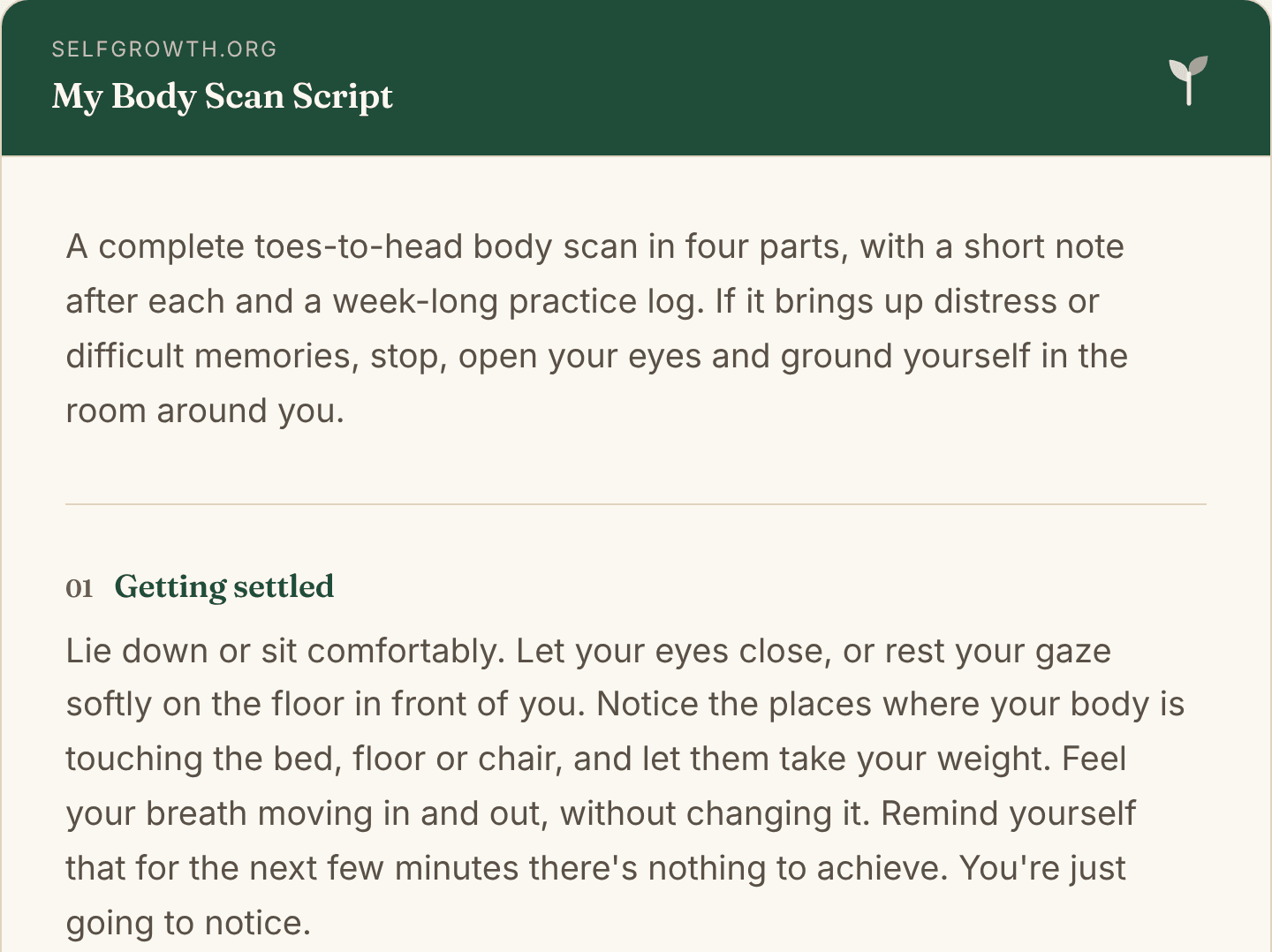
Body Scan Script
A free body scan meditation script in plain English: move your attention slowly from toes to head, noticing without changing, with reflection prompts and a log.
Open worksheet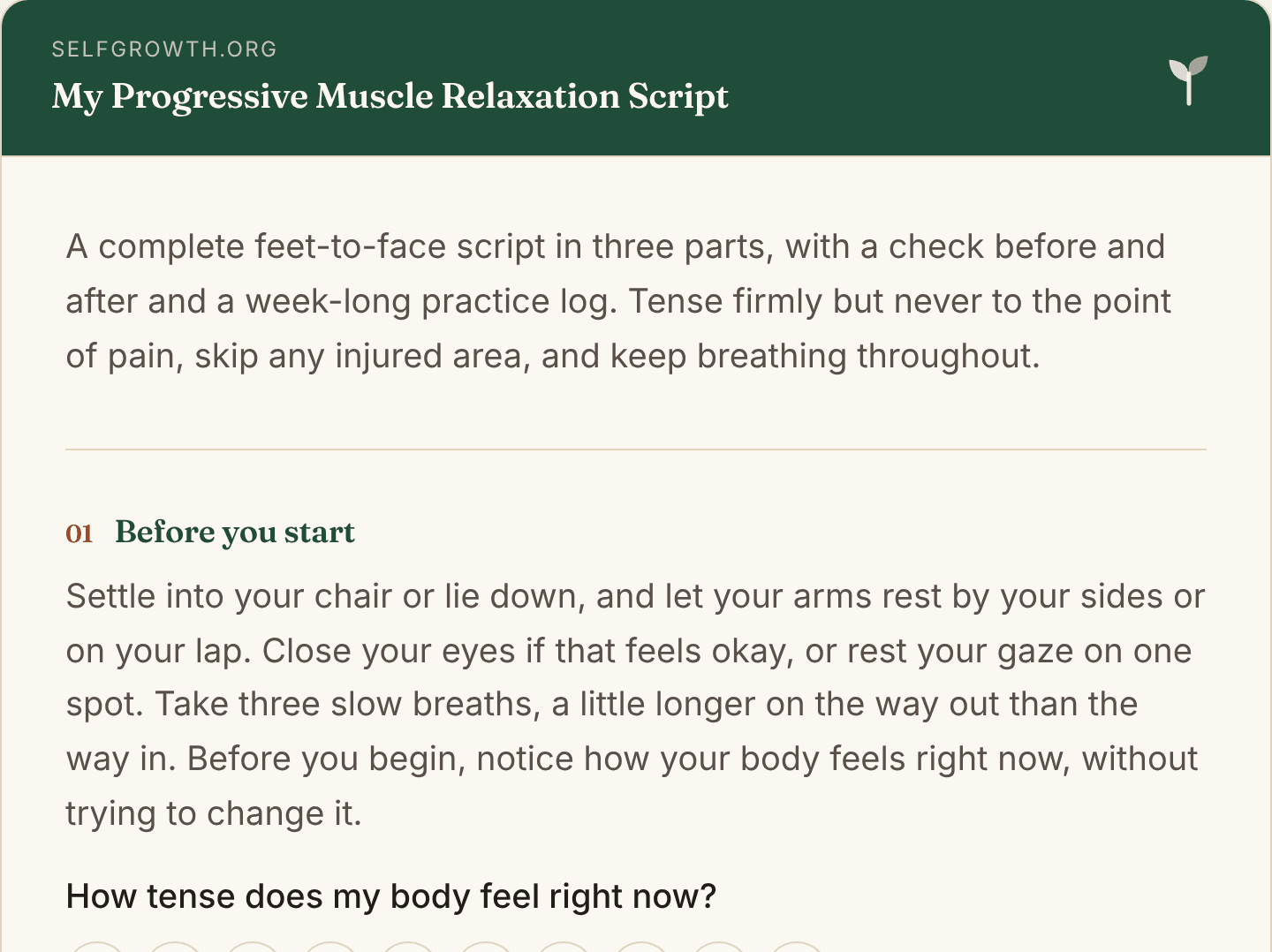
Progressive Muscle Relaxation Script
A free progressive muscle relaxation script in plain English: tense and release 13 muscle groups from feet to face, with a before-and-after check and 7-day log.
Open worksheet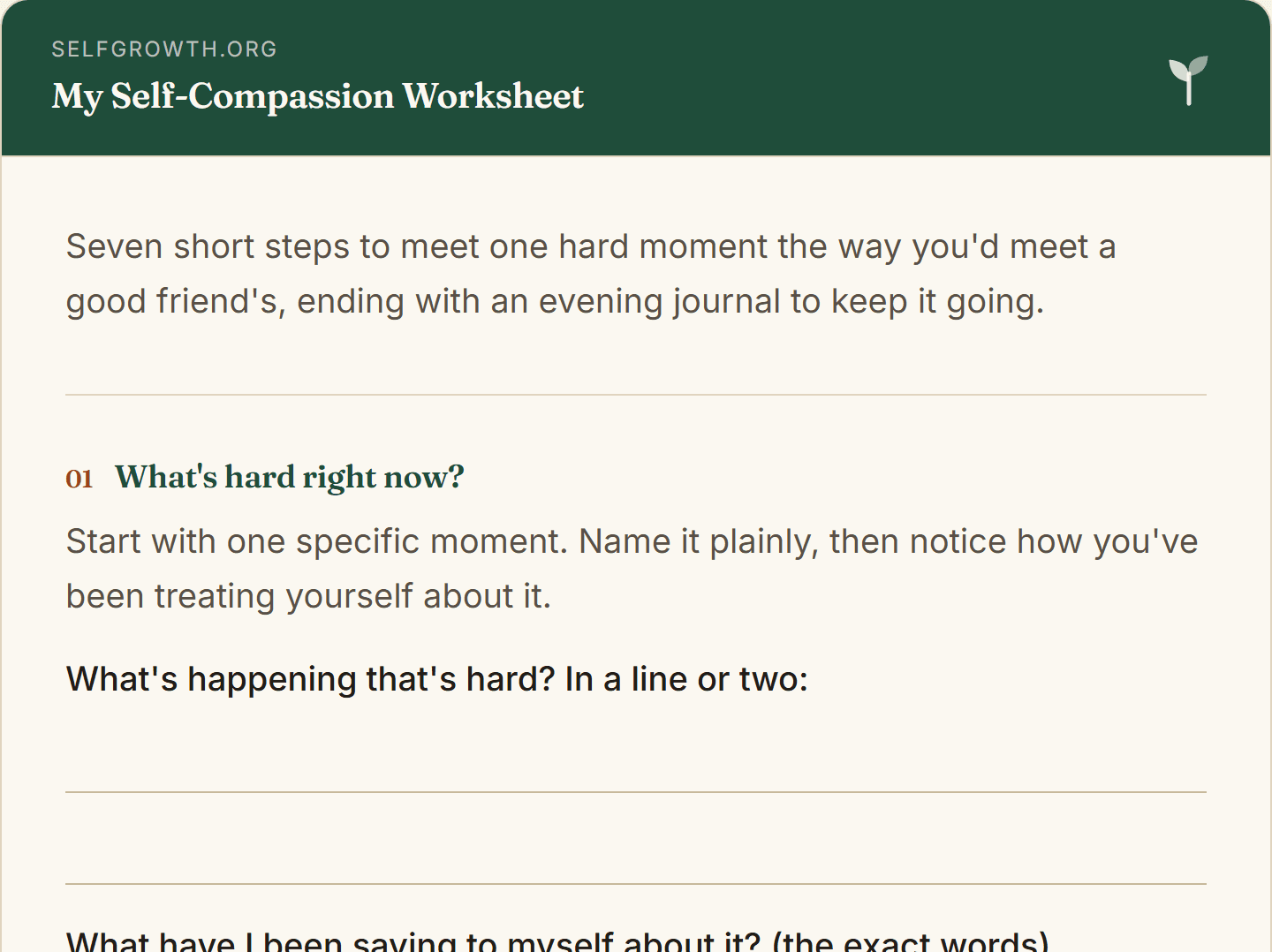
Self-Compassion Worksheet
A free, printable self-compassion worksheet: the self-compassion break, the friend test, a kind letter and journal prompts, based on Kristin Neff's research.
Open worksheetNew worksheets, straight to your inbox
An occasional new worksheet or tool, sent only when there's something genuinely worth your time. No spam, no pressure, unsubscribe any time.