
Guide
Self-worth vs self-esteem: what's the difference?
Updated June 25, 2026 · 8 min read
Self-worth is the belief that you matter as a person, no matter what you achieve. Self-esteem is your overall rating of yourself, which tends to rise and fall with how well things are going. Self-worth is the steadier foundation, self-esteem is the weather on top of it. When self-worth is low, working only on confidence rarely sticks.
By the Self Growth team · drawn from cognitive behavioural therapy and self-compassion research · how we make these
People use "self-worth" and "self-esteem" as if they mean the same thing, and most of the time it doesn't matter. But when you're trying to feel better about yourself and nothing seems to work, the difference is exactly the thing that's been missing.
Here's the short version: self-worth is whether you believe you matter at all. Self-esteem is how well you think you're doing. You can be doing fine on paper, confident even, and still feel, underneath, that you'd have no value if you stopped achieving. That gap is the clue.
Self-worth: the foundation
Self-worth is the steadier foundation. Self-esteem is the weather on top of it.
Self-worth is the deep, quiet belief that you have value simply as a person, the same way you'd say a stranger or a child has value without them having to earn it. It doesn't depend on your job, your looks, your productivity, or whether you're useful to anyone today.
When self-worth is healthy, a bad day is just a bad day. When it's low, every setback feels like evidence of something fundamental: that you're not enough, that you have to keep proving your right to take up space. That's why people with low self-worth often look successful and driven, and feel hollow doing it.
Signs of low self-worth
Low self-worth tends to hide behind coping rather than show itself plainly. It often sounds like:
- Feeling you have to earn the right to rest, to ask for things, or simply to take up space.
- Tying your whole value to one thing, your job, your usefulness, your looks, your role as a parent, so a wobble there feels like a wobble in who you are.
- Struggling to believe people could want you around for you, rather than for what you do for them.
- A quiet hollowness that achievements fill for a day and then drains away.
- Over-giving, people-pleasing, or staying in things that diminish you because some part of you isn't sure you deserve better.
Psychologists Jennifer Crocker and Connie Wolfe describe this as basing your worth on conditions: when self-worth is contingent on meeting a standard, it stays fragile, because the standard can always slip. Steady self-worth is the kind that doesn't have to be re-earned every day.
Self-esteem: the weather on top
Self-esteem is your running self-evaluation, the score you give yourself. It naturally moves with circumstances: it lifts when you do well, dips when you fail or get rejected. That's normal. Some movement is healthy.
The trouble starts when self-esteem is the only thing holding you up, with no steady self-worth underneath. Then your sense of yourself is at the mercy of your last result, the last comment, the last comparison. You're only ever as okay as your most recent win, which is an exhausting way to live.
Self-esteem, the weather on top
Your running rating of yourself. It lifts and dips with how things are going.
Self-worth, the foundation
The steady belief that you matter as a person, whatever you achieve. Everything above rests on it.
Why it matters which one is low
If you treat a self-worth problem as a confidence problem, you end up chasing the wrong fix. You collect achievements, hoping they'll finally make you feel like enough, and they never quite do, because the achievements were never the issue.
- Low self-confidence sounds like: "I can't do this." The fix is practice and evidence.
- Low self-esteem sounds like: "I'm not doing well enough." The fix is fairer self-talk and steadier standards.
- Low self-worth sounds like: "I don't matter" or "I have to earn the right to be here." The fix goes deeper, to the belief itself.
Listen to the sentence in your head when you feel low. The wording tells you which layer to work on.
Where to start with each
If you've spotted that the deeper belief, "do I matter at all", is the shaky one, start with the self-worth worksheet. It works on the foundation rather than the surface.
Open the Self-Worth WorksheetIf it's more that your day-to-day rating of yourself is harsh and your inner critic runs the show, the self-esteem worksheet is built for that.
Open the Self-Esteem WorksheetMost people find they need a bit of both, and that's fine. The point isn't to diagnose yourself perfectly, it's to stop pouring effort into the wrong layer.
When to get more support
Deeply low self-worth, the kind that's been there as long as you can remember, often has roots that self-help can reach the edges of but not always the bottom of. If it comes with lasting low mood, anxiety, or a pattern of relationships that leave you feeling smaller, it's worth bringing in a therapist alongside this work.
A GP can point you to talking therapies, and approaches like CBT and compassion-focused therapy are built for exactly this. These guides and worksheets are educational self-reflection tools, not therapy. You deserve real support, not just a worksheet, especially when the belief runs deep.
How we put this together
This guide is written in plain language from established, evidence-based ideas, not personal opinion. It's an educational self-reflection resource, not therapy or medical advice, see our editorial standards.
If you want to go deeper
- Kristin Neff — Self-Compassion: The Proven Power of Being Kind to Yourself (2011).
- Melanie Fennell — Overcoming Low Self-Esteem, a CBT-based self-help guide.
- Crocker, J. & Wolfe, C. T. (2001). Contingencies of self-worth. Psychological Review.
Questions people ask
- Is self-worth the same as self-esteem?
- No. Self-worth is the belief that you have value as a person regardless of achievement. Self-esteem is your overall rating of yourself, which rises and falls with how well things are going. Self-worth is the steadier foundation underneath self-esteem.
- What are the signs of low self-worth?
- Signs include feeling you have to earn the right to rest or take up space, tying your whole value to one thing like your job or usefulness, struggling to believe people want you around for you, a hollowness that achievements only fill briefly, and over-giving or staying in things that diminish you.
- What causes low self-worth?
- It usually forms early, from messages that your value depended on being good, useful, high-achieving or low-maintenance, rather than being unconditional. Psychologists call this contingent self-worth: when worth is based on meeting conditions, it stays fragile, because the conditions can always slip.
- Can you have high self-esteem but low self-worth?
- Yes, and it's common. People can feel confident and capable, and still believe deep down that their value depends entirely on staying successful. That often shows up as relentless drive paired with a hollow, never-enough feeling.
- Which should I work on first?
- Listen to what you say to yourself when you feel low. "I can't do this" points to confidence. "I'm not good enough" points to self-esteem. "I don't matter" or "I have to earn my place" points to self-worth, which is the deepest and usually the most important to address.
Worksheets to do the work
Free to fill in online or print. No email needed.
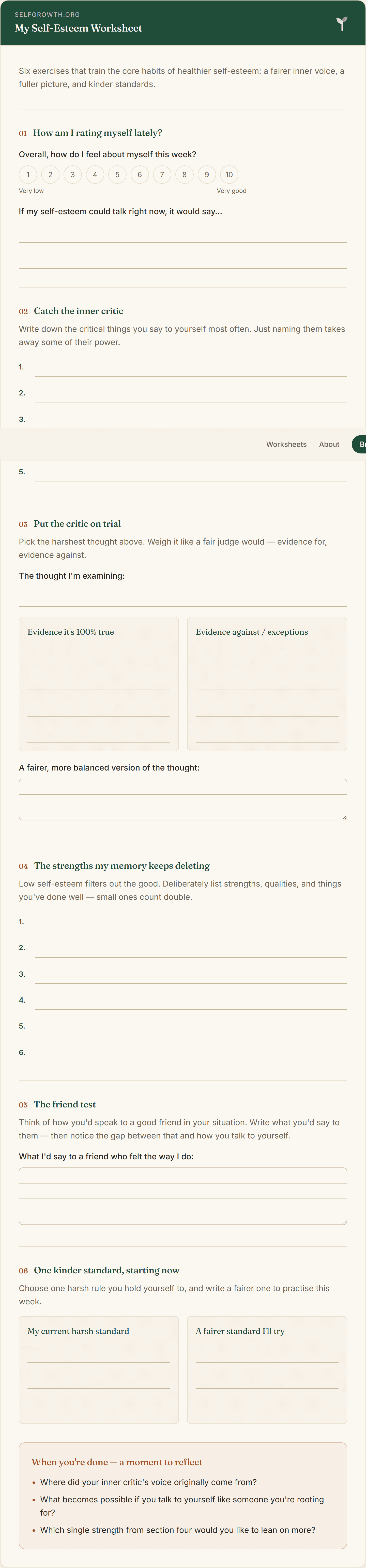
Self-Esteem Worksheet
Free, printable self-esteem worksheets with guided exercises to challenge your inner critic, recognise your strengths, and build steadier, healthier self-esteem.
Open worksheet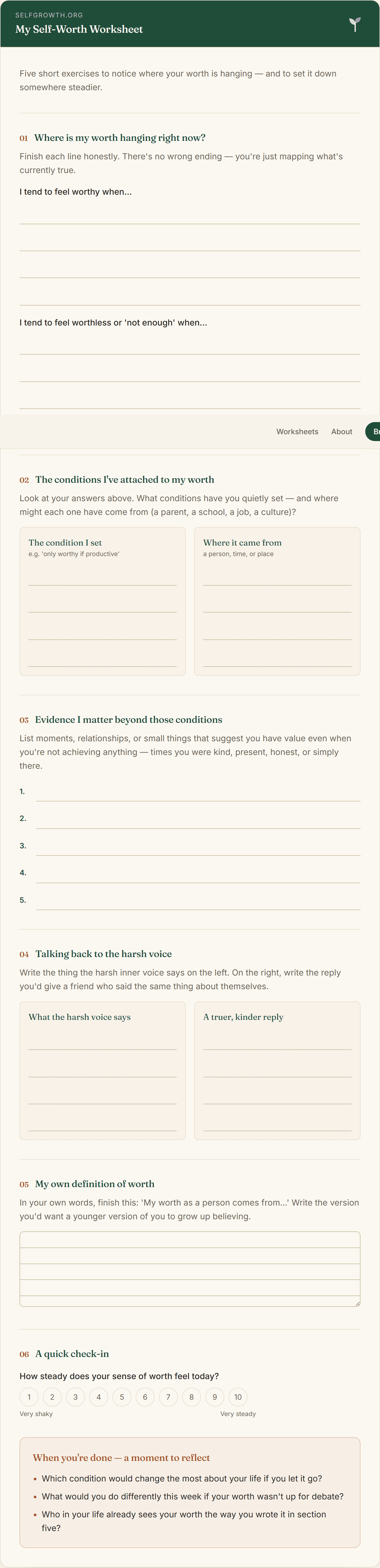
Self-Worth Worksheet
A free, printable self-worth worksheet with five short exercises to separate your value from your achievements and rebuild a steadier sense of worth.
Open worksheetNew worksheets, straight to your inbox
An occasional new worksheet or tool, sent only when there's something genuinely worth your time. No spam, no pressure, unsubscribe any time.