
Anger
Anger management worksheet: a free printable plan for adults
Updated 11 October 2026 · 7 min read · Free to print
An anger management worksheet helps you understand your anger and plan what to do before it boils over. This free printable one walks you through your triggers, your early warning signs on a 1 to 10 anger thermometer, a time-out plan, the calming skills that work for you, and how to say what you need afterwards.
By the Self Growth team · drawn from cognitive behavioural anger management · how we make these
Fill it in here (it saves in this browser, but not in a private window), print it, or download the PDF. Free, no sign-up.
Anger itself isn't the problem. It's a normal feeling, and sometimes it's telling you something important: that something is unfair, or that a line has been crossed. The trouble starts when it goes from nought to sixty before you've had a chance to think, and you say or do something you wish you hadn't.
The good news is that anger rarely comes from nowhere. It builds, and your body and thoughts give you signals as it does: a hot face, a clenched jaw, a voice in your head saying 'they always do this'. If you learn your own signals, you can catch the anger lower down, while you still have choices.
This worksheet helps you make a plan for that. You'll map your triggers and your early warning signs on an anger thermometer, decide what you'll do at each level, plan a time-out, pick the calming skills that suit you, and work out how to say what you need once you've cooled down. A week's review at the end shows you what's working.
If your anger has led to hitting, threatening, frightening or controlling a partner or family member, this worksheet isn't enough on its own. In the UK, the Respect Phoneline (0808 8024040) is free and confidential for people worried about their own behaviour. If someone is hurting you, your anger makes sense, and it isn't yours to manage away: call a domestic abuse service (UK 0808 2000 247, US 1-800-799-7233).
How to use this worksheet
- 1Fill in the first five sections on a calm day, not in the middle of a row. Plans made at the boil rarely work.
- 2Use your own signs and words. The examples are only there to get you started.
- 3Keep the thermometer and time-out plan somewhere you'll see them, like your phone or the fridge.
- 4Use the review for a week. Notice what helped, and change the plan if something doesn't fit.
The worksheet
selfgrowth.org
My Anger Management Worksheet
Six steps to a plan you can actually use when anger starts to build. If your anger has led to hitting, threatening or controlling someone, also talk to the Respect Phoneline (UK 0808 8024040). If someone is hurting you, call a domestic abuse service (UK 0808 2000 247, US 1-800-799-7233).
01My triggers
A trigger is whatever tends to set your anger off. Tick the ones you recognise, then write your own, along with why they get to you.
Entry 1
Entry 2
Entry 3
02My anger thermometer
Picture a scale from 1 (completely calm) to 10 (an explosive loss of control you regret). Your warning signs change as you go up. Notice them in your body (a racing heart, a hot face, a clenched jaw), your thoughts ('how dare they', replaying it) and what you start to do (pacing, raising your voice). For each level, write your own signs and what you'll do there.
Entry 1
Entry 2
Entry 3
Entry 4
The number where I stop thinking clearly, so I need to take a time-out before it:
03My time-out plan
A time-out means stepping away before you reach the top of your thermometer, then coming back. It isn't the silent treatment and it isn't walking out for good. If you can, agree it in advance with the people you live or work with, so they know you'll return. If leaving the room isn't enough to keep everyone safe, that's a sign to get help (see the note at the top).
What I'll say to call a time-out:
e.g. 'I'm getting too angry to talk well. I'm going to take 20 minutes, then I'll come back.'
Where I'll go:
What I'll do while I'm away (something calming, not going over it in my head):
When I'll come back, and how I'll pick things up or agree to talk later:
Who I'll agree this plan with in advance:
04Calming skills that work for me
Pick skills that slow your body down. Research suggests calming activities help with anger more than ones that rev you up, so hitting a pillow or 'letting it all out' isn't on this list. Tick the ones you'll try, then choose your top three.
My top three:
- 1.
- 2.
- 3.
05An assertive way to say it afterwards
Once you've calmed down, the thing that made you angry may still need saying. Saying it assertively means being clear and honest about what you feel and need, without attacking or blaming. An I-statement keeps it about you rather than them.
What happened (just the facts, no 'you always'):
I felt …
because …
What I'd like, or what I need, is …
Put together, in my own words:
06Review my week
Each time anger shows up this week, add a line. At the end of the week, look for patterns, not proof that you've failed.
Entry 1
Entry 2
Entry 3
Entry 4
Entry 5
What I'll keep doing, and what I'll change in my plan:
When you're done, a moment to reflect
- Which warning sign usually comes first for you, and how early could you catch it?
- What's often underneath your anger: hurt, worry, tiredness, feeling ignored?
- Who do you want to be when you're angry? What would that person do at a 5?
- Which relationship would feel different if your time-out plan worked?
Does anger management actually work?
The steps on this sheet come from cognitive behavioural anger management. The NHS says anger management programmes usually include CBT (cognitive behavioural therapy). The structure follows a free workbook published by SAMHSA (the US government's mental health and substance use agency), written by Patrick Reilly and colleagues. It uses a 1 to 10 'anger meter', asks you to notice physical, behavioural, emotional and thought cues, and calls the time-out 'a basic anger management strategy that should be in everyone's anger control plan'. The anger thermometer and time-out plan here are our plain-English versions of those tools.
The evidence for this kind of approach is broadly encouraging. A 2009 meta-analysis (a study that pools many studies) by Michael Saini, covering 96 studies of several kinds of psychological treatment, found they were generally effective, though results varied a lot. And a 2018 review led by Fernandez found that nearly all recent CBT studies reported good results, but warned the picture may need a closer look, because few studies checked whether people were answering to look good.
The calming-skills step is shaped by a 2024 meta-analysis by Sophie Kjærvik and Brad Bushman, which pooled 154 studies. Activities that calm the body, like deep breathing and meditation, reduced anger and aggression. Activities that rev you up, like hitting a bag or going for a run, didn't help overall. That's why venting isn't on the list. The assertive-words step uses I-statements, a simple way of saying what you feel and need without blame. All of it is self-help, not a substitute for a course or a therapist.
These are educational self-reflection tools, not therapy. See our editorial standards.
If you want to go deeper
- Reilly, P. M., Shopshire, M. S., Durazzo, T. C. & Campbell, T. A. (2019). Anger Management for Substance Use Disorder and Mental Health Clients: Participant Workbook. SAMHSA Publication No. PEP19-02-01-002.
- Saini, M. (2009). A meta-analysis of the psychological treatment of anger: Developing guidelines for evidence-based practice. Journal of the American Academy of Psychiatry and the Law, 37(4), 473-488.
- Fernandez, E., Malvaso, C., Day, A. & Guharajan, D. (2018). 21st century cognitive behavioural therapy for anger: A systematic review of research design, methodology and outcome. Behavioural and Cognitive Psychotherapy, 46(4), 385-404.
- Kjærvik, S. L. & Bushman, B. J. (2024). A meta-analytic review of anger management activities that increase or decrease arousal: What fuels or douses rage? Clinical Psychology Review, 109, 102414.
- NHS (n.d.). Get help with anger. nhs.uk.
Your questions, answered
- What is an anger management worksheet?
- It's a guided page that helps you understand your anger and plan what to do about it. This one walks you through your triggers, your warning signs on an anger thermometer, a time-out plan, calming skills, an assertive way to say what you need afterwards and a week's review. It's written for adults, to fill in on your own.
- How can I control my anger in the moment?
- Pause before you react. Count to 10, breathe slowly with a longer out-breath, and unclench your jaw and hands. If you're climbing fast, take a time-out: say you need a break, step away somewhere calm and come back when you've settled. Calming your body down works better than 'letting it out', which tends to feed anger rather than release it. Once you're calm, say what you need with an I-statement.
- What is an anger thermometer?
- It's a 1 to 10 scale for how angry you are, where 1 is completely calm and 10 is an explosive loss of control. You write your own warning signs at each level, in your body, your thoughts and what you start to do, plus what you'll do there. It helps you notice anger rising early and act before you reach the top. Section 2 of this worksheet is an anger thermometer.
- What are some anger coping skills?
- Calming skills such as slow breathing, counting to 10, relaxing your muscles, cold water on your hands, a slow walk or a grounding exercise. Longer-term skills include knowing your triggers, getting enough sleep and food, talking to someone outside the situation and learning to say what you need assertively. Section 4 has a checklist so you can pick the ones that suit you.
- What causes anger problems, and what are the signs?
- Anger is often set off by feeling treated unfairly, criticised, ignored or blocked, and stress, tiredness, pain, alcohol and drugs can all lower your fuse. Past experiences can shape it too. Signs it's becoming a problem include getting angry often or fast, shouting, breaking things, frightening people, often regretting what you've said, or turning it on yourself. The NHS suggests seeing a GP if anger is hard to cope with or you're acting in an abusive or violent way.
- Does anger management actually work?
- The research is broadly encouraging. Meta-analyses (studies that pool many studies) have found that talking treatments for anger, including CBT (cognitive behavioural therapy), generally help. Some reviewers warn the picture may be a little rosier than it really is, because few studies check whether people are answering to look good. A worksheet like this borrows some of the same tools, but it isn't a substitute for a course or a therapist.
- Is this anger management worksheet free, and is there a PDF?
- Yes. It's free, with no payment and no email needed. Use the Download PDF button for a print-ready copy, or fill it in on screen and your answers save in your browser.
- Is this worksheet a substitute for therapy?
- No. It's a self-help tool, not therapy or medical advice. See a GP if anger is hard to cope with, if self-help isn't working, or if you're acting in an abusive or violent way. A GP can refer you to an anger management course or counselling. If you're worried about your behaviour towards a partner or family member, call the Respect Phoneline on 0808 8024040 (UK). If someone is hurting you, call 0808 2000 247 (UK) or 1-800-799-7233 (US). If you ever think about harming yourself, call Samaritans on 116 123 (UK), call or text 988 (US), or find a helpline at findahelpline.com.
Keep going, related worksheets
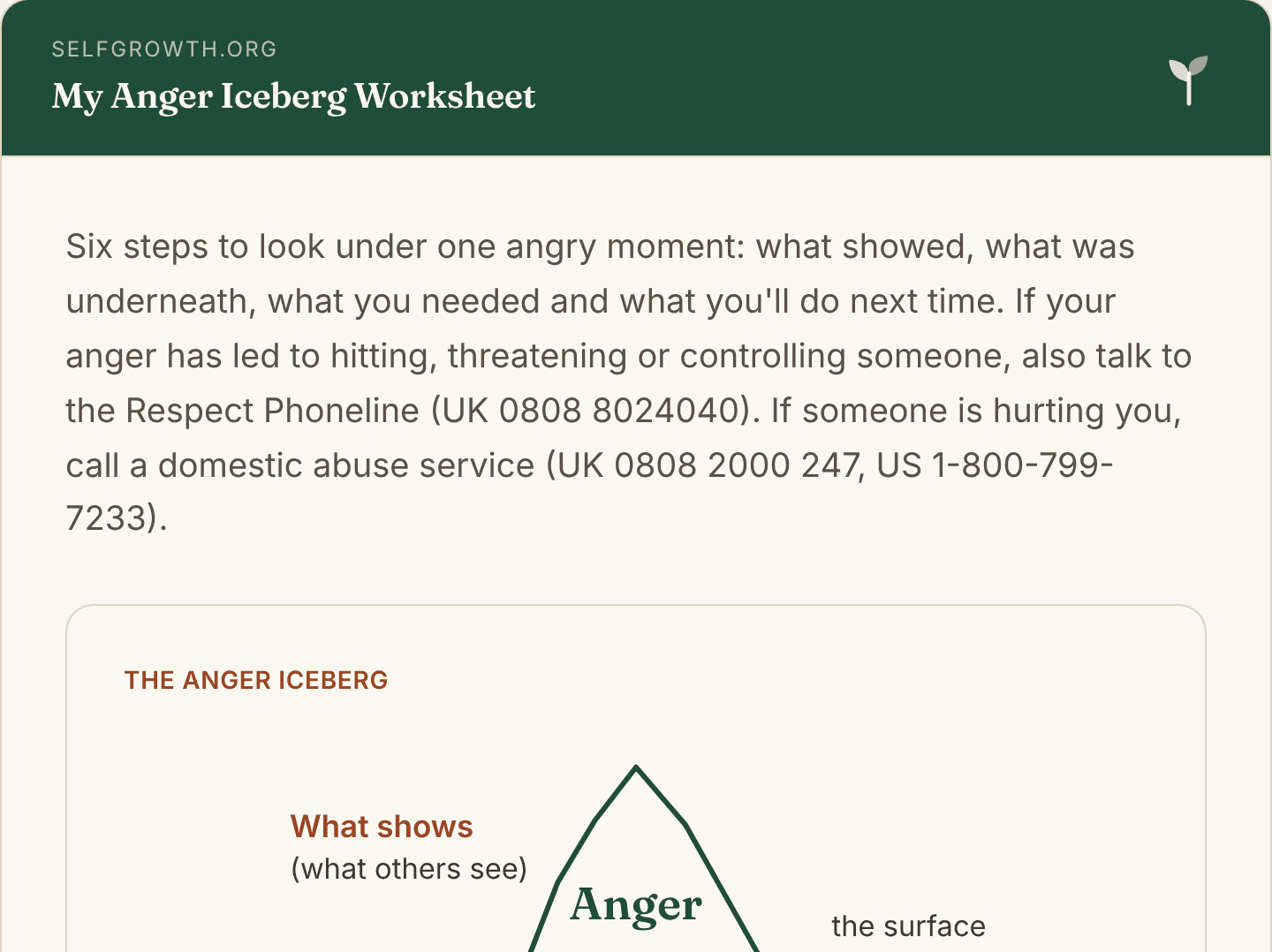
Anger Iceberg Worksheet
A free anger iceberg worksheet and PDF: see what showed on the surface, find the hurt, fear or shame underneath, name what you needed and plan a repair.
Open worksheet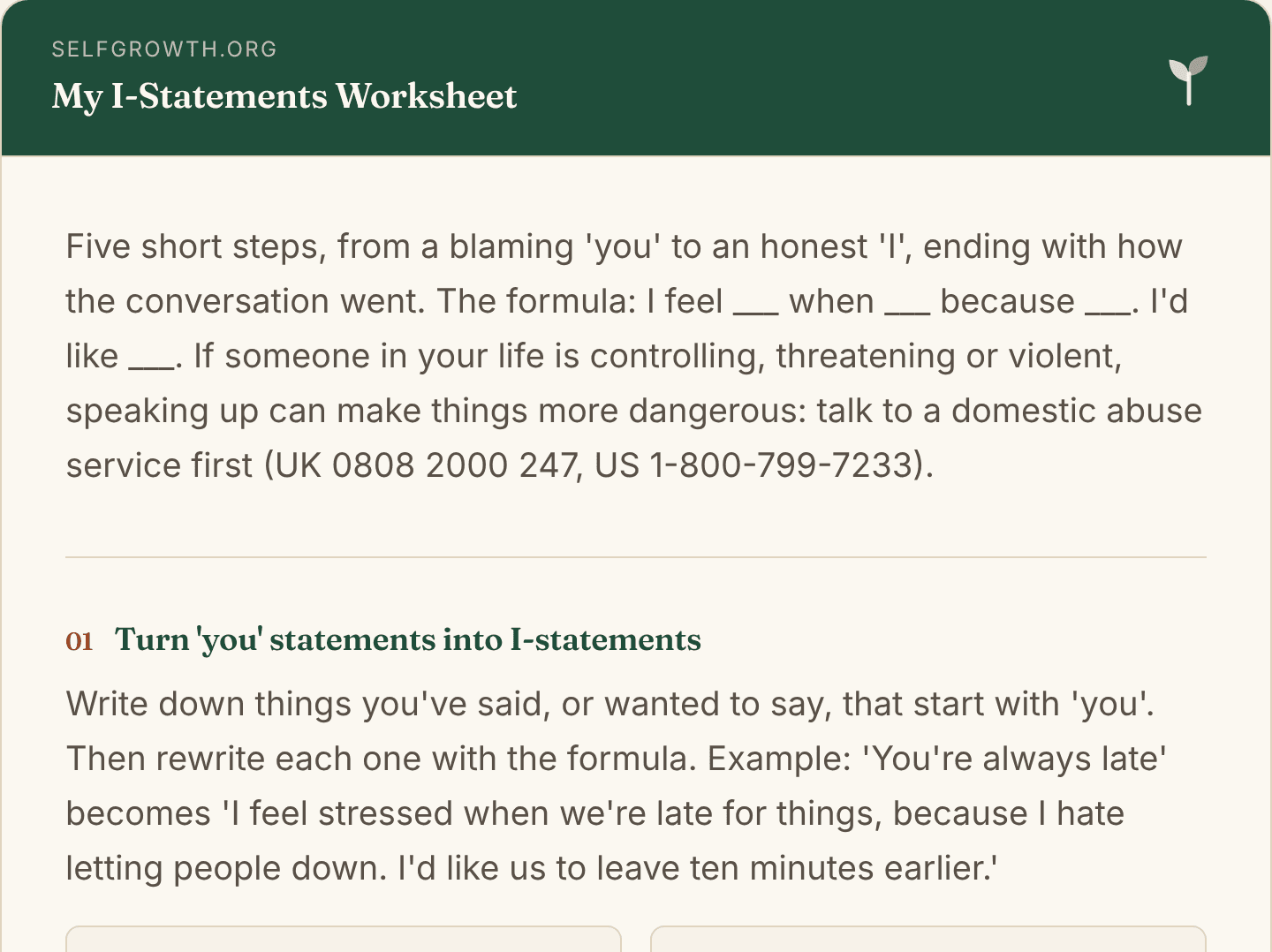
I-Statements Worksheet
A free, printable I-statements worksheet with I statement examples, the 'I feel... when... because...' formula, and space to plan one real conversation.
Open worksheet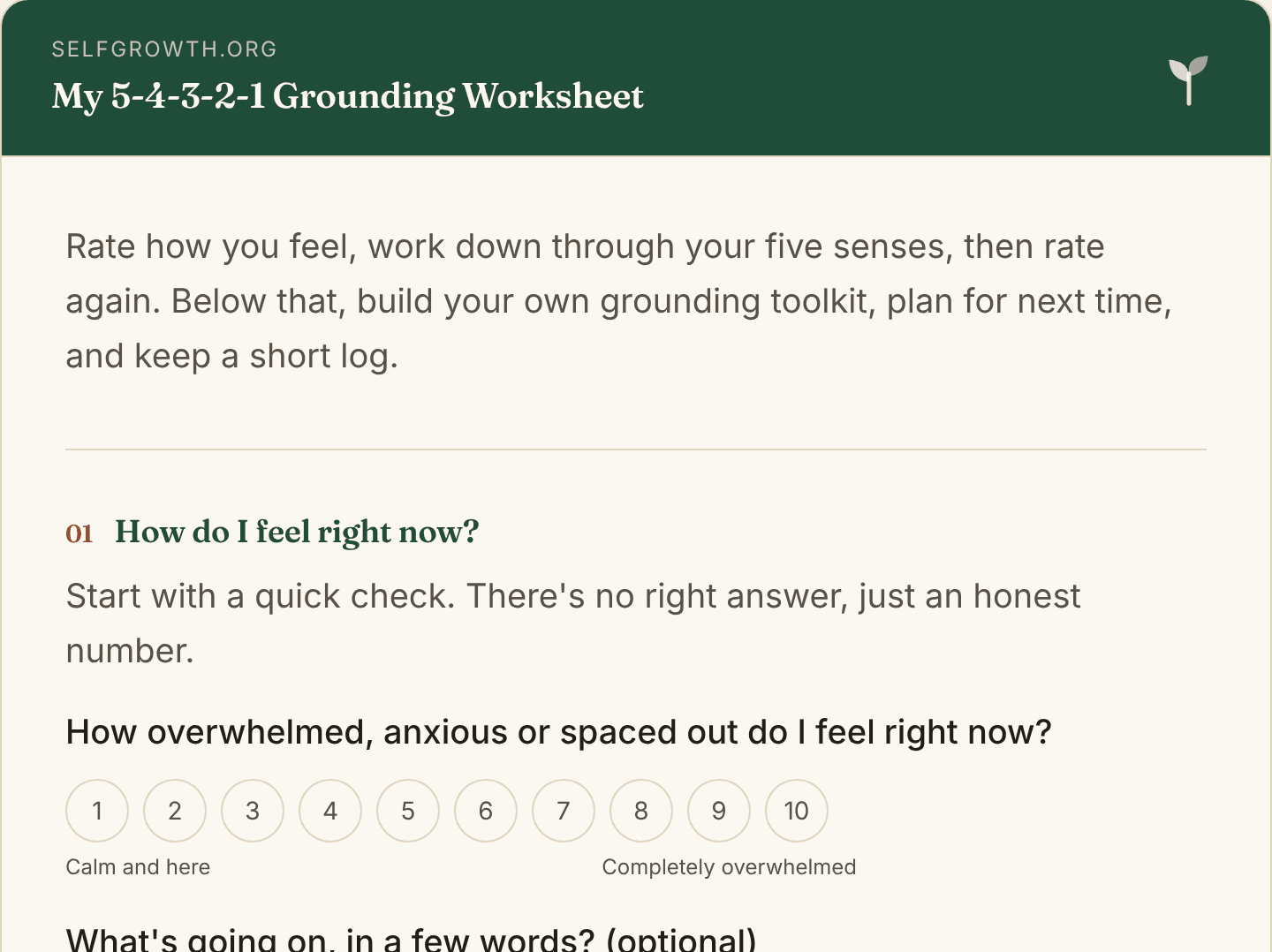
5-4-3-2-1 Grounding Worksheet
A free, printable 5-4-3-2-1 grounding worksheet: rate how you feel, work through your five senses, re-rate, then build your own toolkit and plan for next time.
Open worksheetNew worksheets, straight to your inbox
An occasional new worksheet or tool, sent only when there's something genuinely worth your time. No spam, no pressure, unsubscribe any time.