
Boundaries
I-statements worksheet: say how you feel without blame, with examples
Updated 11 October 2026 · 6 min read · Free to print
An I-statement says how something affects you without blaming the other person: 'I feel ___ when ___ because ___. I'd like ___.' This free, printable worksheet helps you turn 'you' statements into I-statements, plan one for a real situation, prepare for pushback, and look back on how the conversation went.
By the Self Growth team · drawn from Thomas Gordon's I-messages and assertiveness training · how we make these
Fill it in here (it saves in this browser, but not in a private window), print it, or download the PDF. Free, no sign-up.
'You never listen.' 'You always leave it to me.' When you're hurt or fed up, sentences that start with 'you' come out first. They're understandable, and they usually land as an attack. The other person defends themselves, and the thing you actually wanted to say gets lost.
An I-statement turns it round. Instead of a verdict on them, you describe what happened, how it affected you and what you'd like. 'I feel ignored when I'm talking and you're on your phone, because it seems like what I'm saying doesn't matter. I'd like us to put phones down at dinner.' It's still honest. It's just much easier to hear.
The idea comes from psychologist Thomas Gordon, who described 'I-messages' in his 1970 book Parent Effectiveness Training. It has been taught in assertiveness and communication training ever since, with partners, friends, family and colleagues as well as children. This worksheet helps you practise it on paper first, so the words are ready when you need them.
How to use this worksheet
- 1Start with the 'you' statements you've said or thought recently. They're the raw material.
- 2Be specific in the 'when' part. Describe what happened, as a camera would see it, not what you think it says about them.
- 3Name a feeling, not a judgement. 'I feel hurt' is a feeling. 'I feel that you're selfish' is a 'you' statement in disguise.
- 4Plan for one real conversation, at a calm moment. If the other person is controlling, threatening or violent, don't use this to confront them: get support first.
The worksheet
selfgrowth.org
My I-Statements Worksheet
Five short steps, from a blaming 'you' to an honest 'I', ending with how the conversation went. The formula: I feel ___ when ___ because ___. I'd like ___. If someone in your life is controlling, threatening or violent, speaking up can make things more dangerous: talk to a domestic abuse service first (UK 0808 2000 247, US 1-800-799-7233).
01Turn 'you' statements into I-statements
Write down things you've said, or wanted to say, that start with 'you'. Then rewrite each one with the formula. Example: 'You're always late' becomes 'I feel stressed when we're late for things, because I hate letting people down. I'd like us to leave ten minutes earlier.'
Entry 1
Entry 2
Entry 3
Entry 4
02Find the feeling underneath
Blame often sits on top of a softer feeling. Tick the ones that fit the situation you most want to talk about, or add your own.
Any other feeling, in my own words:
03Practise for a real situation
Pick one conversation you'd like to have. Build the I-statement one part at a time, then put it together. Keep the 'when' part to what happened, not what you think it means.
Who it's with, and what it's about:
I feel…
when… (what happened, just the facts)
because… (why it matters to me)
I'd like… (one clear, doable request)
Put together, in words that sound like me:
When and where I'll say it (a calm moment, not mid-argument):
04What I'll say if they push back
They might argue, get defensive or bring up something else. Decide now how you'll stay calm. One technique from assertiveness training is the broken record: repeat your main point in the same few words, kindly, without a new reason each time.
Entry 1
Entry 2
Entry 3
My one-line broken record:
e.g. 'I hear you. I'd still like us to put phones down at dinner.'
If it gets too heated, what I'll do (e.g. suggest a break and a time to come back to it):
05After the conversation
Come back to this once you've said it. Whatever happened, you practised a hard skill.
What I said, and how they responded:
How well did I say what I meant?
What went well:
What I'd try differently next time:
When you're done, a moment to reflect
- Which 'you' statement comes out of you most often, and what feeling is usually underneath it?
- Who is it easiest for you to be honest with, and who is it hardest? What's the difference?
- What are you afraid will happen if you say how you really feel?
- What would it be like to be heard, even if you didn't get what you asked for?
Where do I-statements come from, and do they work?
I-statements come from psychologist Thomas Gordon. He coined the term 'I-message' in the 1960s and set it out in his 1970 book Parent Effectiveness Training, as a way for parents to say how a child's behaviour affected them without blame. In his model, a confronting I-message has three parts: the behaviour, its effect on you, and how you feel about it. The 'I feel… when… because… I'd like…' formula on this sheet is a later, widely used adaptation that adds a clear request.
The idea has since spread into assertiveness training and couples and family communication. Assertiveness training has research behind it. A 2018 review by Brittany Speed, Brandon Goldstein and Marvin Goldfried called it 'a forgotten evidence-based treatment', and noted that research on it has dropped off sharply, so much of the evidence is older. I-statements on their own are best thought of as a practical communication tool rather than a tested treatment. The broken record, in the pushback step, was popularised by psychologist Manuel J. Smith in his 1975 book When I Say No, I Feel Guilty.
If you'd like the bigger picture, the guide to assertive communication covers the four communication styles, assertive phrases and fair fighting rules for a hard conversation.
These are educational self-reflection tools, not therapy. See our editorial standards.
If you want to go deeper
- Gordon, T. (1970). P.E.T.: Parent Effectiveness Training. New York: P. H. Wyden.
- Speed, B. C., Goldstein, B. L. & Goldfried, M. R. (2018). Assertiveness training: A forgotten evidence-based treatment. Clinical Psychology: Science and Practice, 25(1), e12216 (doi:10.1111/cpsp.12216).
- Smith, M. J. (1975). When I Say No, I Feel Guilty: How to Cope Using the Skills of Systematic Assertive Therapy. New York: Dial Press.
Your questions, answered
- What is an I-statement?
- An I-statement is a way of raising a problem by describing how it affects you, rather than what's wrong with the other person. A common formula is: 'I feel ___ when ___ because ___. I'd like ___.' It keeps the focus on your experience, which makes the other person less likely to get defensive.
- What are some I-statement examples?
- 'I feel hurt when plans change at the last minute, because I've been looking forward to it. I'd like a bit more notice.' 'I feel overwhelmed when the washing-up is left, because it all lands on me. I'd like us to take turns.' 'I feel anxious when I don't hear from you, because I worry. Could you text if you'll be late?'
- What is the I-statement formula?
- One widely taught version is: I feel (your feeling) when (what happened, just the facts) because (why it matters to you). I'd like (a clear request). Thomas Gordon, who introduced I-messages in his 1970 book Parent Effectiveness Training, described three parts: the behaviour, its effect on you and how you feel about it. The 'I'd like' part is a later addition.
- What's the difference between an I-statement and a 'you' statement?
- A 'you' statement puts the spotlight on the other person, often as blame: 'You never help.' An I-statement puts it on your experience: 'I feel stretched when I do the cleaning alone.' Watch for disguised ones: 'I feel that you're lazy' starts with 'I' but is still a judgement about them.
- Do I-statements actually work?
- They aren't magic, and the other person can still disagree. What they do is make it easier to hear you without feeling attacked. They're a long-standing part of assertiveness and communication training. They work best said calmly, at a good moment, with one clear request.
- Is this I-statements worksheet free, and is there a PDF?
- Yes. It's free, with no payment and no email needed. You can fill it in on screen and keep your answers, or download the printable PDF and write on it by hand.
- Is this the same as therapy?
- No. It's a self-reflection and communication tool, not therapy or medical advice. If a relationship feels controlling or unsafe, talk to a domestic abuse service (UK 0808 2000 247, US 1-800-799-7233). If you're struggling to cope, see a GP, call Samaritans on 116 123 (UK) or 988 (US), or find a line at findahelpline.com.
Keep going, related worksheets
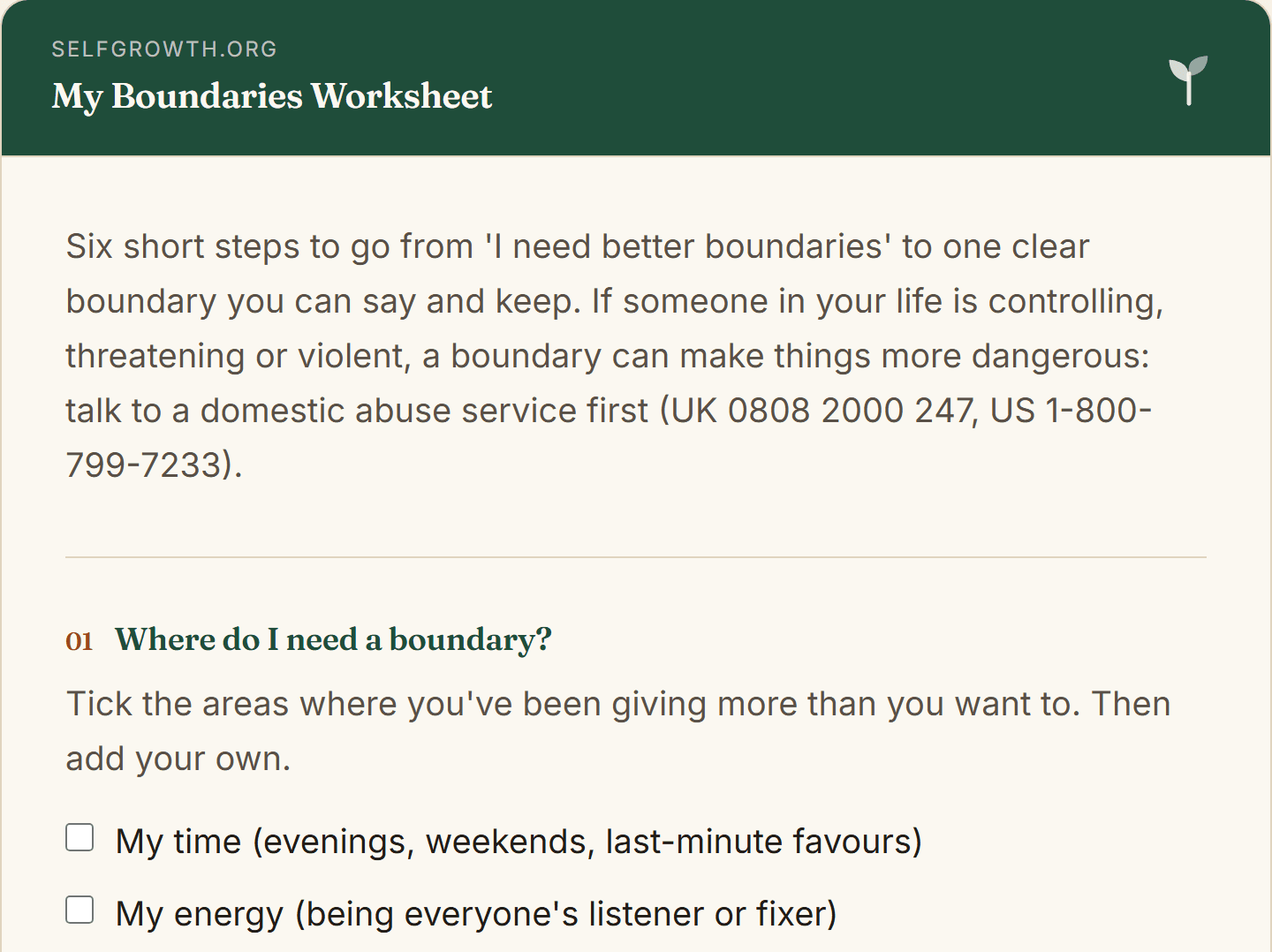
Boundaries Worksheet
A free, printable boundaries worksheet: spot where you need a limit, write it as something you'll do, plan the exact words, and decide what you'll do if it's crossed.
Open worksheet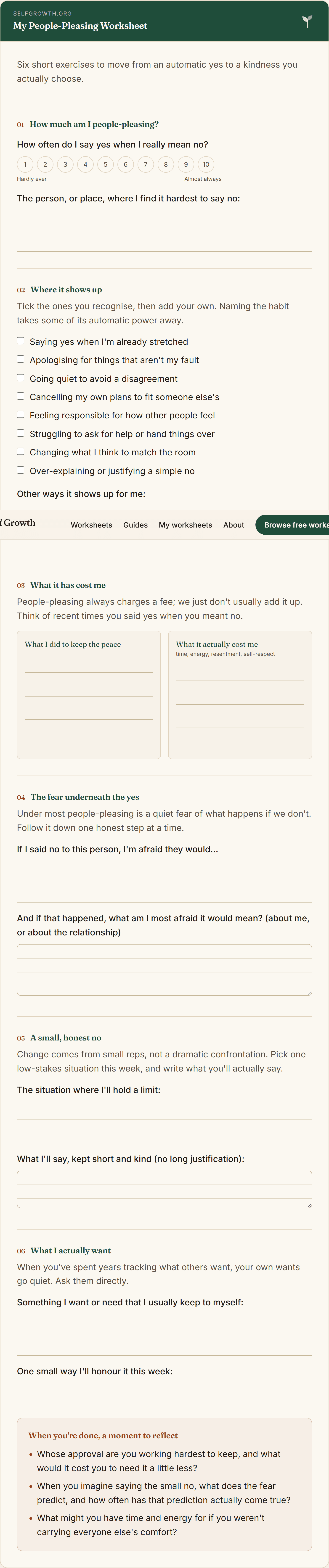
People-Pleasing Worksheet
A free, printable people-pleasing worksheet: see where you over-give, name the fear underneath, count the real cost, and practise one small, honest no.
Open worksheet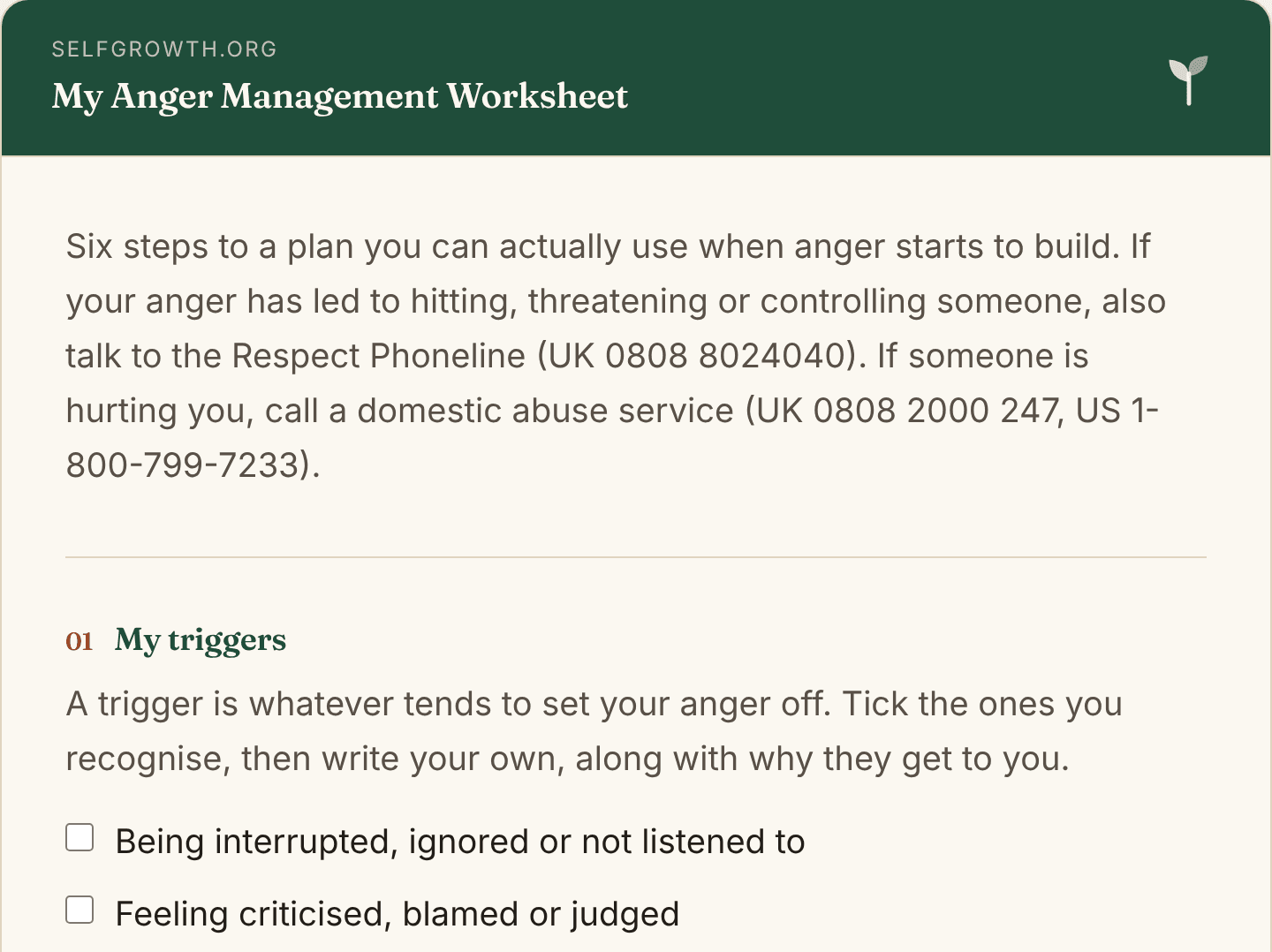
Anger Management Worksheet
A free anger management worksheet for adults: your triggers, an anger thermometer with your own warning signs, a time-out plan and calming skills. Free PDF.
Open worksheetNew worksheets, straight to your inbox
An occasional new worksheet or tool, sent only when there's something genuinely worth your time. No spam, no pressure, unsubscribe any time.