
Self-esteem
Self-Esteem Worksheets for Teens: Free Printable Activities
Updated June 27, 2026 · 5 min read · Free to print
Self-esteem worksheets for teens are short activities that help you build a fairer view of yourself. This free, printable worksheet helps you spot the 'compare trap' (especially online), list what you're genuinely good at, talk back to the mean voice in your head, and do one kind thing for yourself, in plain language, no lectures.
By the Self Growth team · drawn from cognitive behavioural therapy and self-compassion research · how we make these
A clean, print-ready PDF, properly formatted, free, no email needed.
Being a teenager is one of the hardest times to feel good about yourself. Everything's changing, everyone seems to have it figured out (they don't), and your phone is a non-stop highlight reel of other people's best moments. It makes sense that self-esteem takes a hit.
Self-esteem just means how you feel about yourself, and the good news is it's not fixed. A lot of low self-esteem comes from a few habits: comparing yourself to people online, forgetting your own good points, and a mean inner voice that you'd never use on a friend. Those habits can change.
This worksheet is short and judgement-free. No one else has to see it. Be honest, and remember the harsh stuff in your head is not the same as the truth.
How to use this worksheet
- 1It takes about 10–15 minutes. Print it, or fill it in on your phone or laptop.
- 2Write what's actually true for you, not what sounds good.
- 3If a question is hard, skip it and come back, there's no grade here.
- 4Teachers, counsellors and parents: this is free to print for one-on-one or classroom use.
The worksheet
selfgrowth.org
Self-Esteem Activities, for Teens
Six quick activities to help you see yourself a bit more fairly.
01How am I feeling about myself?
Right now, how good do I feel about myself?
If I'm honest, the thing I'm hardest on myself about is…
02The compare trap
Social media shows everyone's highlights, not their real life. Let's name it.
Who or what do I compare myself to the most?
What does that comparison NOT show? (the bad days, edits, stuff behind the photo)
03Things I'm actually good at
Not just school. Being a good friend, funny, kind, good at a game, reliable, all count.
- 1.
- 2.
- 3.
- 4.
- 5.
- 6.
04Talk back to the mean voice
Write what the mean voice in your head says. Then answer it like you'd stick up for a friend.
What the mean voice says
What I'd say to defend a friend
05People and things that remind me I'm okay
Who makes you feel like yourself? What do you enjoy that's just yours?
- 1.
- 2.
- 3.
- 4.
06One kind thing I'll do for myself
This week I'll…
When you're done, a moment to reflect
- If you talked to yourself like you talk to your best friend, what would change?
- Whose opinion are you actually trying to win, and is it worth it?
- What's one thing about you that has nothing to do with how you look?
The approach behind this worksheet
Self-esteem very commonly dips in the teenage years, and that's worth knowing rather than worrying about: it's a stage when comparison, social media, and a louder inner critic all tend to arrive at once. This worksheet uses the same evidence-based moves adults use, gently catching a harsh thought and testing it against the facts, but in plain, age-appropriate language. The aim is to quiet the 'compare and despair' habit and notice the real strengths the critic keeps deleting.
It pairs that thought-work with self-compassion, learning to speak to yourself a bit more like a good friend would, which research links to steadier self-worth than chasing likes or grades. These are educational self-reflection tools, not therapy, and if things feel genuinely heavy, talking to a trusted adult matters more than any worksheet.
These are educational self-reflection tools, not therapy, see our editorial standards.
If you want to go deeper
- Lisa M. Schab — The Self-Esteem Workbook for Teens (Instant Help, 2013).
- Gina M. Biegel — The Stress Reduction Workbook for Teens (Instant Help, 2017): mindfulness skills adapted for adolescents.
- Melanie Fennell — Overcoming Low Self-Esteem (Robinson, 1999): the CBT model the inner-critic exercises draw on.
Questions people ask
- What are the signs of low self-esteem in a teenager?
- Common signs include harsh self-criticism, constant comparison to others (especially online), holding back from things they might fail at, struggling to take a compliment, and an outsized reaction to small setbacks. Some teens go quiet and withdraw; others mask it with perfectionism or people-pleasing. A worksheet can't diagnose anything, but noticing a few of these is a good reason to work through the exercises here, or to talk to a trusted adult.
- What causes low self-esteem in teens?
- It's usually a mix rather than one thing: the highlight-reel comparison of social media, big body and identity changes, pressure at school, and a louder inner critic that tends to arrive in the teenage years. Friendships, family, and a few harsh comments can all leave a mark too. The good news is that most of these are habits and circumstances, not fixed facts about who you are, which is exactly why they can shift.
- Are these self-esteem worksheets really free?
- Yes. Everything here is free to fill in online or print, no payment, no sign-up. Use the Download PDF button for a clean copy, or Print for a paper version.
- Can teachers and counsellors use these in class?
- Absolutely. They're free to print for one-on-one sessions, advisory periods, or classroom use. They're written in plain, non-clinical language so teens can work through them independently or with light guidance.
- Why does social media affect teen self-esteem so much?
- Because it serves up an endless stream of other people's highlights (edited, filtered, and curated), which your brain quietly compares to your own everyday reality. Naming that gap (the 'compare trap' exercise above) is one of the most useful things a teen can practise.
- What if I'm really struggling, not just having a bad week?
- Please tell a trusted adult, a parent, teacher, school counsellor, or doctor. This worksheet is a helpful self-reflection tool, but it isn't therapy. If you ever have thoughts of hurting yourself, reach out to a local helpline or emergency service right away.
Keep going, related worksheets
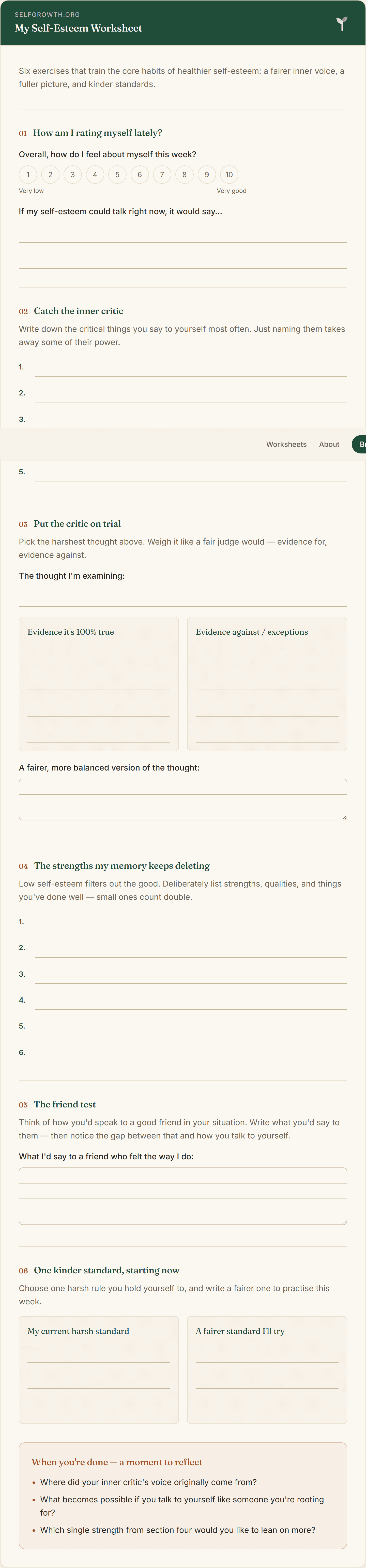
Self-Esteem Worksheet
Free, printable self-esteem worksheets with guided exercises to challenge your inner critic, recognise your strengths, and build steadier, healthier self-esteem.
Open worksheet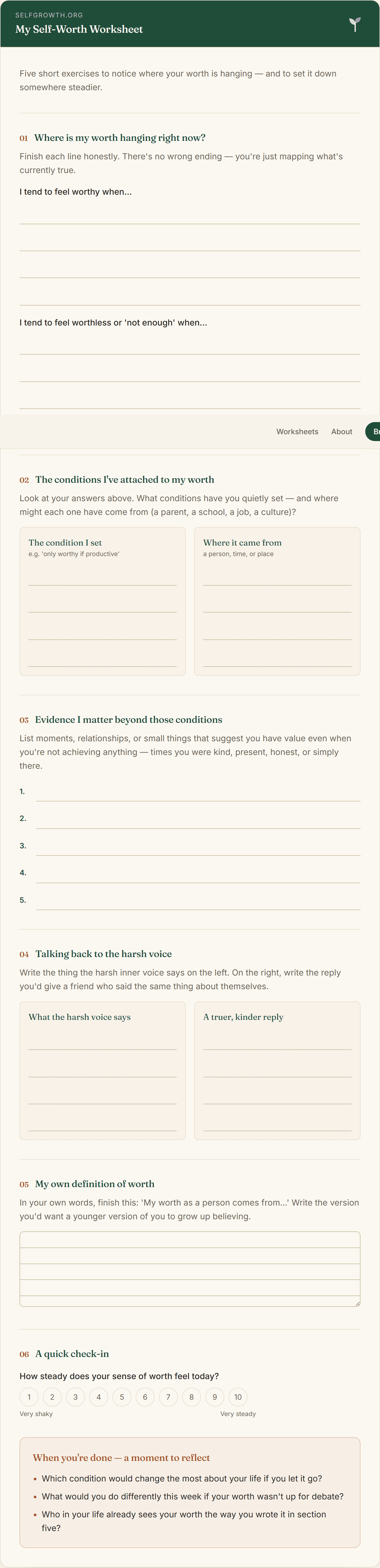
Self-Worth Worksheet
A free, printable self-worth worksheet with five short exercises to separate your value from your achievements and rebuild a steadier sense of worth.
Open worksheet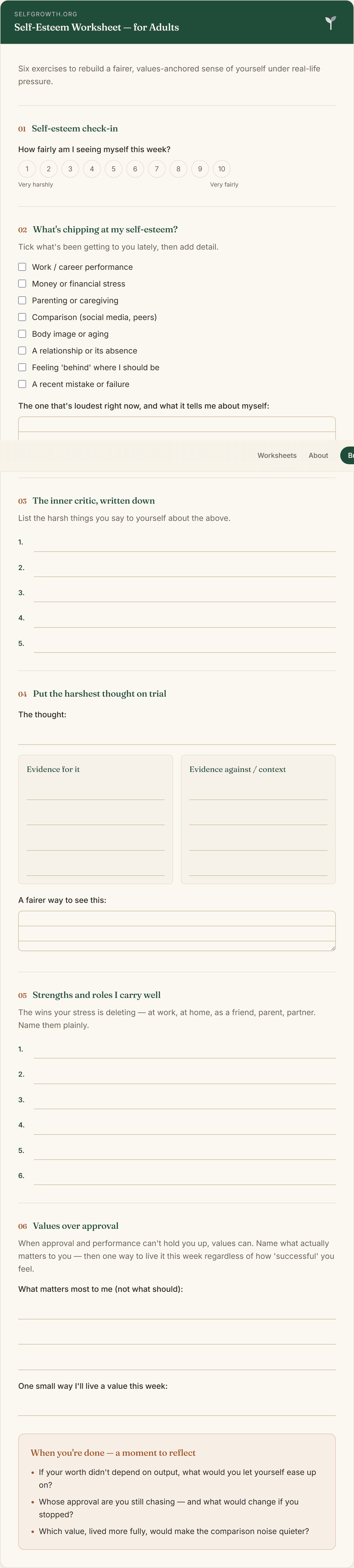
Self-Esteem (Adults)
Free, printable self-esteem worksheets for adults, handle the work, money, parenting and comparison pressures that chip away at self-esteem, and rebuild a fairer view of yourself.
Open worksheetNew worksheets, straight to your inbox
An occasional new worksheet or tool, sent only when there's something genuinely worth your time. No spam, no pressure, unsubscribe any time.