
Guide
How to get motivated
Updated 23 October 2026 · 9 min read
To get motivated, start before you feel ready. Motivation can build once you are moving, so shrink the task to a tiny first step, pick a start time, and remove one obstacle. If low motivation comes with low mood or loss of interest for two weeks or more, see a GP.
Drawn from cognitive behavioural therapy & self-compassion research · Part of habits and getting things done
You know what you want to do, or what you need to do, and the energy to begin is not there. So you wait. You tell yourself you will start when you feel more like it, and the feeling does not arrive.
Low motivation is frustrating, but it is not a flaw in your character. It can have a reason, and the reason can point to what might help. It is self-help, not therapy or medical advice.
What is motivation, and why does it come after starting?
Motivation is the push to act. We tend to picture it as a feeling that arrives first and carries us into the task. In practice it can work the other way round: you take a small step, the task becomes less vague, you notice some progress, and the wish to carry on grows. Waiting for the feeling can mean waiting a long time.
Psychologists Richard Ryan and Edward Deci proposed self-determination theory, which looks at what supports and what drains motivation. Their 2000 paper in American Psychologist describes three basic needs: feeling able to do the thing (competence), feeling that you have a say in it (autonomy), and feeling connected to other people (relatedness). In their account, when those needs are met people are more self-motivated and doing better, and when they are blocked motivation and wellbeing suffer. It is a well-known theory, and it gives you useful questions to ask yourself: Do I feel I can do this? Is this my choice? Do I have anyone alongside me?
None of this means you can switch motivation on at will. It means the conditions around a task matter as much as willpower, and some of those conditions are within your reach.
Why is my motivation low?
Low motivation is a symptom, not a diagnosis. Working out which of these is closest to your situation tells you where to start.
- You are tired. Poor sleep, a long stretch of stress or being run down can all make starting feel like effort. If that sounds like you, the guide to signs of burnout may help.
- The goal is unclear. If you cannot say what finished looks like, it is hard to feel pulled towards it.
- The task is too big. A huge task gives you no obvious first step, so you stay where you are.
- The task does not connect to anything you care about. You may be doing it only because you should.
- You are avoiding a feeling. Fear of getting it wrong or of being judged can look like a lack of drive. The guide to stopping procrastinating goes into this.
- Your mood is low. When everything feels flat or pointless, motivation is hard to find for reasons that willpower will not fix. See the section on when to get more support.
More than one can be true at once. To tell them apart, ask one question: what happens when you picture starting? Do you feel tired, unclear, overwhelmed by the size of it, afraid, low, or do you simply see no point? Pick the answer that feels most like you right now and start there.
How do I get motivated, step by step?
You do not need to do all of these. Try one or two on a single task you have been putting off, and see what changes.
- 1Shrink the task. Cut it down to a first step so small it feels almost silly, such as opening the document, putting your trainers by the door or writing one sentence.
- 2Set a start time. Decide exactly when and where you will begin: 'When I have finished my coffee, I will sit at the desk and open the file.' A time and a place give the moment a job to do, so you are not relying on a feeling.
- 3Make it visible. Put the task where you will see it: the notebook open on the table, a note on the screen, the kit laid out the night before. A task you can see is harder to forget.
- 4Remove one obstacle. Ask what makes starting harder than it needs to be, and take away one thing. Phone in another room, tabs closed, the right tool within reach.
- 5Tie it to a value. Ask what this task serves. If it connects to something you care about, such as your health, a person or the kind of life you want, write that in one line and keep it near the task.
- 6Ask someone to check in. Tell a friend what you plan to do and when, and ask them to message you afterwards. Having someone alongside you meets the need for connection that self-determination theory describes.
- 7Reward the effort, not the result. Count showing up as the win. A cup of tea, a short walk or a tick on a chart after you have done the first step teaches your mind that starting feels good.
The start-time step has a research base. Psychologist Peter Gollwitzer studied plans of the form 'when X, I will Y'. His 1999 paper in American Psychologist set out the idea, and a 2006 review by Peter Gollwitzer and Paschal Sheeran, which combined many studies, found that such plans helped people reach their goals. Those studies covered a range of goals rather than motivation alone, so treat it as a promising tool, not a guarantee.
Here is one task shrunk and scheduled. Say you keep putting off a tax return. 'Sort my tax return' gives you nowhere to begin. Shrink it to 'find the login details and open the tax website', then set a time: 'Tomorrow at 5pm, after I have eaten, I will sit at the desk and do that.' That is all you have to do, and once the page is open the next step often looks less vague.
If you want to set the goal itself more clearly first, the goal setting worksheet and the SMART goals worksheet help, and the guide to setting goals explains the thinking. To keep the habit going afterwards, try the habit tracker and the guide to building good habits.
Open the Goal-Setting WorksheetWhat if I have no idea what I want to do?
Sometimes the problem is not getting started but not knowing what is worth starting. Motivation is easier to find when a task connects to what matters to you. The core values worksheet helps you name what matters, and the procrastination worksheet works through one task you are avoiding. If the bigger question is about direction in life, see the guide to finding your purpose.
When is low motivation a sign of something more?
Flat days happen. It becomes a health question when it lasts and spreads across your life. These may be signs worth taking seriously:
- Low mood, or feeling empty or numb, that lasts two weeks or more.
- Losing interest or pleasure in things you used to enjoy.
- Changes in sleep or appetite, or feeling tired all the time without a clear reason.
- Finding it hard to concentrate or make simple decisions.
- Feeling worthless, guilty or hopeless.
These can be signs of depression, which can be treated, though only a qualified professional can tell you what is going on. If you feel hopeless or have thoughts of not wanting to be alive, call Samaritans on 116 123 (UK and Ireland), 988 (US), findahelpline.com; more routes at selfgrowth.org/help. A GP is a good first step, and you do not need to be sure before you go. If your energy and interest are low, the Behavioural Activation Worksheet and the activity list offer a gentle way to plan small activities, alongside seeing a doctor rather than instead of it.
When to get more support
This guide is not a substitute for medical care. See a GP if low motivation has lasted two weeks or more, is affecting your work, your relationships or your health, or comes with low mood or loss of interest. If you feel hopeless or have thoughts of not wanting to be alive, get support now. Call or text Samaritans on 116 123 (UK and Ireland), call or text 988 (US), use findahelpline.com elsewhere, or see selfgrowth.org/help. If you are in immediate danger, call 999 (UK) or 911 (US) or your local emergency number.
Sources and further reading
This is an educational self-reflection resource, not therapy or medical advice.
If you want to go deeper
- Ryan, R. M. & Deci, E. L. (2000). Self-determination theory and the facilitation of intrinsic motivation, social development, and well-being. American Psychologist, 55(1), 68-78.
- Gollwitzer, P. M. (1999). Implementation intentions: Strong effects of simple plans. American Psychologist, 54(7), 493-503.
- Gollwitzer, P. M. & Sheeran, P. (2006). Implementation intentions and goal achievement: A meta-analysis of effects and processes. Advances in Experimental Social Psychology, 38, 69-119.
- NHS. Symptoms of depression in adults (nhs.uk/mental-health/conditions/depression-in-adults/symptoms).
Your questions, answered
- Why can't I get motivated?
- There are several possible reasons: you are tired, the goal is unclear, the task is too big, it does not connect to what you care about, you are avoiding a feeling, or your mood is low. Work out which fits best and try the matching move. If it has lasted two weeks or more and comes with low mood or loss of interest, talk to a GP.
- How do I motivate myself when I don't feel like it?
- Do not wait for the feeling. Shrink the task to a first step that takes a couple of minutes, decide when and where you will do it, and remove one obstacle. Starting can make the task feel less vague, and the wish to carry on can grow once you are moving.
- Does motivation come before action or after?
- It can be either. Sometimes the wish comes first, and sometimes it builds after you begin and see some progress. If you are stuck waiting, acting first is a practical thing to try.
- What is the difference between motivation and discipline?
- Motivation is the wish to act. Discipline is acting whether or not the wish is there. You can lean on both: use plans, such as a set start time, to act on the days the wish is missing, and tie tasks to what you value to help the wish grow.
- Is low motivation a sign of depression?
- It can be one sign, but on its own it is not a diagnosis. Low mood or loss of interest that lasts two weeks or more, with changes in sleep, appetite or concentration, is worth raising with a GP. Only a qualified professional can assess it.
- Is there a free worksheet to help me get motivated?
- Yes. The goal setting worksheet helps you pick a clear goal and a first step, and the procrastination worksheet works through one task you are avoiding. Both are free with a Download PDF button, and no email is needed.
- Is this guide a substitute for therapy?
- No. It is an educational self-help guide, not therapy or medical advice. If low motivation is affecting your life, talk to a GP. If you are thinking about harming yourself or ending your life, that is serious: call Samaritans on 116 123 (UK and Ireland), call or text 988 (US), or find a line at findahelpline.com. More routes: selfgrowth.org/help. For chest pain, trouble breathing or fainting, call 999 (UK) or 911 (US) or your local emergency number; use NHS 111 if you are unsure.
Worksheets to do the work
Free to fill in online or print. No email needed.

Goal-Setting Worksheet
A free, printable goal-setting worksheet that turns a vague wish into a specific goal, a when-and-where plan, and a first step you'll actually take this week.
Open worksheet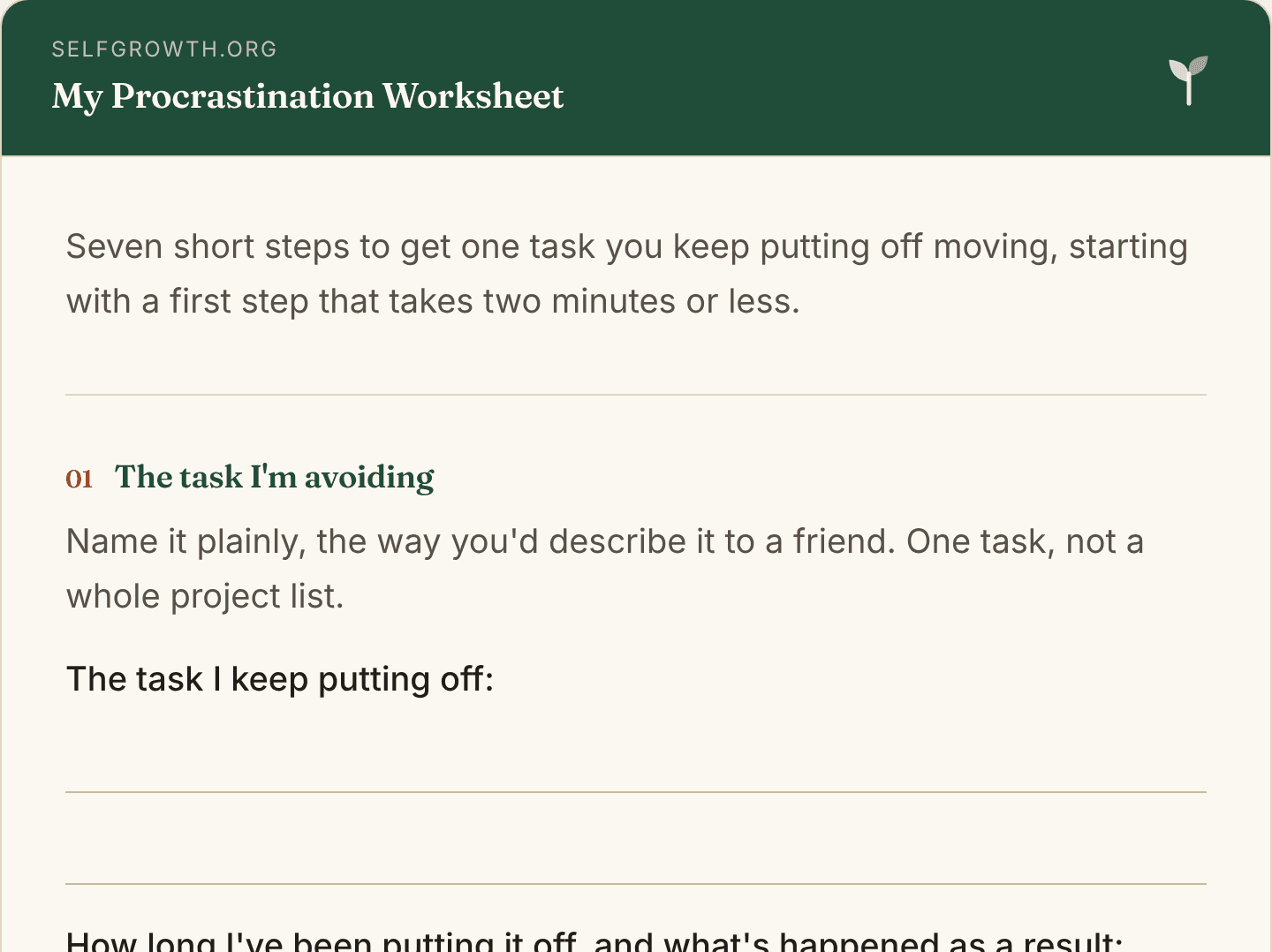
Procrastination Worksheet
A free, printable procrastination worksheet: name the feeling you're avoiding, find a two-minute first step, make an if-then plan and log seven days of starts.
Open worksheet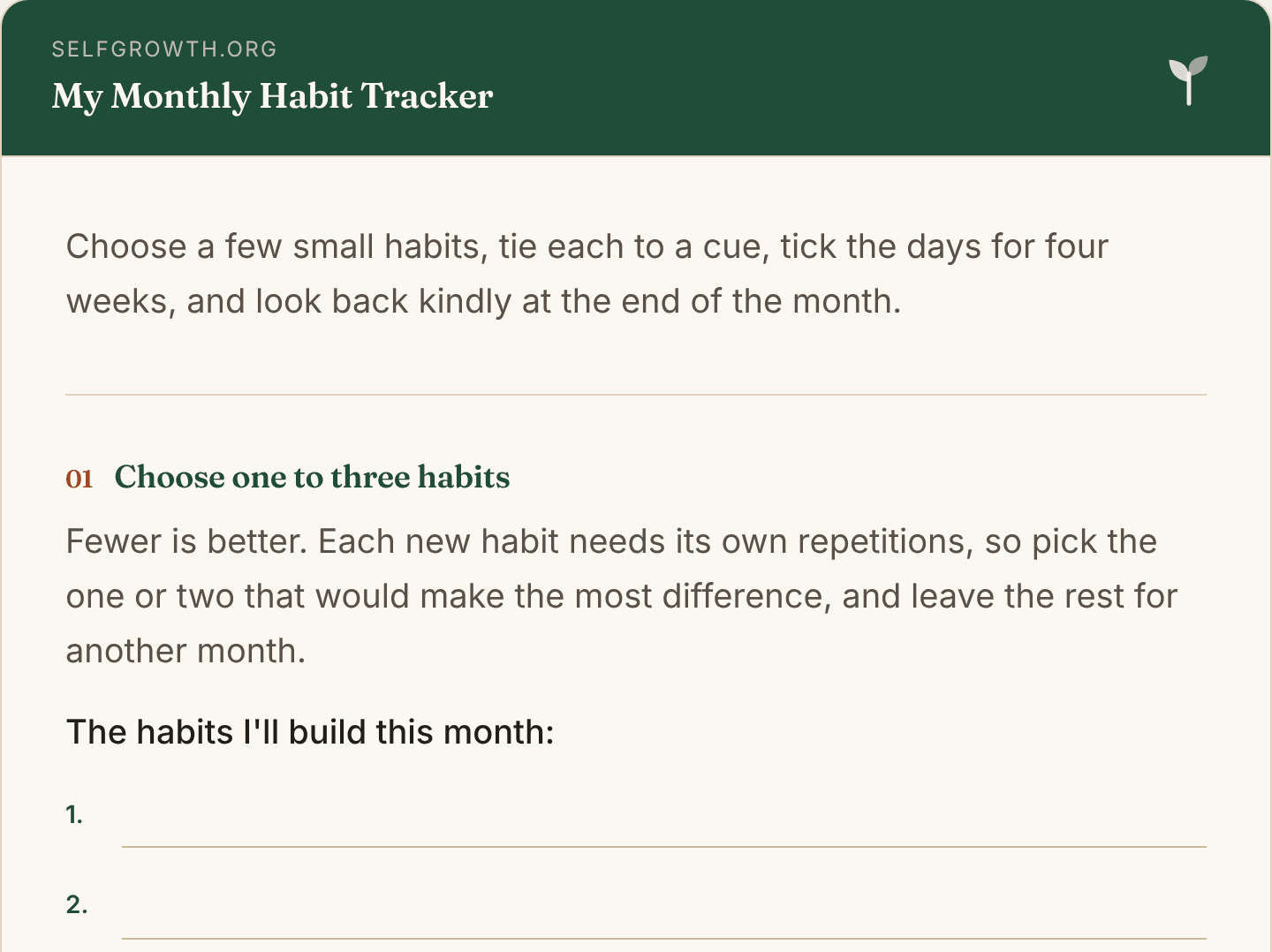
Habit Tracker Printable
A free printable habit tracker for one month: choose one to three small habits, tie each to a cue, tick the days, and review what helped. Print or fill it in.
Open worksheet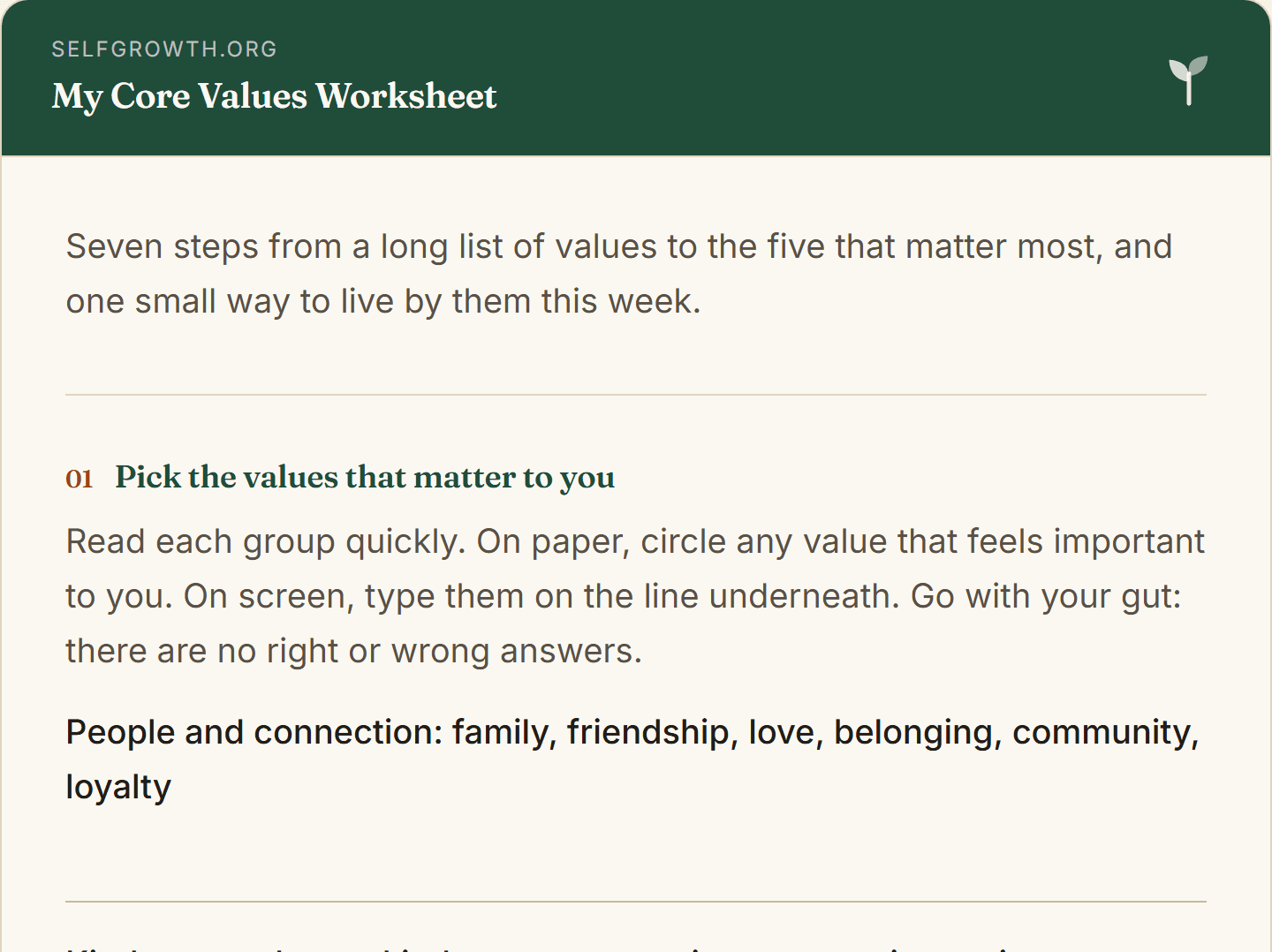
Core Values Worksheet
A free, printable core values worksheet: pick values from a list, narrow them to your top five, put them in your own words and plan one step to live by them.
Open worksheet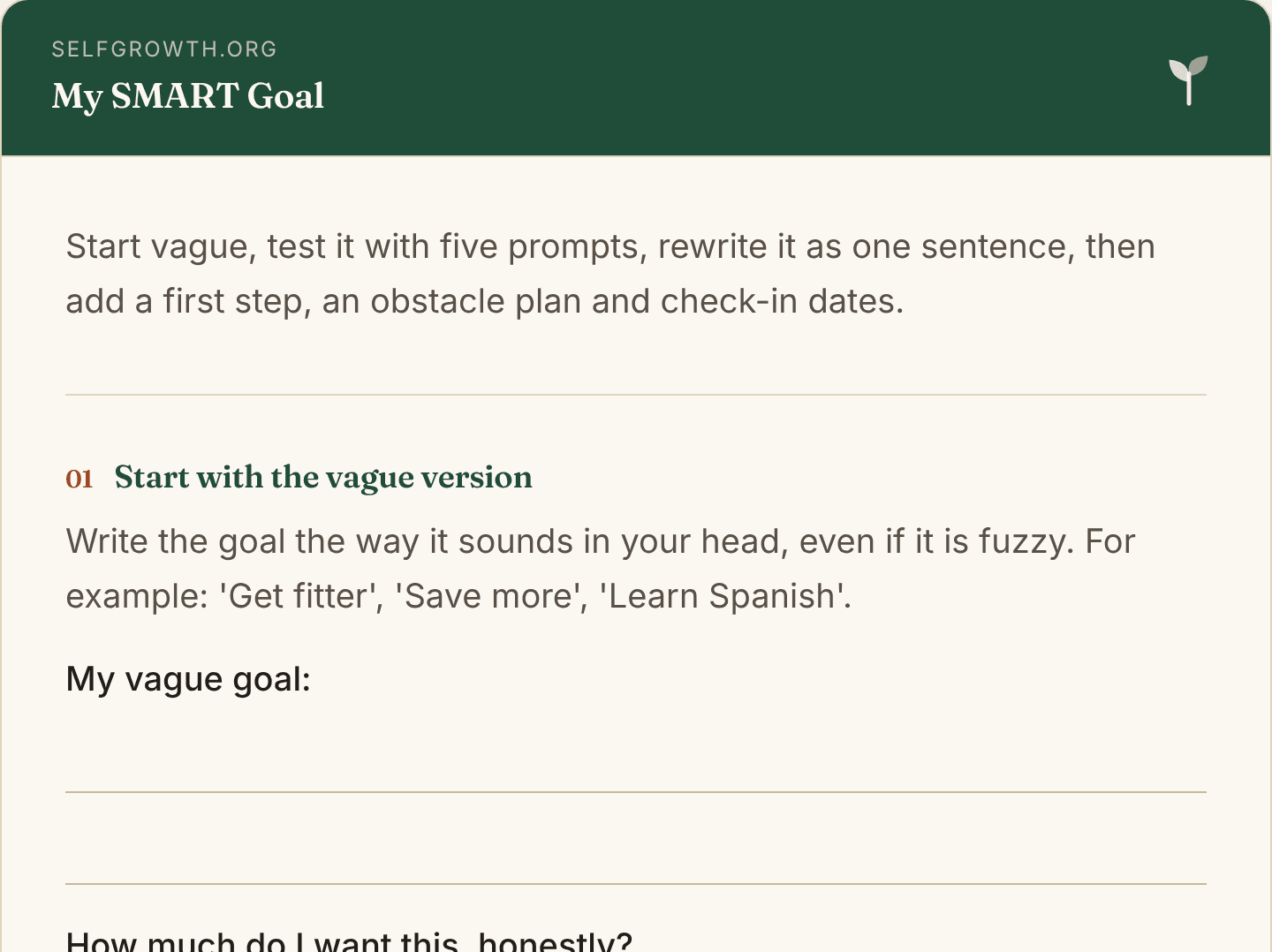
SMART Goals Worksheet
A free, printable SMART goals worksheet: start with one vague goal, answer five prompts with examples, rewrite it as one sentence, then add a first step and check-in dates.
Open worksheet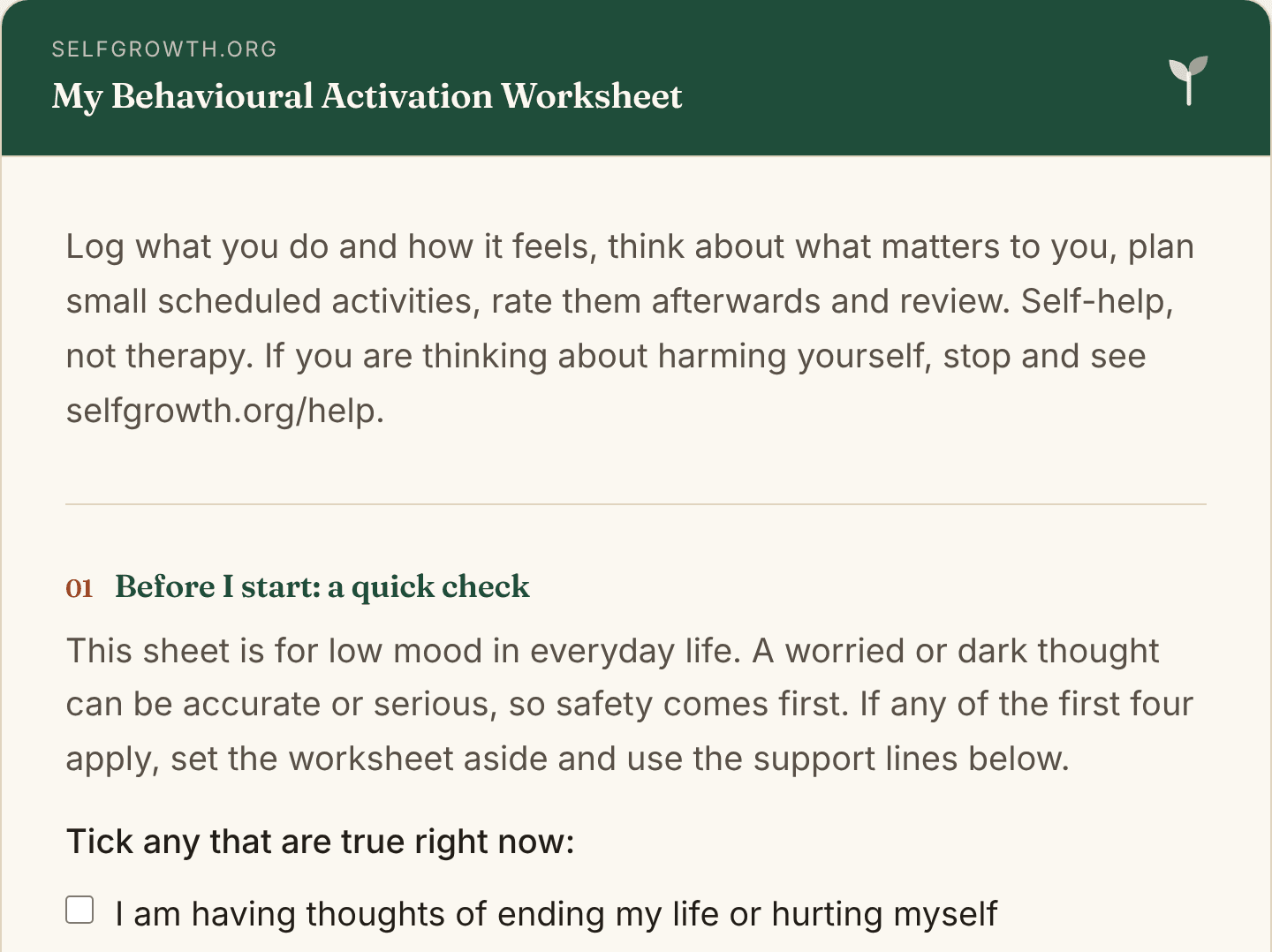
Behavioural Activation Worksheet
Free behavioral activation worksheet: log what you do and how it feels, pick small activities, schedule them and review. Self-help, not therapy.
Open worksheet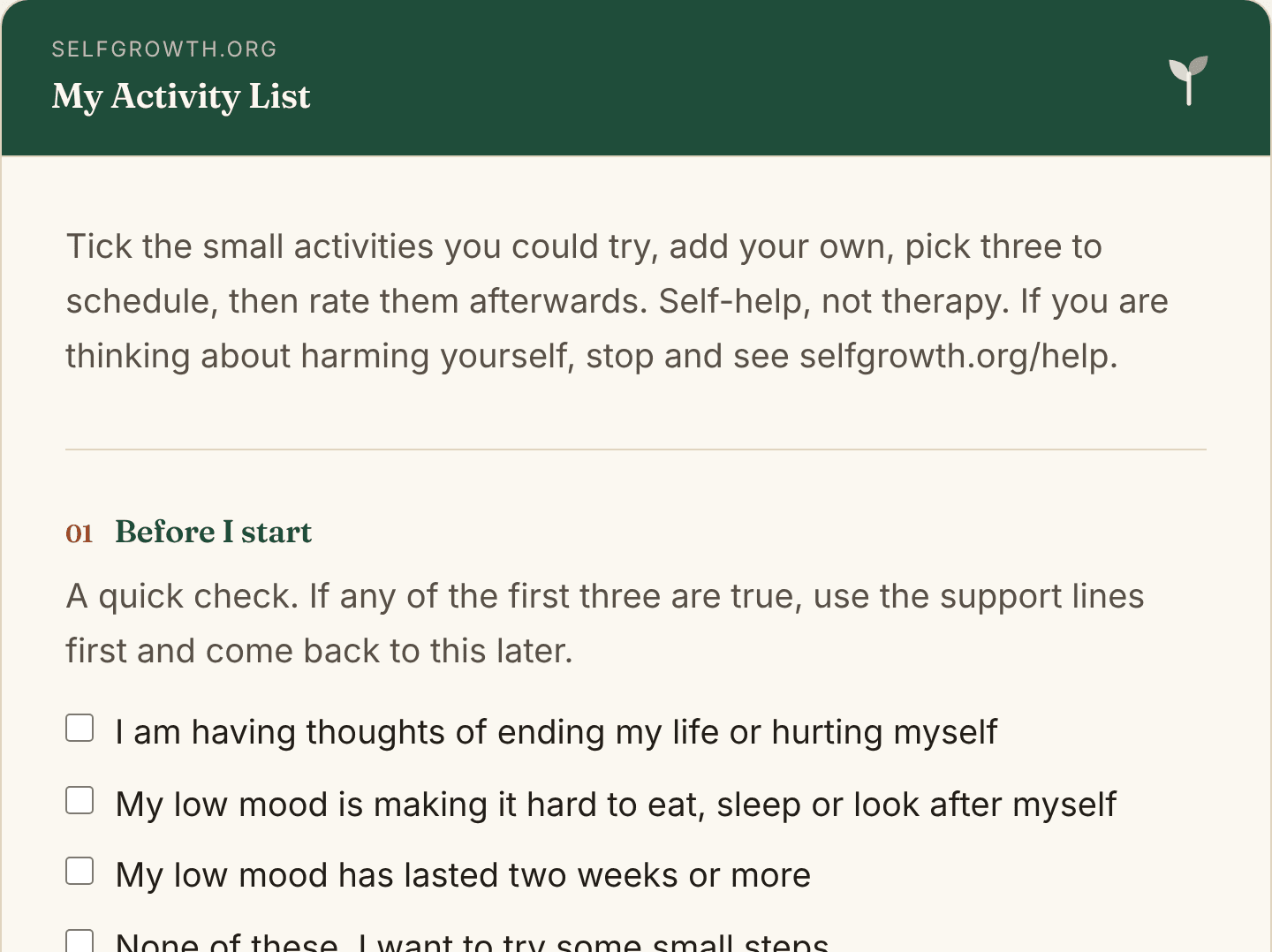
Behavioural Activation Activity List
Free behavioral activation activity list: tick small activities, pick three to schedule, then rate each. A pleasant activities list for low days.
Open worksheetRelated guides
New worksheets, straight to your inbox
An occasional new worksheet or tool, sent only when there's something genuinely worth your time. No spam, no pressure, unsubscribe any time.