
Guide
Signs of burnout, and what to do about it
Updated 17 October 2026 · 8 min read
The World Health Organization describes burn-out as a result of chronic workplace stress that hasn't been managed successfully, with three signs: feeling drained or exhausted, feeling distant, negative or cynical about your job, and feeling less able to do it well. WHO does not classify it as a medical condition. See a GP if symptoms persist.
By the Self Growth team · drawn from the World Health Organization's description of burn-out and NHS guidance · how we make these
Sunday evening comes and your stomach drops. You used to care about this job and now you can't summon the energy to pretend. You're tired in a way sleep doesn't touch, short with people you like, and you've started to wonder what the point is.
If that sounds like you, you may be asking whether it's burnout. It can't tell you whether you have burnout, because there's no test for that on a web page, and we're not a substitute for a doctor.
What is burnout?
The World Health Organization (WHO) includes burn-out in the latest version of its International Classification of Diseases, ICD-11. It describes burn-out as a syndrome that comes from chronic workplace stress that hasn't been successfully managed.
Two things in that description matter. The first is that WHO says burn-out refers specifically to the workplace, and should not be used to describe experiences in other areas of life. The second is that WHO lists it as an 'occupational phenomenon', not as a medical condition. It sits in a section of the classification about factors that influence health, not in the section on illnesses.
Researchers described the same thing before WHO did. In a well-known 2001 review, Christina Maslach, Wilmar Schaufeli and Michael Leiter called burnout a long-term reaction to chronic emotional and interpersonal stress at work, marked by exhaustion, cynicism and reduced efficacy.
What causes burnout?
WHO ties burn-out to chronic workplace stress that hasn't been successfully managed. Maslach, Schaufeli and Leiter (2001) argued that burnout is about the fit between people and their work, not just something wrong with the person. That is worth keeping in mind: the cause is not always something wrong with you.
Signs of burnout
WHO describes burn-out by three dimensions. In plain words, here is what each can feel like:
- Energy depletion or exhaustion. You feel drained, flat and tired in a way rest doesn't fix. Getting going in the morning takes everything you have.
- More mental distance from your job, or feelings of negativity or cynicism about it. You stop caring, expect the worst, or feel detached from your work and the people you do it for.
- Reduced professional efficacy. You feel less able to do your job well. Things take longer, you doubt yourself, and what you produce seems not good enough.
The NHS lists signs of stress that may sit alongside it: headaches or dizziness, chest pain or a faster heartbeat, difficulty concentrating, feeling overwhelmed, being irritable and snappy, and drinking or smoking more. They aren't proof of burnout, and any of them can have other causes. That's why physical symptoms are worth taking to a GP, not diagnosing yourself.
A list like this is not a test and has no score. If you recognise yourself in it, take that as a reason to look at what's going on, not a verdict.
Burnout, stress or depression?
It can be hard to tell them apart, because they overlap. Stress is a response to pressure. Burnout, as WHO describes it, is tied to work and brings exhaustion, distance from your job and feeling less able to do it well. The NHS describes depression as symptoms that last weeks or months and interfere with work, social life and family life.
The NHS lists the symptoms of depression as including continuous low mood or sadness, feeling hopeless and helpless, having no motivation or interest in things, not getting any enjoyment out of life, and finding it difficult to make decisions. It advises seeing a GP if you have symptoms of depression for most of the day, every day, for more than two weeks. Some of those overlap with burnout. You don't have to work out which it is. A GP can help you do that, and the same first step applies to all of them.
If you feel this way outside work too, for example as a carer, a parent or a student, WHO says the word burn-out shouldn't be applied to those experiences, but that doesn't make your exhaustion any less real. The same self-help ideas and the same GP route are still there for you.
What to do if you think you're burning out
You can't fix burnout with a worksheet if the cause is a job that can't be done in the hours you have. But you can take some steps that may help, and give yourself a clearer picture of what to change. The NHS suggests several ways to cope with work stress, including working smarter, accepting you won't have time for everything, leaning on colleagues, and focusing on what you can control.
- 1Name what is draining you. List the tasks, people and pressures, and which ones give you energy. A written list is easier to act on than a general feeling.
- 2Sort what's in your control. Some of it you can change, some you can only influence, some you can't. The circle of control worksheet helps with this.
- 3Take one small thing off your plate. Say no to one request, drop one task, or ask for one deadline to move.
- 4Protect one stretch of recovery time. A real break, an evening without work messages or a proper lunch counts. Make it specific: when, and what you'll do.
- 5Tell someone. A colleague you trust, a friend, a manager or your HR team, whoever feels safest. You don't have to explain everything.
- 6See your GP. Especially if you have physical symptoms, if it has lasted weeks, or if your mood is low. You don't have to be sure what's wrong.
For the self-care side, the self-care worksheet helps you plan the basics. For sorting what you can and can't change, use the circle of control worksheet. Neither can change a workload, but they can help you decide what to ask for. For step 3, the guide to assertive communication has ways to say no.
Open the Self-Care WorksheetWhen to get more support
This guide is a self-help tool, not therapy or medical advice, and it can't diagnose burnout or anything else. See a GP if you're struggling to cope, if what you're trying yourself isn't helping, or if you have physical symptoms such as chest pain, which should always be checked. The NHS also says to see a GP if you have symptoms of depression most of the day, every day, for more than two weeks.
If your work is the cause, you may also have options at work, such as speaking to your manager, HR or a union rep. If you ever feel hopeless or have thoughts of harming yourself, please contact a crisis line straight away: Samaritans on 116 123 in the UK, 988 in the US, or findahelpline.com for other countries. Our helplines and therapist directory lists more.
How we put this together
This guide uses the World Health Organization's description of burn-out and NHS pages on stress and depression, and stays inside them. It is not a diagnosis tool. It's an educational self-reflection resource, not therapy or medical advice, see our editorial standards.
If you want to go deeper
- World Health Organization (28 May 2019). Burn-out an 'occupational phenomenon': International Classification of Diseases. who.int.
- Maslach, C., Schaufeli, W. B. & Leiter, M. P. (2001). Job burnout. Annual Review of Psychology, 52, 397-422.
- NHS. Stress; Symptoms of depression in adults; 10 stress busters (nhs.uk).
Your questions, answered
- What are the signs of burnout?
- The World Health Organization describes three: feelings of energy depletion or exhaustion, increased mental distance from your job or feelings of negativity or cynicism about it, and reduced professional efficacy. It can sit alongside ordinary signs of stress. None of this is a test, and a GP is the right person to check physical symptoms.
- What is burnout, according to the WHO?
- WHO describes burn-out in ICD-11 as a syndrome resulting from chronic workplace stress that has not been successfully managed. It says burn-out refers specifically to the workplace and shouldn't be applied to other areas of life. It is included as an occupational phenomenon, and is not classified as a medical condition.
- Is burnout a medical condition?
- Not according to WHO, which includes it in ICD-11 as an occupational phenomenon and says it is not classified as a medical condition. That doesn't make it less real. Exhaustion and low mood can have medical causes, which is a good reason to see a GP if symptoms last.
- What's the difference between burnout and stress?
- They overlap. Stress is a response to pressure. Burnout, as WHO describes it, comes from chronic workplace stress that hasn't been managed, and brings exhaustion, distance from your job and feeling less effective. If you're unsure, a GP can help you work out what's going on.
- When should I see a doctor about burnout?
- See a GP if you're struggling to cope, if what you're trying yourself isn't helping, if you have physical symptoms, or if you've felt low most of the day, every day, for more than two weeks. You don't need to be sure it's burnout. In a crisis, call Samaritans on 116 123 (UK and Ireland), call or text 988 (US), or find a helpline at findahelpline.com.
- Is there a free burnout worksheet?
- There isn't one specific to burnout here, because we don't want to imply it can diagnose or treat it. Two free worksheets help with parts of it: the circle of control worksheet for sorting what you can and can't change, and the self-care worksheet for planning rest. Both are free to print or fill in, with no email needed.
- Is this guide a substitute for medical advice?
- No. It's an educational self-help guide, not therapy or medical advice, and it can't tell you whether you have burnout. If you're worried about your health, speak to a GP. If you ever have thoughts of harming yourself, contact a crisis line: Samaritans on 116 123 in the UK, 988 in the US, or findahelpline.com.
Worksheets to do the work
Free to fill in online or print. No email needed.
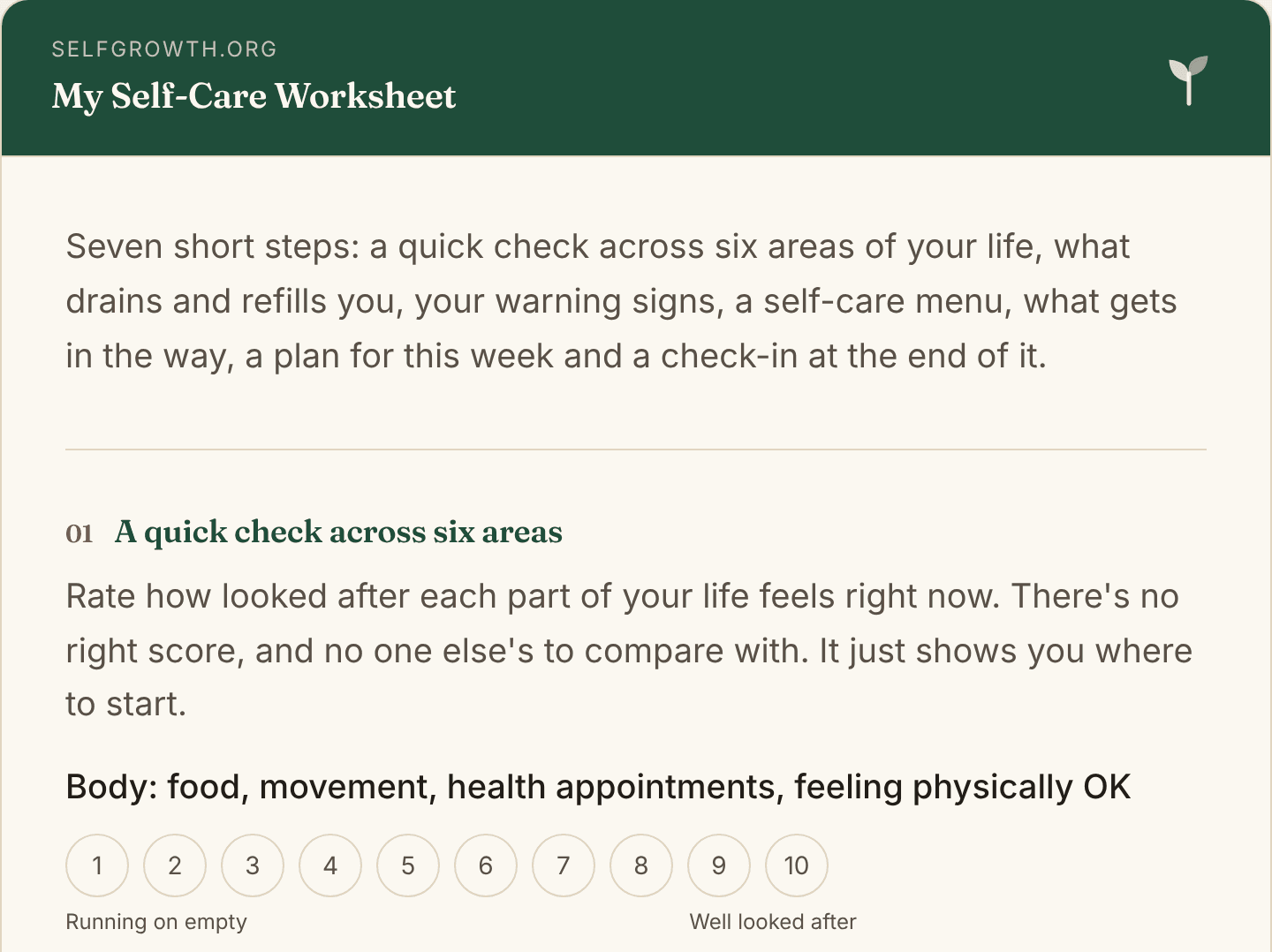
Self-Care Worksheet
A free, printable self-care worksheet for adults: check six areas of your life, see what drains and refills you, and make a self-care plan that costs nothing.
Open worksheet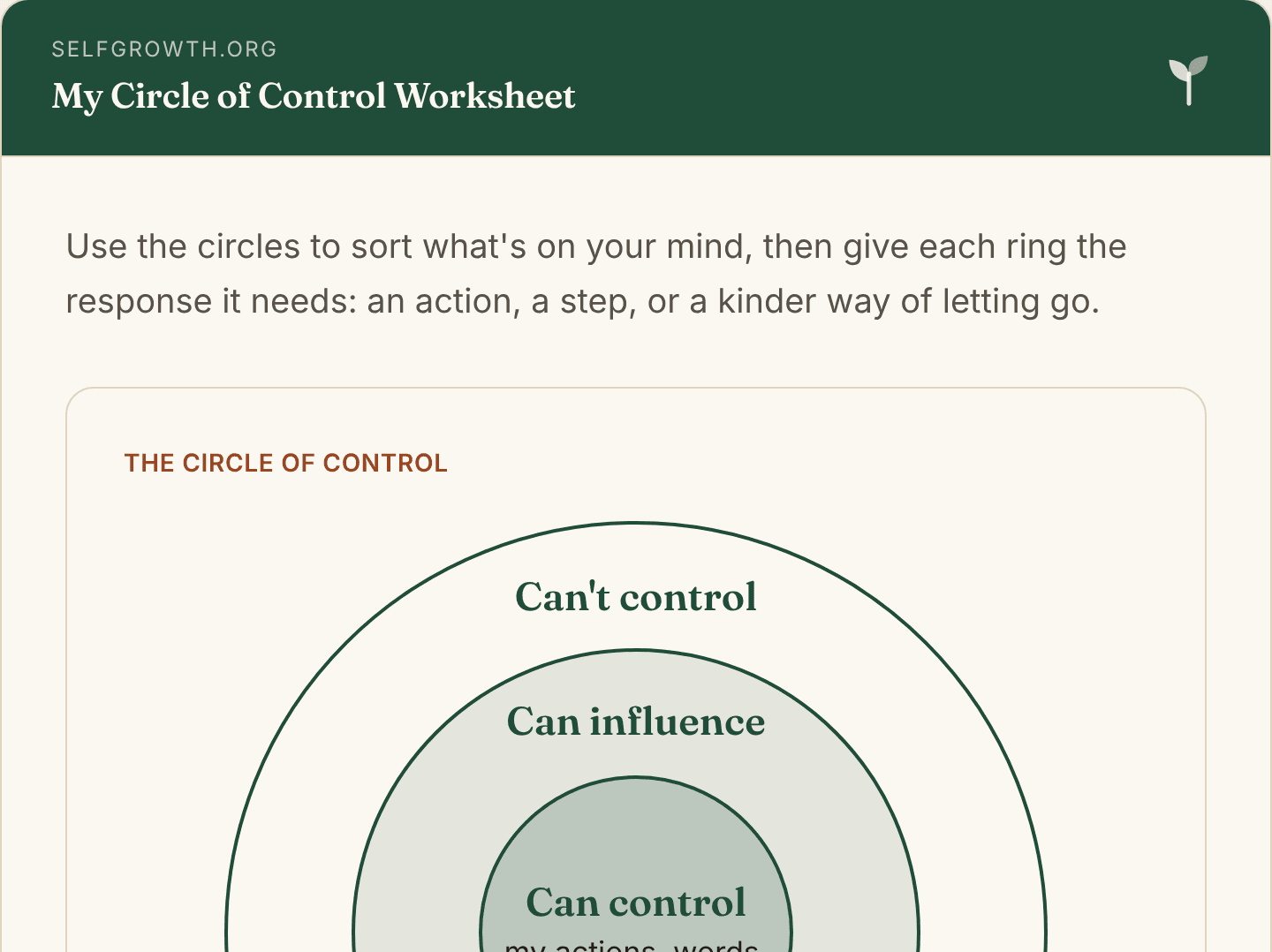
Circle of Control Worksheet
A free circle of control worksheet: sort your worries into what you can control, influence and can't control, then choose one step for each. Free PDF.
Open worksheet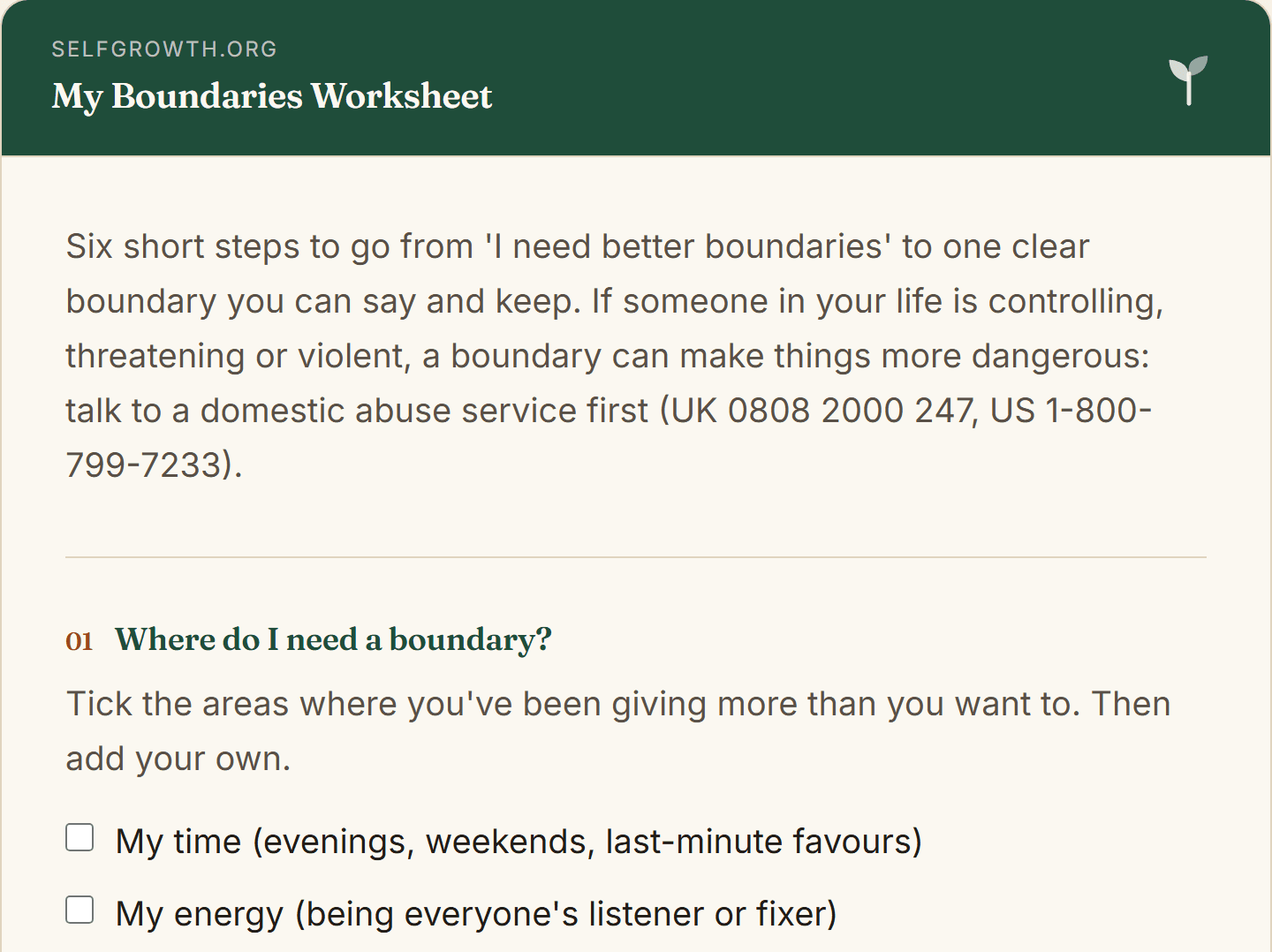
Boundaries Worksheet
A free, printable boundaries worksheet: spot where you need a limit, write it as something you'll do, plan the exact words, and decide what you'll do if it's crossed.
Open worksheetRelated guides
New worksheets, straight to your inbox
An occasional new worksheet or tool, sent only when there's something genuinely worth your time. No spam, no pressure, unsubscribe any time.