
Guide
Work boundaries: how to set them without wrecking your job
Updated 25 October 2026 · 9 min read
Work boundaries are the limits you set on your time, energy and tasks so your job does not take over the rest of your life. To set one, pick a single clear limit, say it calmly in a few words, offer an alternative and then keep to it. Start small, such as when you reply to messages.
Drawn from assertiveness and workplace guidance · Part of work and skills
You may say yes to every request, answer messages at night or skip lunch to keep up. It can feel like being a good colleague, until you notice you are tired, resentful or never off.
You can set work boundaries in plain steps, with words you can use. The boundaries worksheet lets you plan the exact wording, and the wider guide to setting boundaries covers family and friends too.
This is a self-help guide, not therapy or legal advice. If work stress is hurting your sleep or mood, a GP can help.
What are work boundaries?
A work boundary is a limit on what you will do, when and how, said clearly and kept consistently. It covers your time (when you work), your tasks (what is and is not yours), your energy (how much you give) and your contact (how and when people reach you).
A boundary is about your own action, not about controlling someone else. 'Stop emailing me at night' is a request. 'I answer messages between 9 and 5, so I will reply in the morning' is a boundary, because it is something you can do.
Boundaries are not laziness or a lack of commitment. They are a way to decide how much of you the job gets.
Examples of healthy boundaries at work
- Stopping work at a set time most days.
- Taking a proper lunch break away from your desk.
- Turning off work notifications on your phone in the evening and at weekends.
- Saying 'I can do that, but not by Friday. Which should I do first?'
- Using your holiday and not checking in while you are away.
- Not discussing your private life if you do not want to.
- Blocking time in your calendar for focused work.
- Saying no to a meeting that has no clear purpose for you.
Healthy boundaries are firm where it matters and flexible where it does not. Staying late once for a real emergency is not a broken boundary. Staying late every week without choosing to is a pattern worth looking at.
Signs your work boundaries need attention
- You answer messages at all hours and feel guilty if you do not.
- You say yes first and work out how later.
- You regularly work through lunch or past your finishing time without choosing to.
- You take on other people's tasks because it is easier than asking them.
- You feel resentful, drained or dread Sunday evenings.
- You find it hard to switch off, even on holiday.
- Work crowds out sleep, meals, exercise or time with people you care about.
Any one of these can happen in a busy week. It is the pattern that matters. If you also feel exhausted and detached, the guide to the signs of burnout may help you tell what is going on.
How to set boundaries at work: step by step
Pick one boundary, not five. A small, clear one is easier to keep and shows you it can be done.
- 1Notice where it hurts. Which part of work leaves you most tired or resentful? Name one specific situation, such as late messages.
- 2Decide what you want instead. Write it as something you will do, such as 'I will reply to messages by 9am the next day.'
- 3Check it against your job. Does your role include on-call or shift work? Make the boundary fit the real job, not an ideal one.
- 4Write the words. Keep it short, calm and clear, with no long apology. The scripts below give you a start.
- 5Offer an alternative. 'Not today, but I can do it tomorrow' is easier for people to accept than a plain no.
- 6Say it early and in a neutral moment, not mid-argument. A short message or a chat with your manager both work.
- 7Keep to it. The first week is the hardest, because people are used to the old pattern. Respond the same way each time.
- 8Review after two weeks. What worked? What needs adjusting? Change the boundary if it does not fit, rather than dropping it.
What to say: scripts for common situations
These are starting points, not magic phrases, and how people respond will vary.
- Extra work: 'I would like to help. I am at capacity this week. Can it wait until Monday, or shall we decide what to move?'
- After-hours messages: 'I do not check messages after 6pm. I will pick this up first thing tomorrow. If it is urgent, please call me.'
- Interruptions: 'I am in the middle of something. Can I come to you at 2 when I have finished?'
- A manager's unrealistic deadline: 'I can do A by Friday or A and B by Tuesday. Which matters more?'
- A meeting you do not need: 'I do not think I can add much to this one. Could you send me the notes afterwards?'
- A request you cannot say yes to: 'I cannot take that on right now.' You do not have to give a long reason.
These steps and scripts are common workplace advice, not a tested method. Change the words so they sound like you.
Notice that most of these offer a choice or an alternative. That keeps the focus on the work, not on a personal clash. To sort what is truly urgent before you answer, the Eisenhower matrix template helps you separate what is urgent and important from what only feels urgent.
Open the Eisenhower Matrix TemplateBoundaries when working from home
When your home is your office, the day has no natural end. A few cues can stand in for the commute.
- Keep a set start and finish time, and tell your team what they are.
- Use a dedicated space if you can. If not, pack the laptop away at the end of the day.
- Have a short closing routine: write tomorrow's top three, close tabs, shut the laptop.
- Take a real break at lunch and step outside if you can.
- Use status messages or calendar blocks to show when you are away.
- Keep work apps off your personal phone, or silence them in the evening.
- Tell people you live with when you are working, so they know when not to interrupt.
The weekly planner printable is a simple way to put your hours on paper.
When boundaries aren't respected
Sometimes you set a clear, fair limit and it is ignored. Here is a practical order to work through:
- Repeat it calmly, in the same short words. Do not add new reasons.
- Write things down: dates, what was asked, what you said and what happened. Keep it factual.
- Talk to your manager, or if the problem is your manager, to their manager or HR. Describe the effect on your work, not just your feelings.
- If you have a union or staff representative, ask for their help.
- Check your contract and company policies for hours and on-call rules.
In Great Britain, GOV.UK says you cannot work more than 48 hours a week on average, normally averaged over 17 weeks, but you can choose to opt out of that limit. There are exceptions for some jobs, such as emergency services and armed forces. The GOV.UK page on maximum weekly working hours has the details. Acas, which gives advice on workplace rights and rules, has a helpline you can contact through acas.org.uk/contact. Rules differ in other countries and for different kinds of work, so this is not legal advice. For a specific legal question, ask an adviser.
When to get more support
If work stress is affecting your sleep or mood, or you feel low, anxious or worn out most days, see your GP. A counsellor or therapist can also help if saying no brings up strong fear or guilt. This is self-help and is not a substitute.
If you ever feel unsafe or have thoughts of harming yourself, call Samaritans on 116 123 (UK and Ireland), 988 (US), or find a line at findahelpline.com.
Sources and further reading
This is an educational self-reflection resource, not therapy or medical advice.
If you want to go deeper
- Maximum weekly working hours. GOV.UK (gov.uk/maximum-weekly-working-hours).
- Acas, contact page (acas.org.uk/contact).
Your questions, answered
- How do I set boundaries at work without upsetting my boss?
- Keep it calm, short and about the work. Offer an alternative or a choice, such as 'I can do A by Friday or A and B by Tuesday. Which matters more?' Raise it in a neutral moment, not mid-argument, and keep to it.
- What are examples of work boundaries?
- Stopping work at a set time, taking a real lunch break, turning off notifications in the evening, saying a task cannot be done by a given date, using your holiday fully and blocking focus time in your calendar.
- How do I say no at work?
- Say it briefly, without a long apology, and offer another option where you can. For example, 'I cannot take that on right now. I could look at it next week.' You do not need to give a long reason.
- What if I'm expected to reply to messages after hours?
- Check whether your role really includes being on call. If not, tell your manager when you will reply, for example first thing in the morning, and give a way to reach you for real emergencies. Then do it the same way each time.
- Is there a work life balance worksheet?
- Yes. The boundaries worksheet and the weekly planner printable both help. Each has a Download PDF button and a Print option. They are free, with no payment and no email needed. You can fill them in on screen, and your answers save in your browser.
- Can I be punished for setting boundaries at work?
- It depends on your job, your contract and where you live, and a guide cannot say. Keep a factual note of what happens, read your contract and policies, and ask a workplace adviser if you are worried. In Great Britain, Acas can advise on workplace rights.
- Is this guide legal advice or therapy?
- No. It is a self-help guide, not therapy or legal advice. For a legal question, ask a qualified adviser. If work stress is affecting your sleep or mood, see a GP. If you ever feel unsafe or have thoughts of harming yourself, call Samaritans on 116 123 (UK and Ireland), 988 (US), or find a line at findahelpline.com.
Worksheets to do the work
Free to fill in online or print. No email needed.
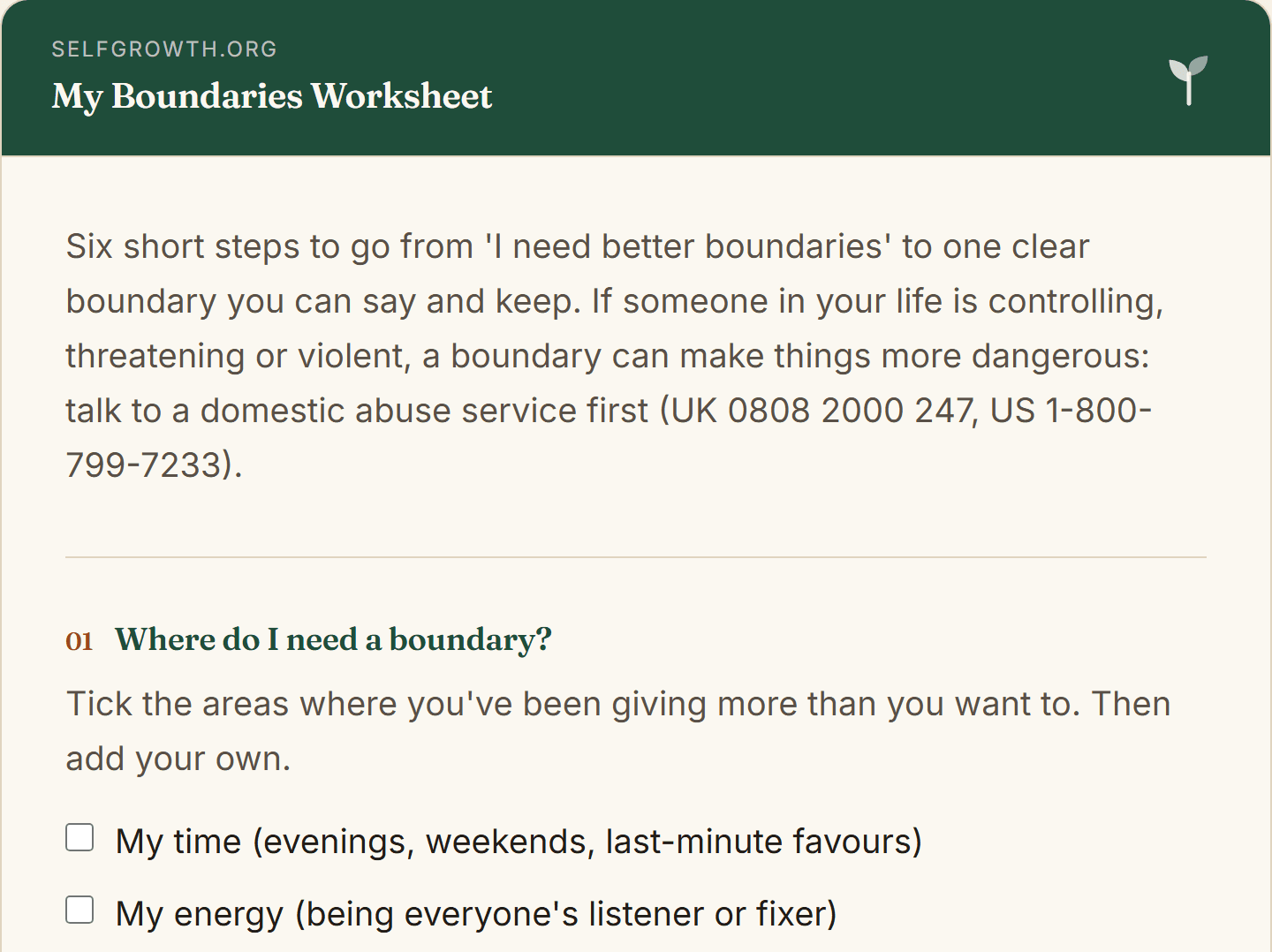
Boundaries Worksheet
A free, printable boundaries worksheet: spot where you need a limit, write it as something you'll do, plan the exact words, and decide what you'll do if it's crossed.
Open worksheet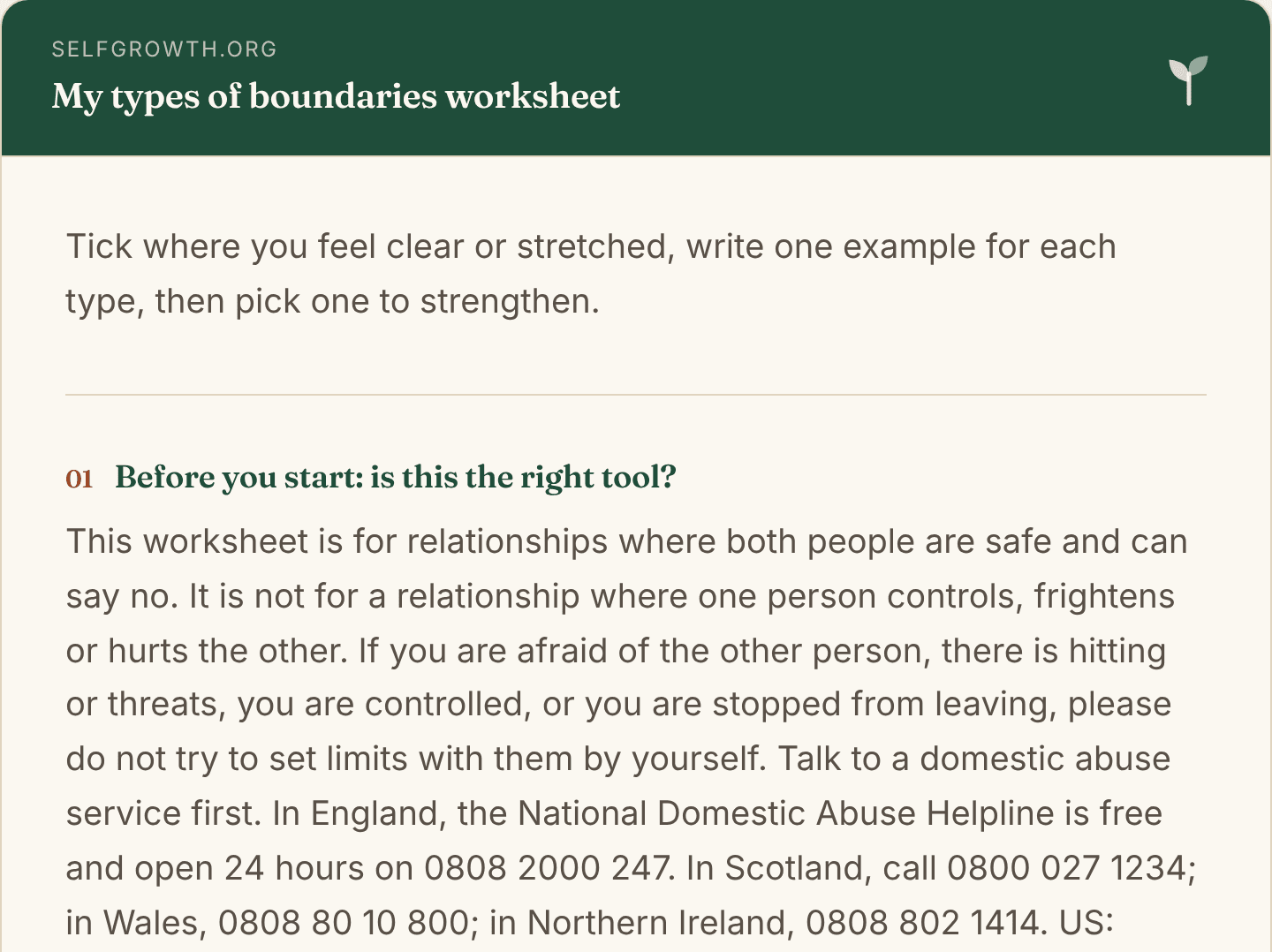
Types of Boundaries Worksheet
A free, printable types of boundaries worksheet: physical, emotional, time, material, digital and mental. Tick where you feel clear or stretched and pick one to strengthen.
Open worksheet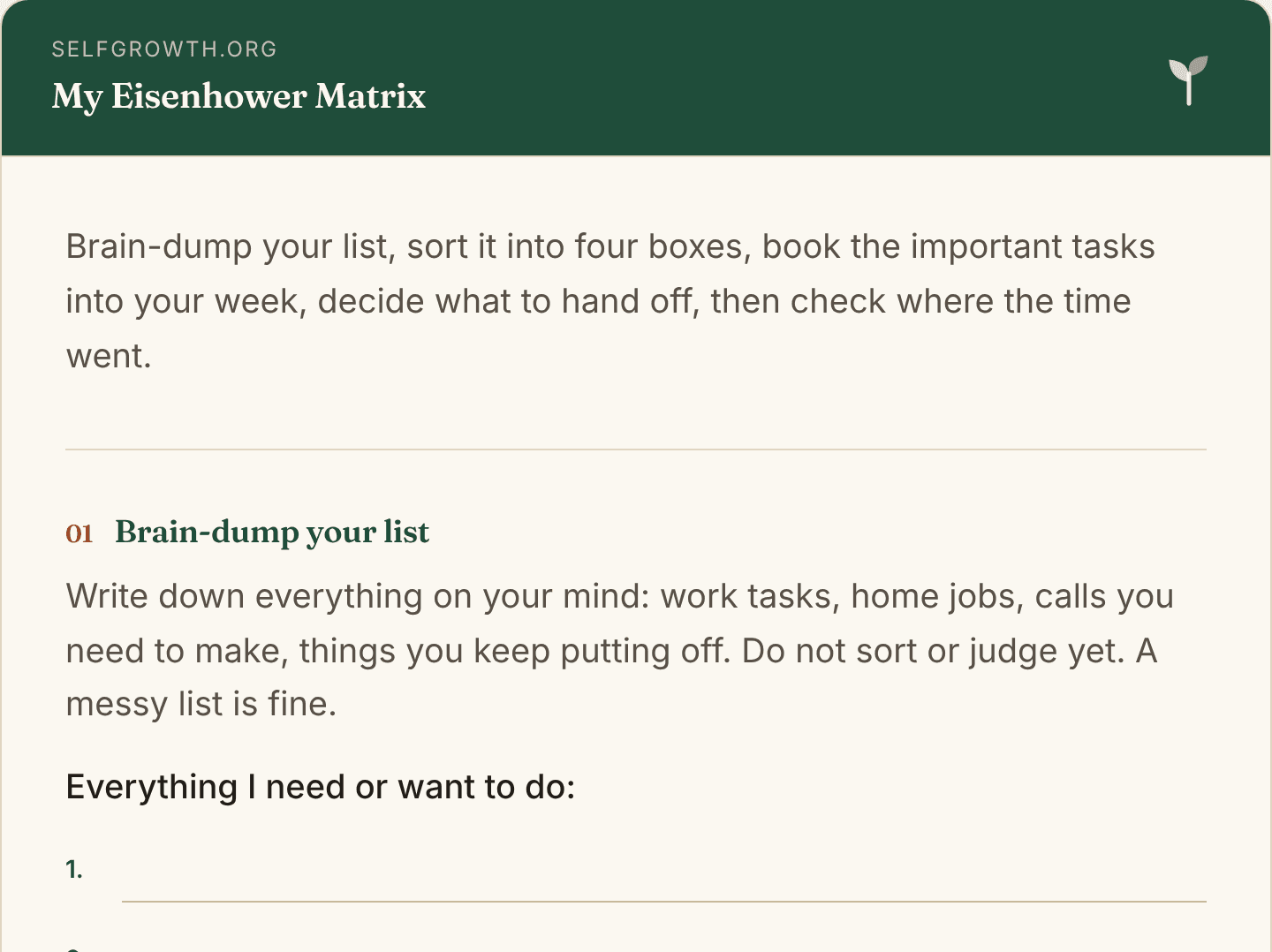
Eisenhower Matrix Template
A free Eisenhower matrix template: empty your head onto a list, sort it into four boxes, book the important tasks into your week, and check where time went.
Open worksheet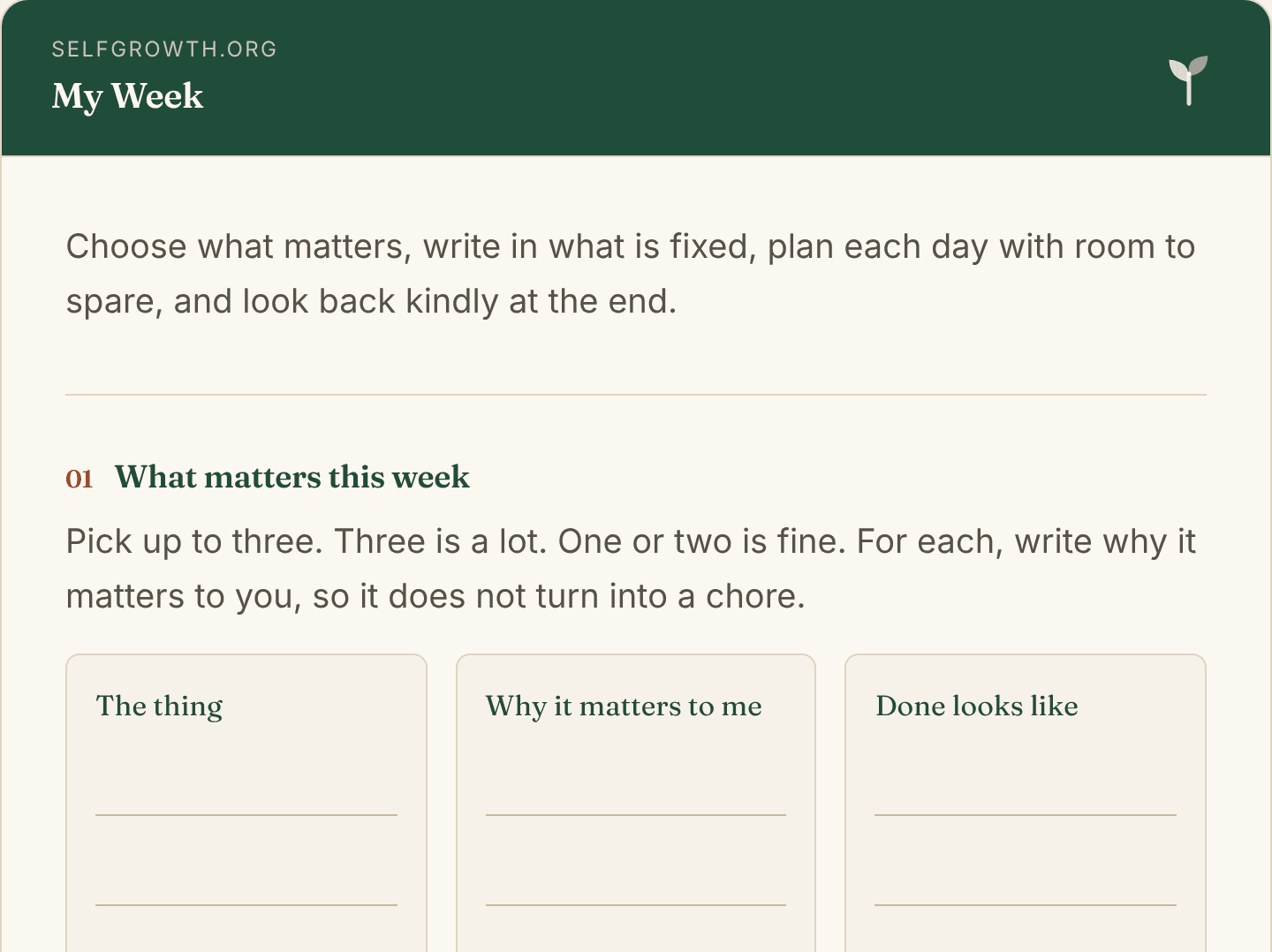
Weekly Planner Printable
A free weekly planner printable: pick up to three priorities, note fixed times, plan each day with a buffer and rest, then look back kindly. Print or fill in.
Open worksheet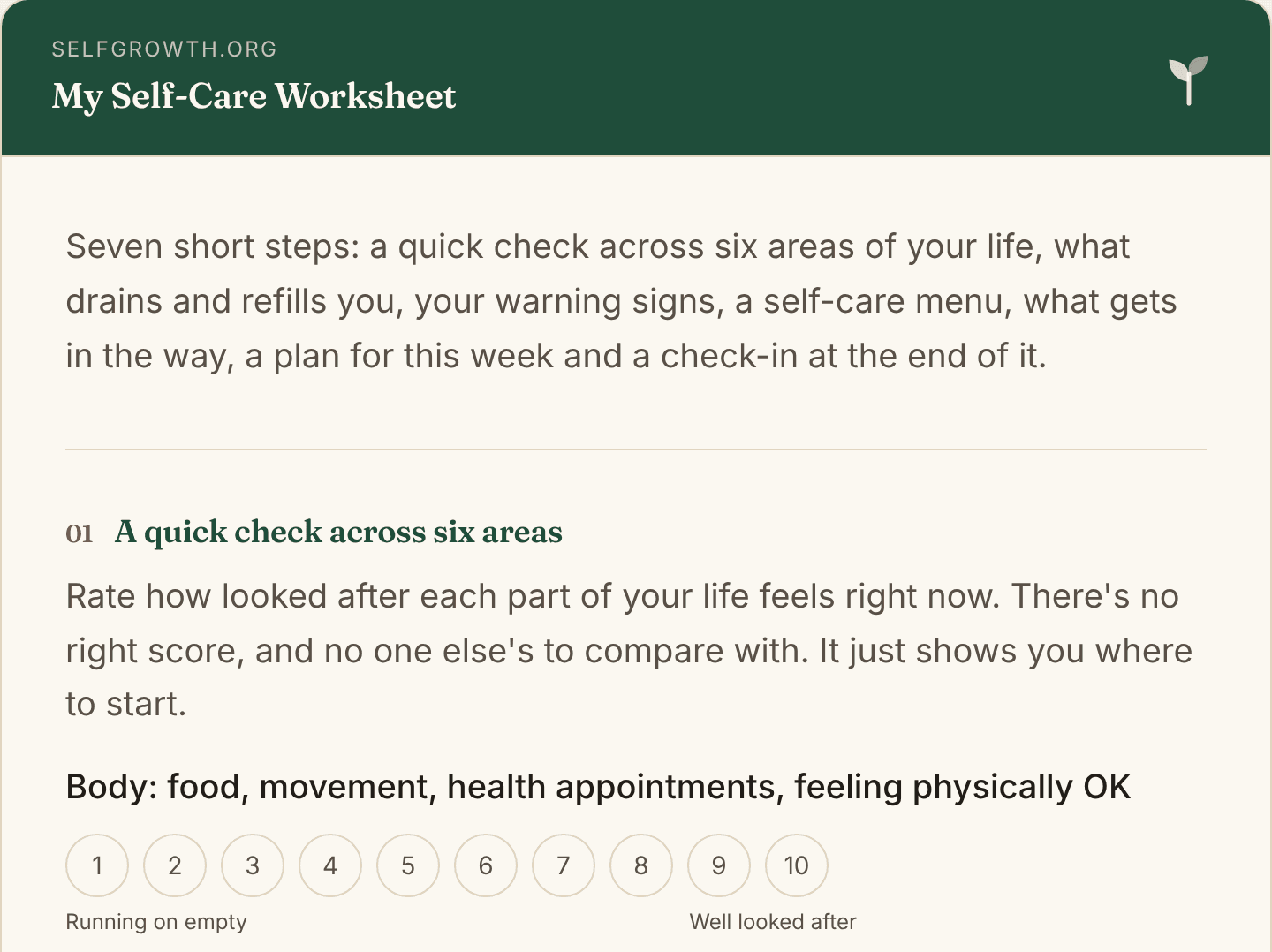
Self-Care Worksheet
A free, printable self-care worksheet for adults: check six areas of your life, see what drains and refills you, and make a self-care plan that costs nothing.
Open worksheetRelated guides
New worksheets, straight to your inbox
An occasional new worksheet or tool, sent only when there's something genuinely worth your time. No spam, no pressure, unsubscribe any time.