
Boundaries
Types of boundaries worksheet: see which kind you need and what to say
Updated 23 October 2026 · 6 min read · Free to print
The main types of boundaries are physical, emotional, time, material, digital and mental. This free, printable worksheet explains each in plain words, lets you tick where you feel clear or stretched, asks for one example in your own words, then helps you pick one to strengthen with an exact sentence to say.
A plain-words guide to common boundary types · Part of relationships and communication
Fill it in here (it saves in this browser, but not in a private window), print it, or download the PDF. Free, no sign-up.
'I need better boundaries' is hard to act on, because it could mean anything. It gets easier once you know which kind of limit is missing. Is it your space, your feelings, your hours, your money, your phone or your opinions?
Counselling services describe boundary types in slightly different ways. No single list is agreed, so treat the ones here as handy labels rather than a rulebook. The point is to spot where you feel clear and where you feel stretched.
You will go through each type, tick how it feels, write one example in your own words, then pick one type to strengthen. If you want the full steps for setting and keeping a boundary, the boundaries worksheet takes you through them.
How to use this worksheet
- 1Set aside about 15 minutes somewhere quiet.
- 2Go with your first reaction when you tick. You are noticing, not grading yourself.
- 3Keep each example to one sentence. A small, real one is better than a dramatic one.
- 4Choose a type that feels hard but safe to work on, not the hardest relationship in your life.
The worksheet
selfgrowth.org
My types of boundaries worksheet
Tick where you feel clear or stretched, write one example for each type, then pick one to strengthen.
01Before you start: is this the right tool?
This worksheet is for relationships where both people are safe and can say no. It is not for a relationship where one person controls, frightens or hurts the other. If you are afraid of the other person, there is hitting or threats, you are controlled, or you are stopped from leaving, please do not try to set limits with them by yourself. Talk to a domestic abuse service first. In England, the National Domestic Abuse Helpline is free and open 24 hours on 0808 2000 247. In Scotland, call 0800 027 1234; in Wales, 0808 80 10 800; in Northern Ireland, 0808 802 1414. US: National Domestic Violence Hotline 1-800-799-7233. Elsewhere, see selfgrowth.org/help. If you are in immediate danger, call your local emergency number (999 UK, 911 US).
02Physical and emotional boundaries
Physical boundaries cover your body, personal space, touch and privacy. Emotional boundaries cover your feelings and energy, such as how much you share and whether you take on someone else's mood as your job.
Physical: how does it feel right now?
One example of a physical boundary, in my own words:
For example: 'I like a hug to be my choice.'
Emotional: how does it feel right now?
One example of an emotional boundary, in my own words:
For example: 'I can listen without having to solve it.'
03Time and material boundaries
Time boundaries are about how your hours and rest are spent. Material boundaries are about your money and belongings, and what you will lend, give or share.
Time: how does it feel right now?
One example of a time boundary, in my own words:
For example: 'I finish work at six.'
Material: how does it feel right now?
One example of a material boundary, in my own words:
For example: 'I do not lend money I need back.'
04Digital and mental boundaries
Digital boundaries are about your phone, messages, passwords and what you share online. Mental boundaries are about your own thoughts, values and opinions, and being free to hold them without being talked out of them.
Digital: how does it feel right now?
One example of a digital boundary, in my own words:
For example: 'I do not answer work messages after dinner.'
Mental: how does it feel right now?
One example of a mental boundary, in my own words:
For example: 'I can say I see it differently and leave it there.'
05Pick one to strengthen
Choose the type where you feel most stretched and a change feels safe to try. Then write the exact sentence, kind and short, that you could say. Signs a boundary is missing: for physical, you go along with touch or closeness you would rather not; for emotional, you carry someone else's mood as your job; for time, your hours keep going to other people's plans; for material, you lend or pay and then feel resentful; for digital, you feel you must always reply or hand over access; for mental, you give in to keep the peace.
The type I will work on:
The situation, in a sentence or two:
Use a role, not a name: 'a colleague', 'a family member'.
The exact sentence I will say:
State what you will do, not what they must do. For example: 'I can't stay late tonight, I will pick it up tomorrow.'
When and where I will say it:
How confident do I feel saying it?
06After I said it
Come back to this part once you have tried it.
What happened, and what did I do?
How confident do I feel now?
When you're done, a moment to reflect
- Which type of boundary feels easiest to hold, and what helps you hold it?
- Which type do you give up first when you are tired or want to keep the peace?
- Is there a type you had not thought of as a boundary until now?
- What would you say to a friend who described the same situation?
- What is one small step you can take this week, and who could support you with it?
Done for now?
Save today's answers as a dated entry. You can come back, fill it in again and compare the two side by side.
Where do these boundary types come from?
The University of Manitoba's Student Counselling Centre names physical, emotional, mental, material and time boundaries among others. The University of Edinburgh's Student Counselling Service describes psychological boundaries as soft, spongy, rigid or flexible. This worksheet uses the common labels, plus digital, because phones and messages are where limits often get tested.
This is a reflection exercise, so use your own notes as the test. Ticking where you feel clear or stretched and writing your own example helps you put a name to a vague feeling, which makes it easier to plan what to say.
These are educational self-reflection tools, not therapy.
If you want to go deeper
- University of Manitoba Student Counselling Centre. Healthy personal boundaries and how to establish and maintain them. https://umanitoba.ca/student-supports/student-counselling-centre/support-resources/healthy-personal-boundaries-how
- University of Edinburgh Student Counselling Service. Types of personal boundary. https://student-counselling.ed.ac.uk/supporting-students/setting-boundaries/types
- National Domestic Abuse Helpline (nationaldahelpline.org.uk); National Domestic Violence Hotline (thehotline.org).
Your questions, answered
- What are the types of boundaries?
- Common types are physical (your body and space), emotional (your feelings and energy), time (your hours and rest), material (money and belongings), digital (your phone and privacy online) and mental (your thoughts and opinions). Different counselling services group them in different ways, so no single list is agreed. They are useful labels for spotting where you feel stretched.
- What are examples of each type of boundary?
- Physical: 'I would rather shake hands.' Emotional: 'I can listen, but I can't fix this for you.' Time: 'I am free until six.' Material: 'I don't lend money.' Digital: 'I'll reply to messages in the morning.' Mental: 'I see it differently, and that's fine.' Use the example lines on this worksheet to write your own.
- How do I know which boundary I need?
- Look for the signals: resentment after saying yes, dread before a call, tiredness from always being on hand. Match the feeling to a type. Resentment about hours points to time. A tight feeling when someone shares your information points to digital or emotional. Then start with one boundary at a time.
- What is the difference between a boundary and a rule for someone else?
- A boundary says what you will do, such as 'I'll leave at ten'. A rule for someone else says what they must do, such as 'You can't keep me late'. You can't control other people, but you can decide your own response, so boundaries that describe your action are easier to keep.
- Is there a types of boundaries worksheet PDF?
- Yes. Use the Download PDF button for a clean, print-ready copy, or Print to print straight from the page. It is completely free, with no payment and no email needed. You can also fill it in on screen, and your answers save in your browser.
- What if someone gets angry when I set a boundary?
- A strong reaction does not always mean you got it wrong, but your safety comes first. If the person has hit you, threatened you or controls what you do, do not push the boundary yourself. Talk to a domestic abuse service first. In England, the National Domestic Abuse Helpline is free and open 24 hours on 0808 2000 247. In Scotland, call 0800 027 1234; in Wales, 0808 80 10 800; in Northern Ireland, 0808 802 1414. US: National Domestic Violence Hotline 1-800-799-7233. Elsewhere, see selfgrowth.org/help. If you are in immediate danger, call your local emergency number (999 UK, 911 US).
- Is this worksheet a substitute for therapy?
- No. It is a self-help tool for thinking through your limits, not therapy or medical advice. If boundaries are tied up with something painful, a GP or counsellor can help. Thoughts like these are serious: if you ever feel unsafe or have thoughts of harming yourself, call Samaritans on 116 123 (UK and Ireland), 988 (US), or find a line at findahelpline.com. More support is at selfgrowth.org/help.
Keep going, related worksheets
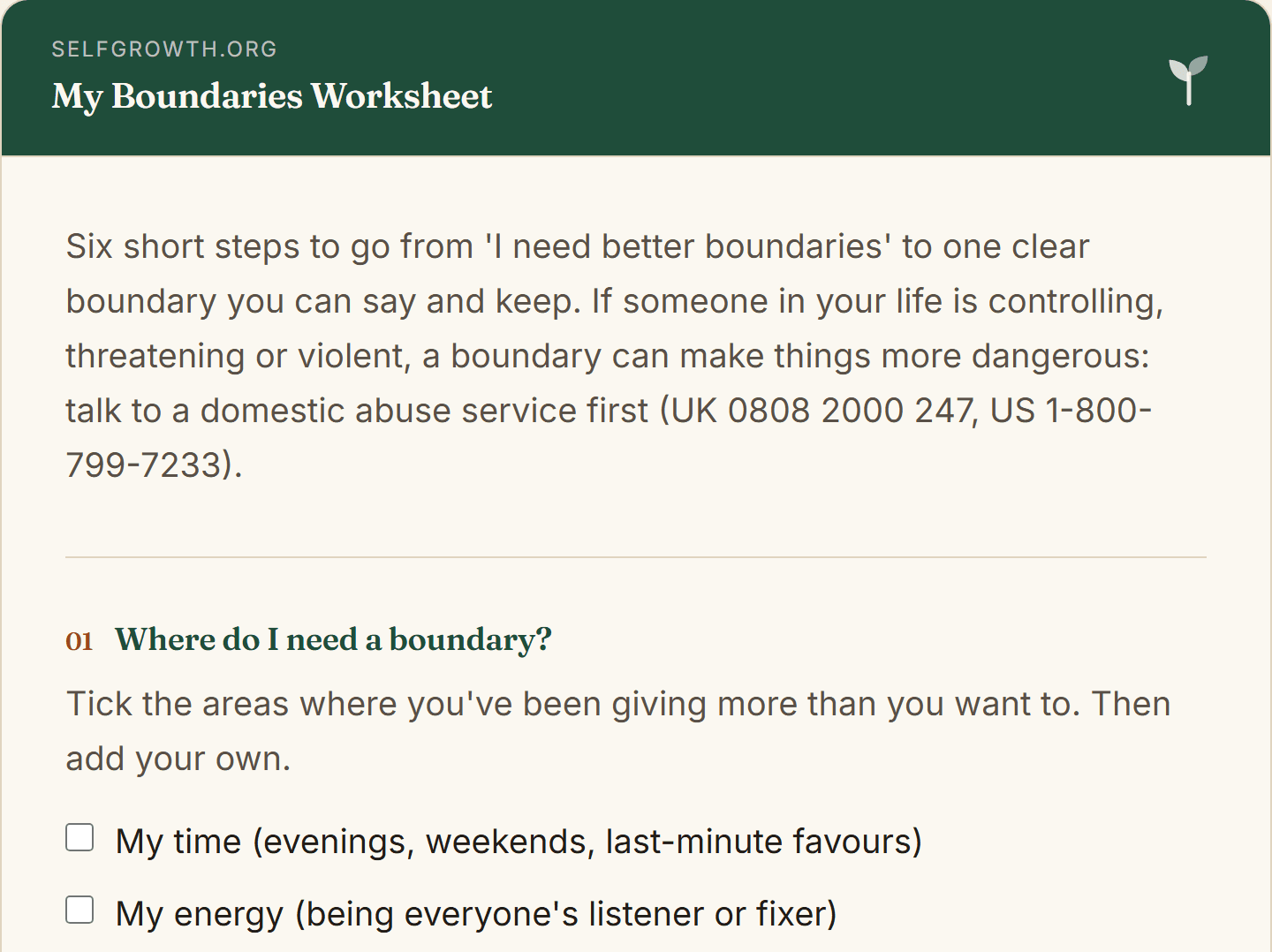
Boundaries Worksheet
A free, printable boundaries worksheet: spot where you need a limit, write it as something you'll do, plan the exact words, and decide what you'll do if it's crossed.
Open worksheet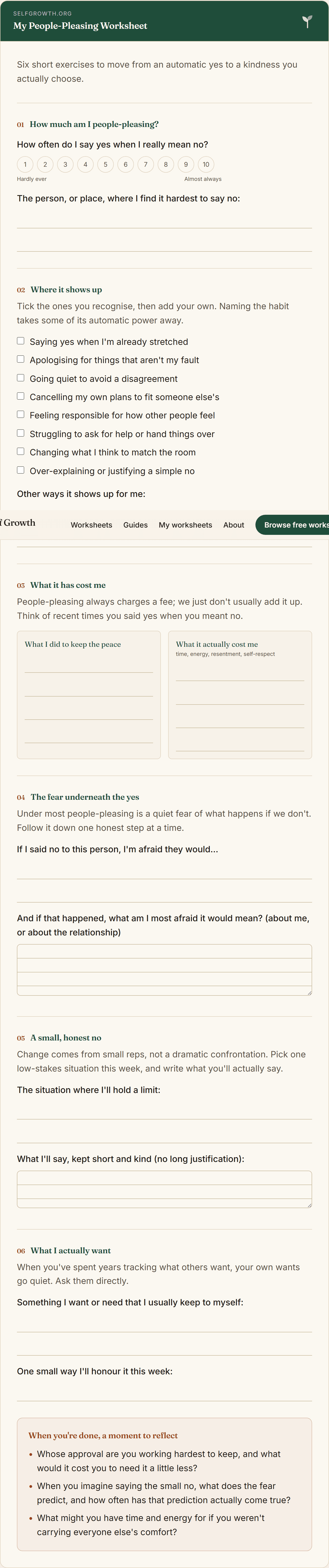
People-Pleasing Worksheet
A free, printable people-pleasing worksheet: see where you over-give, name the fear underneath, count the real cost, and practise one small, honest no.
Open worksheet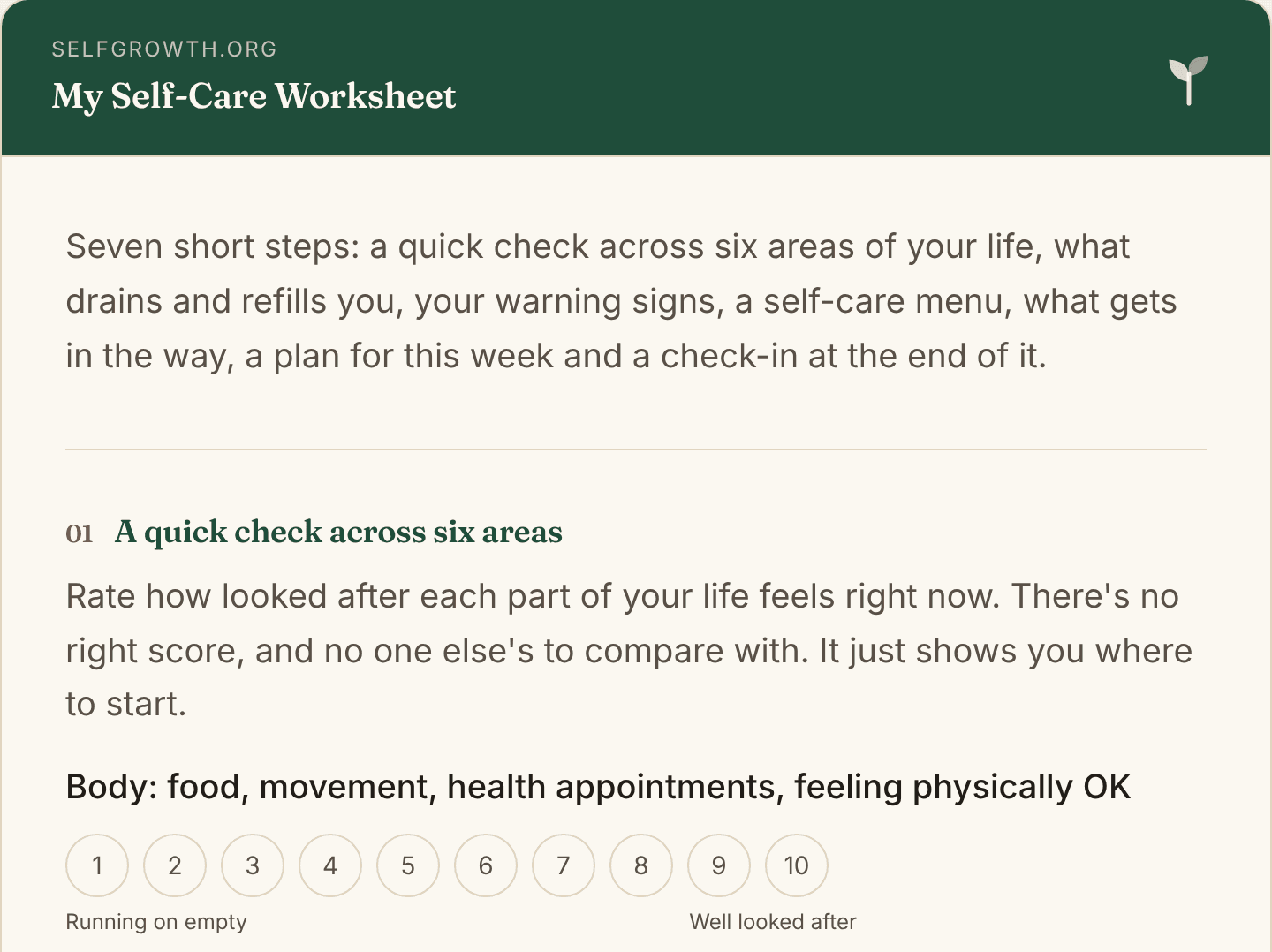
Self-Care Worksheet
A free, printable self-care worksheet for adults: check six areas of your life, see what drains and refills you, and make a self-care plan that costs nothing.
Open worksheetNew worksheets, straight to your inbox
An occasional new worksheet or tool, sent only when there's something genuinely worth your time. No spam, no pressure, unsubscribe any time.