
Planning
Weekly planner printable: a free one-page plan for the week, with room to breathe
Updated 25 October 2026 · 6 min read · Free to print
A weekly planner printable is a one-page plan for the next seven days. This free one helps you pick up to three things that matter, write down fixed commitments, give each day one main thing, plan in rest and a buffer, and finish with a kind look back. Print it or fill it in on screen.
Drawn from research on planning and if-then plans · Part of habits and getting things done
Fill it in here (it saves in this browser, but not in a private window), print it, or download the PDF. Free, no sign-up.
Start with the few things that matter this week, not with a blank grid to fill. Then see the time you really have, once your fixed commitments and rest are written in.
Each day gets one main thing, any fixed times, and one small win. There is also a buffer, because plans tend to run long. If a long list is what's weighing on you, empty your head first with the brain dump template, then pick from it here. If you keep putting the same task off, the procrastination worksheet can help.
A planner is a format, not a treatment. There's no test showing that a paper planner changes your life. It is a tidy place to make choices and see them. It is not therapy either. If stress or low mood is the real problem, a GP is the right person to talk to.
How to use this worksheet
- 1Set aside ten minutes before the week starts. Sunday evening or Monday morning both work.
- 2Fill in the first three sections before the grid. Choose your priorities and write down what is already fixed.
- 3Add a buffer and some rest before you add more tasks. Then fill in one main thing per day.
- 4Keep the page where you will see it. At the end of the week, do the look back, then start a fresh page.
The worksheet
selfgrowth.org
My Week
Choose what matters, write in what is fixed, plan each day with room to spare, and look back kindly at the end.
01What matters this week
Pick up to three. Three is a lot. One or two is fine. For each, write why it matters to you, so it does not turn into a chore.
Entry 1
Entry 2
Entry 3
02What is already fixed
Work, school runs, appointments, calls, anything with a set time. Writing them first shows you the space that is left, not the space you wish you had.
Entry 1
Entry 2
Entry 3
Entry 4
Entry 5
03Rest and energy
Plan the rest as you would plan a meeting. If you only fit it in when everything else is done, it tends not to happen.
Tick what you want to protect this week:
How much energy do I expect to have this week?
When in the week do I usually feel best, and when do I flag?
04Monday to Friday
One main thing per day, and a 'when and where' for it: 'After lunch, at my desk, I will draft the email.' A small win can be tiny. Leave a day blank if it is already full.
Entry 1
Entry 2
Entry 3
Entry 4
Entry 5
05Saturday and Sunday
Weekends often hold the chores, the people and the rest all at once. Choose what you want from them, not just what has piled up.
Entry 1
Entry 2
06My buffer
Plans usually take longer than we expect. A buffer is time you leave empty on purpose, so one late task does not knock the whole week over.
Entry 1
Entry 2
Entry 3
If the week goes sideways, the one thing I will still do is:
07End-of-week look back
Do this at the end of the week, with curiosity and not judgement. You are learning how your weeks really run.
What got done, and what am I glad about?
What moved, and why? (too big, wrong time, not mine, something came up)
Entry 1
Entry 2
Entry 3
Next week I will give myself more time for:
When you're done, a moment to reflect
- Which task took longer than you thought, and by roughly how much?
- Did your priorities feel like yours, or like someone else's list?
- Where did rest actually happen, and where did it get squeezed out?
- What was your best day this week, and what made it work?
- What is one thing you will plan differently next week?
Done for now?
Save today's answers as a dated entry. You can come back, fill it in again and compare the two side by side.
What is behind this weekly planner?
Two ideas shape the layout. The first is the planning fallacy. In 1994, Roger Buehler, Dale Griffin and Michael Ross reported that people's predictions of how long tasks would take were too optimistic, for both school and non-school tasks. People tended to picture the plan going well instead of looking back at how similar tasks had gone. In one study the bias went away when people were told to connect their guesses to past experience. The buffer section and the look back are built on that idea.
The second is the 'when and where' plan. Peter Gollwitzer and Paschal Sheeran's 2006 meta-analysis pooled research on implementation intentions, which are plans shaped like 'when this happens, I will do that'. The 'When and where' column asks you to make that kind of plan for each day's main thing.
Honest limits. No research shows that this particular planner changes how a week goes, and the three-priority cap and the look back are a planning format, not a tested method. Treat it as a tidy format for making choices, and change anything that does not suit you.
These are educational self-reflection tools, not therapy.
If you want to go deeper
- Buehler, R., Griffin, D. & Ross, M. (1994). Exploring the planning fallacy: Why people underestimate their task completion times. Journal of Personality and Social Psychology, 67(3), 366-381.
- Gollwitzer, P. M. & Sheeran, P. (2006). Implementation intentions and goal achievement: A meta-analysis of effects and processes. Advances in Experimental Social Psychology, 38, 69-119.
Your questions, answered
- What is a weekly planner?
- A weekly planner is a single page where you lay out the next seven days. It shows what is already fixed, what you want to get done, and where the gaps are. This one starts with up to three priorities, adds rest and a buffer, gives each day one main thing, and ends with a short look back at the week.
- How do I plan my week?
- Start with what matters most, not with the grid. Pick up to three priorities, write in your fixed commitments, and protect some rest. Then give each day one main thing and a time and place for it. Leave a buffer of empty time. At the end of the week, note what got done, what moved and what to carry over.
- Why do my plans always take longer than I think?
- It is very common. Psychologists call it the planning fallacy. In a 1994 paper, Buehler, Griffin and Ross found that people's predicted times were too optimistic across a range of tasks, partly because they pictured the plan going smoothly instead of remembering similar past tasks. In one of their studies, the bias disappeared when people were asked to link their guess to past experience. That is why this page has a buffer.
- Why write down when and where I will do something?
- Because a plan with a time and place is easier to start than a plan with neither. Researchers call these 'implementation intentions', plans shaped like 'when this happens, I will do that'. Gollwitzer and Sheeran pooled the research on them in a 2006 meta-analysis. This is a planning format, not a proven treatment, so use what helps and skip what does not.
- How many priorities should I have each week?
- Up to three, and one or two is often better. If everything is a priority, nothing is. Your fixed commitments already take a lot of the week. Anything that does not make the list can wait on your brain dump page until next week.
- Is there a weekly planner PDF?
- Yes. Use the Download PDF button for a print-ready copy, or Print to print straight from the page. It is free, with no payment and no email needed. You can also fill it in on screen, and your answers save in your browser on that device.
- Is this a substitute for therapy?
- No. It is a self-help tool, not therapy or medical advice. If stress, low mood or worry is what is really getting in the way of your week, please talk to your GP. If you ever feel unsafe or have thoughts of harming yourself, call Samaritans on 116 123 (UK and Ireland), 988 (US), or find a line at findahelpline.com.
Keep going, related worksheets
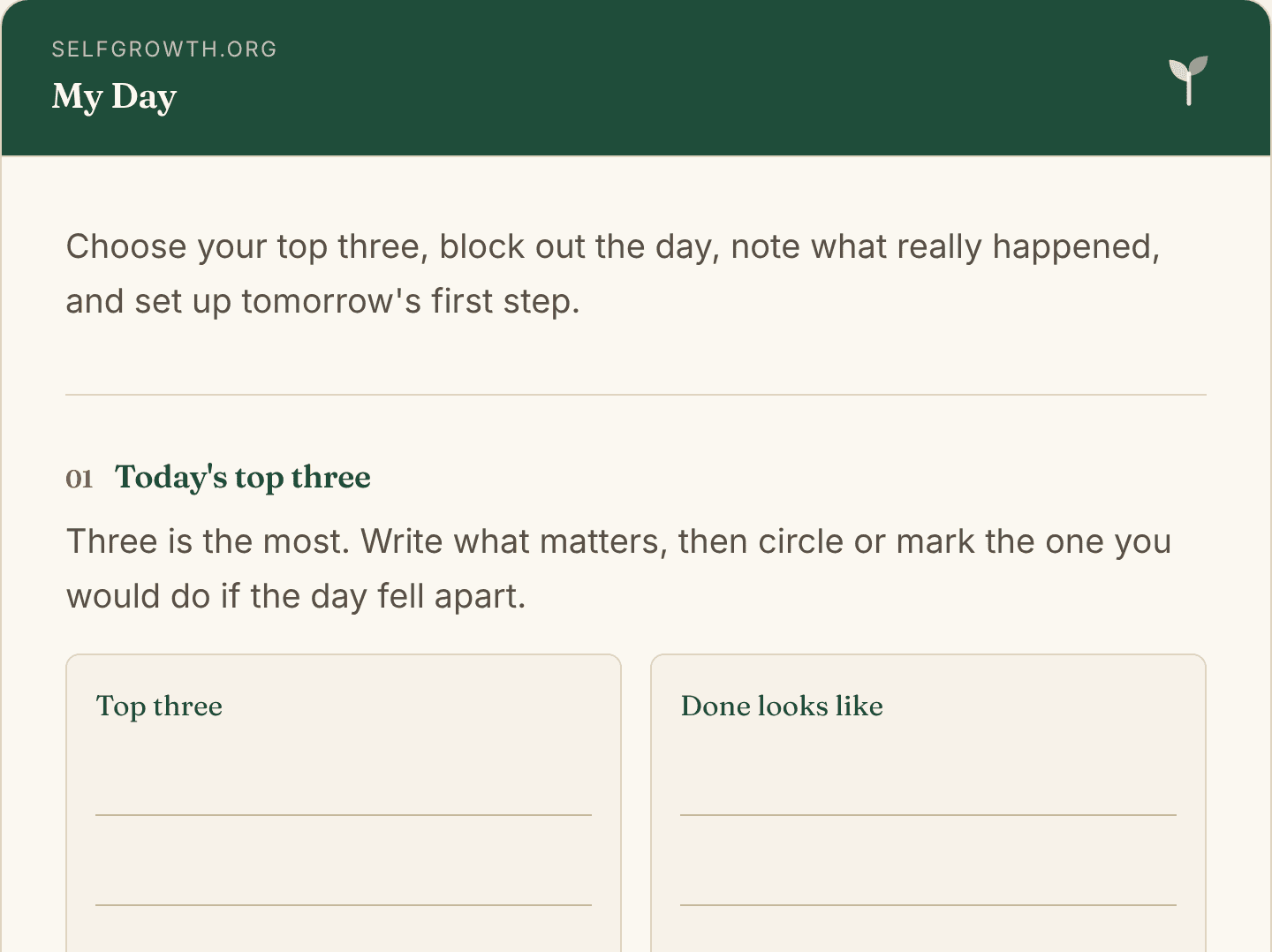
Daily Planner Template
A free daily planner template on one page: top three, time blocks, appointments, breaks, a short to-do list and a two-minute look back. Print or fill in.
Open worksheet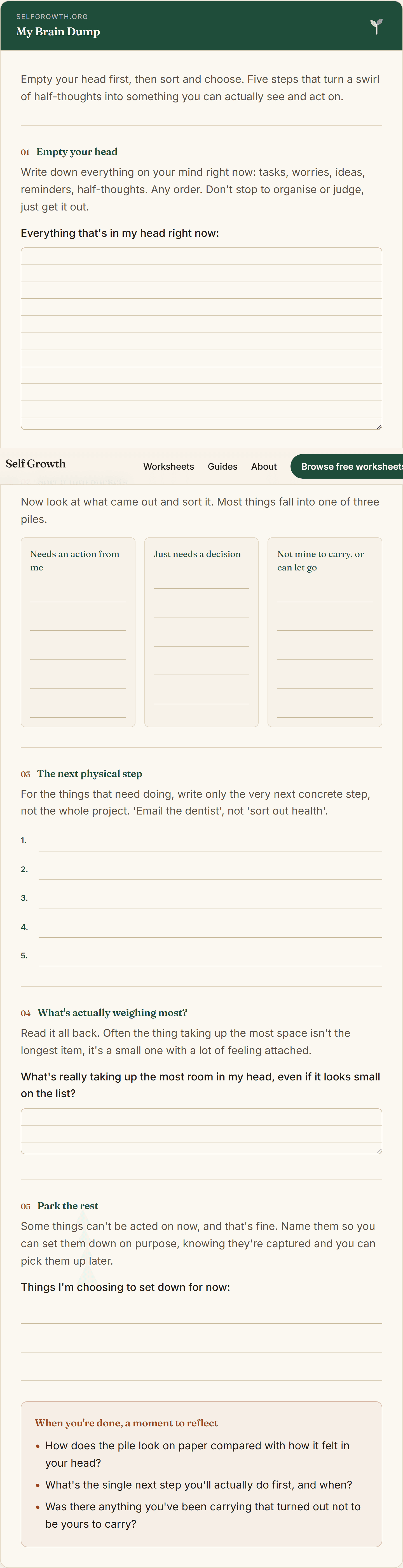
Brain Dump Template
A free, printable brain dump template to empty a cluttered mind onto the page, sort it into what needs action and what to let go, and find the next clear step.
Open worksheet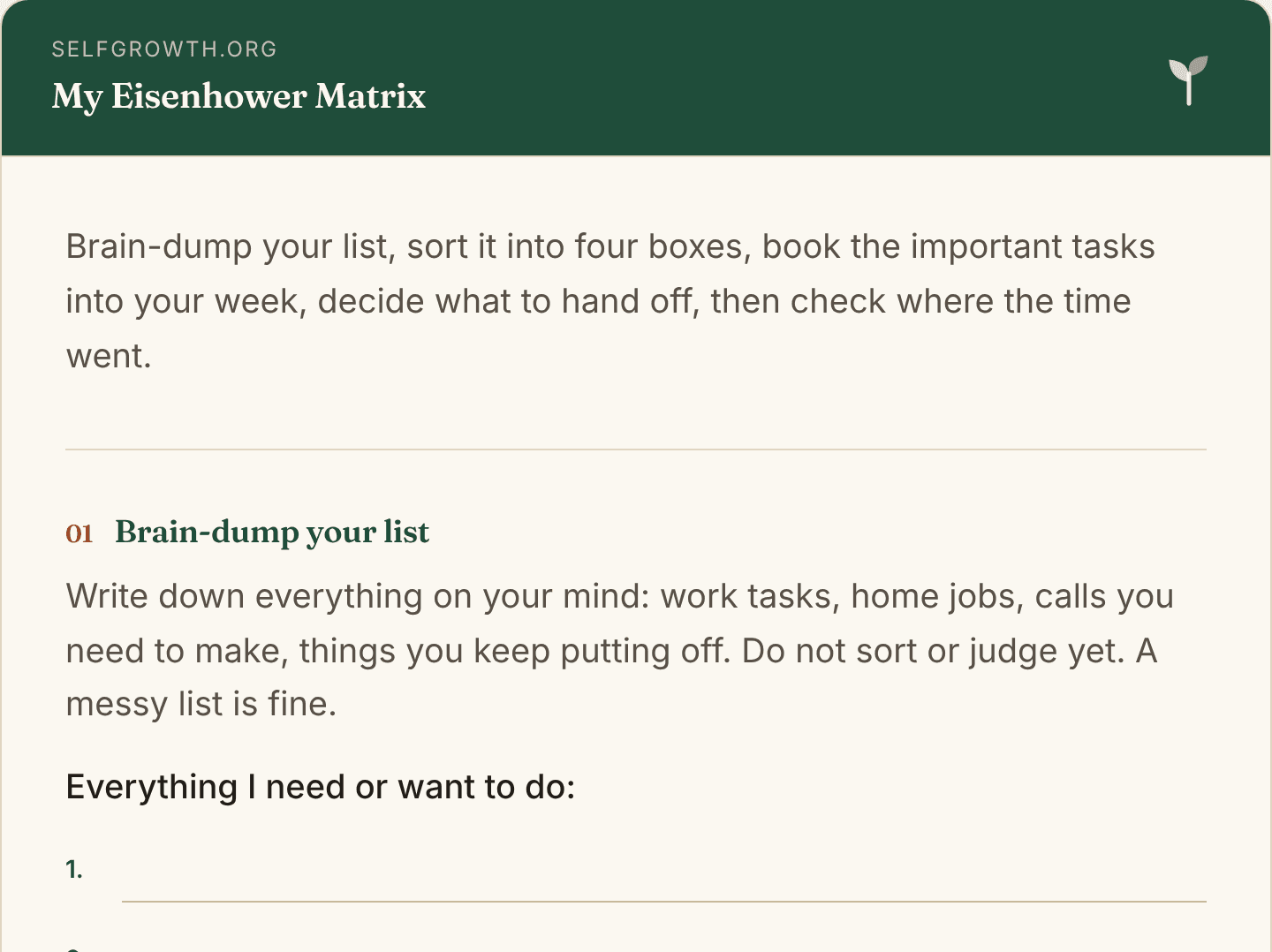
Eisenhower Matrix Template
A free Eisenhower matrix template: empty your head onto a list, sort it into four boxes, book the important tasks into your week, and check where time went.
Open worksheetNew worksheets, straight to your inbox
An occasional new worksheet or tool, sent only when there's something genuinely worth your time. No spam, no pressure, unsubscribe any time.