
Guide
How to manage stress: what to do when it all feels like too much
Updated 23 October 2026 · 12 min read
To manage stress, name what is causing it, sort it into what you can and cannot control, and take one small action today. Calm your body first with slow breathing, protect your sleep, talk to someone, and cut one thing from your load. If stress is constant or you are struggling to cope, see a GP.
A plain order of moves for stress, with a free worksheet for each · Part of rest and self-care
Your head is full, your shoulders ache, and every small job feels like one too many. Being told to 'just relax' or 'think positive' does not help when the pressure is real.
This guide is self-help, not treatment. It gives you a plain order to work in: understand what stress is, spot it in yourself, and try concrete moves one at a time. The last section says when stress is too much to handle alone.
What is stress?
The NHS describes stress as a reaction to mental or emotional pressure. The World Health Organization (WHO) calls it a state of worry or mental tension caused by a difficult situation, and a natural response to a challenge.
Your body and mind get ready to deal with the demand. Your attention narrows, your muscles tighten and your breathing speeds up. That can be useful for a short push, such as a deadline or a difficult conversation. The NHS notes that some stress can be motivating, but constant stress can become a problem, because there is no point where you stand down.
Stress is not the same as anxiety or burnout, although they overlap. Stress can be tied to a pressure you can name. The guide to the signs of burnout covers burnout. If worry has become the main problem, how to stop overthinking goes further into that.
What are the signs of stress?
Stress shows up in different places for different people. The NHS groups the signs into body, mind and behaviour. You do not need all of them, and none of them proves stress on its own.
In your body:
- Headaches or dizziness.
- Muscle tension or pain, such as a tight neck, jaw or shoulders.
- Stomach problems.
- A faster heartbeat or chest pain (see the safety note below).
In your mind:
- Trouble concentrating or making decisions.
- Feeling overwhelmed.
- Constant worry.
- Forgetfulness.
In your behaviour:
- Being more irritable or snappy than usual.
- Changes in sleep or appetite.
- Avoiding certain places or people.
- Drinking or smoking more.
A safety note: chest pain, trouble breathing or fainting can have causes that are not stress and can be serious. Do not assume it is stress. Call 999 (UK) or 911 (US), and use NHS 111 if you are unsure.
What causes stress?
Stress comes from a mix of what is happening to you and how much room you have to cope with it. The NHS lists common sources, and the list is wide:
- Work: pressure, long hours, job insecurity, unemployment or retirement.
- Family and relationships: conflict, separation, or caring for someone.
- Money: unexpected bills, debt or borrowing.
- Health: illness, injury or bereavement.
- Big life events, including good ones such as buying a home or having a baby.
Sometimes there is no clear cause, and that can feel stressful in itself. The NHS also links stress with feeling that you are losing control. WHO adds that wider events, such as economic crises or conflict, can cause stress for whole communities, so it is not always about something you did or failed to do.
How to manage stress: what to do
Work through these in order, or pick the one that fits today. Small and repeated beats big and rare. The NHS advice is not to try to do everything at once and to set small, achievable goals.
- 1Name the stressor. Write down what is actually weighing on you, in plain words, one line each. 'Everything' is hard to act on; 'the report due Friday', 'the overdue bill' and 'my argument with my sister' are not. Getting it out of your head and onto paper can take some of the fog out of it, so do not edit as you go.
- 2Split what you can control from what you cannot. Draw a line down a page. On one side, the parts you can change or influence. On the other, the parts you cannot, such as other people's choices or the past. Put your effort on the first side and decide how you will let the second side be, for now.
- 3Take one small action today. Pick one item from the 'can control' side and choose the smallest next step: send one email, make one phone call, open the letter. Ten minutes counts. Finishing something small gives you a bit of control back.
- 4Calm your body first. Stress is felt in the body, so start there. Sit, stand or lie down. Breathe in through your nose and out slowly through your mouth, making the out-breath a little longer than the in-breath, for at least five minutes. Loosening your muscles from your feet up to your face, or a short walk, work too. When your body settles, thinking gets easier. Stop if you feel dizzy, panicky or far away from your body, or if focusing on your body feels unsafe. Open your eyes and look around, and see a GP if it keeps happening.
- 5Protect your sleep. Keep to similar sleep and wake times, put screens away before bed, and cut back on caffeine and alcohol in the evening.
- 6Talk to someone. Tell a friend, family member, colleague or health professional what is going on, even in a few sentences. You do not need them to fix it. The NHS lists talking to someone as a first step. If there is no one, Samaritans will listen on 116 123 (UK and Ireland).
- 7Say no to one thing, or cut one thing. Look at your load and find one commitment you can drop, delay, shrink or hand to someone else. A short, kind 'I can't take that on right now' is a complete sentence. Fewer demands is a legitimate way to reduce stress, not a failure.
- 8Plan recovery, not just work. Put rest in your diary as you would a meeting: a walk, a meal that is not at your desk, time with someone you like, an evening with no tasks. Regular exercise and time for yourself are both on the NHS list.
Here is what the control split can look like in a real week. Say you have a report due Friday, a tense conversation with your sister and an unexpected bill. You can control when you start the report and whether you ask for help with it. You can influence whether your manager moves the deadline, and how the talk with your sister goes, by how you open it. You can't control that the bill arrived, what your sister said last week, or how your manager feels about the deadline. Your effort goes into the first two lists.
Two of the moves have their own tools. If you are not sure what is getting in the way of your sleep, the sleep diary printable helps you spot a pattern over a week. For recovery, the self-care worksheet helps you plan rest as carefully as you plan work.
Avoid leaning on alcohol, cigarettes, gambling or drugs to cope. The NHS warns they can make mental health worse, and they can add a problem rather than remove one. If you notice that you are drinking or smoking more to get through, that is a good moment to talk to a GP.
Which worksheets and guides help with each move?
Each move has a free tool to go with it. You do not need to do them all.
- Name the stressor: empty your head with the brain dump template.
- Control and what you cannot control: the circle of control worksheet.
- Calm your body: the progressive muscle relaxation script, the guide to how to relax, or grounding techniques if you feel overwhelmed in the moment.
- Sleep: the sleep diary printable.
- Say no: the boundaries worksheet.
- Recovery: the self-care worksheet, and the signs of burnout if stress has been running for a long time.
Does slow breathing help with stress?
Slow breathing has some research behind it, mostly in healthy people. A 2018 review of studies found that breathing slowly, under 10 breaths a minute, left healthy people feeling calmer and less anxious.
These were healthy people, not people living with long-term stress or an anxiety condition, and the studies were about breathing techniques, not about the full list of moves above. So slow breathing looks like a reasonable way to settle yourself in the moment. It does not remove the cause of the stress, which is why the other moves matter.
When to get more support
Self-help is a good start, and it is not always enough. See a GP if you are struggling to cope, if self-help is not working, or if stress is constant rather than coming and going. Also see a GP if it is affecting your sleep, your eating, your work or your relationships, or if you are drinking, smoking or using more to get through. A GP can talk through options and rule out other causes of your symptoms.
The NHS says NHS talking therapies can help with stress, and in England adults can refer themselves without seeing a GP first. In Scotland, Wales and Northern Ireland, ask your GP. If you need help urgently but it is not an emergency, use NHS 111 or ask for an urgent GP appointment.
If you have chest pain, trouble breathing or fainting, call 999 (UK) or 911 (US); use NHS 111 if you are unsure.
Thoughts like these are serious: thoughts of harming yourself or ending your life, or feeling that you cannot go on. Please get help now. Call Samaritans free on 116 123 (UK and Ireland), or call or text 988 (US). Elsewhere, findahelpline.com lists free, confidential lines by country, and selfgrowth.org/help has more. If you are in immediate danger, call 999 (UK) or 911 (US).
Sources and further reading
This is an educational self-reflection resource, not therapy or medical advice.
If you want to go deeper
- NHS. Get help with stress. https://www.nhs.uk/mental-health/feelings-symptoms-behaviours/feelings-and-symptoms/stress/
- World Health Organization. Stress. https://www.who.int/news-room/questions-and-answers/item/stress
- Zaccaro, A., Piarulli, A., Laurino, M., Garbella, E., Menicucci, D., Neri, B. & Gemignani, A. (2018). How breath-control can change your life: A systematic review on psycho-physiological correlates of slow breathing. Frontiers in Human Neuroscience, 12, 353.
Your questions, answered
- What is stress?
- The NHS describes stress as a reaction to mental or emotional pressure, and WHO calls it a state of worry or mental tension caused by a difficult situation. It is a natural response to a demand. A short burst can be motivating, but constant stress can become a problem and is worth getting support for.
- What are the signs of stress?
- The NHS lists signs in the body (headaches, muscle tension, stomach problems, a faster heartbeat), in the mind (trouble concentrating, feeling overwhelmed, constant worry, forgetfulness) and in behaviour (irritability, changes in sleep or appetite, avoiding people, drinking or smoking more). Chest pain, trouble breathing or fainting need urgent medical help, not guesswork.
- How can I manage stress quickly?
- Start with your body. Breathe in through your nose and out slowly through your mouth, with a slightly longer out-breath, for a few minutes. Then name the one thing weighing on you and pick one small action you can take today. For overwhelm in the moment, try a grounding technique. These help you settle; they do not remove the cause.
- What is the best way to deal with stress long term?
- Work on what is causing it and on recovery together. Sort what you can and cannot control, cut or share one commitment, keep a steady sleep routine, move your body, and talk to someone you trust. The NHS also suggests planning ahead for stressful days. If stress is constant, a GP can talk through options such as NHS talking therapies.
- Does slow breathing reduce stress?
- It may help you feel calmer in the moment. A 2018 review of studies found that breathing slowly, under 10 breaths a minute, left healthy people feeling calmer and less anxious. Those were healthy people, not people living with long-term stress, and breathing does not change what is causing the stress.
- When should I see a doctor about stress?
- See a GP if you are struggling to cope, self-help is not working, or stress is constant. Also go if it is affecting your sleep, eating, work or relationships, or you are relying on alcohol, cigarettes or drugs. For chest pain, trouble breathing or fainting, call 999 (UK) or 911 (US), or NHS 111 if you are unsure.
- Are the stress worksheets free, and is this therapy?
- They are free, with no payment and no email needed, and each has a Download PDF button for a print-ready copy. This guide is self-help, not therapy or medical advice. Thoughts like these are serious: if you ever feel unsafe or have thoughts of harming yourself, call Samaritans on 116 123 (UK and Ireland), call or text 988 (US), or find a line at findahelpline.com. More support is at selfgrowth.org/help.
Worksheets to do the work
Free to fill in online or print. No email needed.
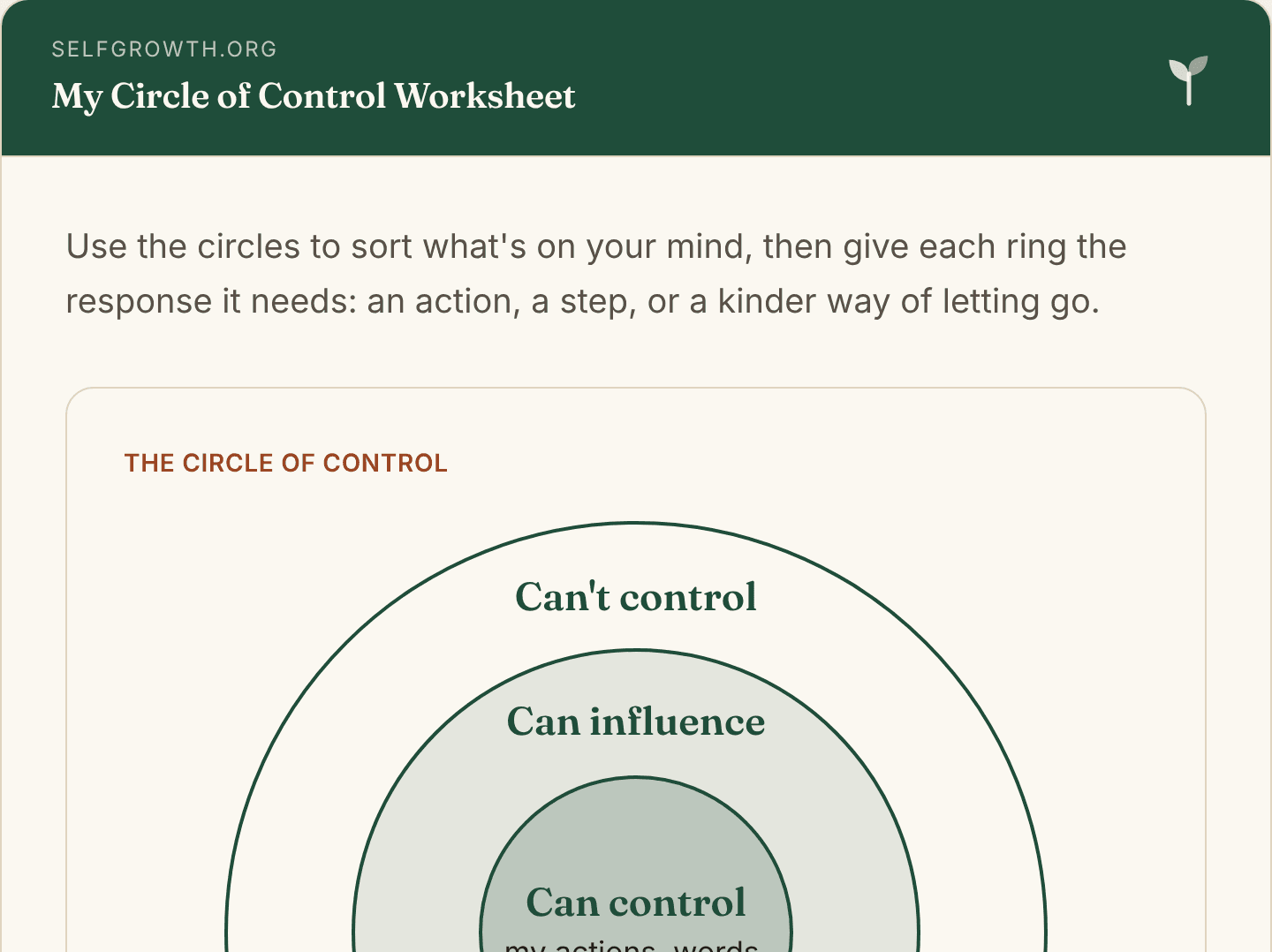
Circle of Control Worksheet
A free circle of control worksheet: sort your worries into what you can control, influence and can't control, then choose one step for each. Free PDF.
Open worksheet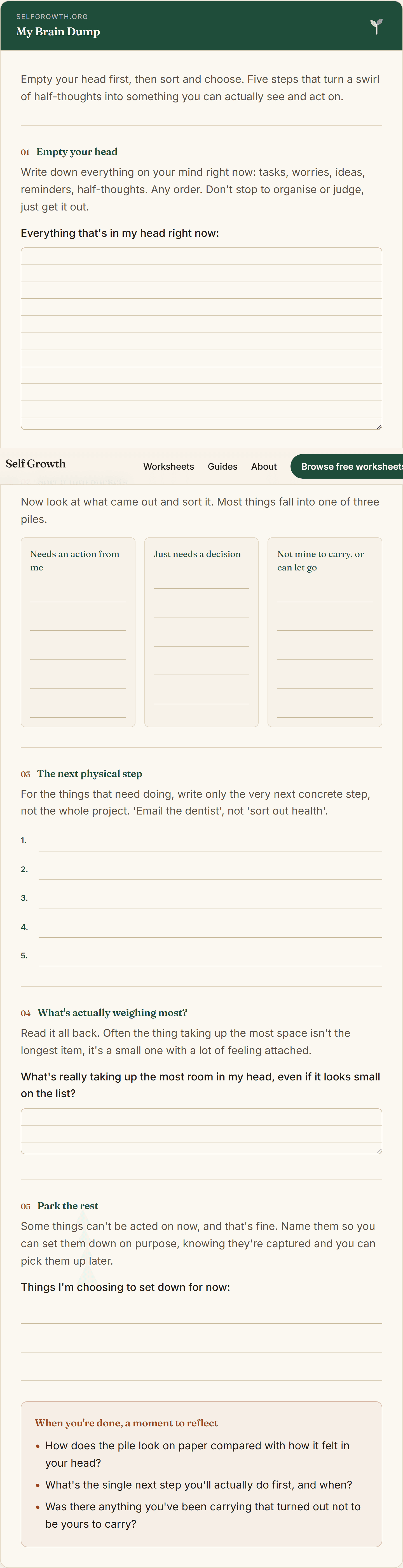
Brain Dump Template
A free, printable brain dump template to empty a cluttered mind onto the page, sort it into what needs action and what to let go, and find the next clear step.
Open worksheet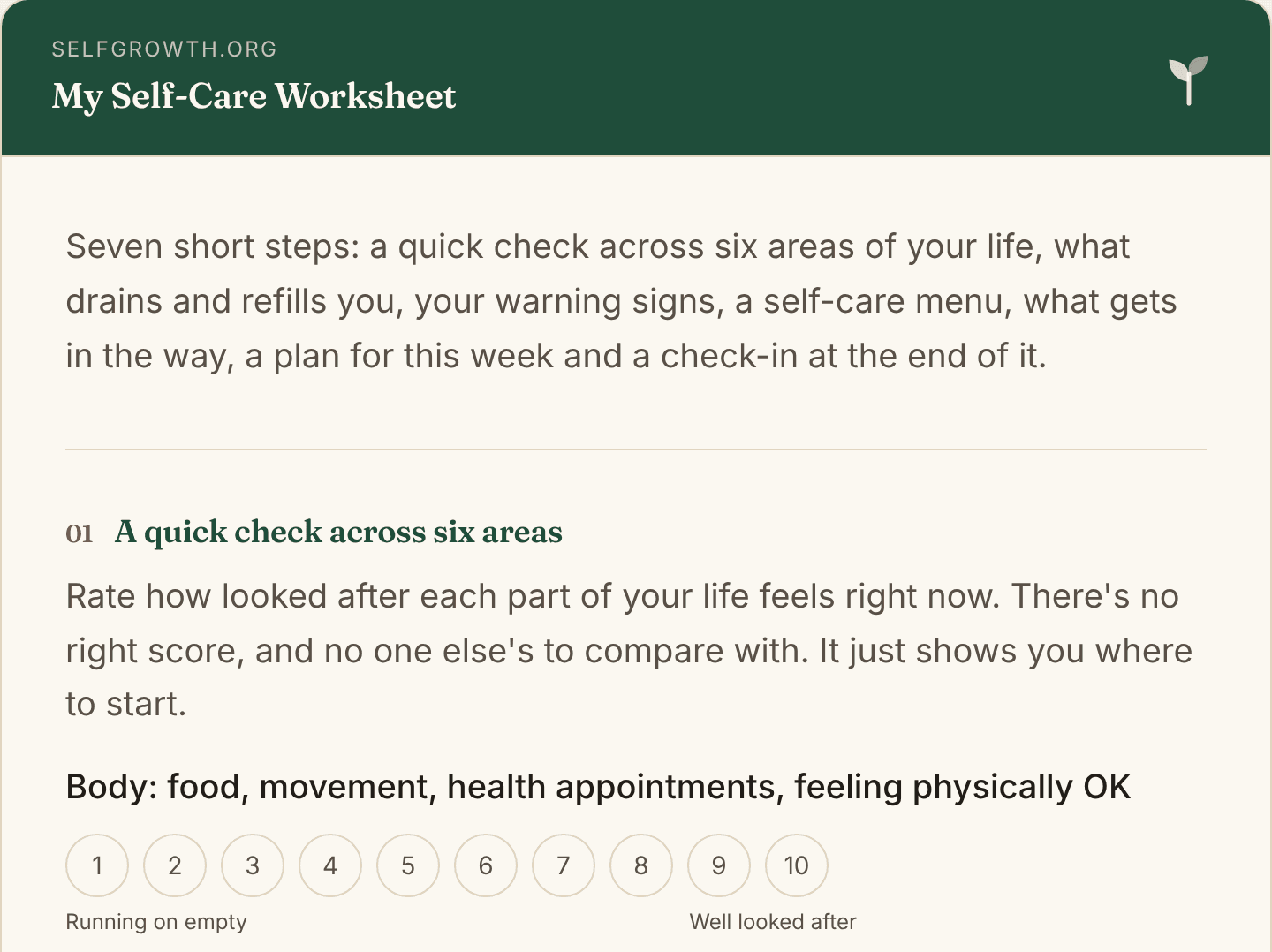
Self-Care Worksheet
A free, printable self-care worksheet for adults: check six areas of your life, see what drains and refills you, and make a self-care plan that costs nothing.
Open worksheet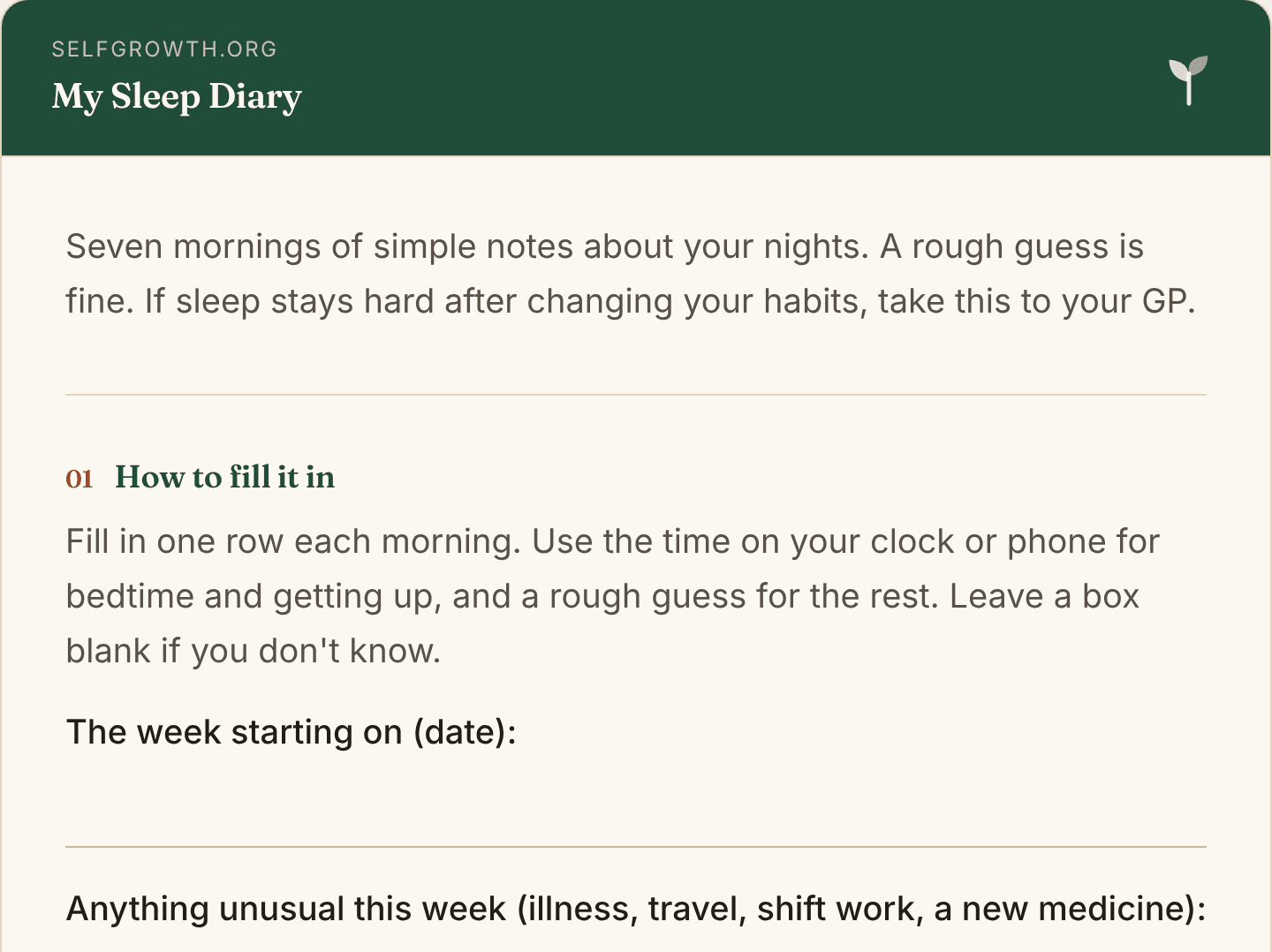
Sleep Diary
A free printable 7-day sleep diary: bedtime, wake time, how rested you felt, caffeine and notes, plus a page to bring to your GP if sleep stays hard.
Open worksheet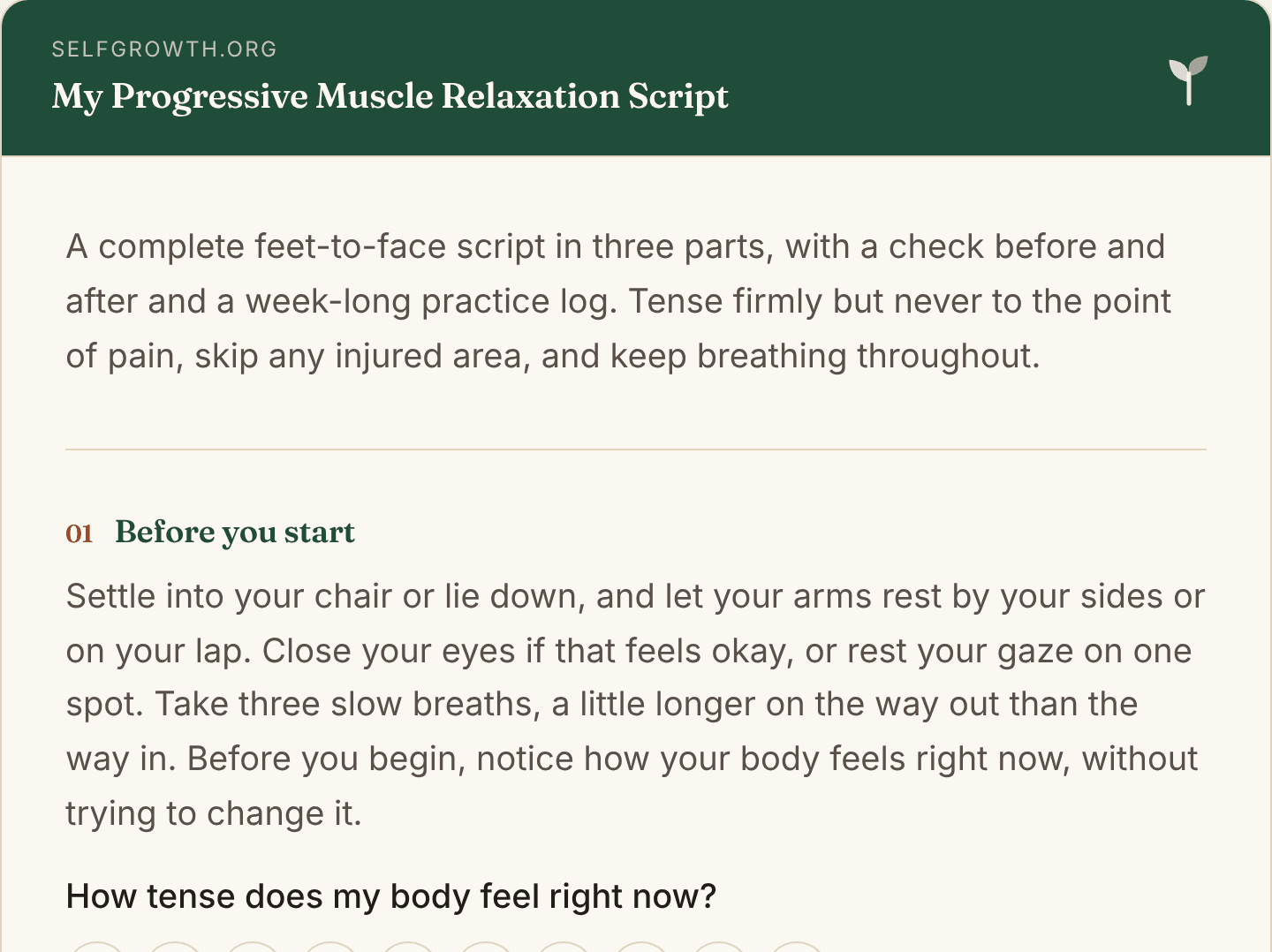
Progressive Muscle Relaxation Script
A free progressive muscle relaxation script in plain English: tense and release 13 muscle groups from feet to face, with a before-and-after check and 7-day log.
Open worksheet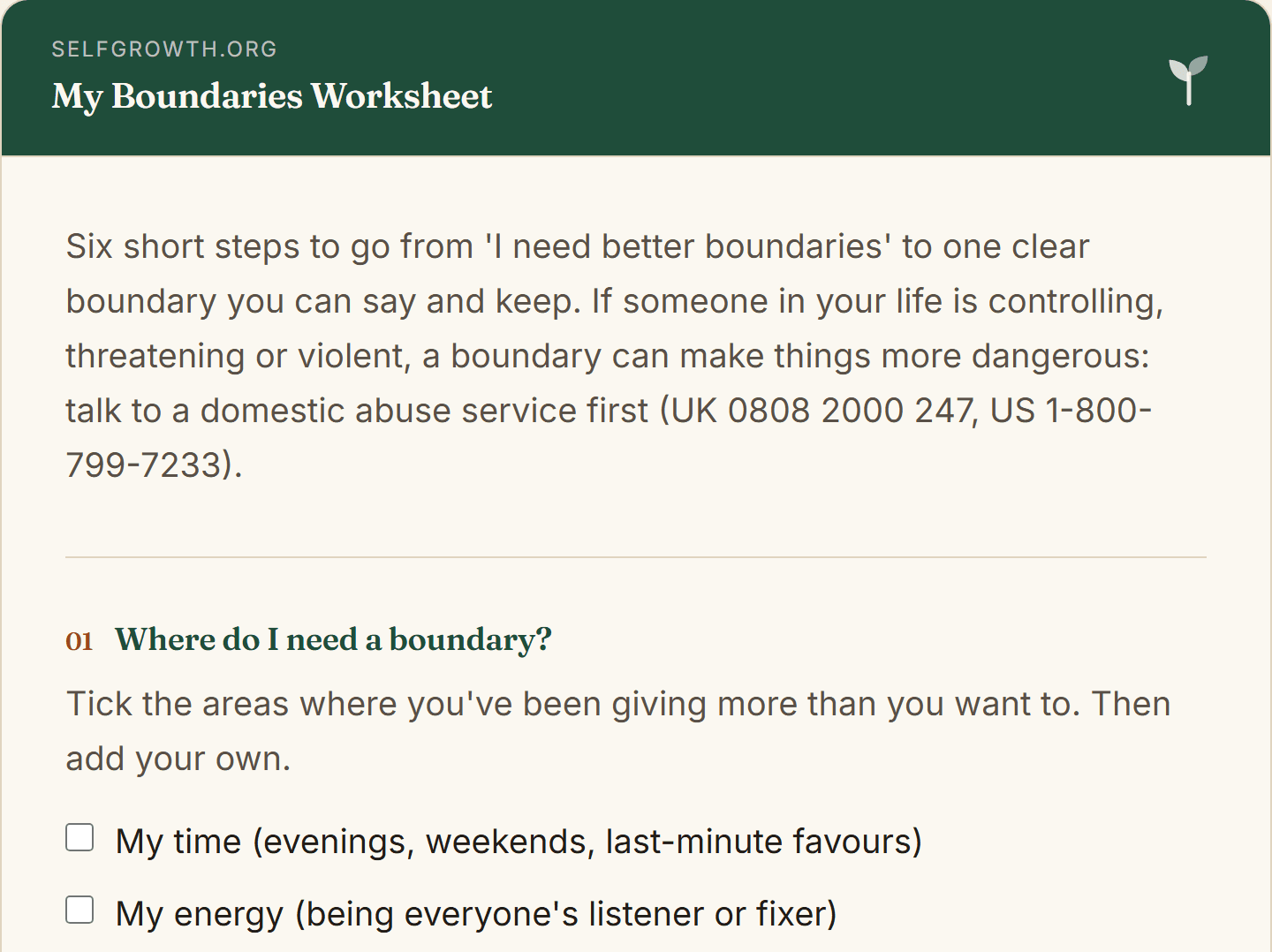
Boundaries Worksheet
A free, printable boundaries worksheet: spot where you need a limit, write it as something you'll do, plan the exact words, and decide what you'll do if it's crossed.
Open worksheetRelated guides
New worksheets, straight to your inbox
An occasional new worksheet or tool, sent only when there's something genuinely worth your time. No spam, no pressure, unsubscribe any time.