
Sleep
Sleep diary printable: a free 7-day sleep diary to fill in each morning
Updated 17 October 2026 · 6 min read · Free to print
A sleep diary is a simple record of your nights: when you went to bed, when you got up, how rested you felt, and what you had to drink. This free printable covers seven days. The NHS says to speak to a GP if changing your sleep habits hasn't helped. It is a record, not a test.
By the Self Growth team · drawn from NHS sleep guidance and sleep-diary research · how we make these
Fill it in here (it saves in this browser, but not in a private window), print it, or download the PDF. Free, no sign-up.
If you're sleeping badly, it's hard to see what's going on. Is it every night? After a coffee? When you go to bed late? A sleep diary gives you a week of notes in one place, so you can look at the pattern instead of guessing from a tired memory.
Fill it in each morning, as soon as you can, for the night before. A rough guess is fine. Nobody has to see it. These columns are simple and written in plain language. They aren't a clinical tool, and this isn't a sleep test.
One honest limit. A diary records how you remember the night, so treat how long you slept as a rough estimate (see the 2021 study below).
The NHS says most healthy adults need around 7 to 9 hours of sleep a night, although the exact amount can be different for each person. This diary doesn't set you a target. If poor sleep goes on, the NHS says to speak to a GP, particularly if changing your sleep habits hasn't helped, if you've had trouble sleeping for months, or if it makes daily life hard to manage. The diary is something you can take with you. This is a self-reflection tool, not medical advice or therapy. If you're in crisis, call Samaritans on 116 123 (UK and Ireland), call or text 988 (US), or find a helpline at findahelpline.com. Our helplines page lists more.
How to use this worksheet
- 1Print it and keep it by your bed with a pen, or type straight onto the page.
- 2Fill in the 'night' details each morning for the night before, and the 'caffeine or alcohol' column from memory of the day before. Note anything else in the notes box.
- 3'How rested' is a 1 to 5 score for how you feel, where 1 is not at all rested and 5 is fully rested. It's your own scale. There's no good or bad number.
- 4After seven days, use the 'looking back' section. If sleep is still hard, take the page to your GP.
The worksheet
selfgrowth.org
My Sleep Diary
Seven mornings of simple notes about your nights. A rough guess is fine. If sleep stays hard after changing your habits, take this to your GP.
01How to fill it in
Fill in one row each morning. Use the time on your clock or phone for bedtime and getting up, and a rough guess for the rest. Leave a box blank if you don't know.
The week starting on (date):
Anything unusual this week (illness, travel, shift work, a new medicine):
02My seven nights
One row per night. For 'how rested', use 1 to 5 (1 = not at all rested, 5 = fully rested). Under caffeine or alcohol, write what you had and roughly when. In notes, write whatever might matter: stress, a late meal, noise, waking in the night.
Entry 1
Entry 2
Entry 3
Entry 4
Entry 5
Entry 6
Entry 7
03Looking back at the week
Look for patterns, not a grade.
What do I notice? (Are the same nights better or worse? Anything in common?)
What did I have to drink on the best nights compared with the hardest ones?
Overall, how rested did I feel this week, from 1 (not at all rested) to 5 (fully rested)?
04One thing to try
The NHS suggests several habits. They include going to bed and getting up at around the same time each day, putting your phone away before bed, avoiding exercise in the 4 hours before bed, and not smoking or drinking alcohol, tea or coffee at least 6 hours before bed. Pick one to try for a week. The NHS also says not to drive when you feel sleepy.
Tick one:
What I'll try, and from when:
05Is it time to speak to a GP?
The NHS says to consider seeing a GP if changing your sleep habits hasn't helped, if you've had trouble sleeping for months, or if insomnia makes daily life hard to manage. It also says stress, anxiety or depression, and alcohol, caffeine or nicotine, can cause insomnia. This is not a test, just a prompt.
Tick any that are true:
What I want to tell my GP (bring this diary):
When you're done, a moment to reflect
- Did filling in the diary change anything about how I think about my nights?
- What pattern, if any, stood out?
- What would I like to ask a doctor or pharmacist about?
Why keep a sleep diary?
Honestly, we don't know of a trial of this diary, and a diary doesn't treat poor sleep. What it does is put a week of your nights in one place so you can see them, and so you have something to show a doctor.
Sleep diaries are used in sleep research. A 2012 paper by Carney and colleagues in the journal Sleep set out an expert-consensus, patient-informed 'Consensus Sleep Diary' for insomnia, with essential items in a core diary and optional items in an expanded one. The abstract doesn't list the items, so we can't say ours matches it. The five columns here are our own plain version.
A 2021 study by Dietch and Taylor tested that Consensus Sleep Diary against devices. Eighty adults kept it for seven days while using a brain-wave (EEG) device and actigraphy (a movement-tracking device). The diary recorded about 40 minutes more sleep than the EEG device and about 31 minutes more than actigraphy, and sleep efficiency (the share of time in bed spent asleep) was estimated about 6 to 7 percentage points higher. But sleep timing matched the devices closely. So the times you write down are reasonably reliable; how long you slept is a rough estimate.
The habits in 'One thing to try' and the signs to speak to a GP come from the NHS pages on insomnia and sleep. If stress or worry keeps you awake, the progressive muscle relaxation script and the body scan script on this site are other things to try, though we don't claim they treat insomnia.
These are educational self-reflection tools, not therapy. See our editorial standards.
If you want to go deeper
- NHS. Insomnia (nhs.uk).
- NHS Every Mind Matters. Sleep (nhs.uk/every-mind-matters).
- Carney, C. E., Buysse, D. J., Ancoli-Israel, S., Edinger, J. D., Krystal, A. D., Lichstein, K. L. & Morin, C. M. (2012). The consensus sleep diary: standardizing prospective sleep self-monitoring. Sleep, 35(2), 287-302.
- Dietch, J. R. & Taylor, D. J. (2021). Evaluation of the Consensus Sleep Diary in a community sample: comparison with single-channel electroencephalography, actigraphy, and retrospective questionnaire. Journal of Clinical Sleep Medicine, 17(7), 1389-1399.
Your questions, answered
- What is a sleep diary?
- A sleep diary is a daily record of your sleep, filled in each morning. This one has seven rows: when you went to bed, when you got up, how rested you felt, caffeine or alcohol, and notes. It's meant to help you see your own pattern, or to show a doctor. It isn't a sleep test.
- How do I fill in a sleep diary?
- Fill in one row each morning for the night before, using your clock or phone for times and a rough guess for the rest. Leave a box blank if you don't know. Do it for seven days.
- How much sleep do I need?
- The NHS says most healthy adults need around 7 to 9 hours of sleep a night, although the exact amount can be different for each person. This diary doesn't set a target, and a number alone isn't a verdict on your sleep. If you don't feel rested, and changing your habits hasn't helped, speak to your GP.
- Is a sleep diary accurate?
- Only roughly. In a 2021 study of 80 adults who kept the Consensus Sleep Diary for seven days alongside a brain-wave (EEG) device and actigraphy (a movement-tracking device), the diary recorded about 40 minutes more sleep than the EEG device and about 31 minutes more than actigraphy, and estimated sleep efficiency (the share of time in bed spent asleep) about 6 to 7 percentage points higher. But sleep timing matched the devices closely. So the times you write down are reasonably reliable; how long you slept is a rough estimate.
- When should I see a GP about my sleep?
- The NHS says to speak to a GP if changing your sleep habits hasn't helped or you think you may have insomnia. For insomnia, it lists not getting better after changing habits, trouble sleeping for months, or insomnia making daily life hard to manage. It says insomnia lasting less than 3 months is short-term and 3 months or longer is long-term. A GP may offer CBT, or refer you if there are signs of another sleep disorder such as sleep apnoea.
- Is this diary free, and is it medical advice?
- It's free, with no payment and no email needed. Use Download PDF for a print-ready copy, or fill it in on screen (answers save in your browser). It's a self-reflection tool, not medical advice, and it can't diagnose a sleep problem. If you're in crisis, call Samaritans on 116 123 (UK and Ireland), call or text 988 (US), or find a helpline at findahelpline.com.
Keep going, related worksheets
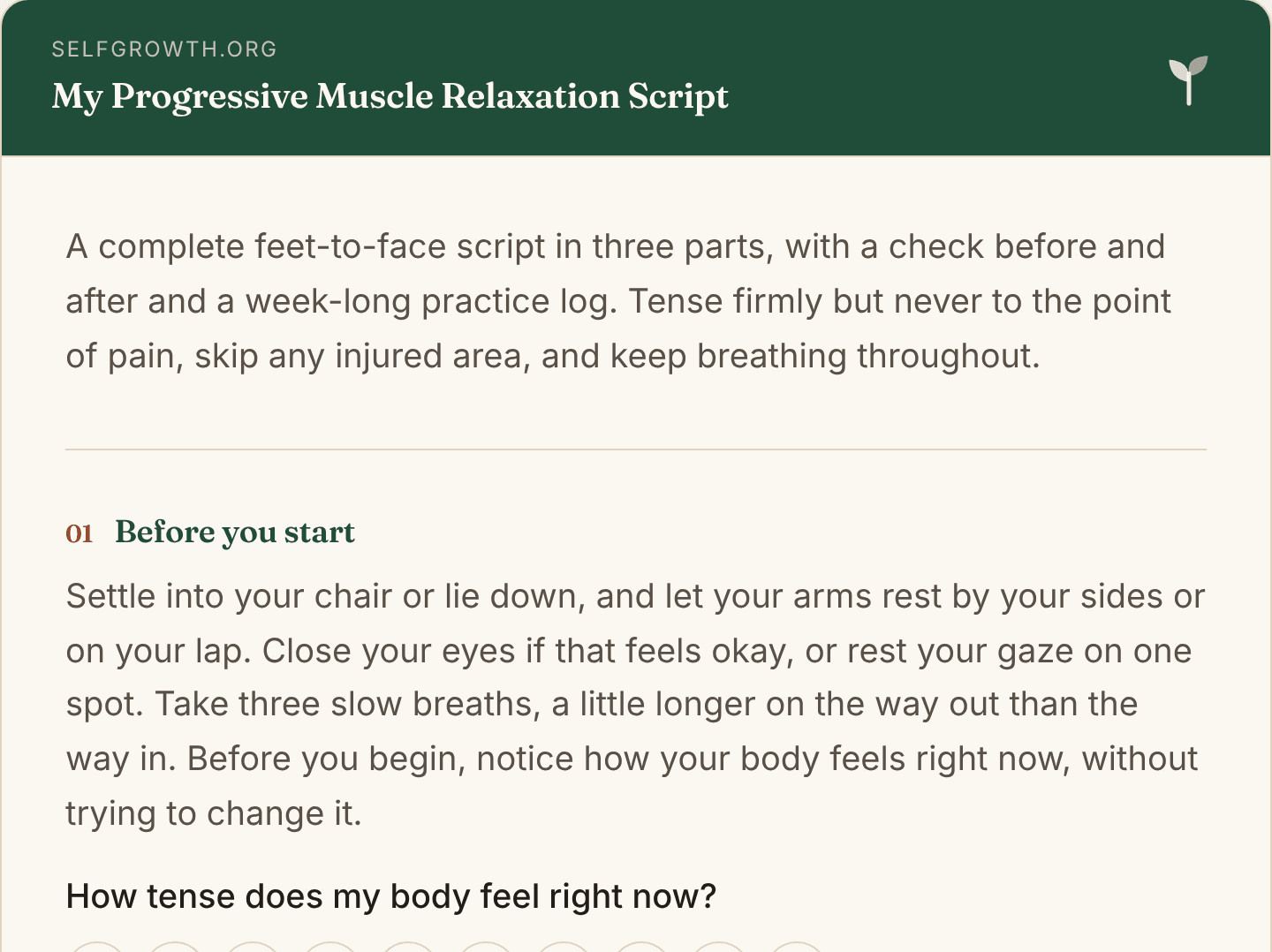
Progressive Muscle Relaxation Script
A free progressive muscle relaxation script in plain English: tense and release 13 muscle groups from feet to face, with a before-and-after check and 7-day log.
Open worksheet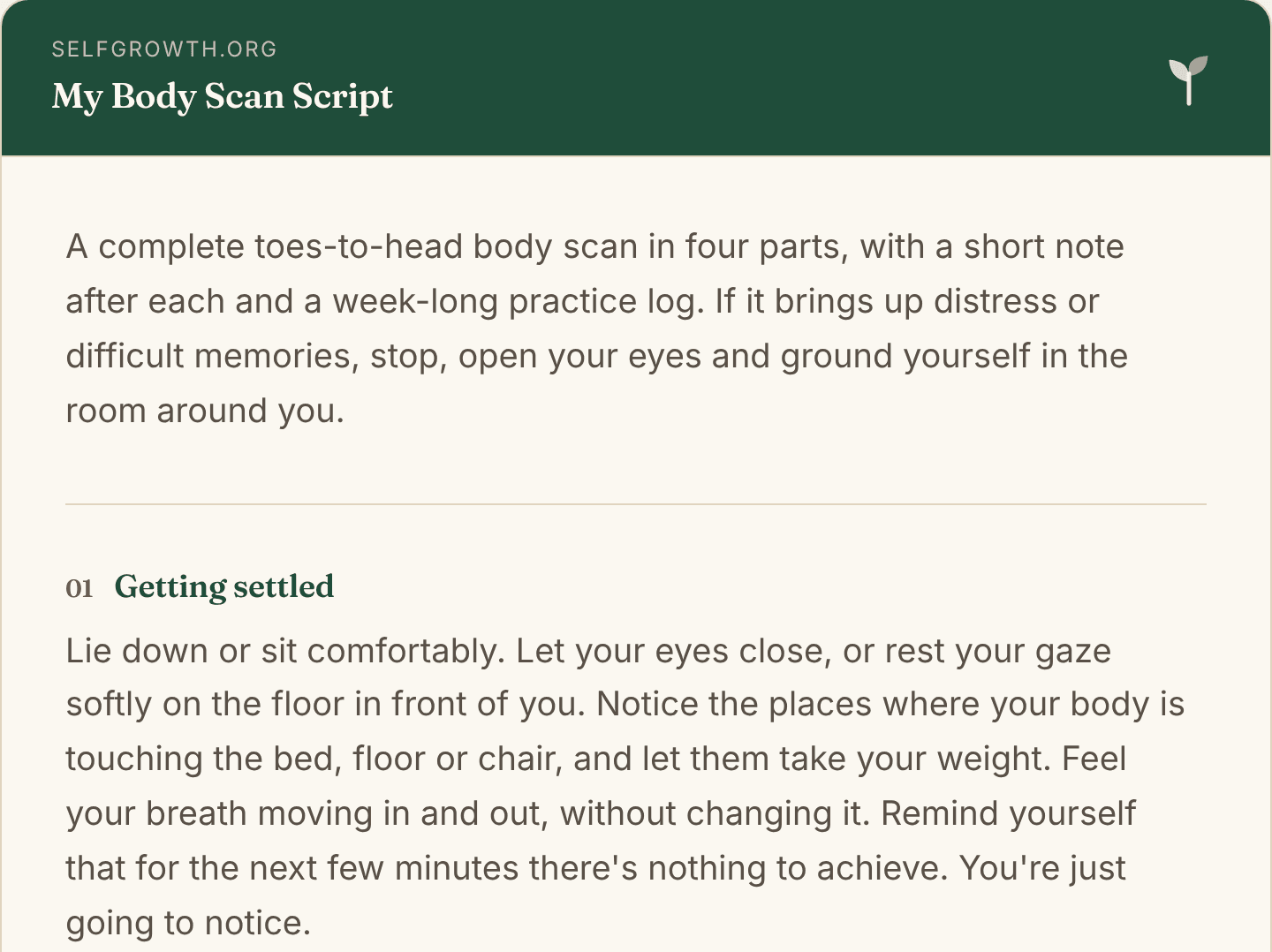
Body Scan Script
A free body scan meditation script in plain English: move your attention slowly from toes to head, noticing without changing, with reflection prompts and a log.
Open worksheet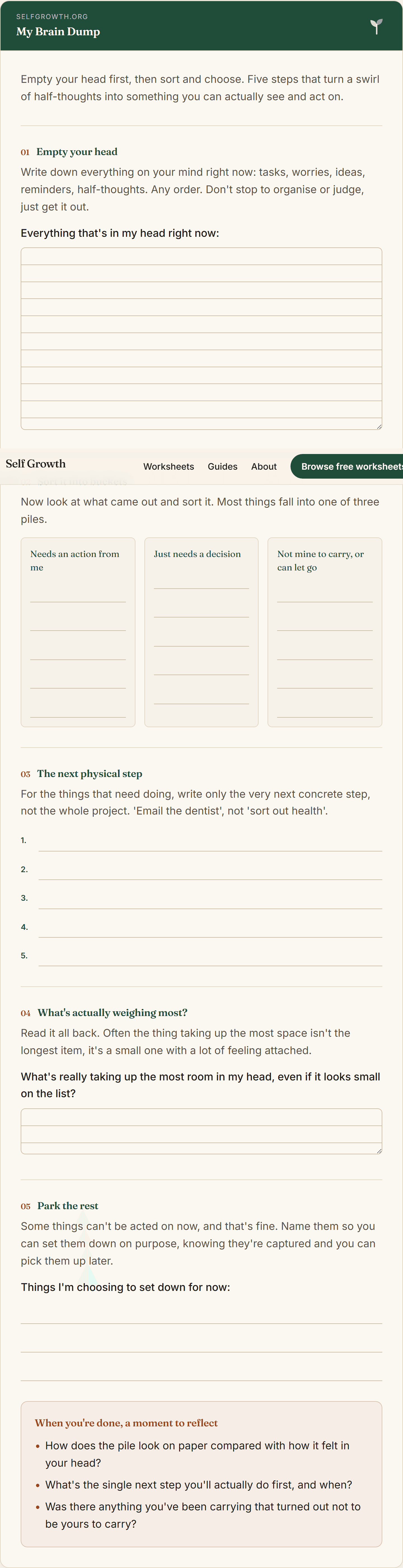
Brain Dump Template
A free, printable brain dump template to empty a cluttered mind onto the page, sort it into what needs action and what to let go, and find the next clear step.
Open worksheetNew worksheets, straight to your inbox
An occasional new worksheet or tool, sent only when there's something genuinely worth your time. No spam, no pressure, unsubscribe any time.