
Guide
How to be more productive without burning out
Updated 25 October 2026 · 8 min read
To be more productive, do fewer things that matter more and work with your energy. Decide what matters this week, notice your best hours, and put your hardest task in them. Rest on purpose, stop at a clear point each day, and build one small habit that saves you time. Busy is not the goal.
Drawn from everyday planning, energy and rest practice · Part of habits and getting things done
Some days you are busy from morning to night and still feel you got nothing done. Other days you do one important thing and go to bed pleased. Often it is about what you chose to do, not how hard you worked.
If you want to get the important things done and still have room to rest, start here. If your trouble is staying with a task once you start, see how to focus better. If you keep putting something off, try how to stop procrastinating. It is a self-help guide, not therapy or medical advice.
What does being productive actually mean?
Being productive means getting the things that matter to you done. It does not mean being busy, answering every message, or filling every hour. A full calendar can hide the fact that the one thing you cared about never got a turn.
A useful test is to ask, at the end of the day, 'What did I do today that I am glad I did?' It might be a piece of work, a call to a friend, or a proper lunch break. Your answer tells you what matters to you, and that is what to protect.
How to be more productive: step by step
These steps work across a week. You do not have to start them all at once. Pick one, try it for a week, then add the next.
- 1Decide what matters this week. Write down the two or three things that would make the week feel worthwhile. If everything is a priority, nothing is.
- 2Notice your best hours for a week. Jot down a few words at lunch and in the evening about when your mind felt clear and when it felt flat.
- 3Match tasks to your energy. Put your hardest task in your clearest hours and easy jobs in the flat part of the day.
- 4Rest on purpose. Plan breaks, a proper lunch, and a finishing time. Planned rest is easier to take than rest you have to talk yourself into.
- 5Stop at a clear point so tomorrow starts easily. Before you finish, write down the first step for tomorrow. Then you come back to a clear start, not a blank.
- 6Make one small habit that saves you time. Pick something that costs you minutes every day, such as hunting for your keys, and give it a fixed place or a fixed time.
For planning tips such as a top three, batching small jobs and a weekly review, see the time management tips.
The weekly planner helps with step 1. The daily planner helps with steps 2 to 4.
Open the Weekly Planner PrintableOpen the Daily Planner TemplateIf you have too many things competing for a place in your top three, the Eisenhower matrix template can help you sort what is urgent from what is important. A calm start to the day also helps, and the morning routine checklist is one way to set that up.
Productivity habits that last
A small habit tied to something you already do is easier to remember. Reviewing your top three while your kettle boils, or setting your focus block straight after lunch, needs no extra willpower. The guide to habit stacking explains how to attach a new habit to an old one.
- Keep each habit tiny. Two minutes of planning beats an hour you never get round to.
- Change one thing at a time.
- Attach it to a cue you already have, such as making a drink or sitting at your desk.
- If you miss a day, restart the next day without a speech to yourself.
For more on building habits that hold, see how to build good habits. If you are low on drive and cannot get started, how to get motivated looks at why.
Why rest belongs in the plan
You cannot run at full speed all the time. When you are tired, your attention can wander and small jobs can take longer, and everything feels like an effort. Resting is part of doing good work, not a reward you earn once the list is done.
Rest also comes in more than one kind. Sleep is one. A walk, time with a friend, a quiet room or something creative are others. If you are not sure which kind you need, the guide to types of rest helps you tell them apart. Try to put at least one planned break into each day, and one longer stretch of time off each week.
When productivity advice makes things worse
Advice about getting more done can backfire. Watch for these:
- Guilt. You feel bad whenever you are not working, even at the weekend.
- Comparison. You measure your days against someone else's tidy routine online.
- Over-planning. You spend more time on your system than on the work.
- Never switching off. You answer messages late at night and feel you cannot stop.
- Running on empty. You are tired, flat or cynical about your work and a new method feels like one more demand.
If this sounds like you, adding another tool is not the answer. Read about the signs of burnout, and think about doing less, not more. Lowering your top three to one on a hard day is a sound plan.
When to get more support
This is a self-help tool, not therapy or medical advice. If you are exhausted, feel low or hopeless, or work is taking over your life, speak to a GP. If you ever feel unsafe or have thoughts of harming yourself, call Samaritans on 116 123 (UK and Ireland), 988 (US), or find a line at findahelpline.com.
Sources and further reading
This is an educational self-reflection resource, not therapy or medical advice.
Your questions, answered
- How can I be more productive every day?
- Choose your top three tasks for the day, put the hardest in the part of the day when your mind is clearest, protect one focus block with your phone out of reach, and plan breaks. Review at the end of the day or week, and carry one lesson forward.
- What does it mean to be productive?
- It means getting the things that matter to you done, not being busy for its own sake. A good test is to ask at day's end what you did that you are glad you did. That answer shows what to protect.
- How do I stay productive when I'm tired?
- Cut your list to one or two tasks, do the easiest thing that still matters, and take a proper break. A smaller plan that you finish beats a long one you drop. If tiredness lasts for weeks, talk to a GP.
- Is it better to plan my day or my week?
- Both help, in different ways. A weekly plan shows what matters most, and a daily plan turns it into three tasks you can actually do. Start with the week, then fill in each day.
- Does resting make me more productive?
- Rest is part of doing good work, because when you are tired, your attention can wander and small jobs can take longer. Plan at least one break a day and one longer rest each week.
- Is there a free productivity planner printable?
- Yes. The weekly planner printable and the daily planner template are free, with a Download PDF button and a Print option, and no payment or email is needed. You can fill them in on screen, and your answers save in your browser.
- Is this a substitute for therapy?
- No. This is a self-help tool, not therapy or medical advice. If you are exhausted, low, or work is taking over your life, talk to a GP. If you ever feel unsafe or have thoughts of harming yourself, call Samaritans on 116 123 (UK and Ireland), 988 (US), or find a line at findahelpline.com.
Worksheets to do the work
Free to fill in online or print. No email needed.
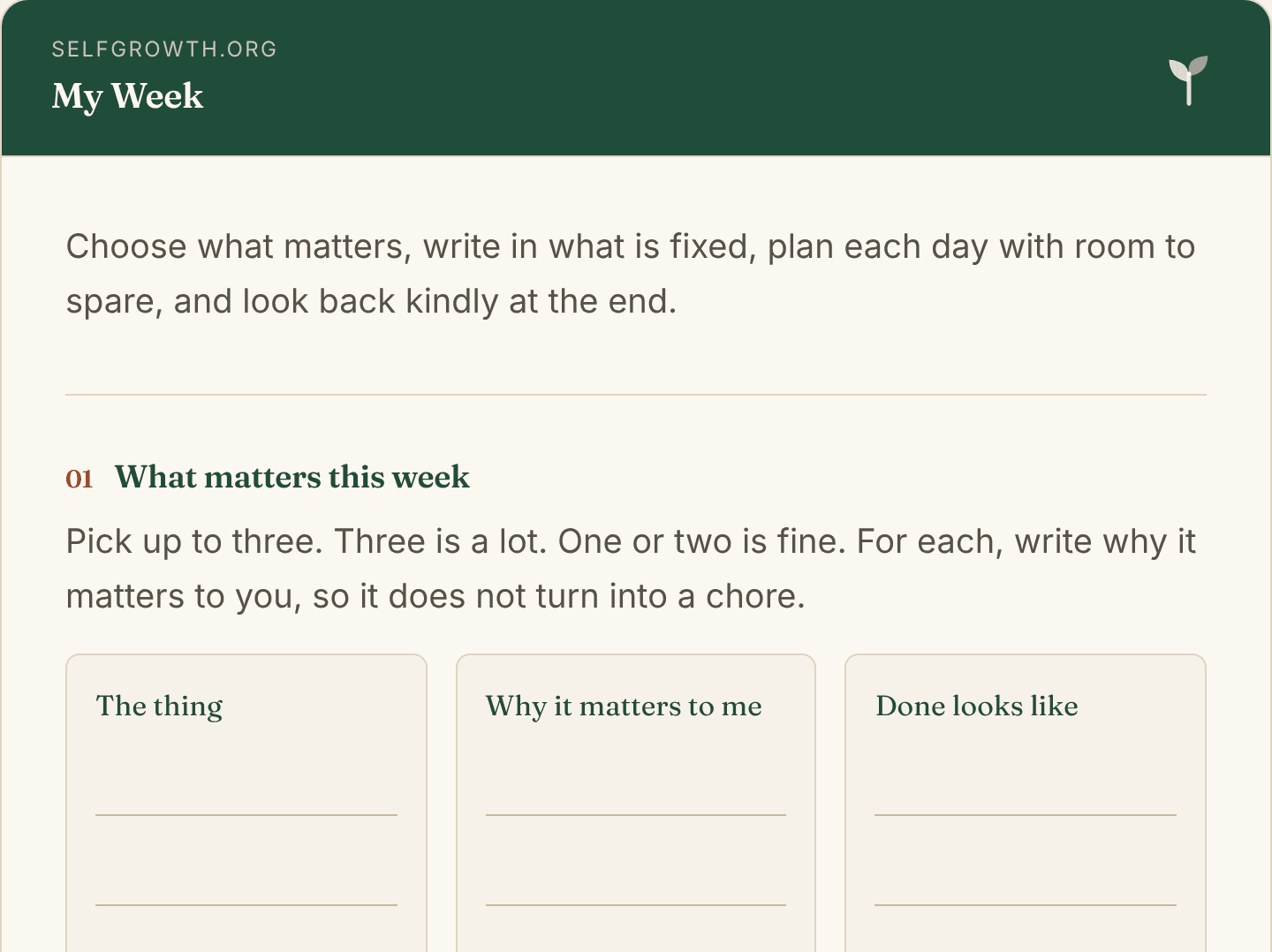
Weekly Planner Printable
A free weekly planner printable: pick up to three priorities, note fixed times, plan each day with a buffer and rest, then look back kindly. Print or fill in.
Open worksheet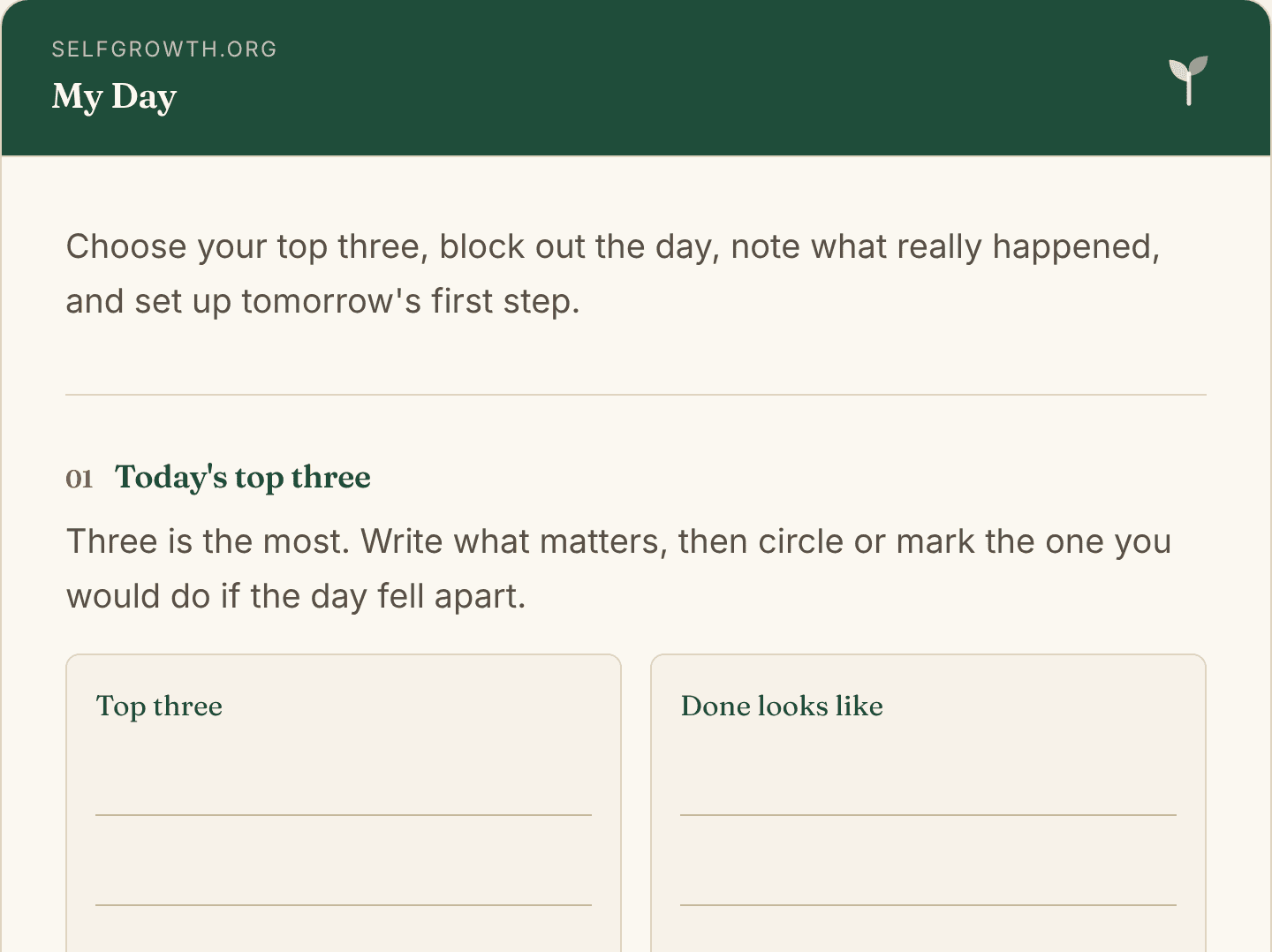
Daily Planner Template
A free daily planner template on one page: top three, time blocks, appointments, breaks, a short to-do list and a two-minute look back. Print or fill in.
Open worksheet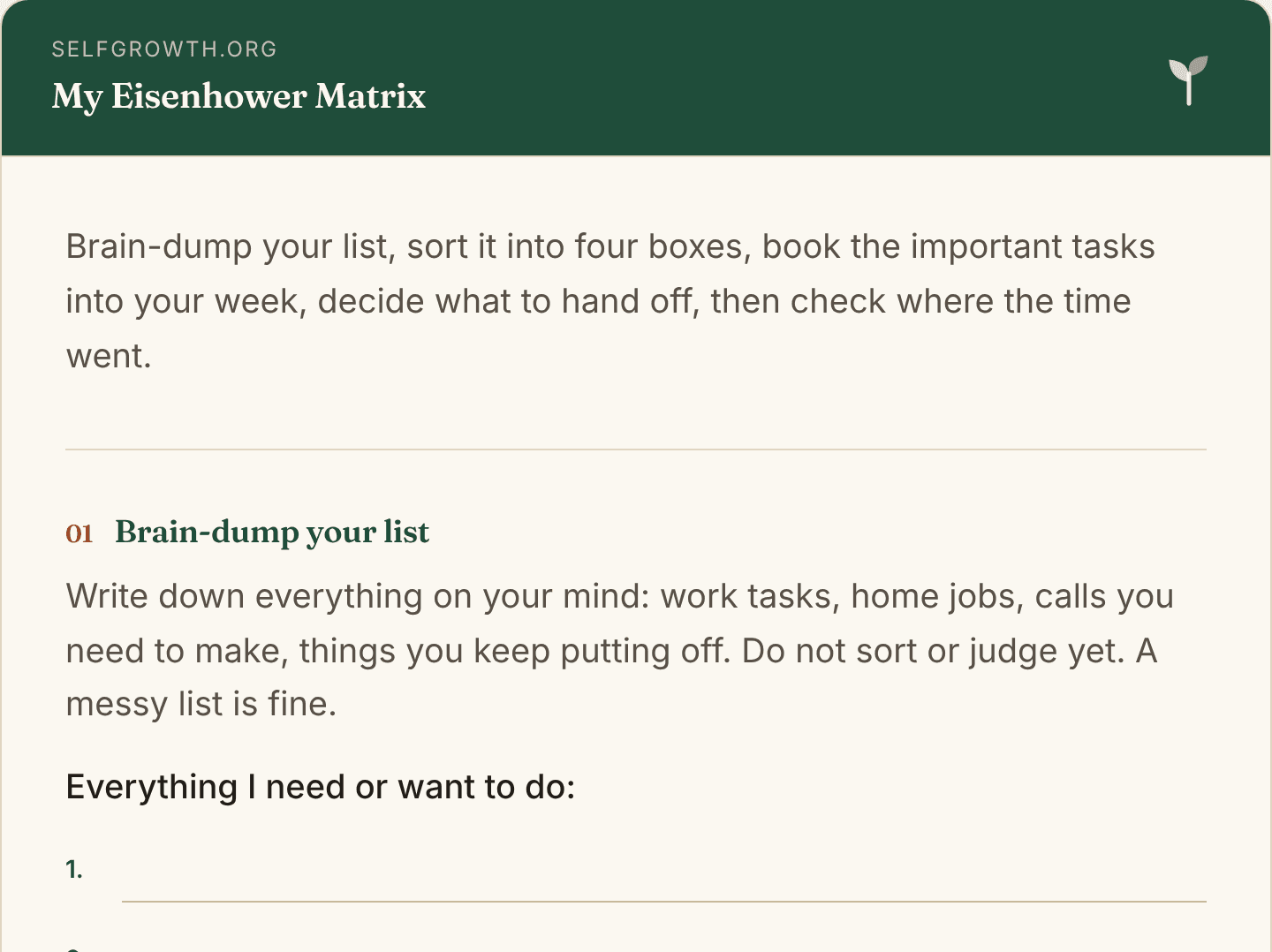
Eisenhower Matrix Template
A free Eisenhower matrix template: empty your head onto a list, sort it into four boxes, book the important tasks into your week, and check where time went.
Open worksheet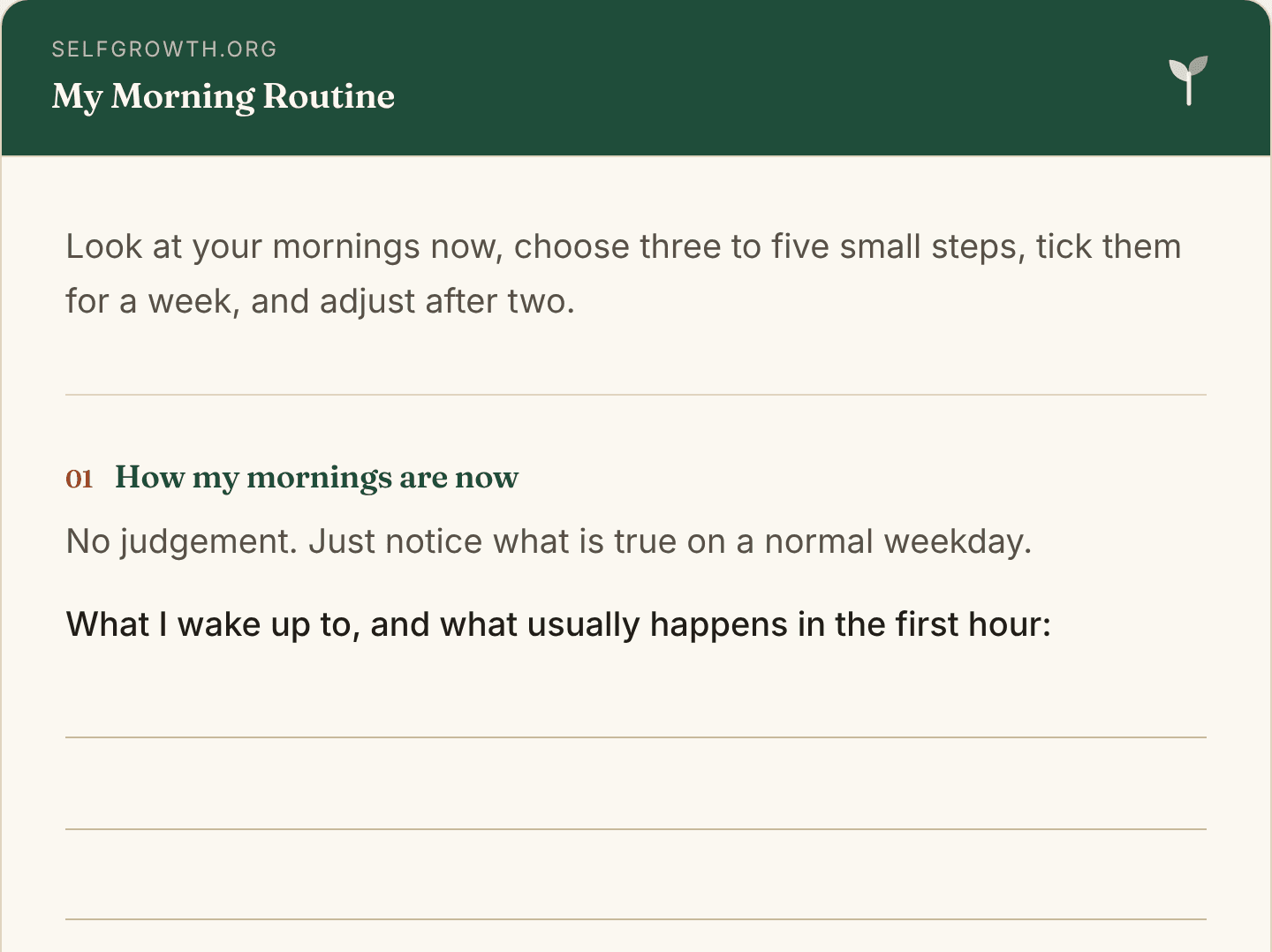
Morning Routine Checklist
A free morning routine checklist and daily routine template: pick 3 to 5 small steps, tick them for a week, plan the night before, set a bad-morning minimum.
Open worksheetRelated guides
New worksheets, straight to your inbox
An occasional new worksheet or tool, sent only when there's something genuinely worth your time. No spam, no pressure, unsubscribe any time.