
Guide
Types of rest: the 7 kinds and how to get each one
Updated 25 October 2026 · 7 min read
The seven types of rest are physical, mental, emotional, social, sensory, creative and spiritual. The idea comes from Saundra Dalton-Smith's book Sacred Rest, and is not tested research. It says tiredness has different sources, so sleep alone may not fix it. Notice what drained you, such as noise, people or screens, and pick the matching rest.
A popular framework from the book Sacred Rest, with NHS guidance on tiredness · Part of rest and self-care
You slept eight hours and still feel flat. Or you had a quiet weekend and Monday feels heavy anyway. If that sounds familiar, it can help to ask what kind of tired you are, not just how tired.
The popular list of seven types of rest is a way to ask that question. It comes from Saundra Dalton-Smith's 2017 book Sacred Rest. Treat it as a prompt to notice what drains you, not as a rule. Below are the seven, how to spot which one you need, and small ways to recharge.
What are the 7 types of rest?
Here are the seven, with a plain description and one small example of each.
- Physical rest: giving your body a break. Example: lying down for ten minutes, or a gentle stretch instead of a hard workout.
- Mental rest: giving your thinking a break. Example: a short walk without podcasts, or writing your worries on paper so they leave your head.
- Emotional rest: a break from holding in or managing feelings. Example: telling a safe person how you really are, instead of saying 'fine'.
- Social rest: a break from people, or time with people who ask little of you. Example: a night with no plans, or a quiet coffee with someone easy.
- Sensory rest: a break from noise, light and screens. Example: ten minutes in a dim, quiet room with your phone out of reach.
- Creative rest: taking in things you enjoy without having to produce anything. Example: sitting by water, looking at art, or listening to music.
- Spiritual rest: time with what gives your life meaning or a sense of belonging. Example: a walk in nature, prayer, meditation, or time with a community that matters to you.
The list is attributed to Saundra Dalton-Smith, author of the book Sacred Rest (2017). Other writers use different names or add types, and there is no agreed list.
How to tell which kind of rest you need
Look at what your day was like, and how you feel at the end of it. These are common clues, not a test.
- Your body feels heavy or sore, and you have been on your feet or sitting still for long stretches: physical rest may be what is missing.
- Your mind feels full, you cannot decide, or you keep re-reading the same line: mental rest.
- You have been holding it together, being strong for others, or hiding how you feel: emotional rest.
- You feel drained after being with people, or lonely even in a crowd: social rest, or a different kind of company.
- Noise, bright light or notifications are starting to feel like too much: sensory rest.
- Everything feels flat, and you have not made or enjoyed anything lately: creative rest.
- You feel disconnected from what matters to you: spiritual rest.
You may notice more than one. Start with the one that stands out most today. The worksheet below has a short check-in to help you spot what you have been missing.
Open the Self-Care WorksheetHow to rest: small ways to recharge
Rest does not have to be a whole day off. A few minutes, chosen to match what drained you, is a place to start.
- 1Ask what drained you today. Was it people, noise, decisions, screens, or feelings you were holding in?
- 2Pick the rest that matches. Use the list above. If you are not sure, start with the one that stood out.
- 3Make it small. Five to ten minutes counts. Set a timer if it helps you stop.
- 4Take away the thing that drained you. If it was screens, put the phone in another room. If it was people, close the door.
- 5Do one calming thing. Sit by a window, stretch, listen to a song, or follow a short body scan.
- 6Notice how you feel afterwards, then plan the next small break. You do not have to earn it first.
If you want something to follow, the body scan script takes a few minutes. For a wider look at how your life feels across different areas, try the wellness wheel. The guide to relaxing has more ways to wind down.
Open the Body Scan ScriptWhy sleep is not the only kind of rest
Sleep matters. The NHS suggests trying to stick to the same sleep times and aiming for 6 to 9 hours. If sleep is hard, the sleep hygiene worksheet is a good place to start.
The seven types idea adds this: you can sleep a full night and still feel you have had no break from people, noise, decisions or feelings. Day-time pauses of the right kind may fill gaps that sleep does not. That is the framework's view, not tested research, so use it as a way to notice, not as a promise.
When tiredness is more than needing rest
The NHS says it is normal to feel tired sometimes, but being tired all the time without knowing why could be a sign of a problem. Common causes it lists include not getting enough sleep, stress, depression, and dealing with life challenges.
It also says not to self-diagnose. See a GP if you have been feeling tired for a few weeks and are not sure why, if your tiredness affects your daily life, or if you are tired and have other symptoms such as weight loss or mood changes. A GP can look at the cause. More rest may not be the answer.
When to get more support
This is a self-help tool, not therapy or medical advice. If you cannot rest even when you have the chance, if you feel low or on edge most days, or if you are running on empty, you deserve real support. A GP is a good first step.
If you ever feel unsafe or have thoughts of harming yourself, call Samaritans on 116 123 (UK and Ireland), 988 (US), or find a line at findahelpline.com.
Sources and further reading
This is an educational self-reflection resource, not therapy or medical advice.
If you want to go deeper
- Dalton-Smith, S. (2017). Sacred Rest. FaithWords.
- NHS. Tiredness and fatigue (nhs.uk/conditions/tiredness-and-fatigue).
Your questions, answered
- What are the 7 types of rest?
- Physical, mental, emotional, social, sensory, creative and spiritual rest. The list is attributed to Saundra Dalton-Smith's 2017 book Sacred Rest. It is a framework to help you notice what has drained you, and other versions of the list differ.
- How do I know what kind of rest I need?
- Think about what your day asked of you. Time with other people, or noise, points to social or sensory rest. Lots of decisions points to mental rest. Holding in feelings points to emotional rest. Start with the one that stands out. These are clues, not a test.
- How do I rest properly?
- Pick a small break that matches what drained you, take away the thing that drained you, and give it five to ten minutes. Rest does not need to be earned or productive. Plan the next small break before the day is over.
- How do I recharge when I'm tired all the time?
- Small, matched breaks can help on an ordinary tired day. But the NHS says to see a GP if you have been tired for a few weeks and are not sure why, or if it affects your daily life. Do not self-diagnose.
- Is sleep enough rest?
- Sleep matters, and the NHS suggests regular sleep times and 6 to 9 hours. The seven types idea says you may also need breaks from people, noise or decisions during the day. That part is the framework's view.
- Is there a types of rest PDF or worksheet?
- Yes. The free self-care worksheet helps you check in on what you need and plan small breaks. Use the Download PDF button or Print. It is free, with no payment and no email needed. You can also fill it in on screen, and your answers save in your browser.
- Is this a substitute for therapy?
- No. It is a self-help tool, not therapy or medical advice. If you are tired all the time, or low mood or stress is what's really in the way, see your GP. If you ever feel unsafe or have thoughts of harming yourself, call Samaritans on 116 123 (UK and Ireland), 988 (US), or find a line at findahelpline.com.
Worksheets to do the work
Free to fill in online or print. No email needed.
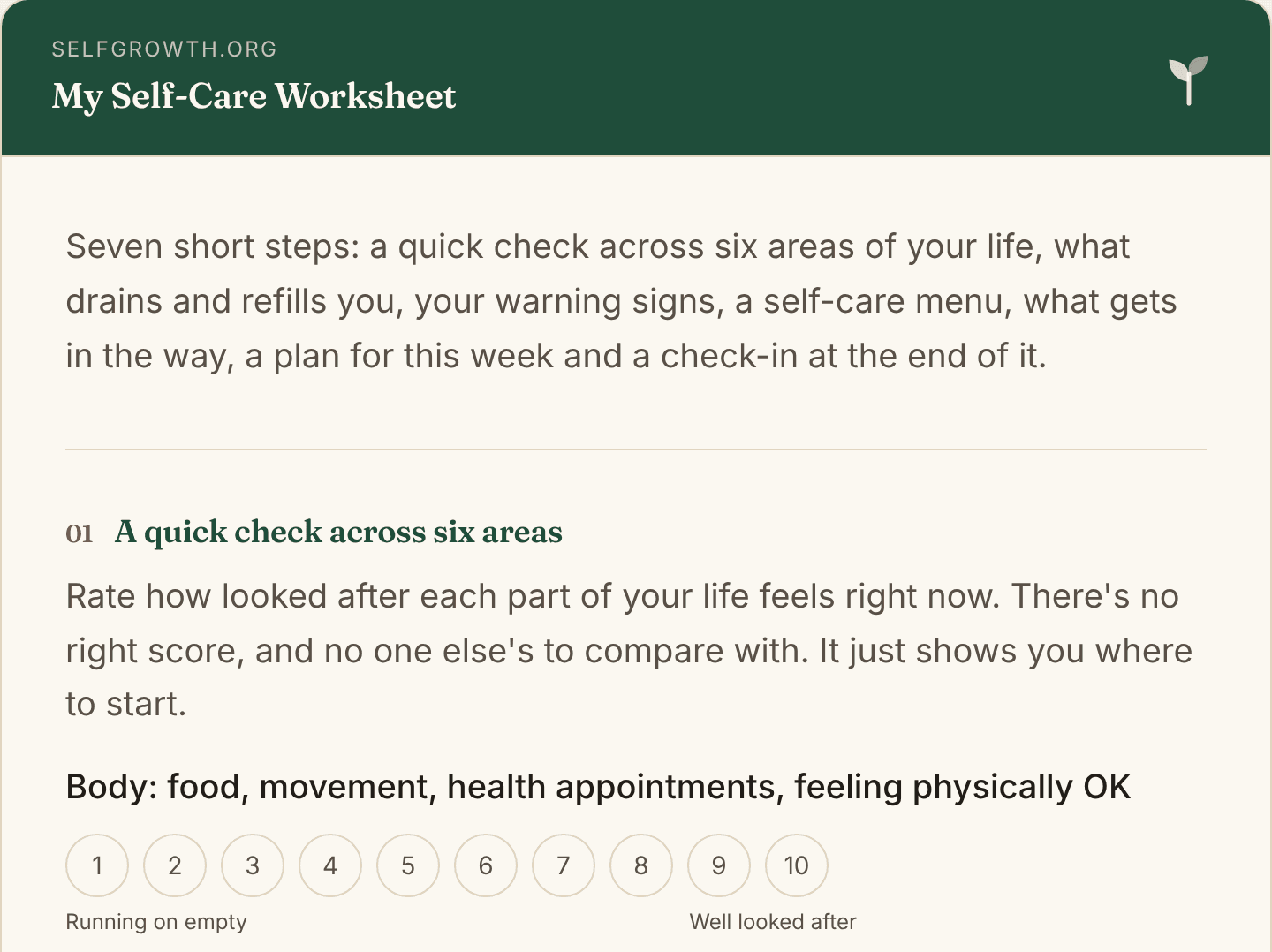
Self-Care Worksheet
A free, printable self-care worksheet for adults: check six areas of your life, see what drains and refills you, and make a self-care plan that costs nothing.
Open worksheet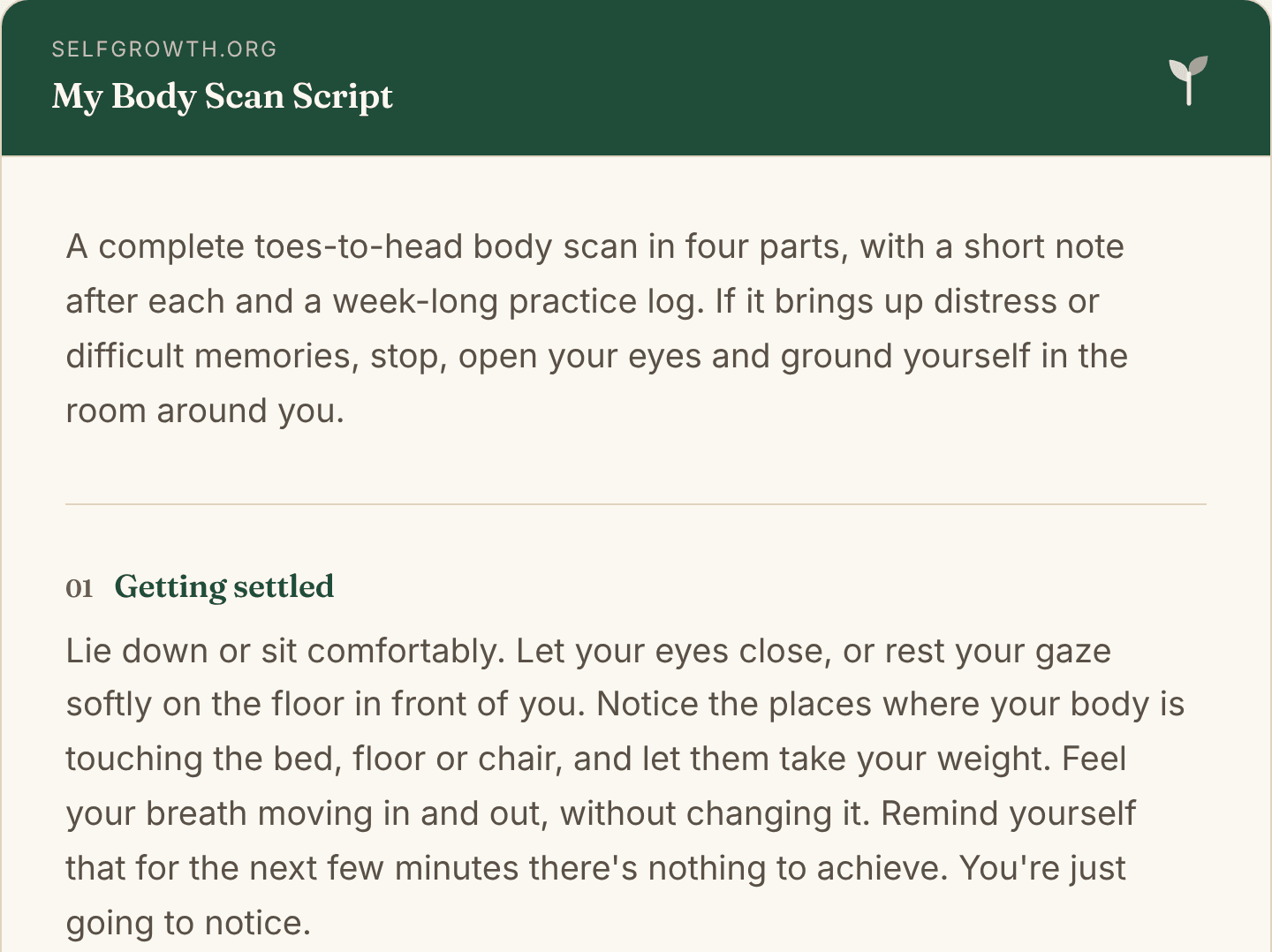
Body Scan Script
A free body scan meditation script in plain English: move your attention slowly from toes to head, noticing without changing, with reflection prompts and a log.
Open worksheet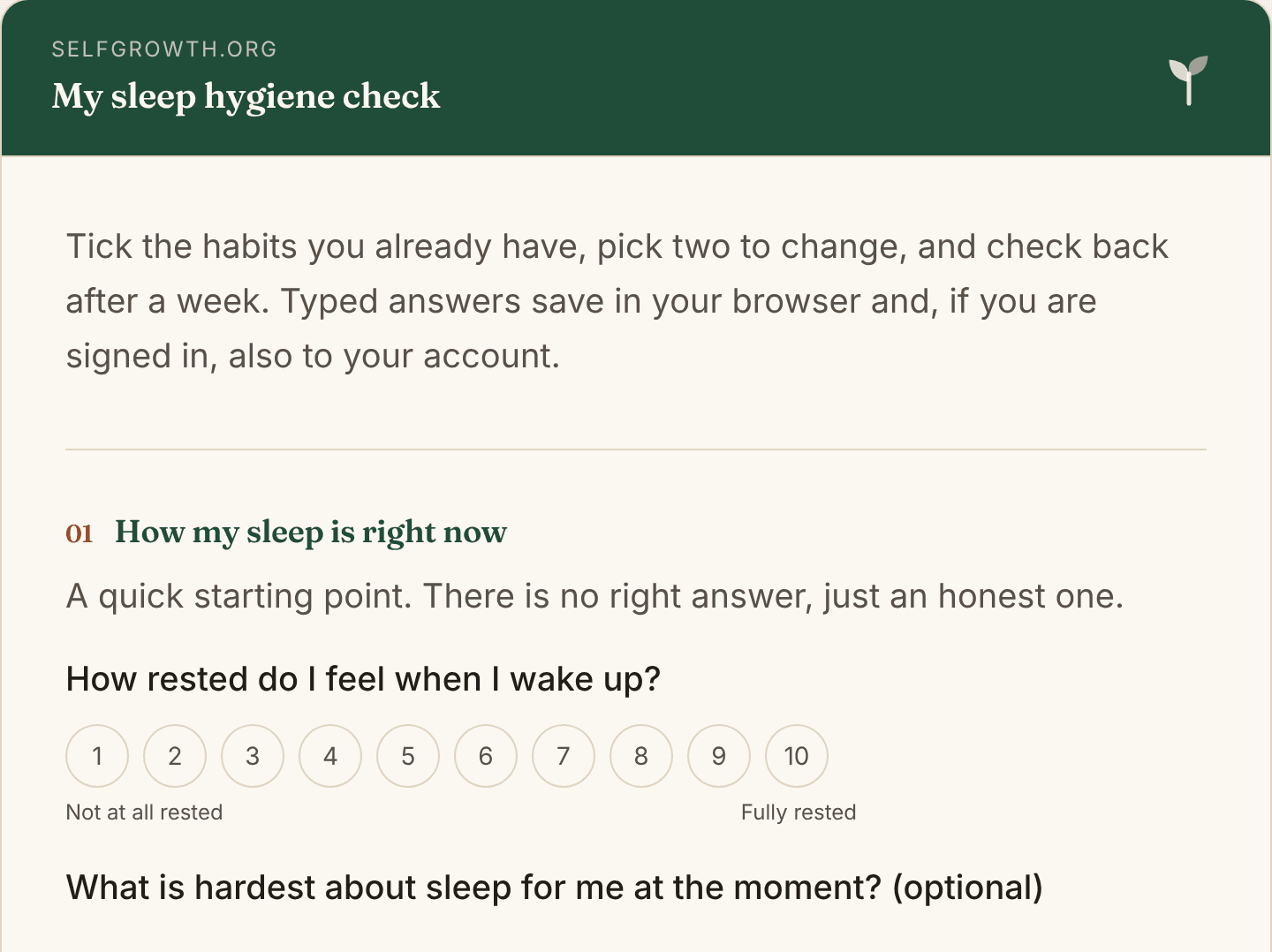
Sleep Hygiene Worksheet
A free printable sleep hygiene worksheet: tick the habits you already have, pick two to change, check back after a week, and know when to see a doctor.
Open worksheet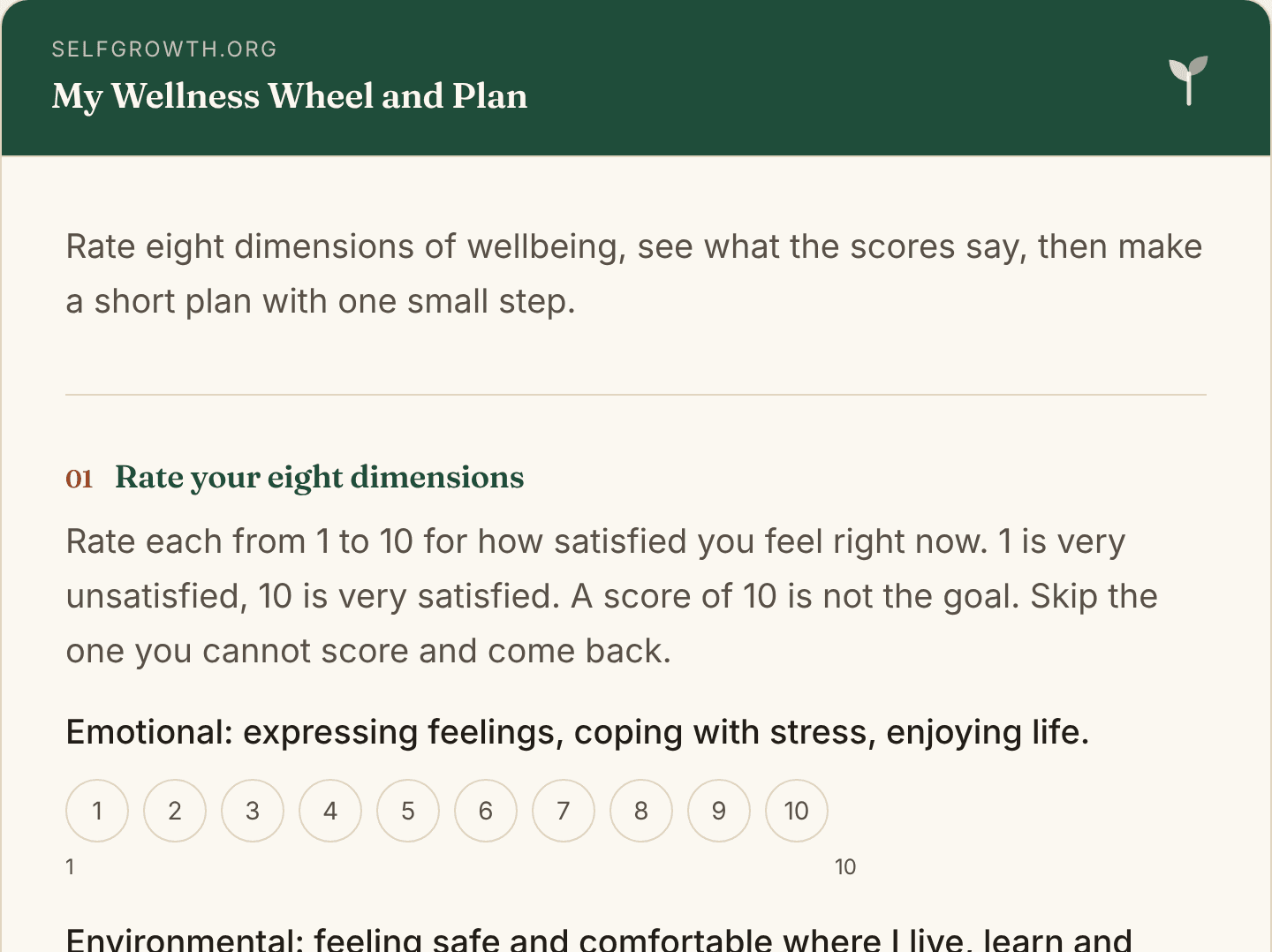
Wellness Wheel
A free printable wellness wheel: rate eight dimensions of wellbeing from 1 to 10, see your wheel, then make a simple wellness plan with one small step.
Open worksheet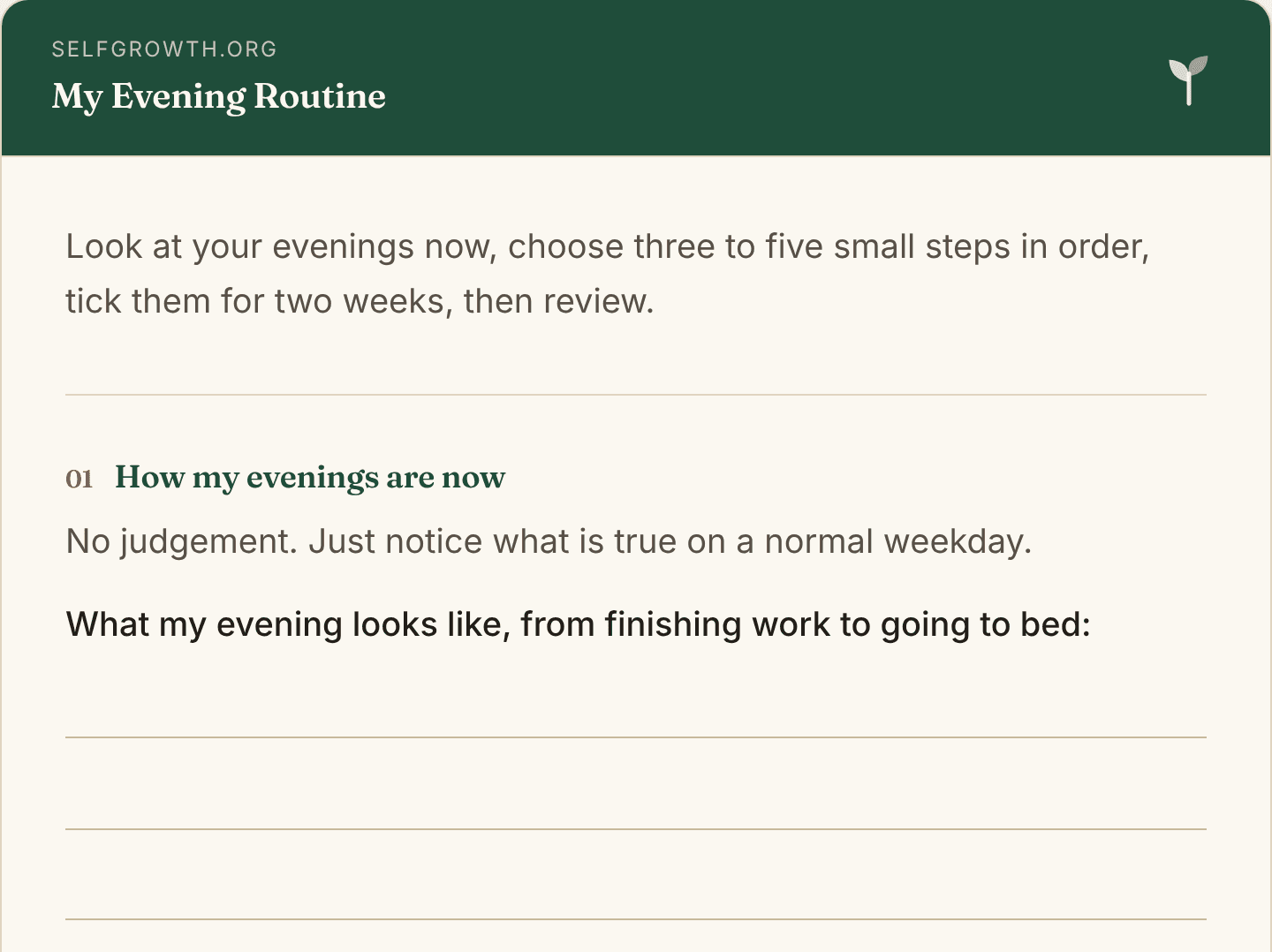
Evening Routine Checklist
A free evening routine checklist and wind down routine: pick 3 to 5 small steps, tick them for two weeks, set a tired-evening minimum, then review what to keep.
Open worksheetRelated guides
New worksheets, straight to your inbox
An occasional new worksheet or tool, sent only when there's something genuinely worth your time. No spam, no pressure, unsubscribe any time.