
Sleep
Sleep hygiene worksheet: a free checklist of everyday habits to tick and change
Updated 23 October 2026 · 6 min read · Free to print
Sleep hygiene means the everyday habits around sleep: caffeine, screens, light, timing, your bedroom and how you wind down. This free worksheet lets you tick what you already do, pick two habits to change and check back after a week. It is general habit advice, not a treatment for insomnia.
Drawn from cognitive behavioural therapy & self-compassion research · Part of rest and self-care
Fill it in here (it saves in this browser, but not in a private window), print it, or download the PDF. Free, no sign-up.
Sleep is shaped by more than what happens at bedtime. What you drink in the afternoon, how bright the evening is, when you get up and what you do with your worries can all play a part. This worksheet puts those everyday habits in one checklist so you can see what you already do and what you might change.
Tick what is true for you. Then pick just two things to try for a week, and write down how it went. Small changes you can keep are easier to stick with than a total overhaul.
Sleep hygiene is general habit advice. It is not a treatment for insomnia, and it will not fix every bad night. If you want a record of your nights to go with it, the sleep diary worksheet is the place for that.
This is a self-help tool, not medical advice or therapy. If you take a prescribed medicine, do not stop or change it on your own: ask your GP or pharmacist. If you snore loudly, gasp or stop breathing in your sleep, fall asleep without meaning to (especially driving), have had trouble sleeping for months, or poor sleep comes with low mood, see a GP first, and do not drive when sleepy. If chest pain, trouble breathing or fainting is part of the picture, call 999 (UK) or 911 (US) or your local emergency number; use NHS 111 if you are unsure.
How to use this worksheet
- 1Tick only what is true for you now, not what you think you should do. An empty box is information, not a failure.
- 2Pick two habits from your empty boxes. Choose ones that feel doable this week.
- 3Fill in the one-week check each morning, then look back. If a change did nothing for you, that is useful to know.
- 4Read the section on when to see a doctor first. Habit changes do not replace medical advice.
The worksheet
selfgrowth.org
My sleep hygiene check
Tick the habits you already have, pick two to change, and check back after a week. Typed answers save in your browser and, if you are signed in, also to your account.
01How my sleep is right now
A quick starting point. There is no right answer, just an honest one.
How rested do I feel when I wake up?
What is hardest about sleep for me at the moment? (optional)
02Daytime and timing habits
The NHS lists several of these in its advice on insomnia. Tick the ones that are true for you.
I already do this:
Another daytime habit that affects my sleep:
03Evening, bedroom and worry habits
These cover screens, light, your bedroom and how you wind down. Tick the ones that are true for you.
I already do this:
Something else in my evening or bedroom that I know gets in the way:
04Pick two to change
Look at your empty boxes. Choose two, no more. Write exactly what you will do, and when, so it is easy to start.
Entry 1
Entry 2
05One-week check
Each morning, note how rested you feel (1 to 10) and whether you kept to your two changes. A rough note is enough. For a fuller record of your nights, use the sleep diary worksheet.
Entry 1
Entry 2
Entry 3
Entry 4
Entry 5
Entry 6
Entry 7
After the week: what did I notice? What will I keep, drop or change?
06When to see a doctor
Habits are a starting point. The NHS says to see a GP if you have had trouble sleeping for months, or if changing your sleeping habits has not helped. Tick any that are true for you.
Notes to take to my GP or pharmacist:
Do not stop a prescribed medicine on your own. Ask first. Do not drive when you feel sleepy.
When you're done, a moment to reflect
- Which habit on the list surprised you, because you did not know it could matter?
- Which empty box would be easiest to fill, and which would be hardest? What is behind the hard one?
- What do you do with your worries in the evening, and is there a better time to deal with them?
- If you kept your two changes for a week, what did you notice, even if it was small?
- Is there anything in your answers that is worth mentioning to a GP?
Done for now?
Save today's answers as a dated entry. You can come back, fill it in again and compare the two side by side.
What does the evidence say about sleep hygiene?
The habits on this sheet match the everyday advice the NHS gives for trouble sleeping, such as keeping regular times, avoiding caffeine, alcohol and nicotine late in the day, and keeping the bedroom dark and quiet. They are general advice, not a programme.
A review that combined studies of sleep hygiene education for insomnia (Chung and colleagues, 2018) found improvements from before to after, with a small to medium effect size. People rated their sleep a little better afterwards, but measured sleep did not clearly change. The same review found sleep hygiene education less effective than CBT-I, and none of the studies compared it with no treatment. The authors said that gaps in the research meant they could not give a firm answer about where it fits in care.
So expect a small to medium effect at best. Habit changes may help you a little, or not at all, and they are no substitute for seeing a doctor when sleep trouble goes on.
These are educational self-reflection tools, not therapy.
If you want to go deeper
- NHS. Insomnia. nhs.uk/conditions/insomnia/
- NHS. Sleep apnoea. nhs.uk/conditions/sleep-apnoea/
- Chung, K.-F., Lee, C.-T., Yeung, W.-F. et al. (2018). Sleep hygiene education as a treatment of insomnia: a systematic review and meta-analysis. Family Practice, 35(4), 365-375.
Your questions, answered
- What is sleep hygiene?
- It is the name for everyday habits that go with sleep: when you get up, what you drink and eat, how you use screens, how dark and quiet your bedroom is, and how you wind down. It is general advice about habits. It is not a medical treatment.
- What are examples of good sleep hygiene?
- The NHS suggests going to bed only when you feel sleepy, getting up at the same time every day, relaxing for at least an hour before bed and keeping your bedroom dark and quiet. It also suggests no tea, coffee or alcohol and no smoking in the 6 hours before bed, and no exercise in the 4 hours before bed. The checklist above covers these.
- Does sleep hygiene work for insomnia?
- Evidence is mixed. A review that combined studies of sleep hygiene education for insomnia found improvements from before to after, mostly in how people rated their own sleep. It also found sleep hygiene education less effective than cognitive behavioural therapy for insomnia (CBT-I), a structured talking treatment. The authors said it was not possible to draw a firm conclusion about its role. Treat it as a sensible starting point, not a cure.
- What is the difference between sleep hygiene and a sleep diary?
- Sleep hygiene is a set of habits you can change. A sleep diary is a record of your nights. Use this worksheet to choose habits to try, and the sleep diary worksheet to keep notes, so you can see whether anything shifts and have something to show a GP.
- When should I see a doctor about my sleep?
- The NHS says to see a GP if you have had trouble sleeping for months, or if changing your sleeping habits has not helped. See a doctor too if you snore loudly, make gasping or choking noises, seem to stop breathing in your sleep, or fall asleep when you do not mean to, including when driving. Do not drive when you feel sleepy. If you take a prescribed medicine, do not stop it on your own. Ask your GP or pharmacist.
- Is there a sleep hygiene worksheet PDF?
- Yes. Use the Download PDF button for a clean, print-ready copy, or Print to print straight from the page. It is free, with no payment and no email needed. You can also fill it in on screen, and your answers save in your browser.
- Is this worksheet a substitute for therapy or medical care?
- No. It is a self-help tool, not therapy or medical advice. If poor sleep goes on, or comes with low mood, anxiety or breathing problems at night, see a GP. For chest pain, trouble breathing or fainting, call 999 (UK) or 911 (US) or your local emergency number; use NHS 111 if you are unsure. If you are thinking about harming yourself or ending your life, that is serious: call Samaritans on 116 123 (UK and Ireland), call or text 988 (US), or find a line at findahelpline.com. More routes: selfgrowth.org/help.
Keep going, related worksheets
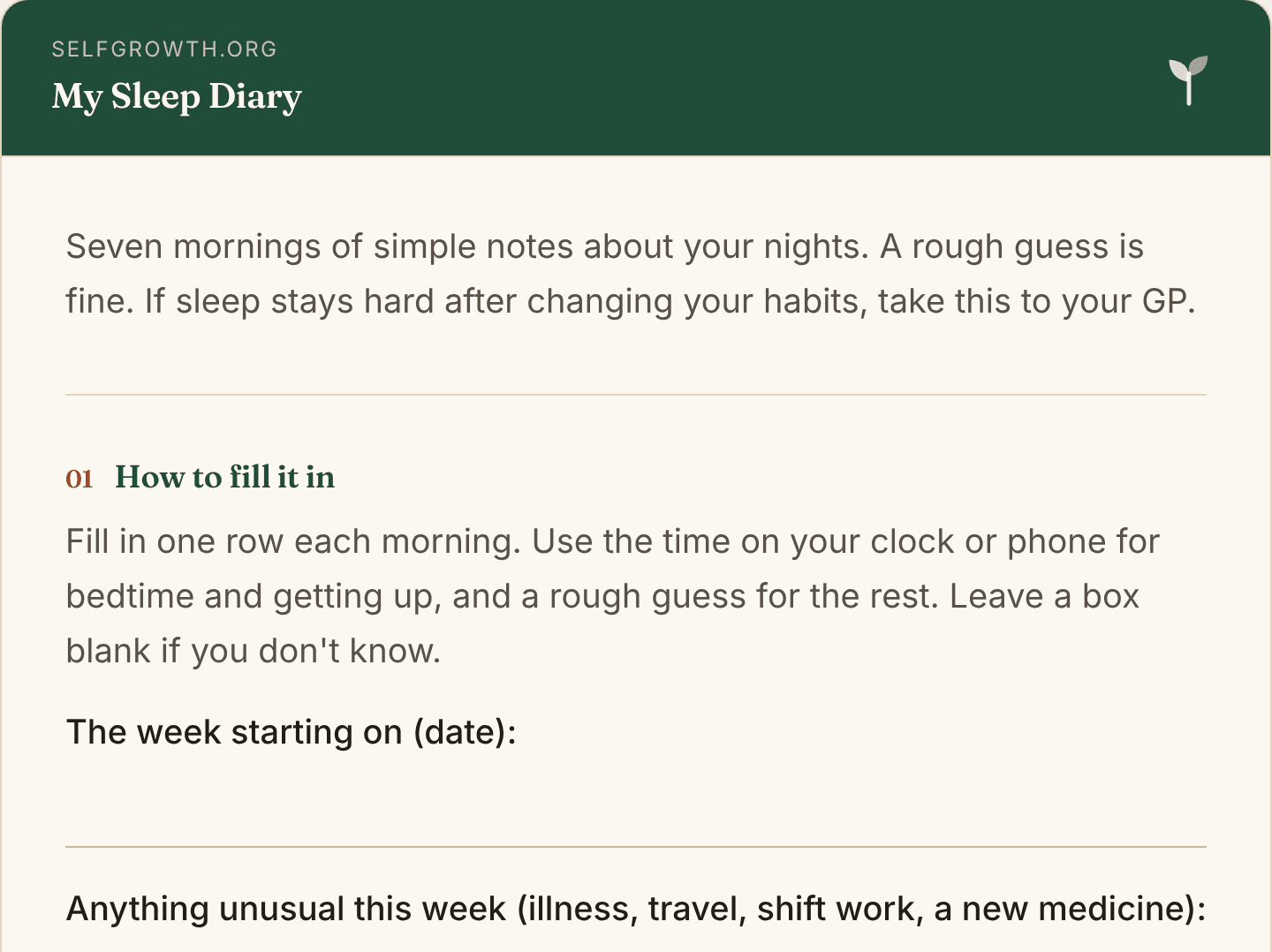
Sleep Diary
A free printable 7-day sleep diary: bedtime, wake time, how rested you felt, caffeine and notes, plus a page to bring to your GP if sleep stays hard.
Open worksheet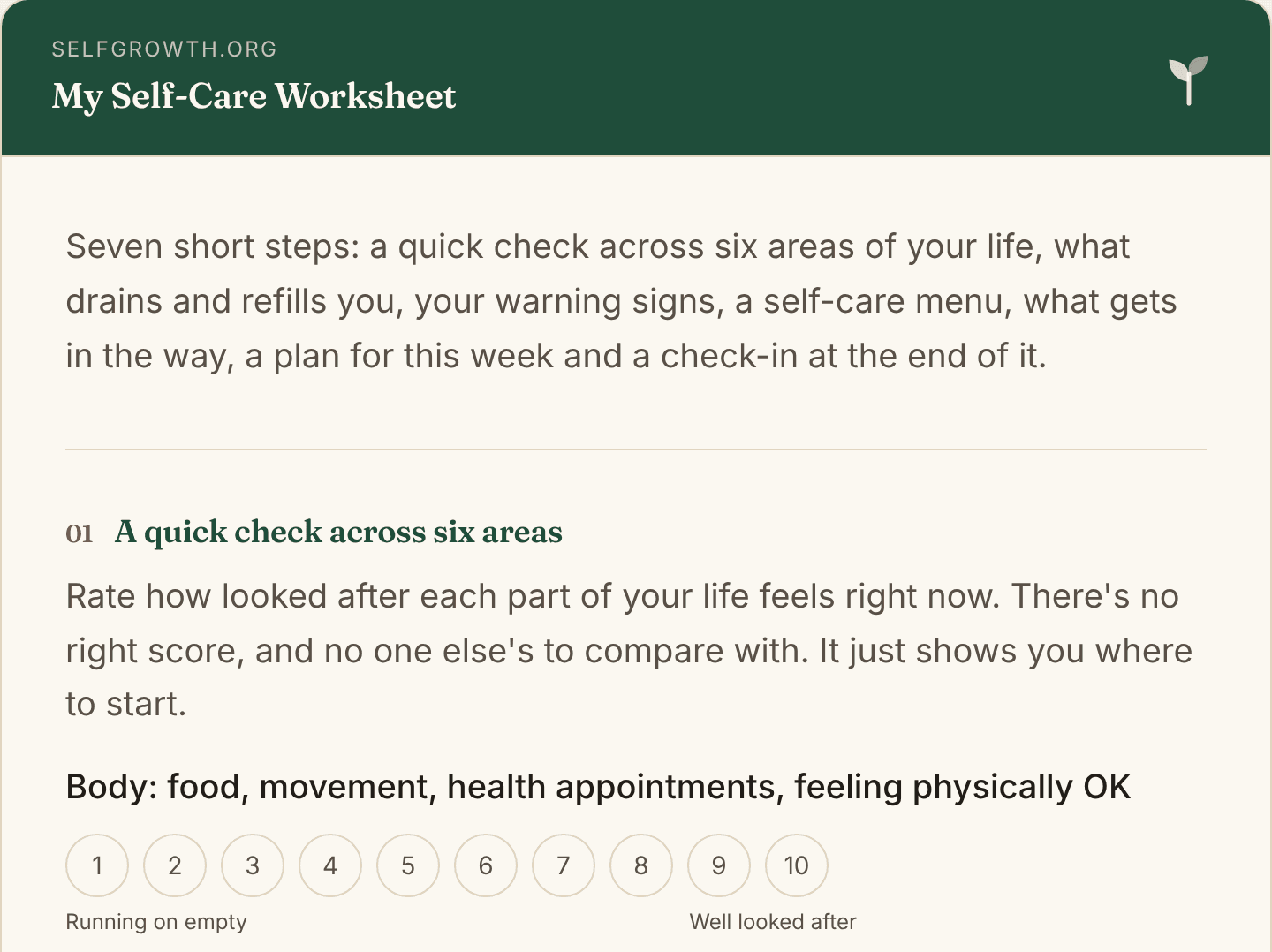
Self-Care Worksheet
A free, printable self-care worksheet for adults: check six areas of your life, see what drains and refills you, and make a self-care plan that costs nothing.
Open worksheet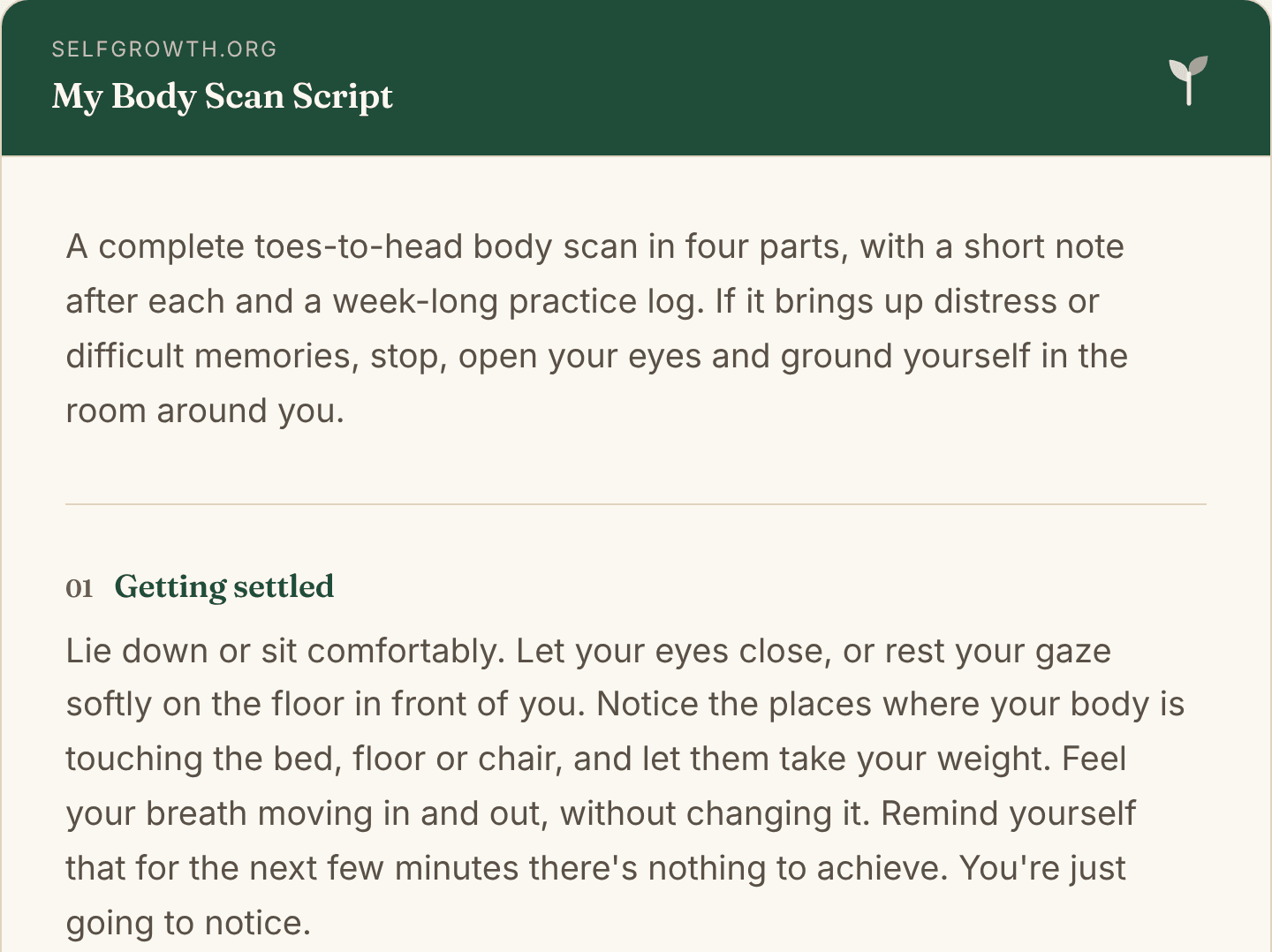
Body Scan Script
A free body scan meditation script in plain English: move your attention slowly from toes to head, noticing without changing, with reflection prompts and a log.
Open worksheetNew worksheets, straight to your inbox
An occasional new worksheet or tool, sent only when there's something genuinely worth your time. No spam, no pressure, unsubscribe any time.