
Guide
How to focus better: simple steps for a distracted day
Updated 25 October 2026 · 8 min read
To focus better, give your attention one job at a time. Pick one task and its next physical step, clear your space, put your phone out of reach, and set a short timer. Jot stray thoughts on paper so you can let them go, take short breaks, and stop at a clear point.
Drawn from research on media multitasking and everyday attention habits · Part of habits and getting things done
You sit down to do one thing. Ten minutes later you have checked your phone, read half an email, and forgotten what you were doing. It is tiring, and it can leave you doubting yourself.
Poor focus is not a sign of weak character. It can come from a messy setup: too many pulls on your attention, too little rest, or a task that has no clear first move. If your trouble is staying with one thing, start here. If your trouble is planning your hours, the guide to productivity covers that, and if the real problem is avoiding a task, see how to stop procrastinating.
It is a self-help guide, not therapy or medical advice.
Why is it so hard to focus?
Your attention is easy to pull away. A few common reasons you may recognise:
- Interruptions. Messages, notifications and people stepping in all break your train of thought, and getting back to it takes effort.
- Your phone. Even when it is face down on the desk, it is one tap from something more interesting than your task.
- Tiredness. When you are short on sleep or run down, staying with one thing can feel like hard work.
- Worry. If your mind is busy with something else, such as a bill, an argument or tomorrow's meeting, it keeps pulling you away from the task.
- An unclear next step. 'Work on the report' gives your mind nowhere to land. 'Write the first heading' does.
More than one can be true at once. Notice which fits you best today, and start with the matching fix below. If your focus has been poor for a long time, see the section on when it is more than a bad week.
How to focus better: step by step
You do not need to do all of these every day. Try them in order on one task and keep the ones that work for you.
- 1Pick one task and its next physical step. Not 'finish the project', but 'open the document and write the first heading'. A step you can see yourself doing is easier to stay with.
- 2Clear the space. Close extra tabs and programs, and put away anything not needed for this task. Fewer things in view means fewer things to drift towards.
- 3Put your phone out of reach. Another room is best. If you cannot do that, turn it face down and switch off notifications for now.
- 4Set a short timer. Choose a length you can manage, such as 15 or 25 minutes, and tell yourself you only have to stay with the task until it rings. Then you can stop or carry on.
- 5Park stray thoughts on paper. Keep a sheet beside you. When a worry or an errand pops up, write it down in a few words and go back to the task. The brain dump template is made for this.
- 6Take a short break when the timer ends. Stand up, stretch, get water, look out of a window. Leave your phone alone, or the break will swallow the next session.
- 7Stop at a clear point. End each session with a note of what you will do next. When you come back, the first step is already waiting for you.
To plan your day around a few focus blocks, use the daily planner. To empty your head before you begin, use the brain dump.
Open the Daily Planner TemplateOpen the Brain Dump TemplateTips to focus when working from home
Home has its own pulls: the washing, the fridge, the sofa. A few things that can help:
- Make one spot your work spot, even if it is the end of the kitchen table. Sitting there can become a cue that it is time to begin.
- Set a start and a finish time, and tell the people you live with when you are not to be interrupted.
- Do a short, fixed start ritual: make a drink, open the first task, start the timer.
- Keep a list of household jobs beside you and promise yourself a time to do them, such as lunch. Then they stop nagging.
- Get out of the house at least once. A walk at lunch gives your day an edge.
- Plan your hardest task for the part of the day when your mind is clearest, and leave email for the flat patches. The daily planner template has space for this.
How to focus when you're tired or stressed
Some days your head is not up to a long stretch of deep work. Pushing harder may not help. Try these instead:
- Shrink the session. Ten minutes on one small step still counts.
- Choose the task that needs the least thinking. Save the hard one for a clearer day.
- Write your worries down first. Getting them onto paper may make them easier to set aside.
- Move for a few minutes. Walk round the block or stretch before you start.
- Eat, drink some water, and open a window.
- Ask what you would tell a friend in your position. You would probably tell them to be gentler with themselves today.
If you are tired or stressed most days, that is a sign to look at your rest, not just your focus. The guide to types of rest and the guide to managing stress are places to begin.
Does multitasking hurt focus?
A 2009 study looked at this. In 2009, Eyal Ophir, Clifford Nass and Anthony Wagner published a series of experiments in the journal PNAS. They used a questionnaire to pick out people who often use several kinds of media at once and people who rarely do, then compared the two groups on tests of attention and task switching.
The heavy media multitaskers were more easily thrown off by things that were not relevant to the task, and they did worse on a test of switching between tasks. The researchers describe this as an association between heavy media multitasking and a different way of handling information. The study compared two existing groups, so it cannot tell you whether multitasking caused the difference. It does fit with a simple habit worth trying: give each task your whole attention for a short while, then switch on purpose.
When trouble focusing is more than a bad week
Days when focus will not come happen to all of us. It is worth talking to a GP if:
- poor focus has lasted a long time, not just a rough patch,
- it is getting in the way of your work, studies or relationships,
- it comes with low mood, constant worry, or loss of interest in things you used to enjoy.
A GP can talk through the possible causes with you. You do not need to be sure what is wrong before you go. Writing down a few examples of when focus has been hard can help you explain.
When to get more support
This is a self-help tool, not therapy or medical advice. If poor focus is hurting your job, your studies or how you feel about yourself, you deserve more than a page to fill in. A GP is a good first step. If you ever feel unsafe or have thoughts of harming yourself, call Samaritans on 116 123 (UK and Ireland), 988 (US), or find a line at findahelpline.com.
Sources and further reading
This is an educational self-reflection resource, not therapy or medical advice.
If you want to go deeper
- Ophir, E., Nass, C. & Wagner, A. D. (2009). Cognitive control in media multitaskers. Proceedings of the National Academy of Sciences, 106(37), 15583-15587.
Your questions, answered
- Why can't I focus on anything?
- Common reasons include constant interruptions, your phone within reach, tiredness, worry on your mind, or a task with no clear first step. Work out which fits best today and try the matching fix. If poor focus has lasted a long time or comes with low mood or constant worry, talk to a GP.
- How can I improve my focus quickly?
- Pick one task and its next small step, put your phone in another room, close extra tabs, and set a timer for 15 to 25 minutes. Write any stray thoughts on paper and go back to the task. After the timer, take a short break.
- How long should I focus for before taking a break?
- There is no single right length. Start with a stretch you can manage, such as 15 to 25 minutes, then take a short break. If you stay with the task easily, make the stretch a little longer. If you drift, make it shorter.
- How do I focus when working from home?
- Use one fixed work spot, set a start and finish time, and keep your phone out of reach. Keep a list for household jobs and give them a set time, such as lunch. Start with a short ritual, like making a drink and opening the first task.
- Does multitasking make it harder to focus?
- A 2009 study in PNAS compared heavy and light media multitaskers. The heavy group was more easily distracted by irrelevant things and did worse on a task-switching test. It shows an association, not that multitasking caused it. Giving one task your full attention for a short while is a simple habit to try.
- Is there a free focus worksheet?
- Yes. The daily planner template helps you choose your focus blocks, and the brain dump template clears stray thoughts from your head. Both are free, with a Download PDF button and a Print option, and no payment or email is needed. You can fill them in on screen and your answers save in your browser.
- Is this a substitute for therapy?
- No. This is a self-help tool, not therapy or medical advice. If poor focus has lasted a long time, affects your work or relationships, or comes with low mood or constant worry, talk to a GP. If you ever feel unsafe or have thoughts of harming yourself, call Samaritans on 116 123 (UK and Ireland), 988 (US), or find a line at findahelpline.com.
Worksheets to do the work
Free to fill in online or print. No email needed.
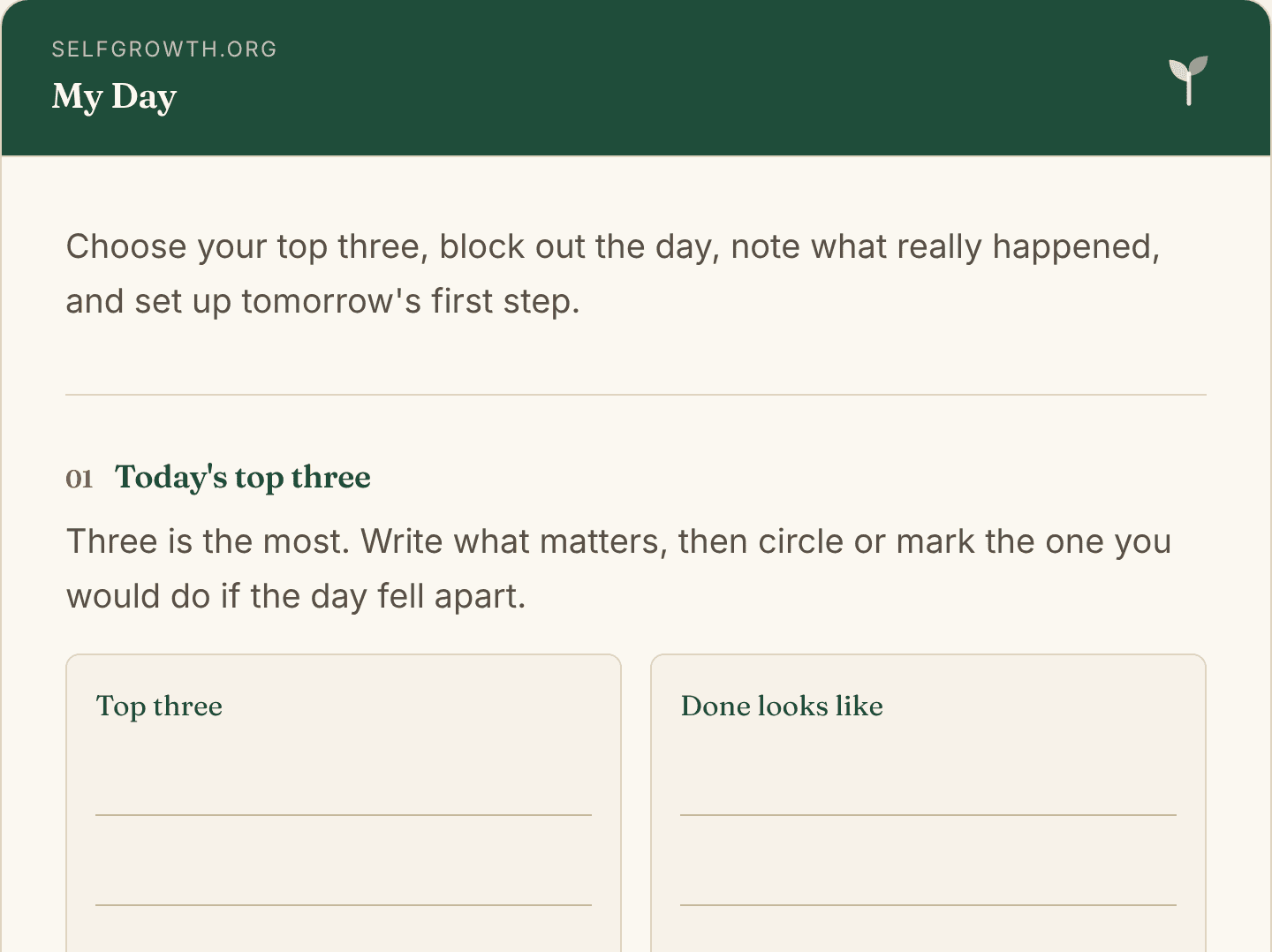
Daily Planner Template
A free daily planner template on one page: top three, time blocks, appointments, breaks, a short to-do list and a two-minute look back. Print or fill in.
Open worksheet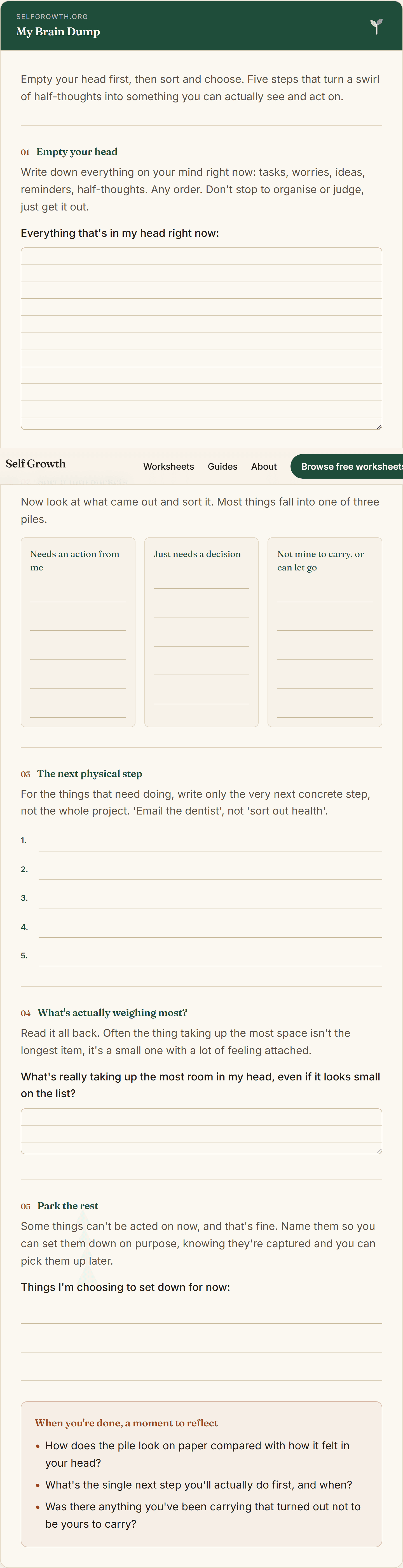
Brain Dump Template
A free, printable brain dump template to empty a cluttered mind onto the page, sort it into what needs action and what to let go, and find the next clear step.
Open worksheet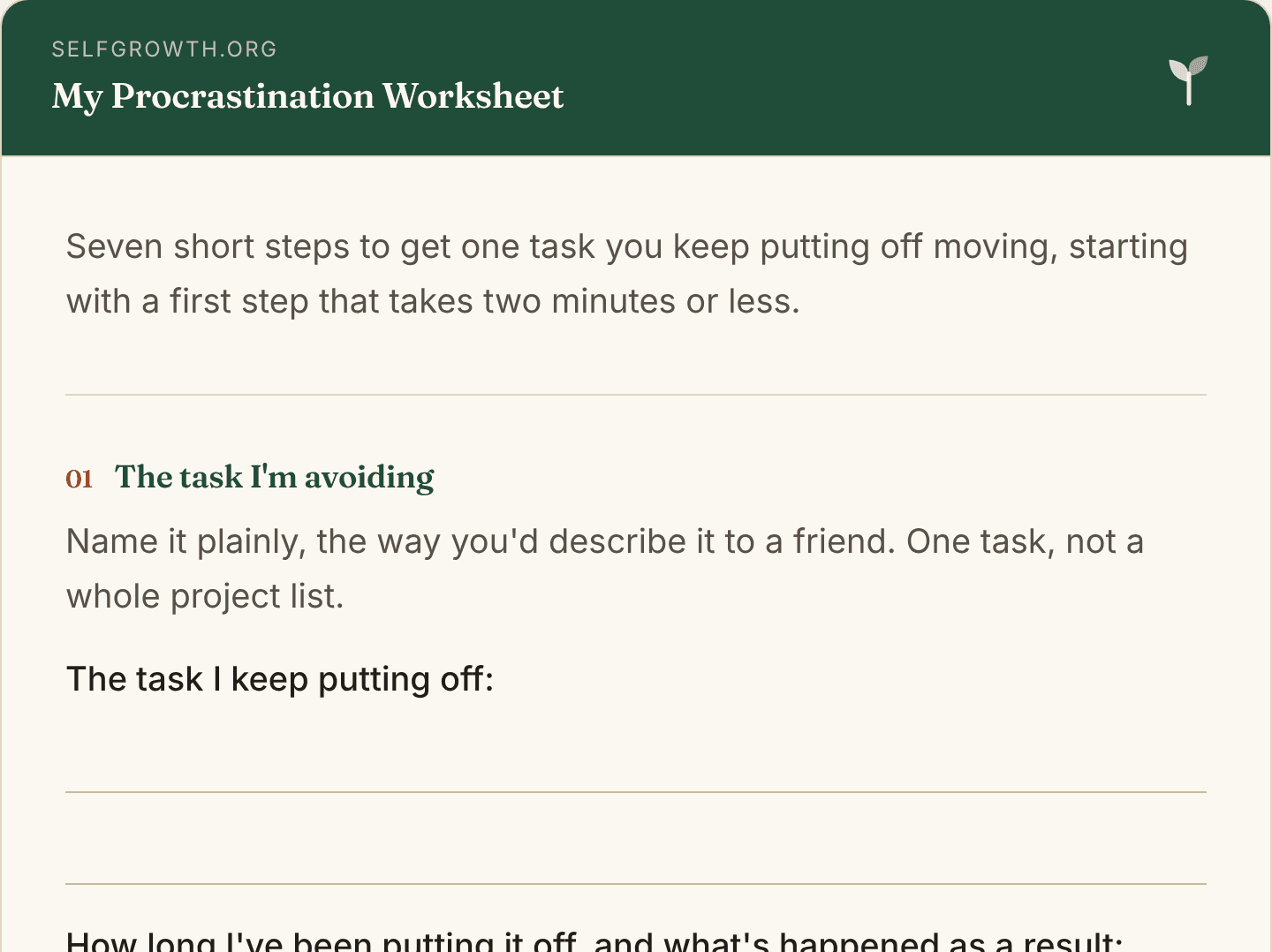
Procrastination Worksheet
A free, printable procrastination worksheet: name the feeling you're avoiding, find a two-minute first step, make an if-then plan and log seven days of starts.
Open worksheet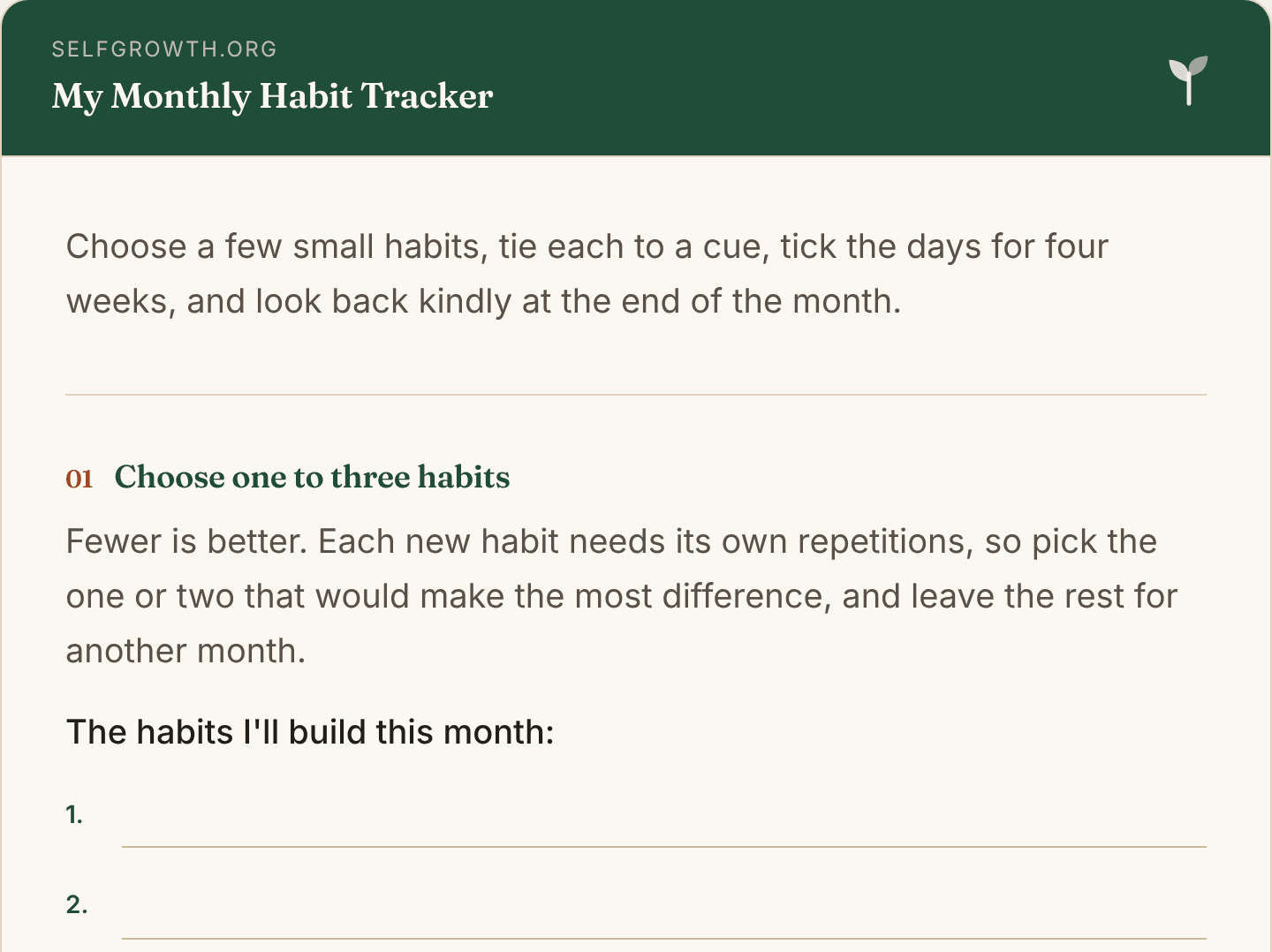
Habit Tracker Printable
A free printable habit tracker for one month: choose one to three small habits, tie each to a cue, tick the days, and review what helped. Print or fill it in.
Open worksheetRelated guides
New worksheets, straight to your inbox
An occasional new worksheet or tool, sent only when there's something genuinely worth your time. No spam, no pressure, unsubscribe any time.