Habits
Morning routine checklist: a free, printable way to build a calm start that fits your life
Updated 25 October 2026 · 6 min read · Free to print
A morning routine checklist is a short list of small steps you do in the same order each morning, with a box to tick each day. This free daily routine template helps you pick three to five realistic steps, add rough times, set up the night before, plan a bad-morning version, and review after two weeks.
Drawn from habit-formation research · Part of habits and getting things done
Fill it in here (it saves in this browser, but not in a private window), print it, or download the PDF. Free, no sign-up.
Most morning routine advice assumes a perfect day: up at five, a long list, everything done. Real mornings have kids, late trains, poor sleep and a phone that wants you. A routine that only works on a perfect day is not much use.
This sheet helps you build a small one. You look at how mornings go now, decide what you want from them (calm, ready, one thing for yourself), and choose three to five steps with rough times. Then you tick them for a week, plan the night before, and write a minimum version for bad mornings. After two weeks, you adjust. To track other habits alongside, use the habit tracker printable, or read how to build good habits.
This is a planning format, not a tested treatment, and it makes no promises about your health or your day. It is a self-help tool, not therapy. If getting up feels very hard because of low mood or poor sleep, see your GP.
How to use this worksheet
- 1Start with the first two sections. Be honest about your mornings as they are, not as you wish they were.
- 2Choose fewer steps than you think you need. Three is a good start.
- 3Print the weekly checklist or keep it on screen, and tick each step as you finish it.
- 4Do the night-before list once a day, in the evening, for the first week.
- 5After two weeks, do the review and change one thing.
The worksheet
selfgrowth.org
My Morning Routine
Look at your mornings now, choose three to five small steps, tick them for a week, and adjust after two.
01How my mornings are now
No judgement. Just notice what is true on a normal weekday.
What I wake up to, and what usually happens in the first hour:
What gets in the way most (people, phone, snooze, rushing, being tired):
How do my mornings feel at the moment?
02What I want from my mornings
A routine works better when it points at something you actually want. Tick any that fit, then say it in your own words.
I'd like my mornings to feel:
In one sentence, a good morning looks like:
My wake-up time, and the time I need to leave or start:
03Choose 3 to 5 small steps
Pick steps you can do on a normal day. Small is good: drink a glass of water, open the curtains, write today's one task. Put them in the order you would do them, with a rough time. Tie each to the one before it, so each step prompts the next.
Entry 1
Entry 2
Entry 3
Entry 4
Entry 5
Check my steps:
04This week's checklist
Write your steps in the first column and circle each day you do it. A tick for a small version counts. A blank is information, not failure.
Entry 1
Entry 2
Entry 3
Entry 4
Entry 5
05The night before
A calmer morning is often made the evening before. Choose two or three set-up jobs that take five minutes or less.
My evening set-up list:
- 1.
- 2.
- 3.
- 4.
Ideas to pick from:
06My bad-morning minimum
Some mornings will go wrong. Decide now what the smallest version is, so a bad morning does not mean no routine at all.
On a bad morning I'll just do these one or two steps:
What I'll say to myself when the morning falls apart:
07Two-week review
After two weeks, look at the checklist. Be curious about what the ticks and gaps show.
Which steps felt easy, and what helped?
Which steps kept slipping, and why?
Entry 1
Entry 2
Entry 3
Entry 4
How do my mornings feel now?
When you're done, a moment to reflect
- What is the one step that makes the biggest difference to how my morning feels?
- What did the night before change?
- On a bad morning, did my minimum version help?
- Is anything on my list there only because I think I should do it?
- What would make my mornings a little kinder for me and for others at home?
Done for now?
Save today's answers as a dated entry. You can come back, fill it in again and compare the two side by side.
What is behind a morning routine checklist?
The idea draws on habit research. Wendy Wood and Dennis Rünger's 2016 review of the psychology of habit describes how people tend to repeat the same behaviours in recurring contexts, and how habits form as people repeat the same responses in a given context. That is why each step here is tied to the one before it.
Phillippa Lally and colleagues followed 96 volunteers who each chose one eating, drinking or activity behaviour to do daily in the same situation for 12 weeks. The time it took for the habit to feel automatic ranged from 18 to 254 days, and missing one opportunity did not materially affect the process. These were single behaviours, not whole morning routines, so treat the findings as a guide to patience, not a schedule.
The checklist, the night-before list, the bad-morning minimum and the two-week review are a planning format. No study has tested them, and nothing here makes claims about health effects of any morning habit.
These are educational self-reflection tools, not therapy.
If you want to go deeper
- Lally, P., van Jaarsveld, C. H. M., Potts, H. W. W. & Wardle, J. (2010). How are habits formed: Modelling habit formation in the real world. European Journal of Social Psychology, 40(6), 998-1009.
- Wood, W. & Rünger, D. (2016). Psychology of habit. Annual Review of Psychology, 67, 289-314.
Your questions, answered
- What should be on a morning routine checklist?
- Three to five small steps you can do on an ordinary day, in the order you would do them. Good ones are simple: drink some water, get dressed, eat something, write your one task for the day, and one thing just for you. Leave out anything you would do only on a perfect day. You can always add a step later.
- How do I make a daily routine template that I'll stick to?
- Keep it small and tie each step to the one before it. In a 2010 study by Lally and colleagues, people repeated one chosen behaviour in the same situation each day. Missing a single day did not materially affect how the habit formed. Set a bad-morning minimum, and review after two weeks to change what is not working.
- How long does it take to build a morning routine?
- It varies a lot. In Lally's study of eating, drinking and activity habits, the time it took for the habit to feel automatic ranged from 18 to 254 days. That study was about single behaviours, not whole routines, so expect to adjust over weeks. Wood and Rünger's 2016 review describes habits as forming when you repeat the same response in the same context.
- What if I'm not a morning person?
- You do not need to be. This sheet does not ask you to wake earlier. It asks you to make the time you already have a bit smoother. Start with the night before and one or two steps, and set the times around when you really get up. A short, steady routine at your own pace will serve you better than a long one you drop.
- What do I do on a bad morning?
- Use your minimum version: the one or two steps you wrote in the bad-morning section. Doing the smallest version keeps the thread without making the morning harder. If you miss it altogether, carry on the next day, with no catching up. One missed day is not the end of a routine.
- Is there a morning routine printable PDF?
- Yes. Use the Download PDF button for a print-ready copy, or Print to print straight from the page. It is free, with no payment and no email needed. You can also fill it in on screen, and your answers save in your browser on that device.
- Is this a substitute for therapy?
- No. It is a self-help tool, not therapy or medical advice. If low mood, anxiety or poor sleep is what makes mornings hard, please speak to your GP. If you ever feel unsafe or have thoughts of harming yourself, call Samaritans on 116 123 (UK and Ireland), 988 (US), or find a line at findahelpline.com.
Keep going, related worksheets
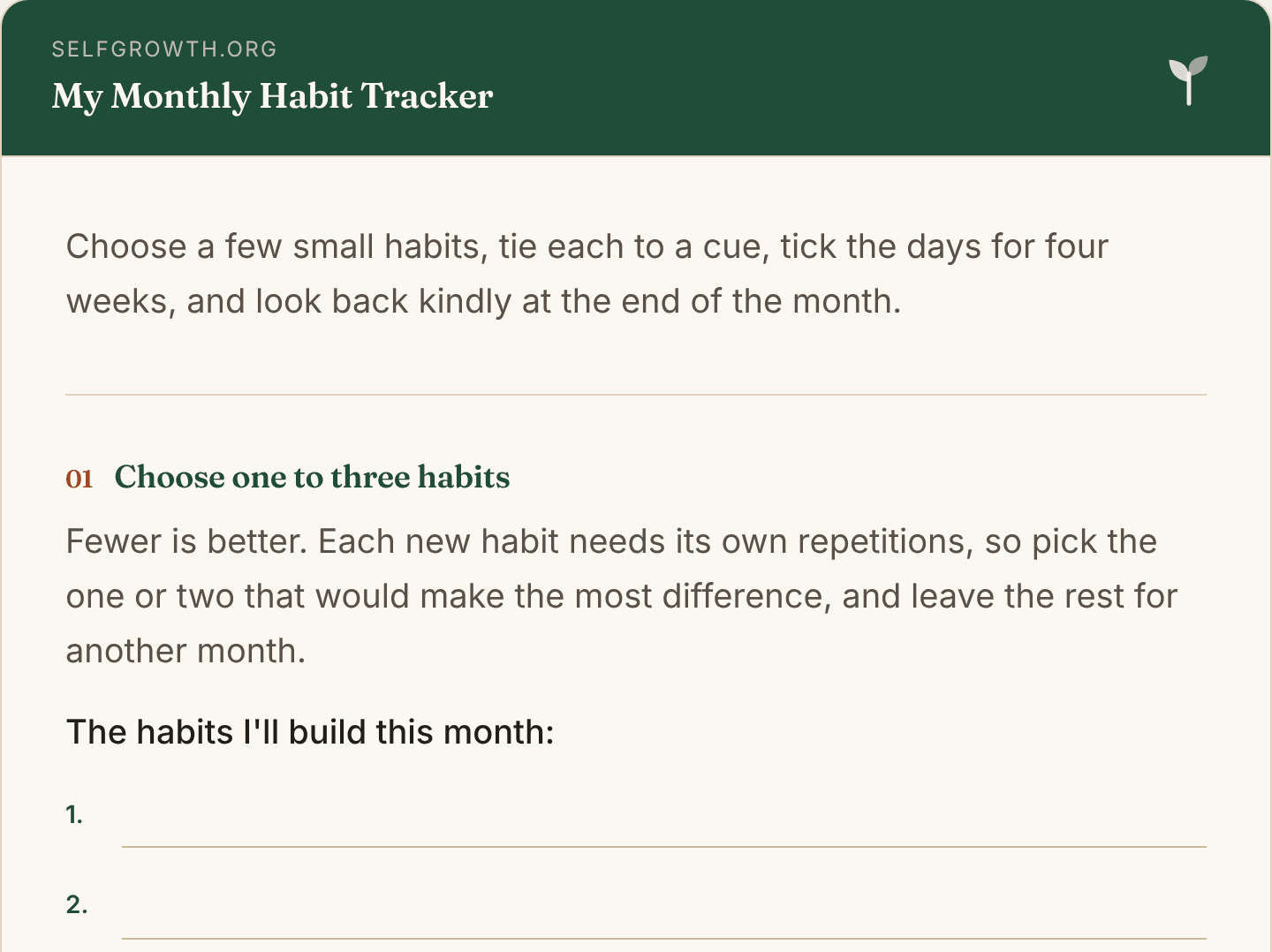
Habit Tracker Printable
A free printable habit tracker for one month: choose one to three small habits, tie each to a cue, tick the days, and review what helped. Print or fill it in.
Open worksheet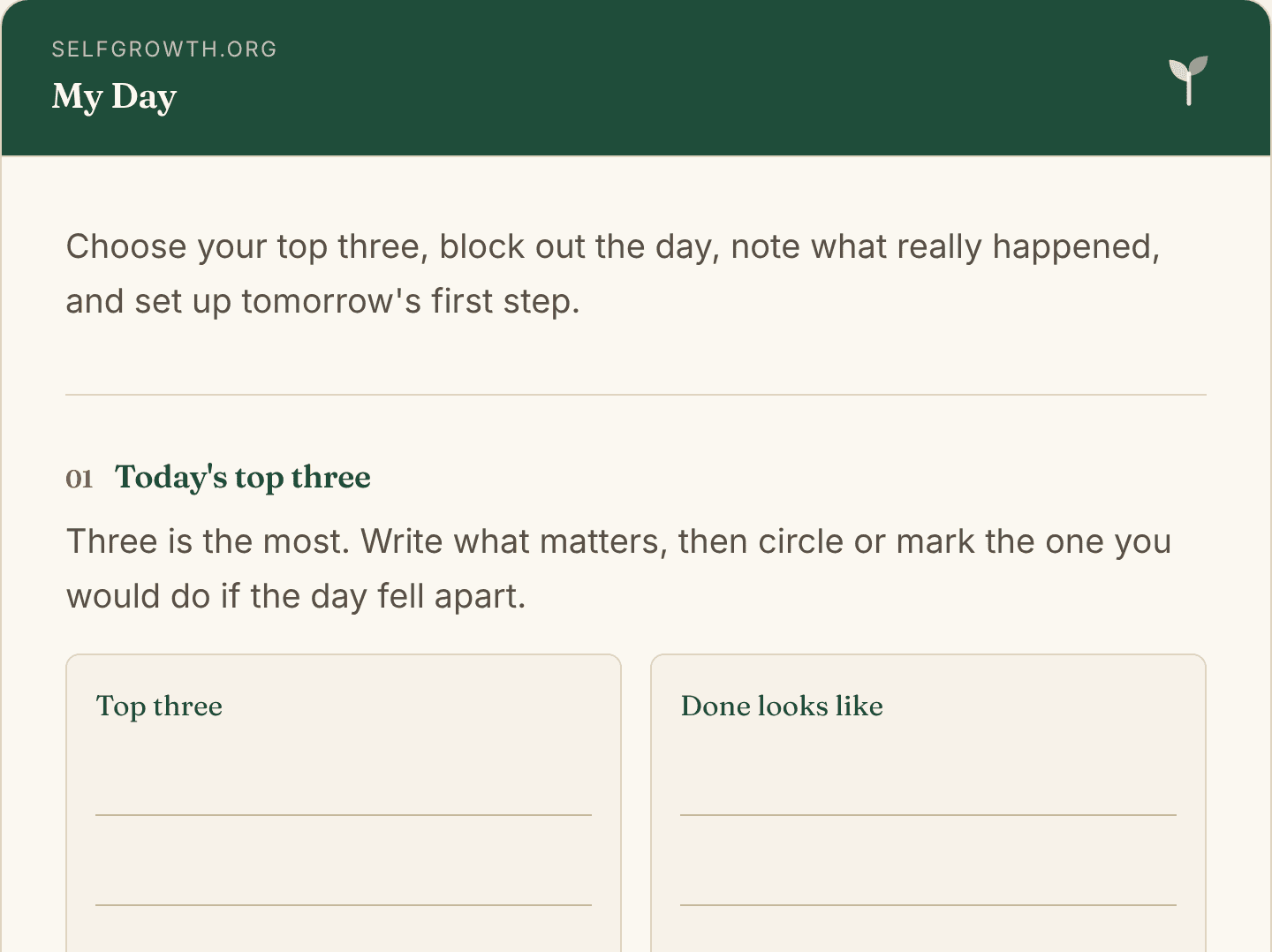
Daily Planner Template
A free daily planner template on one page: top three, time blocks, appointments, breaks, a short to-do list and a two-minute look back. Print or fill in.
Open worksheet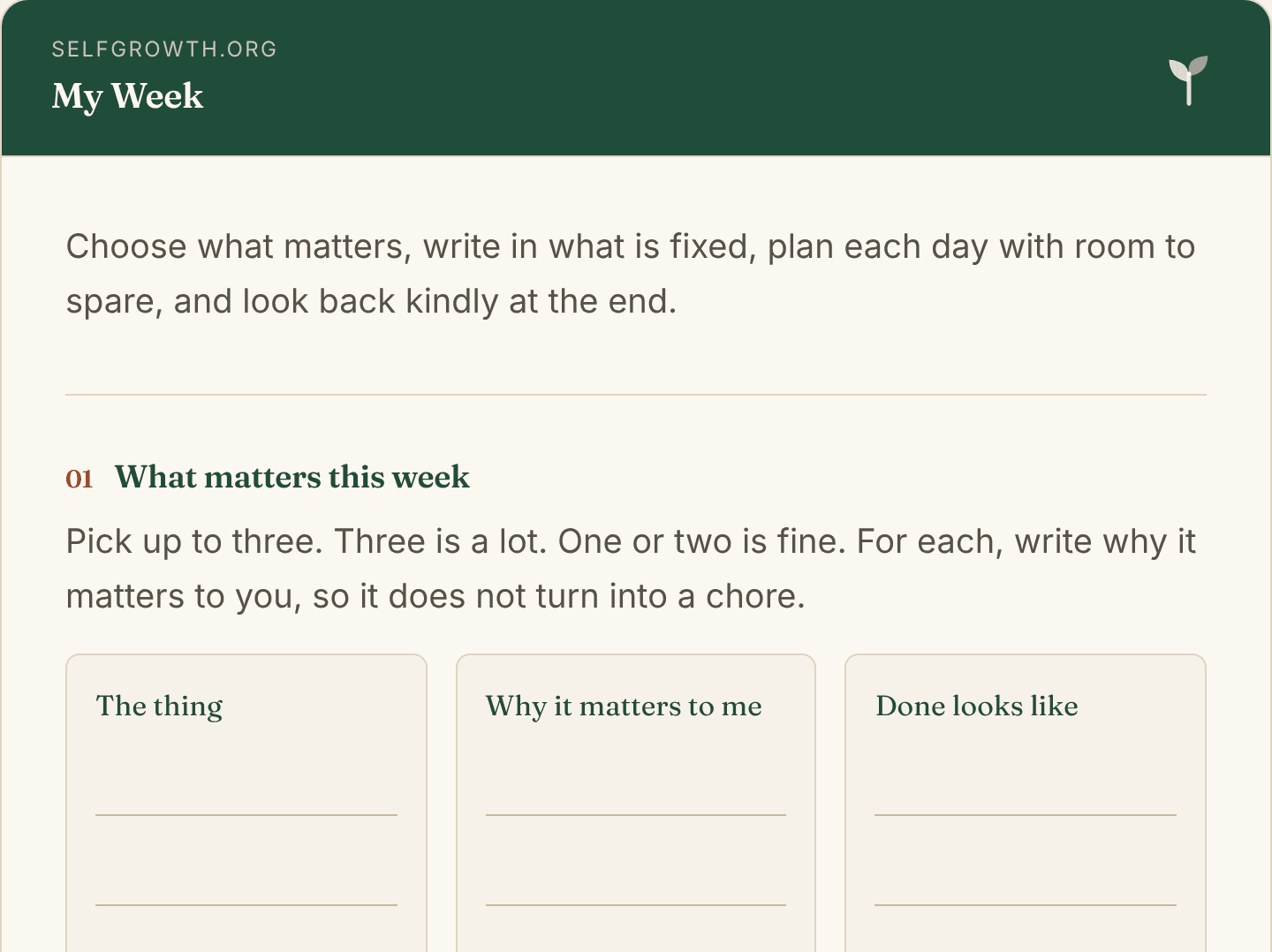
Weekly Planner Printable
A free weekly planner printable: pick up to three priorities, note fixed times, plan each day with a buffer and rest, then look back kindly. Print or fill in.
Open worksheetNew worksheets, straight to your inbox
An occasional new worksheet or tool, sent only when there's something genuinely worth your time. No spam, no pressure, unsubscribe any time.