
Guide
The five stages of grief: what they are and what they miss
Updated 23 October 2026 · 9 min read
The five stages of grief are denial, anger, bargaining, depression and acceptance, popularised by Elisabeth Kubler-Ross. They are not a fixed order or a timetable, and you may feel some, all or none of them. There is no right way to grieve. If grief feels overwhelming or is getting worse, talk to a GP or a bereavement service.
Drawn from Kubler-Ross's stages, grief research and other models of loss · Part of feelings and calm
There is no right way to grieve, and no timetable. If someone close to you has died, or you have lost something that mattered, you may have been told you will go through 'the five stages'. Maybe you are checking yourself against the list. Maybe you are wondering why you don't feel angry, or why you feel something that isn't on it at all.
This is a self-help guide, not therapy.
What are the five stages of grief?
The five stages are denial, anger, bargaining, depression and acceptance. Psychiatrist Elisabeth Kubler-Ross set them out in her 1969 book On Death and Dying. Here is what each one describes in everyday terms:
- Denial: a feeling of shock, numbness or disbelief. 'This can't be happening.'
- Anger: anger at the situation, at other people, at yourself, or at the person who has gone.
- Bargaining: 'if only' thoughts and what-if deals. 'If I had gone sooner.' 'If I do this, can it be undone?'
- Depression: a deep sadness, withdrawal or emptiness as the loss sinks in.
- Acceptance: coming to terms with the loss and its reality. It doesn't mean you are fine with it, or that the pain has gone.
You may recognise some of these feelings in yourself, and putting names to feelings can help. If you want help naming what you feel, the feelings wheel and the list of emotions are good places to start.
Where did the five stages come from?
Kubler-Ross's work began with seminars and conversations with people who were dying. On Death and Dying, published in 1969, described the responses she heard from them. According to the Elisabeth Kubler-Ross Foundation, her own chart in that book shows overlapping bands rather than a fixed staircase of steps. She later applied the same responses to other big losses and changes, which is part of why they became the best-known description of grief.
So the stages did not start as a map for people who are bereaved. They started from listening to people facing their own deaths, and the neat, ordered list of five is the version that spread.
Do you have to go through the stages in order?
Not necessarily, and you may not recognise all five in yourself. You might feel several at once, skip one, return to one months later, or feel something that isn't on the list: yearning for the person, guilt, relief, anxiety, or numbness. None of that means you are grieving wrongly.
Researchers have tested the idea. In 2007, Paul Maciejewski, Holly Prigerson and colleagues published a study in the Journal of the American Medical Association called 'An empirical examination of the stage theory of grief'. They followed bereaved people in Connecticut and rated five feelings (disbelief, yearning, anger, depression and acceptance) at points from 1 to 24 months after the death. The results were mixed. Contrary to stage theory, disbelief was not the first or strongest feeling. Acceptance was the most frequently reported, and yearning (missing the person) was the strongest negative feeling. Yet the authors also found that the five feelings reached their peaks in the order stage theory predicts: disbelief, then yearning, anger, depression, acceptance. The people in the study had lost someone to natural causes, so a different path after a sudden or violent death is not abnormal.
The study looked at group averages. It cannot tell you what your grief will do.
Other ways to understand grief
The stages are one way of describing grief. Two others have research and thinking behind them, and some people find them closer to their own experience.
- The dual process model. Margaret Stroebe and Henk Schut described it in a 1999 paper in the journal Death Studies. It suggests there are two kinds of stress after a loss: ones about the loss itself, such as sadness and missing the person, and ones about rebuilding life, such as new roles, tasks and routines. Rather than moving through steps, you swing back and forth between facing the loss and taking a break from it, and the authors treat those breaks as a normal part of coping, not avoidance.
- Continuing bonds. In a 1996 book edited by Dennis Klass, Phyllis Silverman and Steven Nickman, contributors challenged the idea that grief is about cutting ties with the person who died. They argue that healthy grieving can include an ongoing relationship with them: talking to them, keeping their things, or carrying their values forward.
Neither is a rulebook. If one of them fits what you are feeling, it might make it feel less strange. If you feel pulled to talk about the person or to write to them, the grief journal prompts and the grief worksheet are gentle places to begin. If you are also holding on to something that happened before the loss, the letting go of the past worksheet can help.
Open the Grief WorksheetThere is no right way or timetable to grieve
You may cry a lot, or not at all. You may want company, or silence. You may feel fine for a week and flattened the next. Grief can come back around birthdays, anniversaries or a smell or a song, long after you thought it was behind you. None of this is failing at grief.
Some things that may help, without any guarantee. Be as gentle with yourself as you would be with a friend in your position.
- 1Let the feelings come when they come, rather than trying to schedule them.
- 2Keep a little routine: regular food, some sleep, a short walk.
- 3Talk about the person you lost, to someone you trust or out loud on your own.
- 4Accept help with practical things, and say yes to specific offers.
- 5Take breaks from the grief without guilt: a film, a meal out, an hour with a friend.
When to get more support
Grief is not an illness, and it doesn't need treating. But you don't have to carry it alone. Consider talking to a GP or family doctor if your grief feels like it is getting worse rather than easing, if it keeps getting in the way of sleep, eating, work or looking after yourself or others, or if you stay overwhelmed and can't see a way through. A GP can listen, check how you are, and point you to support. You don't need to wait for it to be bad enough.
In the UK, Cruse Bereavement Support has a free helpline on 0808 808 1677 (check their website, cruse.org.uk, for opening times), plus local support. In the US, your doctor, a local hospice or your faith community can point you to bereavement support nearby. Our helplines and support page lists more routes.
If your grief comes with hopelessness, or thoughts of harming yourself or not wanting to be alive, please reach out now. Those thoughts can be serious, and you deserve support from a real person. In the UK and Ireland, call Samaritans free on 116 123, any time. In the US, call or text 988. Elsewhere, findahelpline.com lists free, confidential lines by country. If you are in immediate danger, call your local emergency number.
Sources and further reading
This is an educational self-reflection resource, not therapy or medical advice.
If you want to go deeper
- Kubler-Ross, E. (1969). On Death and Dying. Macmillan.
- Elisabeth Kubler-Ross Foundation. 5 Stages of Grief. ekrfoundation.org/5-stages-of-grief/
- Maciejewski, P. K., Zhang, B., Block, S. D. & Prigerson, H. G. (2007). An empirical examination of the stage theory of grief. JAMA, 297(7), 716-723.
- Stroebe, M. & Schut, H. (1999). The dual process model of coping with bereavement: Rationale and description. Death Studies, 23(3), 197-224.
- Klass, D., Silverman, P. R. & Nickman, S. L. (Eds.) (1996). Continuing Bonds: New Understandings of Grief. Taylor & Francis.
Your questions, answered
- What are the 5 stages of grief?
- Denial, anger, bargaining, depression and acceptance. They were popularised by Elisabeth Kubler-Ross, who described them in On Death and Dying (1969) after listening to people who were dying. They are not a fixed order or a timetable, and you might feel some, all or none of them.
- Do you have to go through all five stages of grief?
- No. Grief doesn't follow a set path. You might feel several feelings at once, skip some, return to others, or feel things that aren't on the list, such as yearning, guilt or relief. There is no right way to grieve.
- Are the stages of grief real?
- They describe feelings you may recognise, but they aren't a reliable sequence. A 2007 JAMA study of bereaved people found mixed results: disbelief wasn't the first or strongest feeling, yearning was the strongest negative one, yet the five feelings peaked in the predicted order on average. It describes groups, not you.
- How long does grief last?
- There is no set time. Grief can ease and return, sometimes years later, around anniversaries or reminders. If it feels like it is getting worse or stays overwhelming and gets in the way of daily life, talk to a GP or a bereavement service.
- What is the difference between the stages of grief and the dual process model?
- The stages describe five feelings, often presented as steps. The dual process model, from Stroebe and Schut (1999), describes swinging between facing the loss and dealing with rebuilding life, with breaks from grief as a normal part. It is a way of understanding movement, not a set of steps.
- When should I get help with grief?
- Consider talking to a GP or a bereavement service if your grief is getting worse, keeps disrupting sleep, eating or daily life, or feels overwhelming. In the UK, Cruse Bereavement Support has a free helpline on 0808 808 1677. If you have thoughts of harming yourself, call Samaritans on 116 123 (UK and Ireland), call or text 988 (US), or see findahelpline.com.
- Is this therapy, and is it free?
- It is free, with no email needed, and it is a self-help guide, not therapy or medical advice. It can't tell you what your grief means or diagnose anything. For personal support, speak to a GP or a bereavement service. If you ever feel unsafe, contact a crisis line straight away.
Worksheets to do the work
Free to fill in online or print. No email needed.
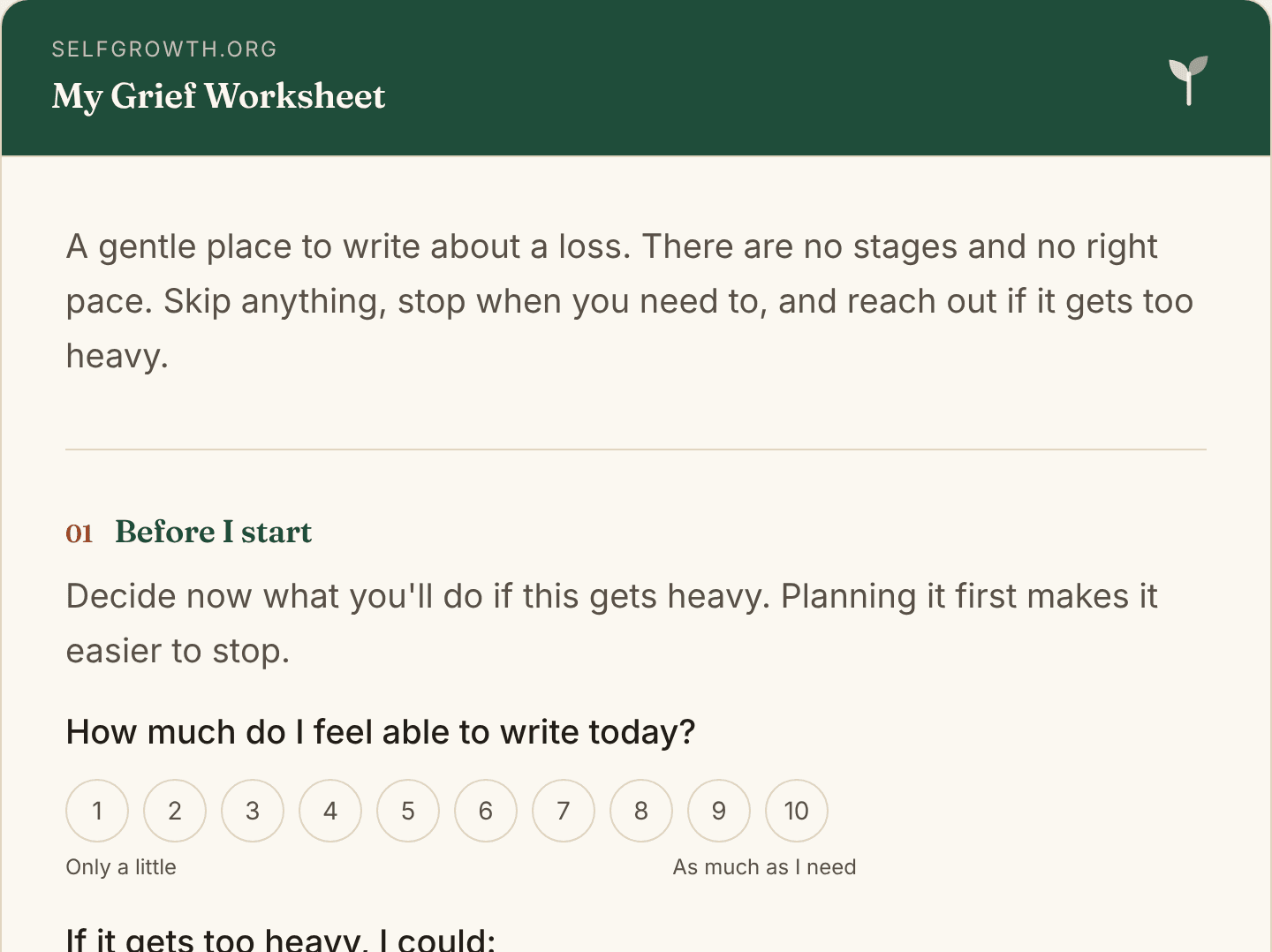
Grief Worksheet
A free, gentle grief worksheet for after a bereavement: write about who you miss, what you feel and what helps today. No stages, no timetable. Free PDF.
Open worksheet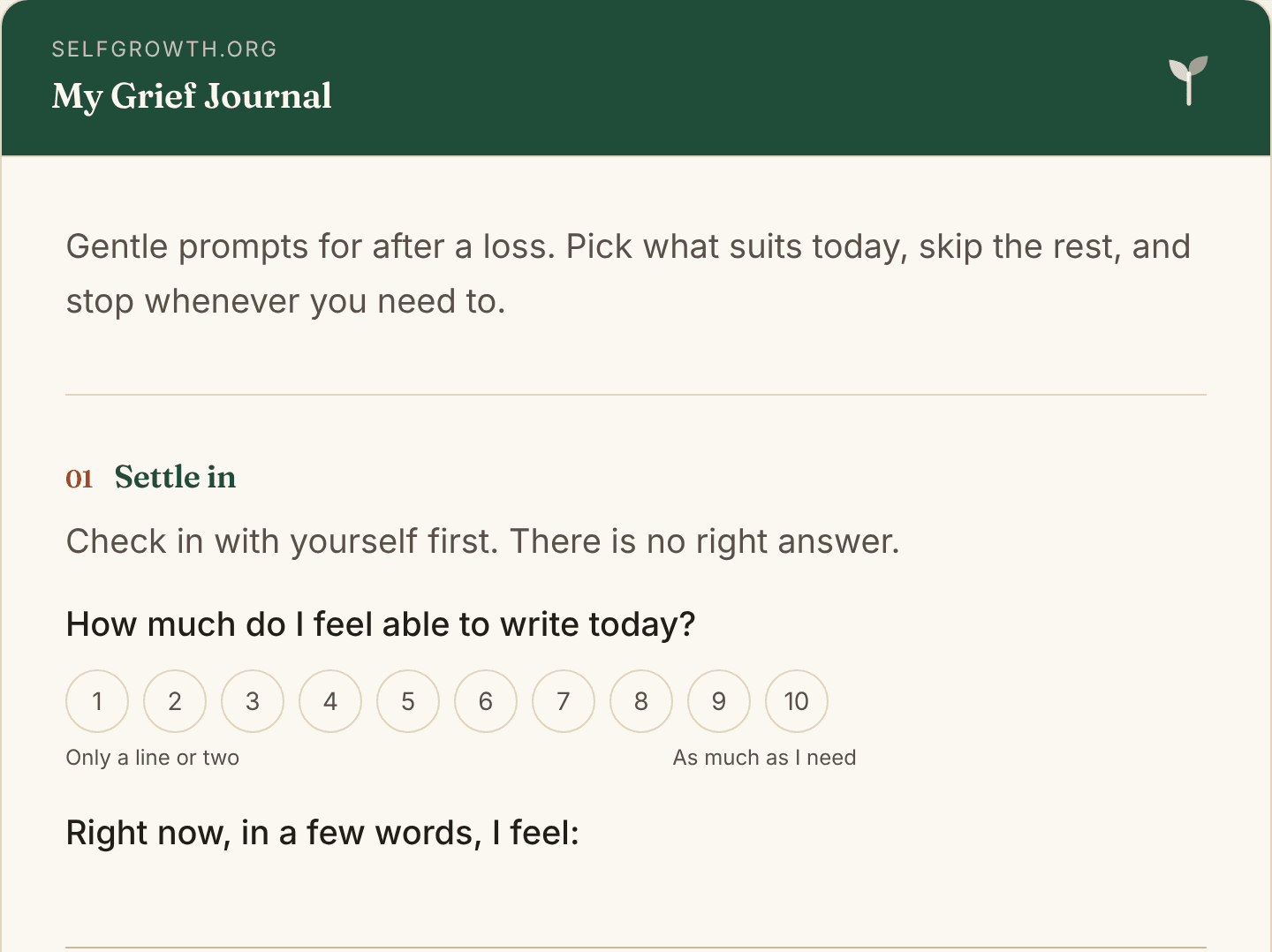
Grief Journal Prompts
Free, gentle grief journal prompts for after a bereavement: who you miss, what you feel, what you wish you'd said. Skip any prompt. No stages. Free PDF.
Open worksheet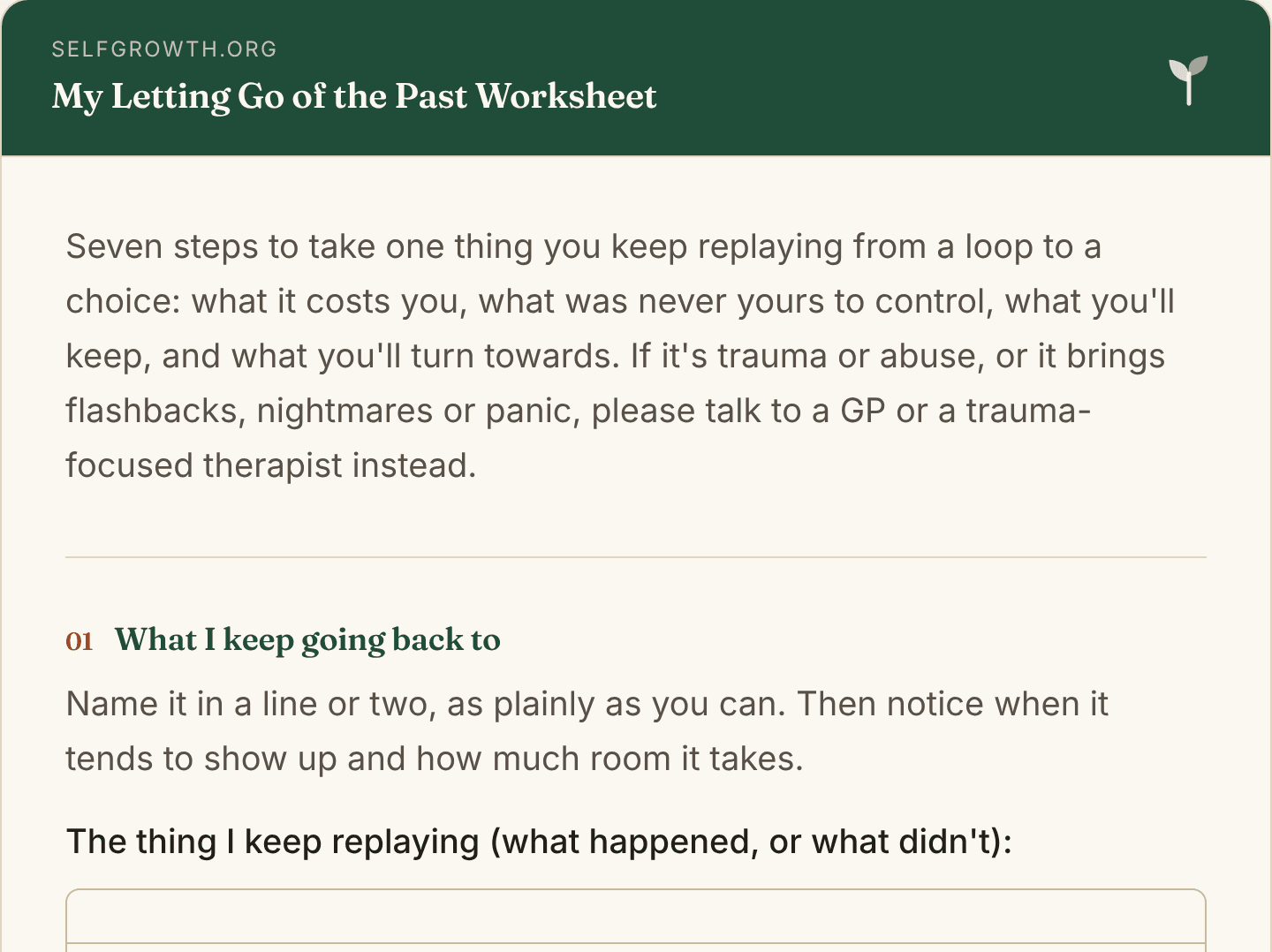
Letting Go of the Past Worksheet
A free printable letting go worksheet: see what replaying the past costs you, sort what was in your control, write an unsent letter, plan for when it returns.
Open worksheet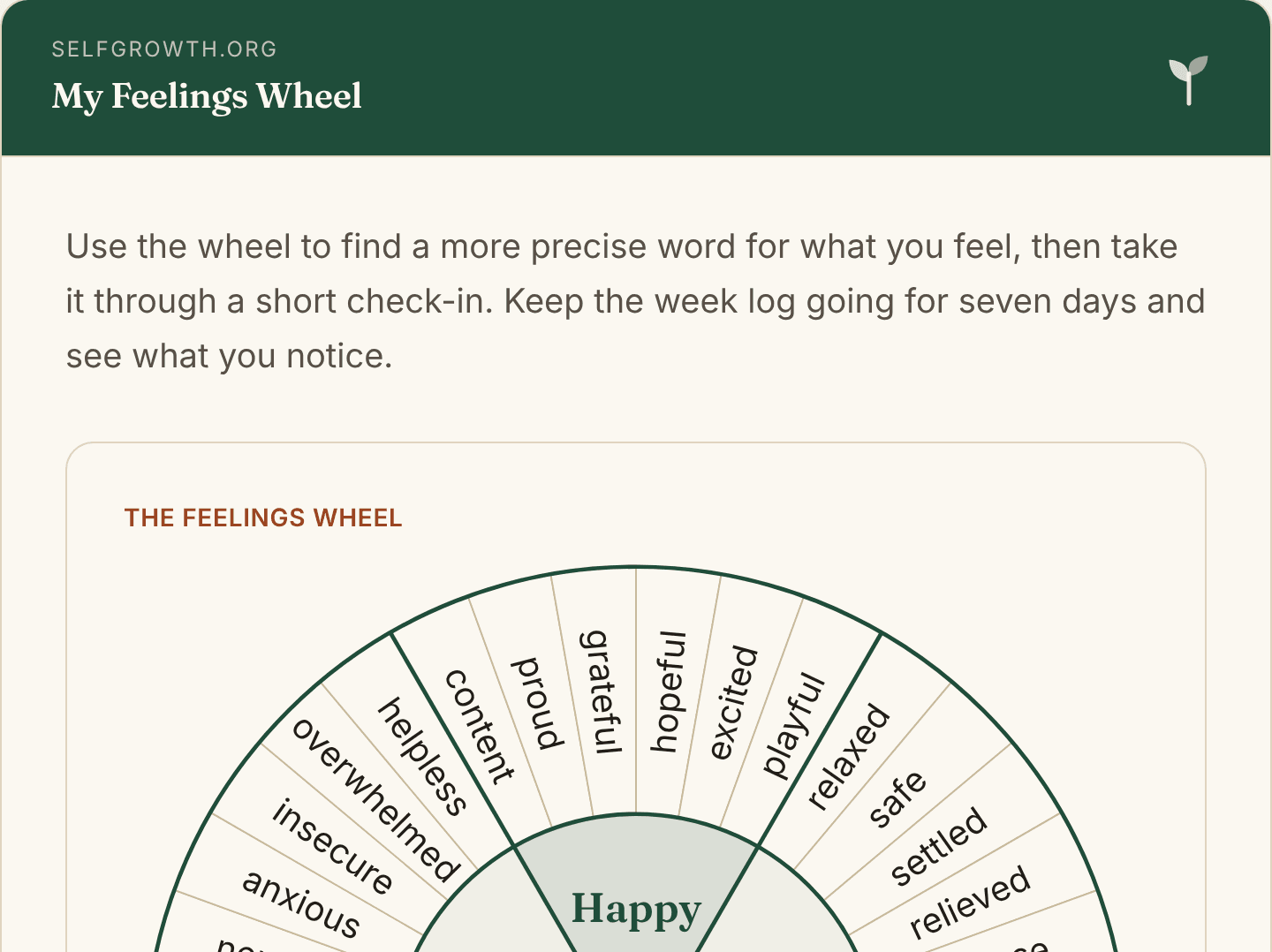
Feelings Wheel
A free printable feelings wheel (emotion wheel) PDF: six core feelings and 36 more precise words, with a daily check-in and a week log to name what you feel.
Open worksheet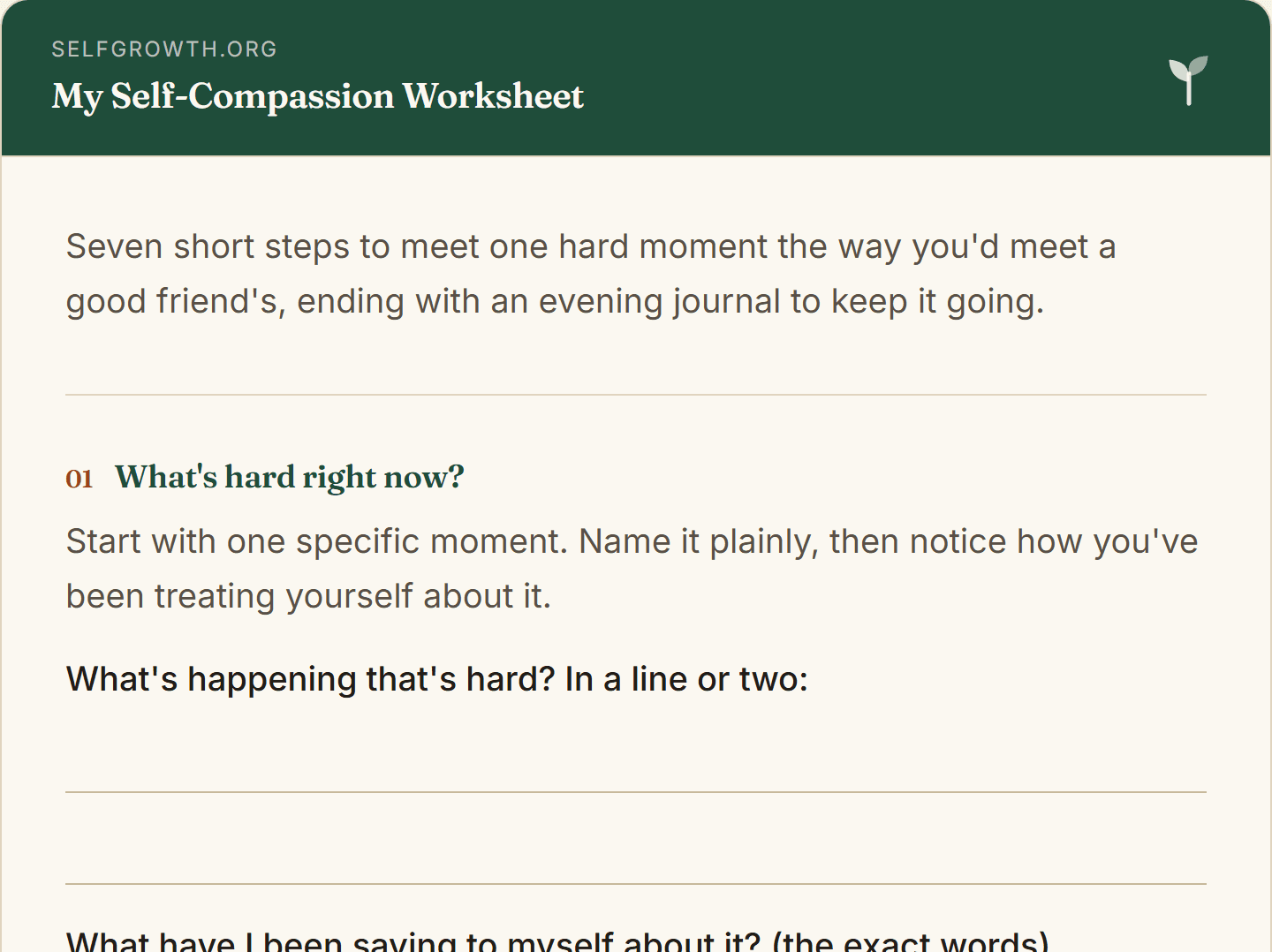
Self-Compassion Worksheet
A free, printable self-compassion worksheet: the self-compassion break, the friend test, a kind letter and journal prompts, based on Kristin Neff's research.
Open worksheetRelated guides
New worksheets, straight to your inbox
An occasional new worksheet or tool, sent only when there's something genuinely worth your time. No spam, no pressure, unsubscribe any time.