
Grief
Grief journal prompts: free, gentle prompts to write through a loss
Updated 17 October 2026 · 8 min read · Free to print
Grief journal prompts are gentle questions that give you something to write when you can't find the words for a loss. This free printable has prompts about who you miss, what today is like, and what you wish you'd said. You can skip any of them, and the NHS says there's no right or wrong way to feel.
By the Self Growth team · drawn from NHS guidance on grief and research on writing · how we make these
Fill it in here (it saves in this browser, but not in a private window), print it, or download the PDF. Free, no sign-up.
When someone has died, a blank page can feel impossible. A prompt gives you one small door to walk through. Write a line, a list or a page. Stop in the middle of a sentence if you need to.
These prompts don't follow stages, and none of them asks you to feel a particular way. The NHS says there's no right or wrong way to feel, that powerful feelings can appear unexpectedly, and that you may not go through the well-known stages of grief, or in order. So pick a prompt that suits today and ignore the rest.
Research on writing about grief is mixed, and we don't promise journalling will ease it (details below).
This is a self-reflection tool, not therapy. In the UK, the Cruse Bereavement Support helpline (0808 808 1677) is free from UK landlines and mobiles. Lines are open Monday, Wednesday, Thursday and Friday 9.30am to 5pm and Tuesday 1pm to 8pm, and closed at weekends. The line can be busy. If you can't get through, keep trying, or call Samaritans on 116 123. Please also see our helplines page. If you're in crisis or having thoughts of ending your life, call Samaritans on 116 123 (UK and Ireland), call or text 988 (US), or find a helpline at findahelpline.com.
How to use this worksheet
- 1Choose one prompt, not all of them. Write for as long as feels right, then stop.
- 2Skip any prompt that feels too much. A skipped prompt is not a failure, and you can come back to it, or not.
- 3Write in whatever way suits you: full sentences, a list, single words, or a letter. Spelling doesn't matter and nobody else needs to read it.
- 4If writing leaves you feeling worse for more than a moment, stop, do something that steadies you (a drink, fresh air, a call to someone), and consider talking to your GP or a bereavement helpline.
The worksheet
selfgrowth.org
My Grief Journal
Gentle prompts for after a loss. Pick what suits today, skip the rest, and stop whenever you need to.
01Settle in
Check in with yourself first. There is no right answer.
How much do I feel able to write today?
Right now, in a few words, I feel:
If this gets heavy, I'll:
02Who they are to me
Pick any one of these.
Describe them to someone who never met them.
What is a small habit, phrase or gesture of theirs that I can still picture?
What did I learn from them, or what did they give me?
03What today is like
Not what you think it should be like. What it's like.
Describe today so far in as much detail as I want.
What did I notice that surprised me about how I felt?
A moment today when I felt something other than the loss, even for a second:
04What I miss
Small things count.
Ten small things I miss:
- 1.
- 2.
- 3.
- 4.
- 5.
- 6.
- 7.
- 8.
- 9.
- 10.
Which of these is hardest, and why?
05What I wish I'd said
A letter that doesn't need to be sent. You can leave it on the page.
Dear ... (write to them)
What would they say back?
06When it's hard
If you are having thoughts of ending your life, stop writing and call Samaritans on 116 123 (UK and Ireland) or call or text 988 (US) now. Otherwise, here are some prompts for the harder moments. Only if you feel up to them.
What is the hardest part right now, and have I told anyone about it?
Is there something I'm blaming myself for? What would I say to a friend who felt the same?
What do I need most this week, and who could I ask?
07Small comforts
Looking after yourself counts as part of grieving.
Small things that have helped me, even a little:
- 1.
- 2.
- 3.
- 4.
- 5.
One kind thing I'll do for myself in the next 24 hours:
08Prompts to take with you
Tick these off over time. One is plenty for a sitting.
When you're done, a moment to reflect
- How was it to write today? Was there a line I'd like to keep?
- Did anything come up that I'd like to tell someone?
- What would help me look after myself this evening?
Do grief journal prompts help?
We don't know of a trial of these prompts, and journaling is not a treatment for grief. The prompts are ours. They're built to be small, skippable and free of any set stages.
The research on writing about a hard experience is mixed. In a 2000 randomised study by Range, Kovac and Marion, 64 undergraduates who had lost a loved one to an accidental death or a homicide began a writing project (44 completed it), writing for 15 minutes a day over four days about their bereavement or about neutral topics. Both groups improved by a six-week follow-up and the abstract reports no overall difference between them. The bereavement-writing group reported less subjective distress on days 1 to 3. A 2006 meta-analysis by Mogk and colleagues combined the results of 30 trials of writing about stressful experiences and found no significant effects overall on physical or psychological health measures. These studies used a different technique from our one-line prompts and a specific type of loss, so they can't say how these prompts will go for you.
The NHS's guidance on grief shapes the rest. It says there's no right or wrong way to feel, that you may not go through all of the stages of grief or in order, and that talking to someone can help. If you'd like to go through a structured set of exercises instead, see the grief worksheet.
These are educational self-reflection tools, not therapy. See our editorial standards.
If you want to go deeper
- NHS. Grief after bereavement or loss (nhs.uk).
- Cruse Bereavement Support. Helpline (cruse.org.uk/get-support/helpline).
- Range, L. M., Kovac, S. H. & Marion, M. S. (2000). Does writing about the bereavement lessen grief following sudden, unintentional death? Death Studies, 24(2), 115-134.
- Mogk, C., Otte, S., Reinhold-Hurley, B. & Kroner-Herwig, B. (2006). Health effects of expressive writing on stressful or traumatic experiences: a meta-analysis. Psycho-Social Medicine, 3, Doc06.
Your questions, answered
- What are grief journal prompts?
- They are short questions or starting lines that help you write about a loss when you don't know where to begin. A good prompt points to one small, answerable thing, such as a memory, a feeling in your body, or something you wish you'd said, instead of asking you to 'process everything'.
- What should I write in a grief journal?
- Whatever is true today. It could be a memory, a list of what you miss, a letter to the person who died, or a plain description of how the day went. There's no right way. The NHS says there's no right or wrong way to feel, and a journal can hold anger and guilt as well as love and longing.
- Does journaling help with grief?
- It might give you somewhere to put your thoughts, but we can't promise it helps. In a small randomised study of 64 students bereaved by an accidental death or a homicide (44 finished), writing about the bereavement for 15 minutes a day over four days did no better by six weeks than writing about trivial topics, though both groups improved. A 2006 review that combined the results of 30 trials of writing about stressful experiences found no significant effects overall on health measures. If your grief feels too heavy, the NHS lists talking to someone as something that can help, and a GP or the Cruse helpline are good places to start.
- What if writing about my loss makes me feel worse?
- Stop. You don't have to keep going, and you can try again another day or leave it. Do something that steadies you, such as a drink, fresh air or a call to someone. If it keeps happening, or you feel unsafe, speak to your GP, ring the Cruse helpline on 0808 808 1677 (UK) or call Samaritans on 116 123. In the US, call or text 988.
- Are there stages of grief I should be journaling through?
- No. The NHS describes five stages (denial, anger, depression, bargaining and acceptance, in no set order) and says you may not go through all of them, or in order. These prompts don't follow any stages, so use them in any order.
- Is this free, and is it a substitute for support?
- It's free to fill in online or print, with no payment and no email needed. It is an educational self-reflection tool, not therapy or medical advice. For grief support in the UK, the Cruse helpline is on 0808 808 1677 (free; hours at cruse.org.uk). You can also speak to your GP. Our helplines page lists more.
Keep going, related worksheets
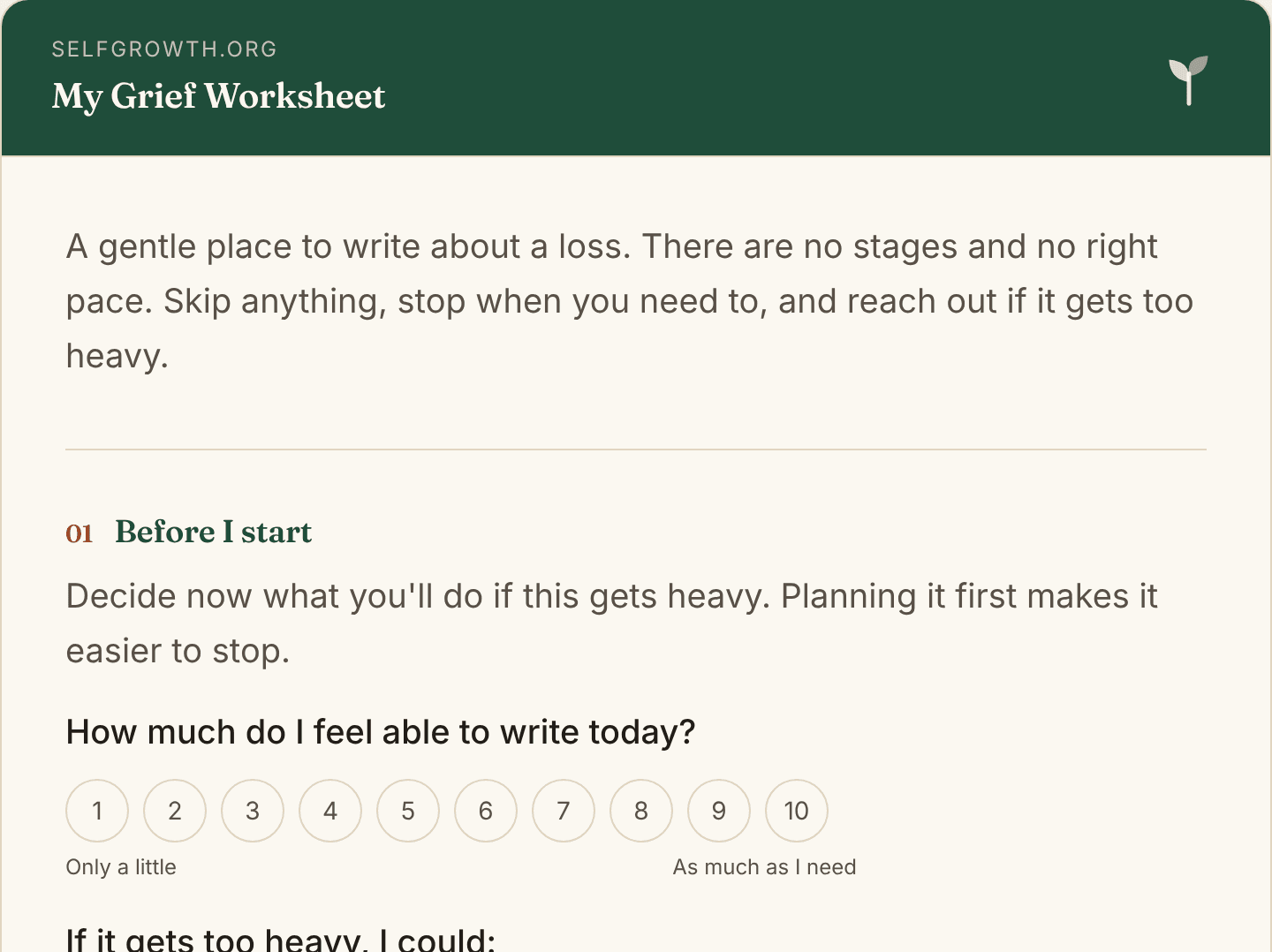
Grief Worksheet
A free, gentle grief worksheet for after a bereavement: write about who you miss, what you feel and what helps today. No stages, no timetable. Free PDF.
Open worksheet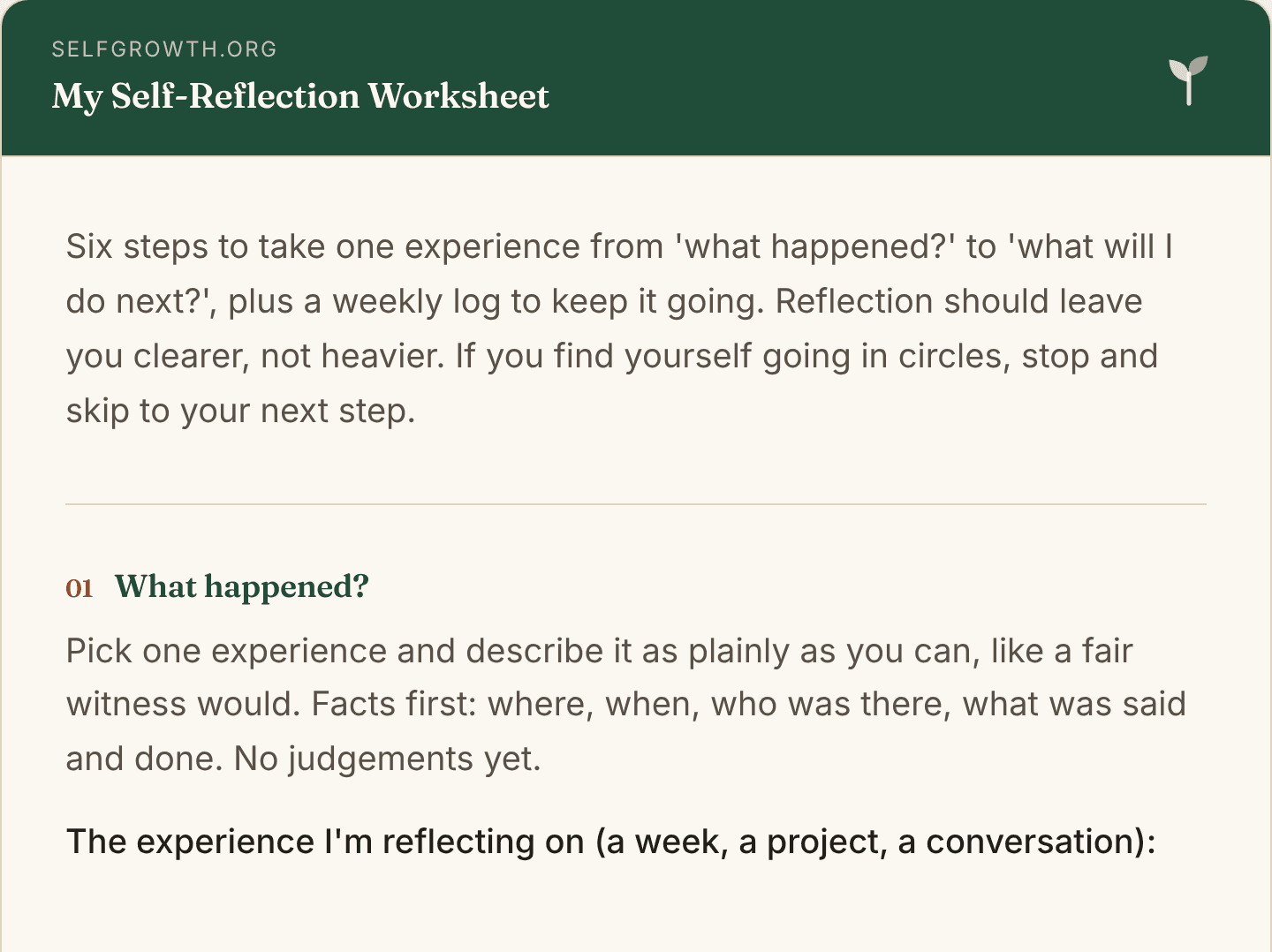
Self-Reflection Worksheet
A free, printable self-reflection worksheet: take one experience through Gibbs' reflective cycle, find your next step and keep a 10-minute weekly log.
Open worksheet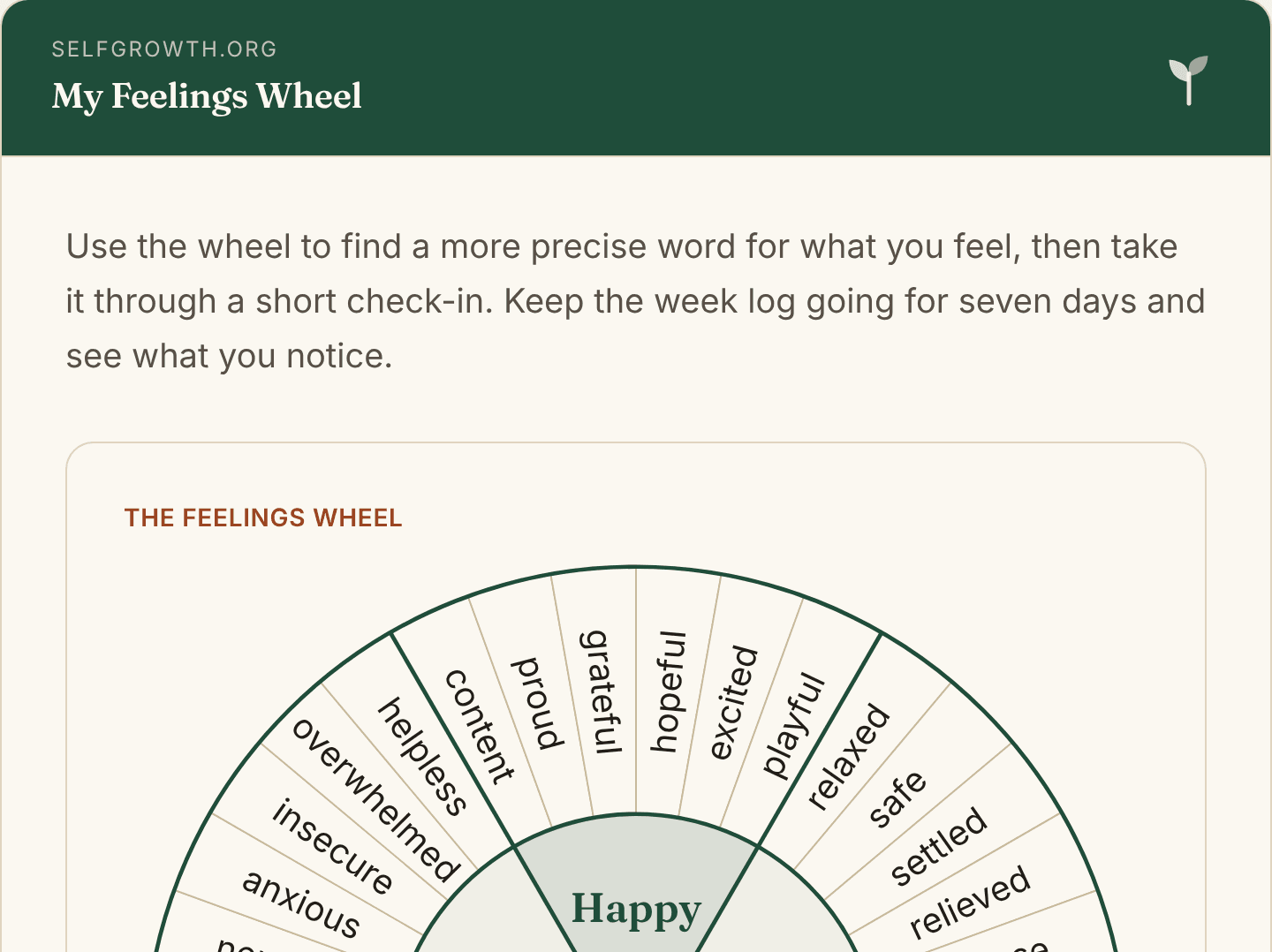
Feelings Wheel
A free printable feelings wheel (emotion wheel) PDF: six core feelings and 36 more precise words, with a daily check-in and a week log to name what you feel.
Open worksheetNew worksheets, straight to your inbox
An occasional new worksheet or tool, sent only when there's something genuinely worth your time. No spam, no pressure, unsubscribe any time.