
Guide
Journal prompts: ideas for every kind of day
Updated 25 October 2026 · 8 min read
Journal prompts are questions or sentence starters that give your writing a direction, so you are not facing a blank page. Pick one that fits your mood, set a timer for five or ten minutes, and write whatever is true. Short, honest answers are enough. You can stop or switch prompts at any point.
A library of plain writing prompts, not a tested programme · Part of self-discovery
The first line can be the hardest part. A prompt takes that away. It gives you one small thing to answer, and you can write a sentence or a page.
Prompts are sorted by what you need today: an easy start, a quick daily one, a way to know yourself better, or something gentle for a rough day. Each theme leads to a longer worksheet if you want more room to write.
What are journal prompts?
A journal prompt is a question or an unfinished sentence that you answer in writing. 'Today I noticed...' is a prompt. So is 'What did I need this week and not ask for?'
There is no right way to answer. You can write one line, a list, or a long messy page. Nobody else has to read it, and you can skip any prompt that does not fit.
Journal prompts for beginners
If you have never kept a journal, start with easy questions that have plain answers. You are only learning to put thoughts on paper.
- What is on my mind right now?
- What happened today that I want to remember?
- What is one thing I am looking forward to this week?
- Who made my day easier, and how?
- What did I eat, hear or see today that I liked?
- What is one thing I wish I had said or done differently?
- What do I want from the next hour?
- Right now I feel... because...
- A small thing I am proud of lately is...
- Something I noticed on my way here today is...
- A thing I keep meaning to do, and what is stopping me, is...
- If today had a colour, it would be... because...
Fun and creative journal prompts
Not every page has to be serious. These prompts are for when you want to play with words, and there is no wrong answer.
- Write the first line of a story about someone who finds an unmarked door. What is behind it?
- Write your life so far in exactly six words.
- Invent a holiday that only you celebrate. What happens on it?
- Write a short postcard from a place you have never been. Where is it, and what do you say?
- Describe your perfect ordinary Tuesday, hour by hour.
- If your home could talk, what would it say about how you have been lately?
- Write about an object on your desk as if it had a secret.
Playing with words still counts as journaling. If one of these makes you smile, keep going. If it feels forced, swap it for a plainer prompt, such as 'Today I noticed...'.
Daily journal prompts
These are quick. Each one takes a few minutes, so they fit before bed or with a morning drink.
- One word for today, and why.
- The best five minutes of my day were...
- Something that took more energy than I expected was...
- Something I handled better than I would have a year ago is...
- One thing I am carrying into tomorrow is...
- One thing I can put down tonight is...
- Today I was kind to myself when I...
- The one thing that would make tomorrow easier is...
- A question I am still thinking about is...
- Something that made me laugh, or nearly laugh, today was...
If you ask yourself the same few daily questions, you start to spot patterns. If you want the questions to change, rotate through the themes below.
Journal prompts for self-discovery
These ask about who you are and what you want, which are hard to answer fast. Take your time, and expect your answer to change.
- Which of my habits would I be glad to keep for ten more years, and which would I drop?
- When was the last time I lost track of time? What was I doing?
- What do I say yes to out of habit, when I would rather say no?
- What would a close friend say is my best quality?
For a longer set with space to write, see the self-discovery journal prompts.
Journal prompts for gratitude
Gratitude prompts are easier to answer when they are small and specific. 'My family' is easy to write and easy to forget. 'My sister texting me a photo of the dog' is something you can picture.
- Which small comfort did I use today without thinking about it?
- Who did something helpful this week that I have not thanked them for?
- What is one thing in my home I am glad to have?
- What went right today that could easily have gone wrong?
More of these, with room to write, are in the gratitude journal prompts. If you want a steady habit, the guide to starting a gratitude journal covers that.
Journal prompts for self-growth
Growth prompts look at change over weeks and months. They help you see what is moving, even when each day feels the same.
- What am I better at now than six months ago?
- Which problem keeps coming back, and what might it be telling me?
- What is one small step I could take this week towards something I want?
- What advice would I give a friend in my exact position?
The self-growth journal prompts go deeper, theme by theme.
Journal prompts for mindfulness
Mindfulness prompts ask what you notice right now, not what you think about it. They are short and can be done anywhere.
- What are three sounds I can hear at this moment?
- Where in my body do I feel my breath most clearly?
- What is the weather doing, and how does it feel on my skin?
- What thought keeps coming back, and what happens if I just watch it for a minute?
For a fuller set, try the mindfulness journal prompts.
Journal prompts for hard days
On a hard day, you do not need deep questions. You need small, kind ones that ask little of you.
- Right now my body feels like...
- The hardest part of today is...
- One thing that would make the next hour a little easier is...
- Something I do not have to decide today is...
- If a friend felt like this, I would tell them...
- One thing that is still okay is...
Writing is not a crisis plan. If you ever feel unsafe or have thoughts of harming yourself, call Samaritans on 116 123 (UK and Ireland), 988 (US), or find a line at findahelpline.com. If you are in danger right now, call 999 (UK), 911 (US) or your local emergency number. If worry or loss is the theme, you may find the anxiety journal prompts or grief journal prompts a better fit, and you can stop at any point.
How to use journal prompts
- 1Pick one prompt that fits how you feel. If it does not, pick another.
- 2Set a timer for five or ten minutes, so it has an end.
- 3Write the first honest thing that comes, and keep your pen moving. Spelling and neatness do not matter.
- 4If you get stuck, write 'I am stuck because...' and carry on from there.
- 5Stop when the timer ends, even if you have more to say. You can come back.
- 6Read it over once, if you like, and underline one line that surprised you.
For setting up a routine around this, see how to start journaling. If you want a place to keep your answers, try the self-improvement journal.
Open the Self-Discovery Journal PromptsOpen the Self-Improvement JournalWhen to get more support
Journal prompts are a self-help tool, not therapy. If writing keeps bringing up the same painful thoughts, or you feel worse after each session, stop for a while and talk to someone. A GP is a good first step if low mood, worry or stress is getting in the way of daily life.
If you ever feel unsafe or have thoughts of harming yourself, call Samaritans on 116 123 (UK and Ireland), 988 (US), or find a line at findahelpline.com.
Sources and further reading
This is an educational self-reflection resource, not therapy or medical advice.
Your questions, answered
- What are some good journal prompts to start with?
- Start with easy ones that have plain answers, such as 'What is on my mind right now?' or 'What happened today that I want to remember?'. They help you get used to writing before you try deeper questions.
- How often should I use journal prompts?
- There is no set rule. Use one when you sit down to write, whether that is daily, weekly or only when you feel like it. A short, regular habit you can keep is better than a long one you drop.
- How long should I write for each prompt?
- Five to ten minutes is enough. A timer helps, because it gives the session an end. You can write one line or a full page.
- What should I do if I do not know what to write?
- Write 'I do not know what to write because...' and see where it goes. You can also switch to a simpler prompt, such as a description of your day, or list three things you noticed.
- Can I use journal prompts on my phone or do I need a notebook?
- Either works. Pick the one you will actually use. A notebook has no notifications, and a phone is always with you. You can also print a worksheet and write on that.
- Are there free printable journal prompts?
- Yes. The worksheets linked in each section above are free to print as a PDF or fill in on screen, with no payment and no email. Your answers save in your browser.
- Is this a substitute for therapy?
- No. It is a self-help tool, not therapy. If low mood or stress is what is getting in the way, talk to your GP. If you ever feel unsafe or have thoughts of harming yourself, call Samaritans on 116 123 (UK and Ireland), 988 (US), or find a line at findahelpline.com.
Worksheets to do the work
Free to fill in online or print. No email needed.
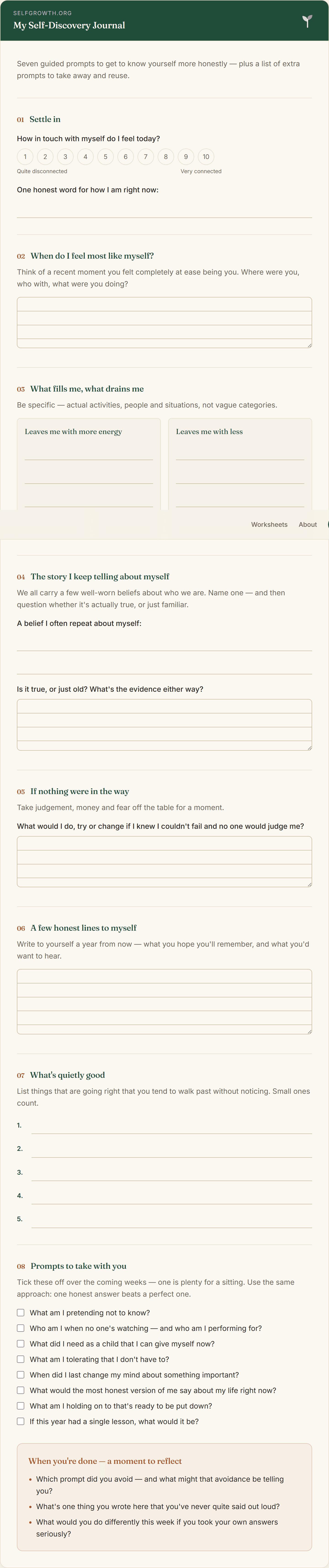
Self-Discovery Journal Prompts
Free journal prompts for self discovery: questions on your values, your energy and the stories you tell yourself, with space to write. No sign-up.
Open worksheet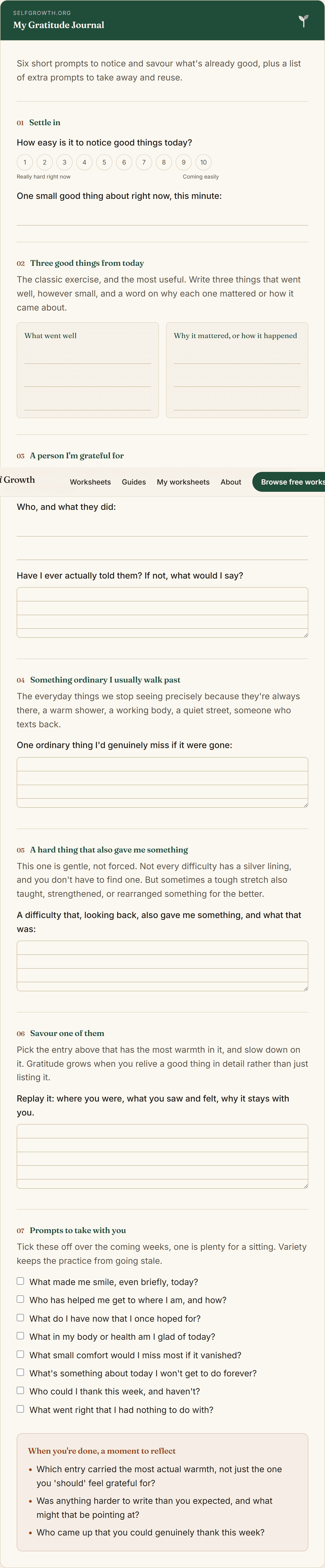
Gratitude Journal Prompts
Free, printable gratitude journal prompts: guided questions with space to write, plus a take-away list, to help you notice and savour what's already good.
Open worksheet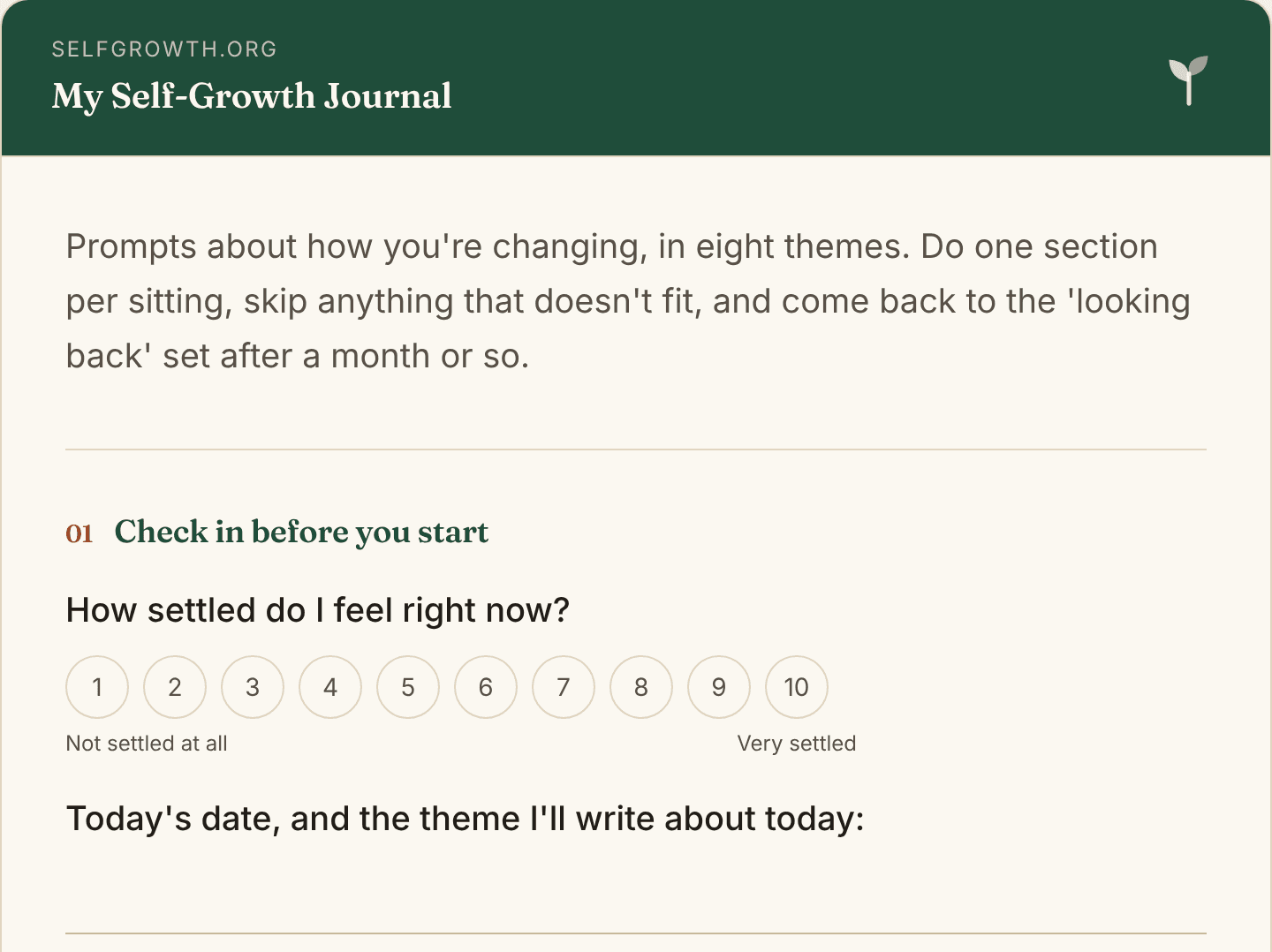
Self-Growth Journal Prompts
58 free, printable journal prompts for self growth, in themes from habits and setbacks to values and a look back, with honest tips on how often to write.
Open worksheet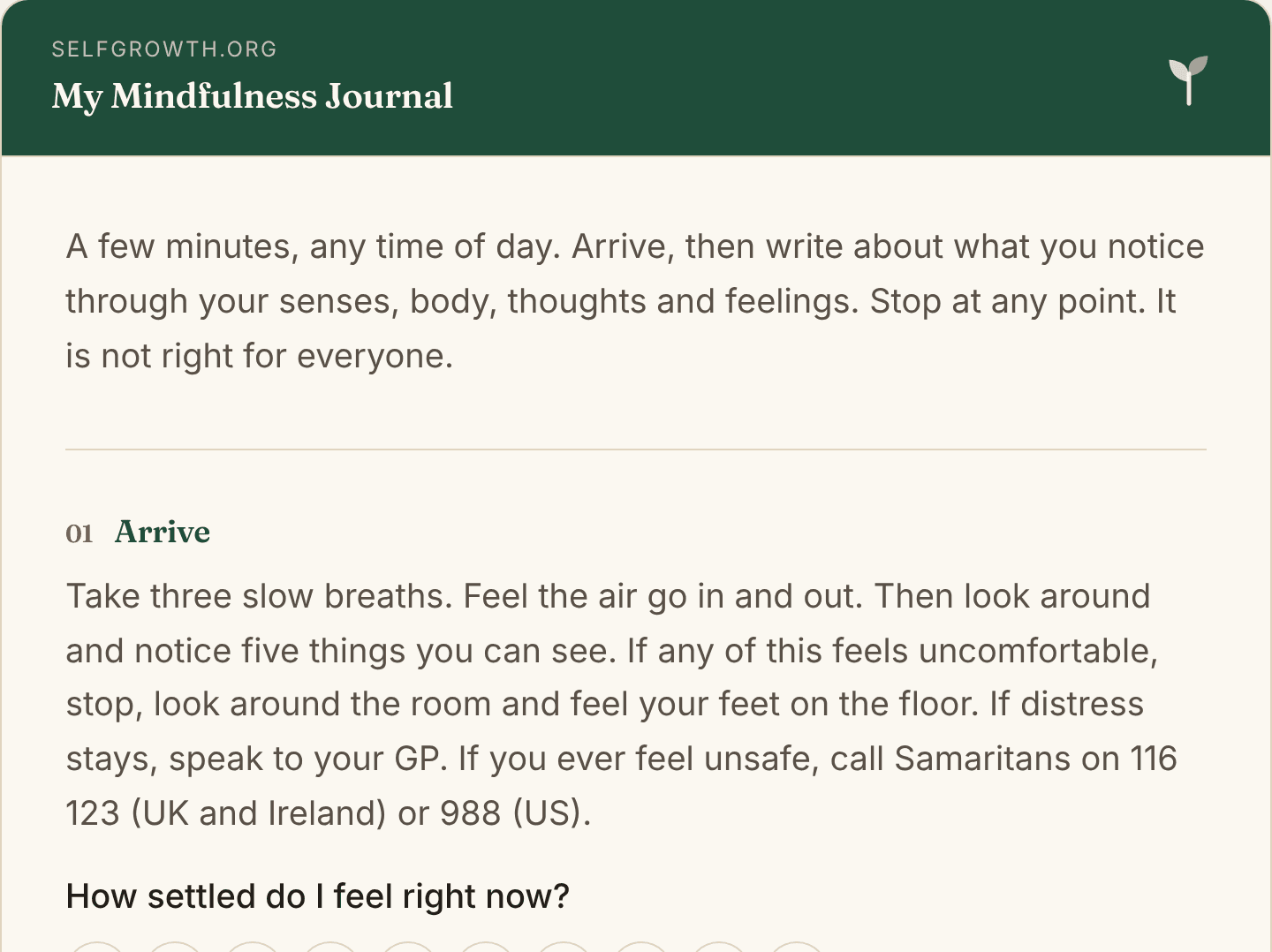
Mindfulness Journal Prompts
A free printable mindfulness journal: a three-breath start, six sets of prompts for senses, body, thoughts and feelings, and a 7-day log. A few minutes a day.
Open worksheet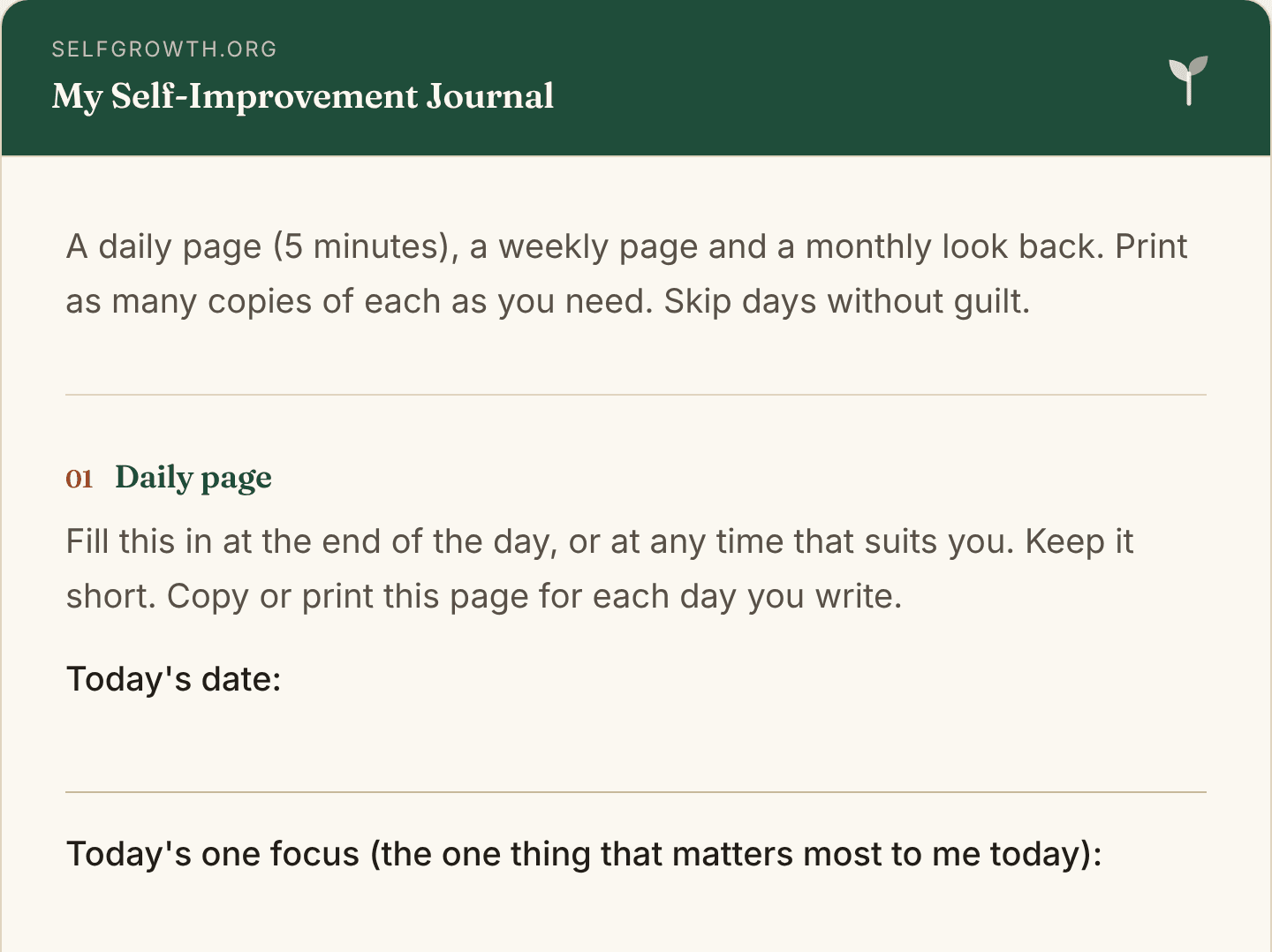
Self-Improvement Journal
A free printable self improvement journal: a five-minute daily page, a weekly page and a monthly look back. Use it as a personal growth journal too.
Open worksheetRelated guides
New worksheets, straight to your inbox
An occasional new worksheet or tool, sent only when there's something genuinely worth your time. No spam, no pressure, unsubscribe any time.