
Anxious moments
Anxiety journal prompts: free printable prompts to get worries onto the page
Updated 17 October 2026 · 8 min read · Free to print
Anxiety journal prompts are short questions that help you get worries out of your head and onto paper, so you can look at them. This free printable is not treatment for an anxiety disorder, and the NHS advises speaking to a GP if you're worried about how you're feeling. It ends with one small step.
By the Self Growth team · drawn from NHS self-help guidance on anxiety and research on journaling · how we make these
Fill it in here (it saves in this browser, but not in a private window), print it, or download the PDF. Free, no sign-up.
Worries can feel bigger inside your head. Writing them down is a way of getting them out where you can see them. The prompts here ask what the worry is, whether it's about now or later, what you can influence, what has helped before, and what one small step might be.
Please be clear about what this is. These prompts are a reflection tool, not treatment for an anxiety disorder. The NHS advises you not to self-diagnose, and to speak to a GP if you're worried about how you're feeling. It also lists a faster or more noticeable heartbeat, dizziness, chest pain, poor sleep and trouble concentrating among the symptoms of anxiety. Anxiety can cause chest pain, but so can a heart problem, and you can't tell the difference from the inside. If you get sudden chest pain or pressure that doesn't go away, pain spreading to your arm, neck, jaw, stomach or back, or chest pain with sweating, feeling sick, light-headedness or shortness of breath, call 999 (UK) or 911 (US) straight away. For other physical symptoms that worry you, see your GP.
Research on journaling for anxiety is mixed: it may help you sort your thoughts, but it isn't a treatment (details below).
If anxiety is affecting your sleep, work, relationships or daily life, or your own efforts aren't helping, speak to your GP. In England, if you're 18 or over you can also refer yourself to NHS talking therapies. Our helplines page has other routes. This is a self-reflection tool, not therapy. If you're in crisis, call Samaritans on 116 123 (UK and Ireland), call or text 988 (US), or find a helpline at findahelpline.com.
How to use this worksheet
- 1Pick a quiet ten minutes. Print it, or type straight onto the page. Choose one or two prompts, not all of them.
- 2Write quickly and don't edit. Nobody else needs to read it.
- 3If writing about a worry makes you more worked up, stop. Look around the room, name five things you can see, or put the page away and come back later.
- 4You don't have to do the 'something I've been avoiding' section. If avoiding things is taking over your life, that's worth taking to your GP rather than a worksheet.
The worksheet
selfgrowth.org
My Anxiety Journal
Prompts to get a worry out of your head and onto the page. This isn't treatment for anxiety. If your worries are hard to control or are affecting daily life, speak to your GP.
01Check in
If you have sudden chest pain that doesn't go away, call 999 (UK) or 911 (US) now rather than writing. A minute to see where you are. Nothing to fix yet.
How anxious do I feel right now?
In my body I notice (the NHS lists these among the signs of anxiety):
In a few words, what's going on:
02Name the worry
What am I worried about? Write it out in full, as it sounds in my head.
Is it about something happening now, soon, or a long way off?
What am I afraid will happen?
03What I can and can't influence
The NHS suggests focusing on what you can influence. Sort the worry into the two columns.
Entry 1
Entry 2
Entry 3
Entry 4
What would it look like to leave the second column alone for today?
04Looking at the prediction
What I predict will happen:
What other outcomes are possible, including ones I could cope with?
A time I was worried about something before. What actually happened?
05What's helped before
What has helped me when I've felt like this? (people, places, activities)
What would I say to a friend who had this worry?
06The basics
The NHS lists these as things that can help with anxiety: regular exercise, regular meals, enough sleep, limiting caffeine, and not relying on alcohol, cigarettes, gambling or drugs to cope. A quick look.
This week I could:
07Something I've been avoiding
Optional. The NHS says that gradually facing anxiety-provoking situations, rather than avoiding them, can reduce anxiety. You don't have to do anything about this today. Don't take on something big or frightening alone. If avoiding is taking over your life, speak to your GP.
Something I've been avoiding because of anxiety:
The smallest step towards it that would feel manageable (or 'none today'):
08One small step
In the next hour, I will:
Someone I could tell how I'm feeling:
How anxious do I feel now?
09Prompts to take with you
Tick these off over time. One is plenty for a sitting.
When you're done, a moment to reflect
- Did writing it down change how the worry looks?
- What did I notice about what I can and can't influence?
- What is one thing I'd like to bring to my GP or someone I trust?
Does anxiety journaling help?
Honestly, we don't know of a trial of these prompts, and a journal isn't a treatment for an anxiety disorder. Here's where the ideas come from and what research does and doesn't say.
The prompts that ask what you can influence, and the 'basics' and 'something I've been avoiding' sections, follow the NHS's self-help advice on anxiety: focus on what you can influence, take small achievable steps, eat and sleep regularly, limit caffeine, don't rely on alcohol, cigarettes, gambling or drugs to cope, and gradually face situations rather than avoiding them. The NHS pages we read don't mention journaling. The prompts are our own way of putting that advice on paper.
On journaling itself, a 2022 systematic review and meta-analysis by Sohal and colleagues in Family Medicine and Community Health pooled 20 randomised controlled trials (31 outcomes) of journaling for people with PTSD, other anxiety disorders, depression or combinations. The change in symptom scores was bigger in the journaling groups, and the review suggested a small to moderate benefit. But the results differed a lot between trials, and the authors said flaws in the studies mean we can't be sure how big or how steady any benefit is. They suggest GPs and family doctors consider journaling as an addition to established treatments. The trials tested set journaling protocols, not these prompts.
A 2006 meta-analysis by Mogk and colleagues pooled 30 randomised trials of expressive writing about stressful or traumatic experiences and found no significant effects on physical or psychological health measures. Put together, the honest summary is that journaling may help you sort your thoughts, the research doesn't show it treats anxiety, and persistent anxiety deserves proper help. If you'd like a technique for a hard moment, try the 5-4-3-2-1 grounding worksheet. If your mind keeps looping, see the guide to stopping overthinking.
These are educational self-reflection tools, not therapy. See our editorial standards.
If you want to go deeper
- NHS. Anxiety, fear and panic (nhs.uk).
- NHS. Generalised anxiety disorder in adults (nhs.uk).
- NHS. Chest pain (nhs.uk/conditions/chest-pain/, https://www.nhs.uk/conditions/chest-pain/).
- Sohal, M., Singh, P., Dhillon, B. S. & Gill, H. S. (2022). Efficacy of journaling in the management of mental illness: a systematic review and meta-analysis. Family Medicine and Community Health, 10(1), e001154.
- Mogk, C., Otte, S., Reinhold-Hurley, B. & Kroner-Herwig, B. (2006). Health effects of expressive writing on stressful or traumatic experiences: a meta-analysis. Psycho-Social Medicine, 3, Doc06.
Your questions, answered
- What are anxiety journal prompts?
- They are short questions that help you write about what is worrying you, so it's out of your head and on the page. This set asks you to name the worry, sort what you can influence, check the prediction against what has happened before, and pick one small step. They aren't a treatment.
- What should I write in an anxiety journal?
- Start with what the worry actually is and how it feels in your body. Then ask what you can influence, what has helped before and what one small step might be. Write quickly, and don't worry about neatness. If it makes you more anxious, stop and come back later.
- Does journaling help with anxiety?
- It may help you sort your thoughts, but the evidence is mixed. A 2022 review of 20 randomised trials (people with PTSD, other anxiety disorders or depression) suggested a small to moderate benefit. The results differed a lot between trials, and the authors said flaws in the studies mean we can't be sure how big or how steady any benefit is. A 2006 review of 30 trials of writing about stressful experiences found no significant effects on health measures. Journaling is not a replacement for treatment.
- When should I see a GP about anxiety?
- For sudden chest pain that doesn't go away, call 999 (UK) or 911 (US) rather than waiting for a GP appointment; see the NHS chest pain page. Otherwise, the NHS advises you not to self-diagnose and to speak to a GP if you're worried about how you're feeling. It also says to speak to a GP if you're struggling to cope or self-help isn't working. For generalised anxiety disorder it says to see a GP if you think you might have it. In England, if you're 18 or over (16 in some areas) you can also refer yourself to NHS talking therapies.
- Can a journal replace therapy or medication?
- No. This is an educational self-reflection tool, not therapy or medical advice. The 2022 review's authors suggested journaling as an addition to established treatments, not a substitute. If you're on treatment, a journal can sit alongside it. Talk to your GP before changing anything.
- Is this free, and what if I'm in crisis?
- It's completely free, with no payment and no email needed. If you're in crisis or having thoughts of ending your life, call Samaritans on 116 123 (UK and Ireland), call or text 988 (US), or find a helpline at findahelpline.com. Our helplines page lists more.
Keep going, related worksheets
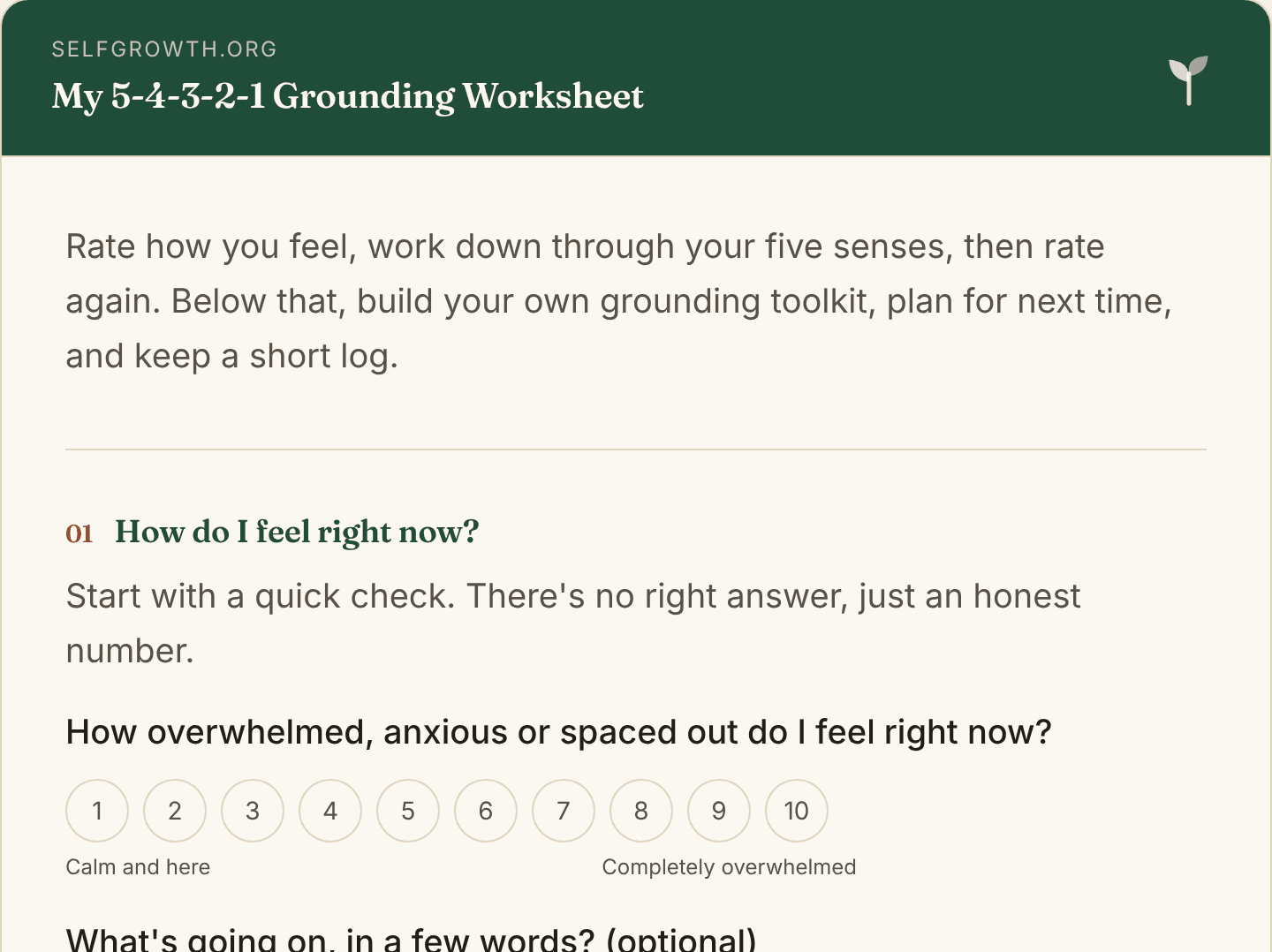
5-4-3-2-1 Grounding Worksheet
A free, printable 5-4-3-2-1 grounding worksheet: rate how you feel, work through your five senses, re-rate, then build your own toolkit and plan for next time.
Open worksheet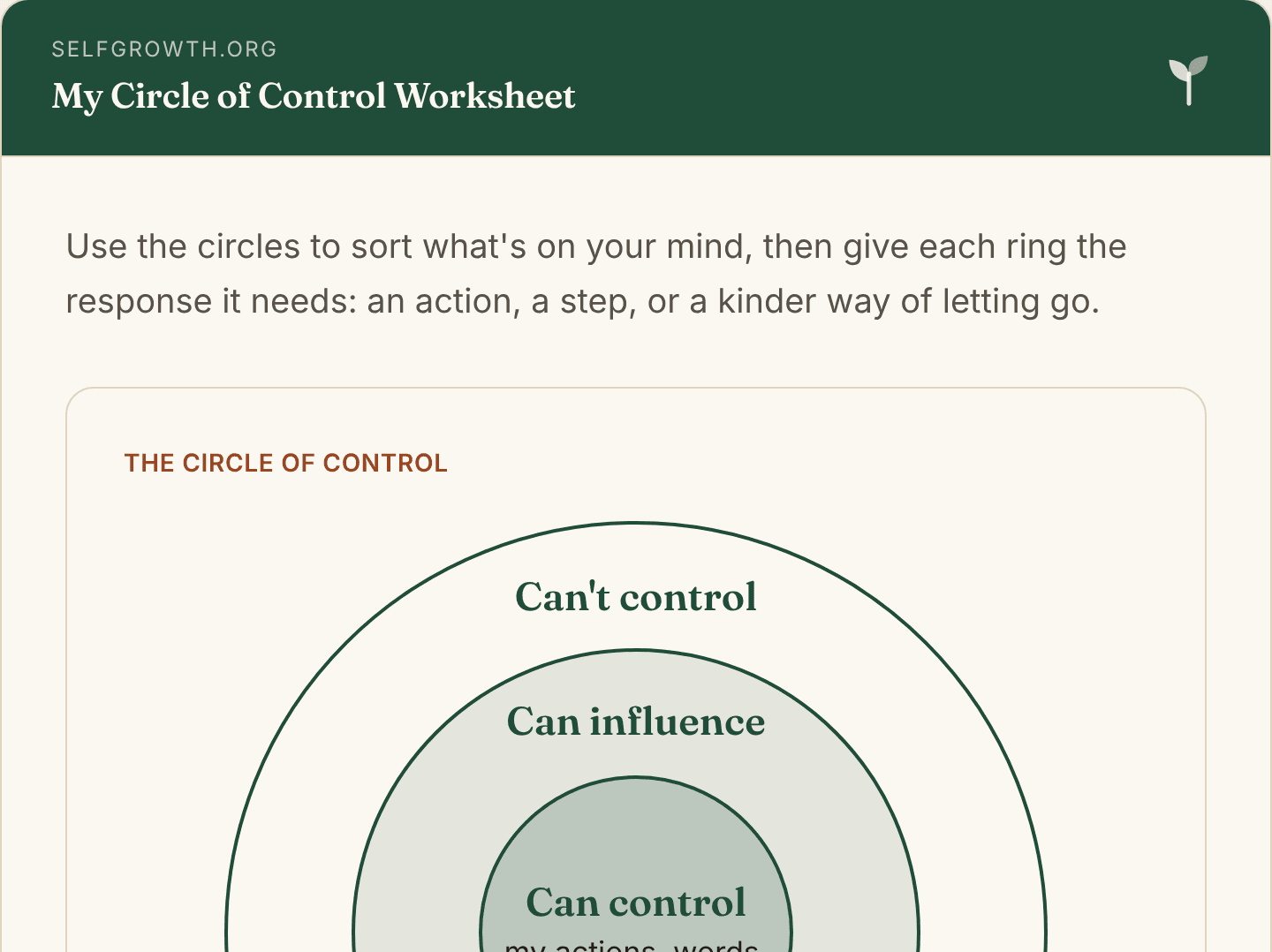
Circle of Control Worksheet
A free circle of control worksheet: sort your worries into what you can control, influence and can't control, then choose one step for each. Free PDF.
Open worksheet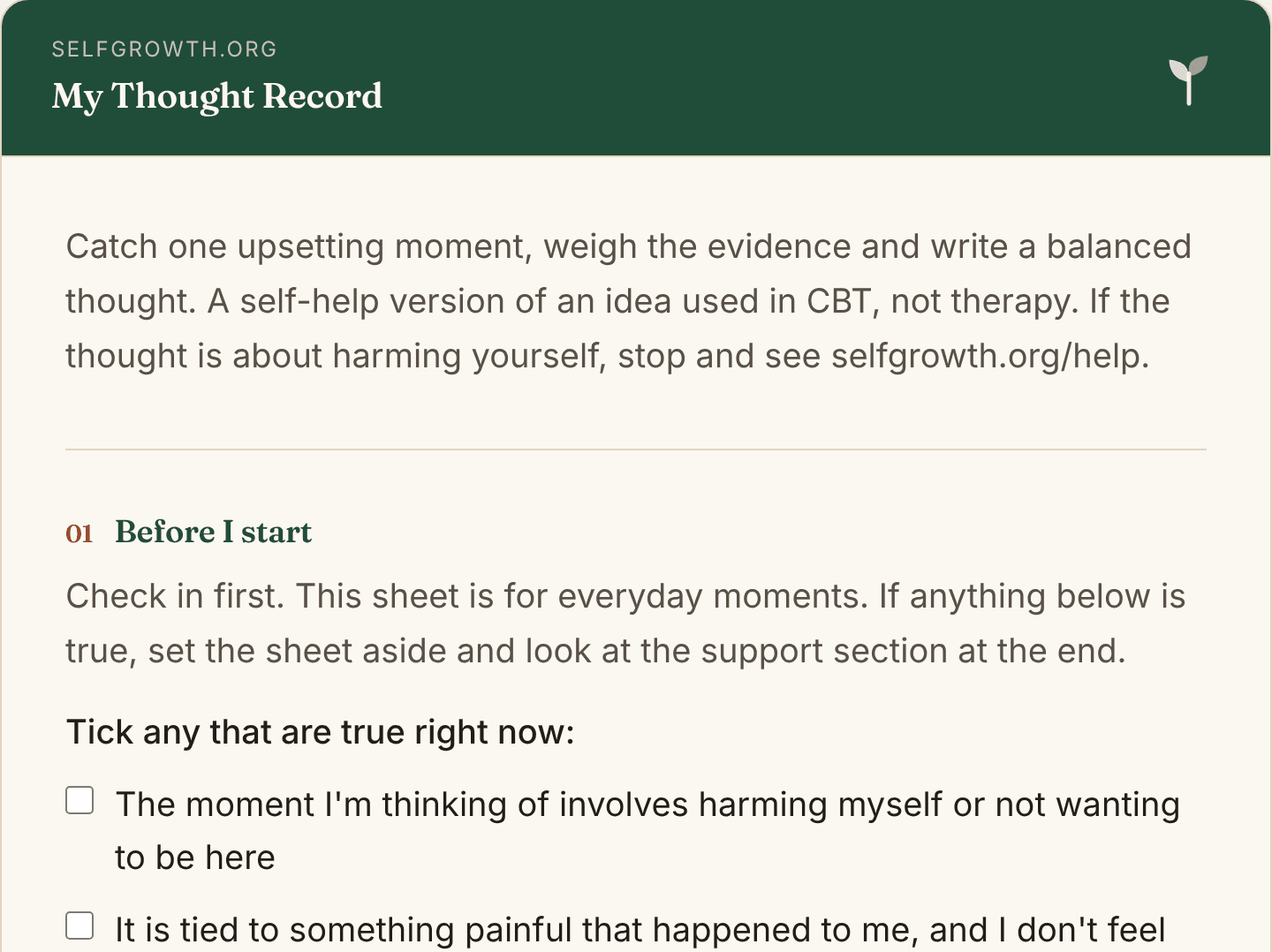
Thought Record Worksheet
Free thought record worksheet: note the situation, feeling and thought, weigh the evidence and write a balanced thought. Self-help, not therapy. Free PDF.
Open worksheetNew worksheets, straight to your inbox
An occasional new worksheet or tool, sent only when there's something genuinely worth your time. No spam, no pressure, unsubscribe any time.