
Mindfulness
Mindfulness journal: free printable prompts for a few quiet minutes
Updated 25 October 2026 · 7 min read · Free to print
A mindfulness journal is a notebook where you write short notes on what you notice in the present moment: sights, sounds, body sensations, thoughts and feelings. This free printable gives you a three-breath arrival practice, six sets of prompts and a 7-day log. A few minutes at any time of day is enough.
Drawn from NHS guidance on mindfulness · Part of feelings and calm
Fill it in here (it saves in this browser, but not in a private window), print it, or download the PDF. Free, no sign-up.
The NHS describes mindfulness as paying attention to what is going on inside and outside yourself, moment by moment. A mindfulness journal gives that attention somewhere to land. You notice something, then you write a line or two about it.
You do not need to sit still or empty your mind. You can fill this in on the bus, at the kitchen table or before bed. If you want a practice built around activities, try the mindfulness worksheet. If you are new to writing things down, how to start journaling has simple first steps.
The NHS says mindfulness is not right for everyone, and that it can make some people feel worse. Stop whenever you like. This is a self-help tool, not therapy. If low mood or stress is what is really in the way, see your GP.
How to use this worksheet
- 1Pick a time that suits you, and give it a few minutes. Morning, lunch or bedtime all work.
- 2Start with the arrival practice. Do one prompt set, or just one prompt. You do not need to finish the sheet.
- 3Write what you actually noticed, in your own words. Short is fine. There is no right answer.
- 4If your mind wanders, that is part of it. Notice, then come back. Stop if anything feels upsetting.
The worksheet
selfgrowth.org
My Mindfulness Journal
A few minutes, any time of day. Arrive, then write about what you notice through your senses, body, thoughts and feelings. Stop at any point. It is not right for everyone.
01Arrive
Take three slow breaths. Feel the air go in and out. Then look around and notice five things you can see. If any of this feels uncomfortable, stop, look around the room and feel your feet on the floor. If distress stays, speak to your GP. If you ever feel unsafe, call Samaritans on 116 123 (UK and Ireland) or 988 (US).
How settled do I feel right now?
Five things I can see:
What I noticed about my breath:
02The senses
The NHS suggests paying attention to the sights, sounds, smells and tastes of the present moment. Choose any moment and use your senses.
Something I can hear right now, near and far:
Something I can touch, and what it feels like:
A smell or taste I notice, or a smell I would like to notice more:
Something I can see that I have not really looked at before:
Which sense was easiest to pay attention to?
03The body
Reconnect with how your body feels, without trying to change it. If paying attention to your body feels uncomfortable, skip this set.
Where do I feel my feet, my hands, my breath?
Is any part of me tense, heavy, light or warm?
What does my body seem to be asking for right now?
What does it feel like to rest my attention on one body part for a few breaths?
04Thoughts as passing events
The NHS describes seeing thoughts as mental events that come and go, rather than trying to make them disappear. Watch for a minute, then write.
Three thoughts that passed through my mind, in a few words each:
Which thoughts were about the past? The future? Right now?
What was it like to watch a thought instead of following it?
A thought that kept coming back, and what I called it (worry, plan, memory, judgement):
05Feelings without judgement
The NHS suggests silently naming thoughts and feelings. Try 'This is ...' and fill in the gap. A feeling is not good or bad, it is just here.
Right now I notice a feeling of:
Where do I feel it in my body?
What happens if I let it be there for a few breaths, without fixing it?
Did I judge the feeling? What did the judging voice say?
What would I say to a friend who felt this?
06Ordinary moments
The NHS suggests noticing the everyday, such as the food you eat or the air moving past you as you walk. Pick something you do anyway.
An ordinary moment I will give my full attention to today:
What I noticed during it that I usually miss:
A small thing I took for granted today:
Something I could do in a new way tomorrow (a different route, a different seat):
How did my attention feel while I did it?
07Kindness to myself
Paying attention does not have to be strict. When you notice your mind has wandered, you can come back gently.
When did I notice I was being hard on myself today?
How could I come back to the moment more gently?
One kind thing I could say to myself right now:
One small thing I could do to look after myself today:
08My 7-day log and looking back
One line a day. Write what you noticed and how you felt, however small. No grade, just curiosity. Do it at the same time each day if you like.
Entry 1
Entry 2
Entry 3
Entry 4
Entry 5
Entry 6
Entry 7
Looking back: what did I notice about myself this week?
Did anything feel uncomfortable? What did I do?
What I will do next (keep going, change it, or stop):
When you're done, a moment to reflect
- Which prompt set was easiest to write about, and which was hardest?
- What did I notice that I normally rush past?
- When did my mind wander, and where did it go?
- What was it like to write about a feeling instead of acting on it?
- Is there one moment in my day I would like to keep paying attention to?
Done for now?
Save today's answers as a dated entry. You can come back, fill it in again and compare the two side by side.
What the NHS says about mindfulness
The NHS describes these everyday practices: paying attention to the sights, sounds, smells and tastes of the present moment, noticing thoughts and feelings as they happen, seeing thoughts as mental events that come and go, and silently naming them. The NHS also suggests keeping it regular and trying new things.
Writing about what you notice is a reflection format. Treat it as a way to practise paying attention, not a tested treatment. The NHS says many people find mindfulness helpful, but it is not right for everyone, and some people find it can make them feel worse.
If you want a longer guided practice, try the body scan script. To come back to the room quickly, the 5-4-3-2-1 grounding worksheet is shorter.
These are educational self-reflection tools, not therapy.
If you want to go deeper
- NHS. Mindfulness (nhs.uk/mental-health/self-help/tips-and-support/mindfulness/).
Your questions, answered
- What is a mindfulness journal?
- A mindfulness journal is a notebook where you write short notes about what you notice in the present moment, such as sights, sounds, body sensations, thoughts and feelings. The NHS describes mindfulness as paying attention to what is going on inside and outside yourself, moment by moment.
- How do I start a mindfulness journal?
- Choose a time, take three slow breaths, then pick one prompt and write a line or two about what you notice. A few minutes is enough. Short entries are fine. You can do one prompt set a day or repeat the same one.
- What do I write in a mindfulness journal?
- Write what you notice, not what you think you should feel. That could be what you can hear, where you feel tension in your body, a thought that passed through, or a feeling you can name. There are no right answers.
- How is a mindfulness journal different from a gratitude journal?
- A gratitude journal asks you to look for good things. A mindfulness journal asks you to notice whatever is here, pleasant, unpleasant or neutral, without judging it. They can sit side by side. The gratitude journal prompts are a good companion.
- Can mindfulness journaling make me feel worse?
- It can for some people. The NHS says mindfulness is not right for everyone, and that some people find it does not help or can make them feel worse. If paying attention to your body or feelings is upsetting, stop, look around the room and skip that set. If distress stays, speak to your GP.
- Is there a mindfulness journal PDF?
- Yes. Use the Download PDF button for a print-ready copy, or Print straight from the page. It is free, with no payment and no email needed. You can also fill it in on screen, and your answers save in your browser.
- Is a mindfulness journal a substitute for therapy?
- No. This is a self-help tool, not therapy or medical advice. If low mood, stress or worry is what is really in the way, speak to your GP. If you ever feel unsafe or have thoughts of harming yourself, call Samaritans on 116 123 (UK and Ireland), 988 (US), or find a line at findahelpline.com.
Keep going, related worksheets
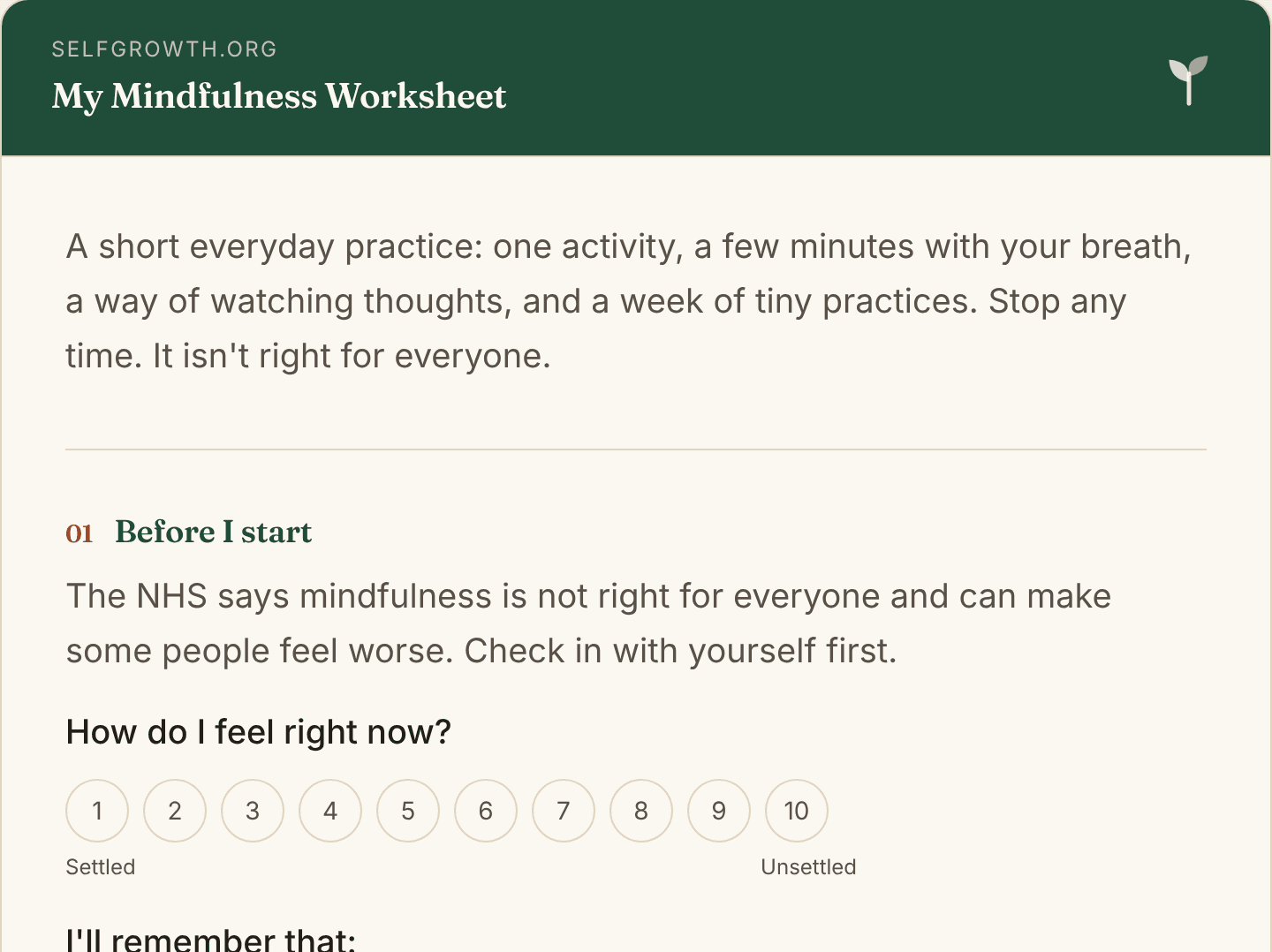
Mindfulness Worksheet
A free mindfulness worksheet: one everyday activity, a few minutes with your breath, a way to watch thoughts and a week of tiny practices. Not for everyone.
Open worksheet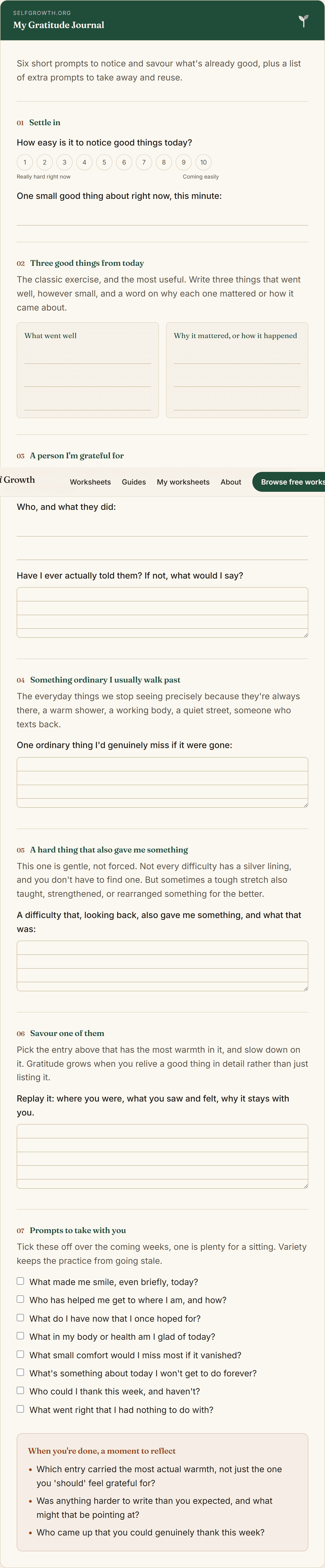
Gratitude Journal Prompts
Free, printable gratitude journal prompts: guided questions with space to write, plus a take-away list, to help you notice and savour what's already good.
Open worksheet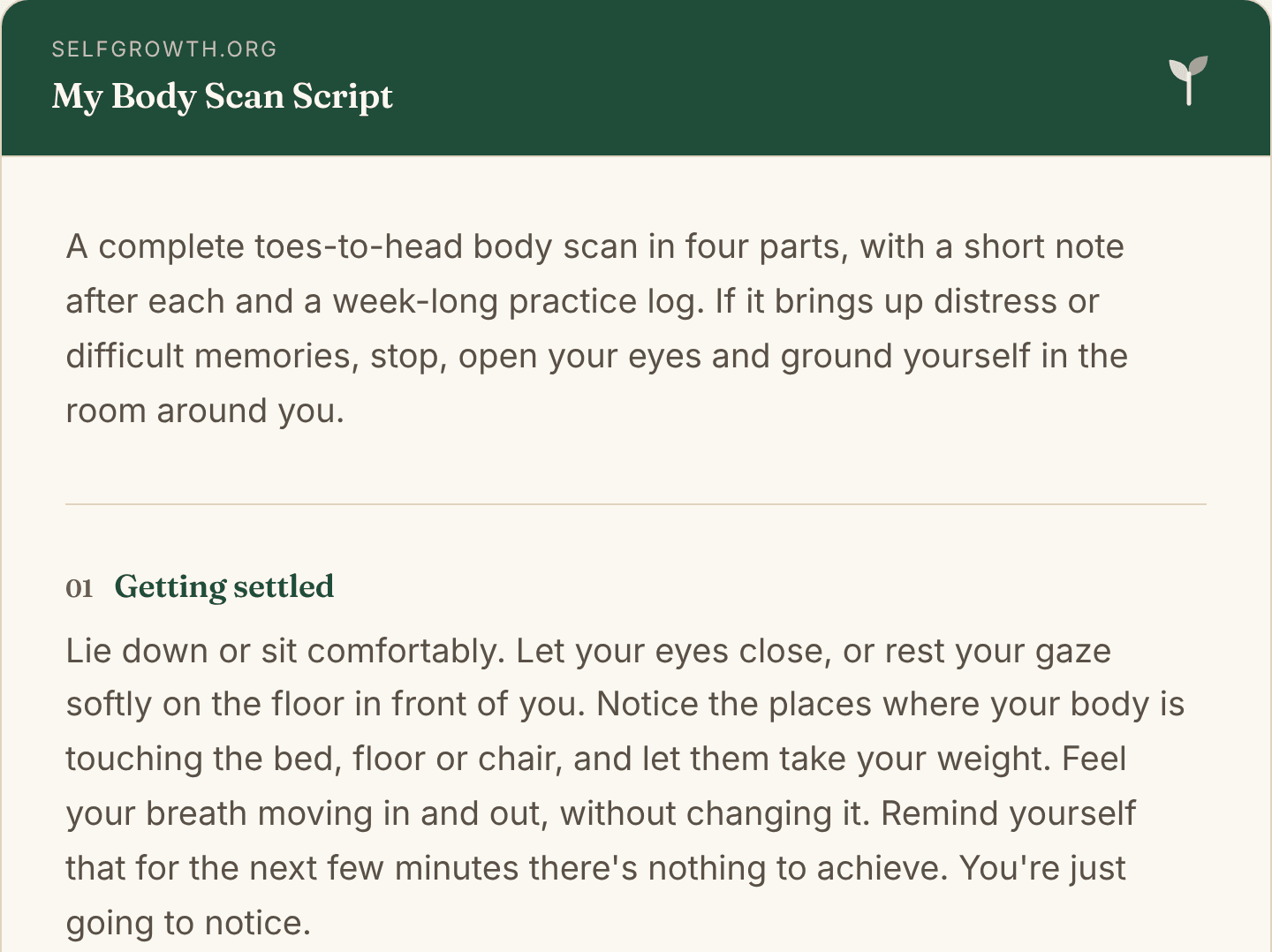
Body Scan Script
A free body scan meditation script in plain English: move your attention slowly from toes to head, noticing without changing, with reflection prompts and a log.
Open worksheetNew worksheets, straight to your inbox
An occasional new worksheet or tool, sent only when there's something genuinely worth your time. No spam, no pressure, unsubscribe any time.