
Relaxation
Mindfulness worksheet: a free printable for a short everyday practice
Updated 17 October 2026 · 7 min read · Free to print
A mindfulness worksheet gives you a short, everyday practice for noticing the present moment. The NHS describes mindfulness as paying attention to what is going on inside and outside you, moment by moment. This free printable adds a few minutes with your breath and a week of tiny practices. The NHS says it's not right for everyone.
By the Self Growth team · drawn from NHS mindfulness guidance and meditation research · how we make these
Fill it in here (it saves in this browser, but not in a private window), print it, or download the PDF. Free, no sign-up.
Mindfulness is a simple idea: pay attention to now. The NHS describes it as paying attention to what's going on inside and outside yourself, moment by moment, including the sensations in your body and your thoughts and feelings as they happen. You can do it while you eat, walk or wait for the kettle.
Trials of mindfulness programmes show some benefit for anxiety, depression and pain, and some people have a bad experience, so go gently.
Mindfulness isn't for everyone. The NHS says it's not right for everyone, and that some people find it does not help them or can make them feel worse.
So go gently. If paying attention to your breath or body brings up distress, stop, open your eyes and look around the room, or try the 5-4-3-2-1 grounding worksheet. If the distress stays, speak to your GP. This is a self-reflection tool, not therapy. If you're in crisis, call Samaritans on 116 123 (UK and Ireland), call or text 988 (US), or find a helpline at findahelpline.com. Our helplines page lists more.
How to use this worksheet
- 1Start small. Do one section, not the whole sheet at once. A few minutes is enough.
- 2Notice, don't fix. If your mind wanders, bring your attention back without telling yourself off.
- 3You can stop at any time. If focusing on your breath or body feels uncomfortable, look around the room and notice the things you can see, or skip that section.
- 4Use the week of tiny practices to try a different everyday moment each day, and note what you noticed, not whether you did it 'well'.
The worksheet
selfgrowth.org
My Mindfulness Worksheet
A short everyday practice: one activity, a few minutes with your breath, a way of watching thoughts, and a week of tiny practices. Stop any time. It isn't right for everyone.
01Before I start
The NHS says mindfulness is not right for everyone and can make some people feel worse. If it brings up thoughts of harming yourself, stop and call Samaritans on 116 123 (UK and Ireland) or call or text 988 (US). Check in with yourself first.
How do I feel right now?
I'll remember that:
02One everyday activity
The NHS suggests noticing sensations during ordinary activities, such as eating or walking. Choose something you do anyway and give it your full attention for a few minutes.
The activity I'll try (a cup of tea, a walk, washing up, a shower):
Entry 1
Entry 2
Entry 3
Entry 4
Entry 5
Where did my mind go? What did I do when I noticed?
03A few minutes with my breath
The NHS describes formal practice as sitting quietly and returning your attention to your breath, sounds or body each time your mind wanders. Try two or three minutes. Sit comfortably. Feel the breath in your nose or belly. When your mind wanders, which it will, bring your attention back. Stop if it feels uncomfortable.
How many minutes I sat, and what I noticed:
How easy was it to come back to my breath?
Anything uncomfortable that came up? (If it was upsetting, skip this section next time.)
04Watching my thoughts
The NHS suggests treating thoughts as passing mental events rather than trying to push them away, and silently naming them, such as 'This is anxiety.' Try it for a minute.
Entry 1
Entry 2
Entry 3
Entry 4
What was it like to watch thoughts instead of following them?
05A week of tiny practices
One tiny moment a day. Pick from the ideas below, or choose your own. Write what you noticed, however small.
Ideas:
Entry 1
Entry 2
Entry 3
Entry 4
Entry 5
Entry 6
Entry 7
06Looking back
No grade, just curiosity.
What did I notice about myself this week?
Did anything get harder or more uncomfortable? What did I do?
How did this feel overall?
What I'll do next (keep going, change it, or stop):
When you're done, a moment to reflect
- What was easier to notice than I expected?
- When did my mind wander most, and where did it go?
- Is there an everyday moment I'd like to give more attention to?
- Did anything feel uncomfortable, and what would help if it did?
Does a mindfulness worksheet help?
Honestly, we don't know of a trial of this worksheet, and a worksheet isn't a mindfulness course. The exercises are our own short, everyday versions of the practices the NHS describes: noticing ordinary activities, returning attention to the breath when the mind wanders, treating thoughts as passing mental events and naming them.
The evidence for mindfulness programmes is mixed. In the 2014 review by Goyal and colleagues in JAMA Internal Medicine (47 randomised trials with active control groups, 3,515 adults in diverse clinical populations, searches to November 2012), mindfulness programmes had moderate evidence of improving anxiety, depression and pain. For stress and distress, and mental health quality of life, the evidence was low. For positive mood, attention, substance use, eating habits, sleep and weight, the authors found low-grade evidence of no effect or insufficient evidence. They also found no evidence that meditation programmes were better than any active treatment. Their conclusion was that meditation programmes can give small to moderate reductions in several negative aspects of psychological stress.
On the downside, the 2020 review by Farias and colleagues looked at adverse events in meditation: 83 studies, 6,703 adults. 55 of the studies reported at least one adverse event, Across all the studies, about 8.3% of participants had an adverse effect. In experimental studies it was 3.7%; in studies that just observed people it was 33.2%, so the figure varies a lot with how the study was done. Anxiety, depression and cognitive changes were the most frequently reported. The authors say such events are not uncommon and may occur in people with no prior mental health history. That's why this worksheet puts stop-any-time reminders at the start and in the breath practice.
If you want a longer guided practice, try the body scan script. For a quick way to come back to the room, the 5-4-3-2-1 grounding worksheet is shorter. For a week-by-week habit, see the gratitude journal prompts.
These are educational self-reflection tools, not therapy. See our editorial standards.
If you want to go deeper
- NHS. Mindfulness (nhs.uk).
- Goyal, M., Singh, S., Sibinga, E. M. S., et al. (2014). Meditation programs for psychological stress and well-being: a systematic review and meta-analysis. JAMA Internal Medicine, 174(3), 357-368.
- Farias, M., Maraldi, E., Wallenkampf, K. C. & Lucchetti, G. (2020). Adverse events in meditation practices and meditation-based therapies: a systematic review. Acta Psychiatrica Scandinavica, 142(5), 374-393.
Your questions, answered
- What is mindfulness?
- The NHS describes mindfulness as paying attention to what is going on inside and outside yourself, moment by moment. That includes noticing sensations in your body and your thoughts and feelings as they happen. You can practise it in ordinary moments such as eating or walking, or sit quietly and return your attention to your breath.
- How do I practise mindfulness every day?
- Pick one ordinary activity and give it your attention for a few minutes: the sensations, sounds and smells of making tea, a walk or a shower. When your mind wanders, notice and bring it back. The NHS suggests choosing a regular routine to focus on. This worksheet gives you a week of tiny practices to try.
- Does mindfulness work?
- It depends what you mean by work. A 2014 review of 47 randomised trials with active control groups, 3,515 adults in diverse clinical populations (searches to November 2012), found moderate evidence that mindfulness programmes improved anxiety, depression and pain, low evidence for stress and quality of life, and low-grade evidence of no effect, or not enough evidence, for positive mood, attention, sleep, eating habits, substance use and weight. It found no evidence that meditation programmes were better than any active treatment. Those were programmes tested in trials, not a worksheet.
- Can mindfulness make anxiety or low mood worse?
- For some people, yes. The NHS says mindfulness is not right for everyone and that some people find it can make them feel worse. In a 2020 review of 83 studies, 55 reported at least one adverse event, and anxiety and depression were among the most reported. If it makes you feel worse, stop, and speak to your GP if the distress doesn't pass.
- Is mindfulness a replacement for therapy?
- No. This is an educational self-reflection tool, not therapy or medical advice. The NHS says NICE recommends mindfulness-based therapies for less severe depression, but those are therapies, not a worksheet. If you're struggling, speak to your GP. In a crisis, call Samaritans on 116 123 (UK and Ireland), call or text 988 (US), or find a helpline at findahelpline.com.
- Is this mindfulness worksheet free?
- Yes. Use Download PDF for a print-ready copy, or Print straight from the page. There is no payment and no email needed. You can also fill it in on screen, and your answers save in your browser.
Keep going, related worksheets
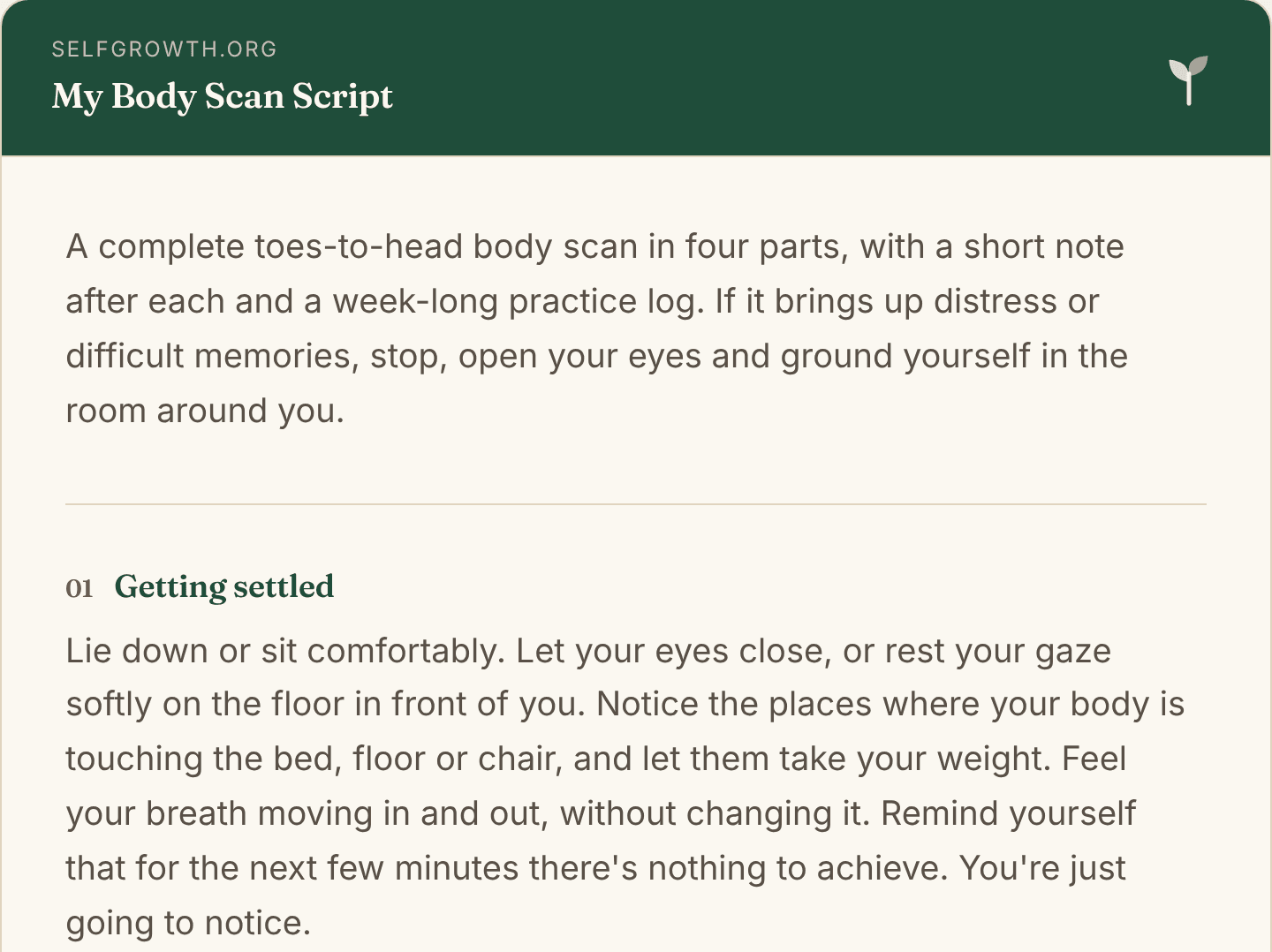
Body Scan Script
A free body scan meditation script in plain English: move your attention slowly from toes to head, noticing without changing, with reflection prompts and a log.
Open worksheet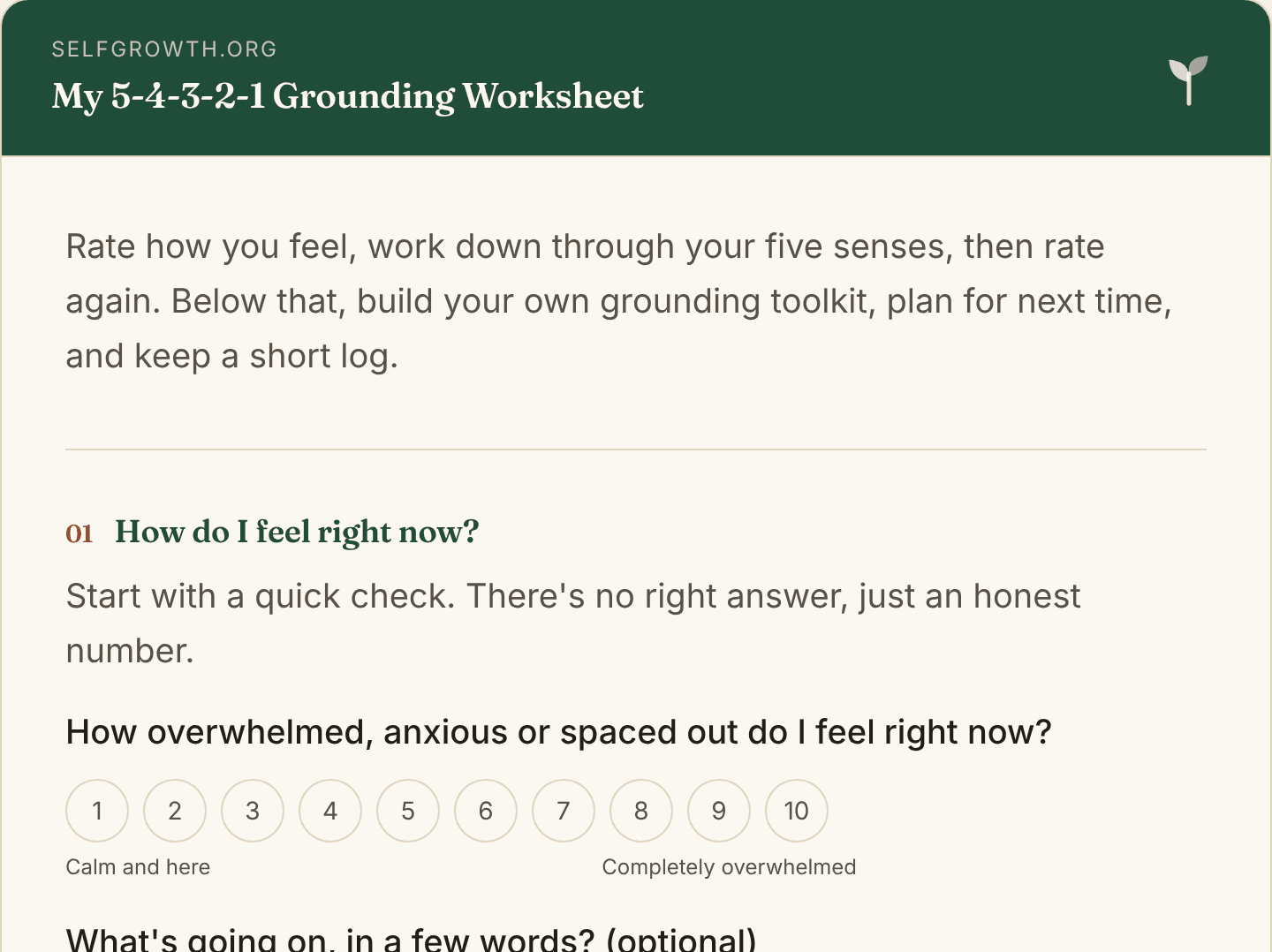
5-4-3-2-1 Grounding Worksheet
A free, printable 5-4-3-2-1 grounding worksheet: rate how you feel, work through your five senses, re-rate, then build your own toolkit and plan for next time.
Open worksheet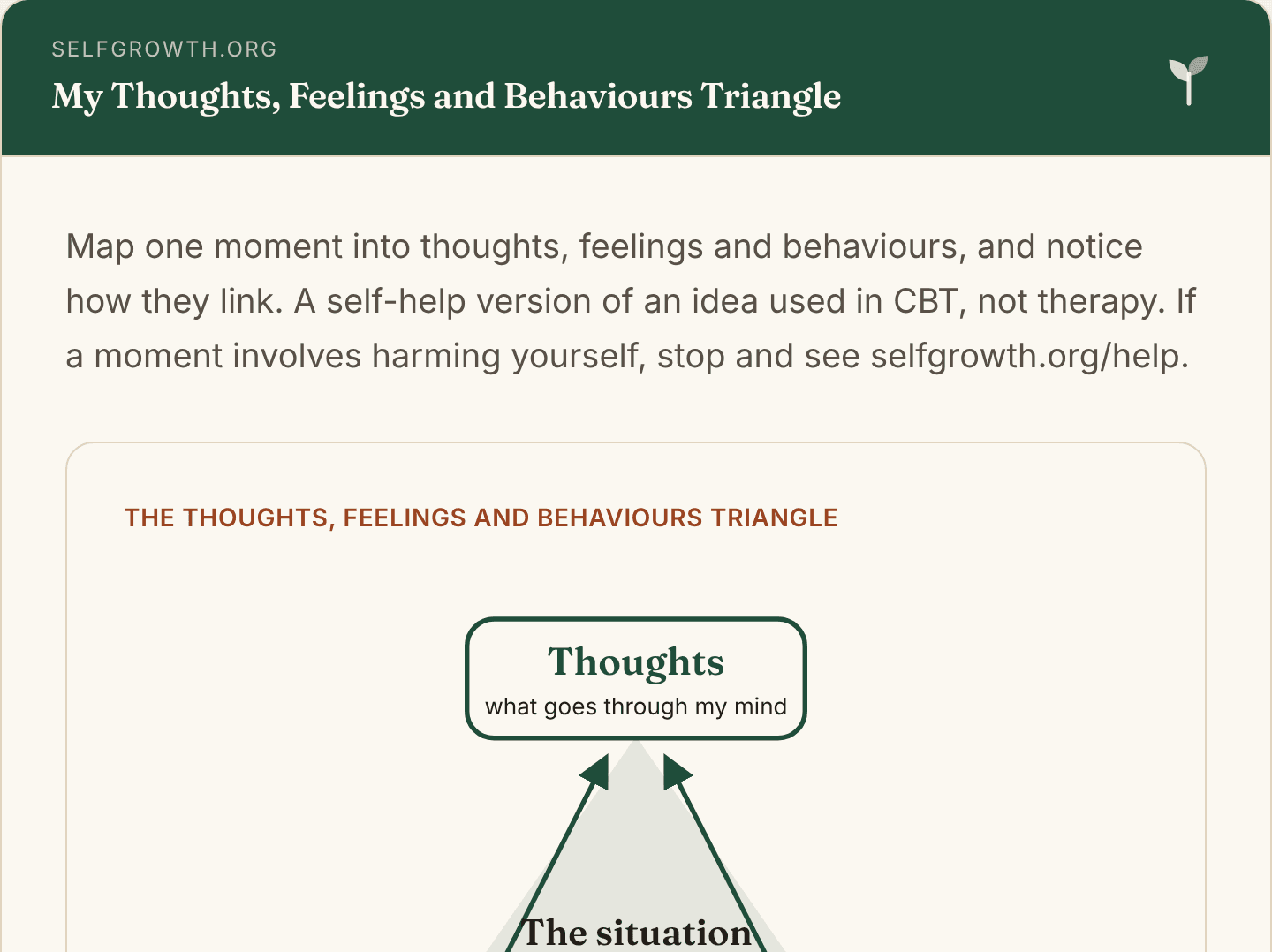
CBT Triangle Worksheet
Free CBT triangle worksheet: map one moment into thoughts, feelings and behaviours and see how they link. Self-help, not therapy. Free printable PDF.
Open worksheetNew worksheets, straight to your inbox
An occasional new worksheet or tool, sent only when there's something genuinely worth your time. No spam, no pressure, unsubscribe any time.