
Guide
Existential crisis: what it is and what helps
Updated 23 October 2026 · 9 min read
An existential crisis is a period of deep questioning about meaning, purpose, death or where you belong. It is not a diagnosis, and it can prompt you to look at what matters. If it comes with hopelessness or thoughts of not wanting to be alive, call Samaritans 116 123 (UK and Ireland) or 988 (US) now.
Drawn from existential psychology and research on meaning in life · Part of self-discovery
It might start with a small thing, like a birthday or a quiet Sunday. Suddenly the questions are huge: what is the point of any of this, am I living the life I actually want, what happens when it ends. Everyday things that felt solid can feel flat or far away.
This is a self-help guide, not therapy, and it can't tell you what your experience means. One thing matters before anything else: if these questions come with hopelessness, or thoughts of not wanting to be alive, please get support now: call or text Samaritans on 116 123 (UK and Ireland) or 988 (US), use findahelpline.com elsewhere, or see the helplines page at selfgrowth.org/help. The last section has more.
What is an existential crisis?
An existential crisis is a period when you start questioning the big foundations of your life: whether it has meaning, what your purpose is, what death means for you, how much freedom and responsibility you have over your own choices, and where you fit among other people. It is a description of an experience, not a medical or psychiatric diagnosis.
The ideas behind it come from existential psychology and philosophy. Viktor Frankl wrote about his time in the Nazi concentration camps, and about finding meaning in spite of suffering, in Man's Search for Meaning. His theory is called logotherapy. Irvin Yalom organised his book Existential Psychotherapy around four 'ultimate concerns of life': death, freedom, isolation and meaninglessness. Those four are a useful way to name what the questions are about. They are one thinker's framework, not a test you can pass or fail.
Having these questions doesn't mean something is wrong with you. But a crisis can be painful, and it can sit alongside low mood or anxiety. If you are unsure which it is, a GP can help you work that out.
Signs of an existential crisis
There is no checklist, and you don't need all of these. You might notice:
- You keep asking 'what is the point?' about work, relationships or life in general.
- Things you used to care about feel empty or pointless.
- You feel stuck between the life you have and a life you can't quite picture.
- Thoughts about death or time running out keep coming back and feel heavy. If they turn into thoughts of not wanting to be alive, get support now: Samaritans 116 123 (UK and Ireland), 988 (US), findahelpline.com elsewhere.
- You feel alone with the questions, as if nobody else could understand.
- You feel overwhelmed by the number of choices, or by the weight of being responsible for your own life.
- You are restless, anxious, flat or tearful, and can't quite say why.
Some of these also look like depression or anxiety. If low mood, loss of interest or worry has lasted for a while or is affecting your sleep, work or relationships, please talk to a GP. You don't have to decide for yourself what it is first.
What can set off an existential crisis?
Sometimes there is a clear trigger and sometimes there isn't. Things that can set the questions off include:
- A death, a serious illness, or a brush with your own mortality.
- A big life change: leaving school or a job, a breakup, becoming a parent, moving country, retiring.
- A milestone birthday, or a moment when you compare your life with the one you expected.
- Achieving something you wanted and finding it didn't feel the way you thought it would.
- Loneliness, or losing a role or a group that gave you a sense of who you were.
- A period of stress or burnout that leaves you with no energy for the usual answers. See signs of burnout.
- A world event that makes the future feel uncertain.
It also helps to know the questions aren't a sign you have done something wrong. Asking what matters is part of being a person who can look at their own life.
What helps when you are in an existential crisis?
Nobody can hand you an answer to 'what is the meaning of life'. These ideas are about steadying yourself while you live with the question, and slowly building a sense of what matters to you. Try one or two rather than all of them.
- 1Be with the question before you try to solve it. Notice that you are asking, and let yourself say 'this is hard and I don't have an answer yet'. Rushing to a neat conclusion doesn't make the question go away. You can write the question down in your own words, then put it aside for a while.
- 2Get clearer on your values. Values are the things that matter to you, such as honesty, care for others, learning or creativity. Naming them gives you something to steer by, even when the big picture is unclear. The core values worksheet walks you through it, and how to find your core values explains the idea.
- 3Look for small, daily meaning. Meaning doesn't have to be a grand purpose. It can be a task done well, a conversation, a walk, cooking for someone, or tending something. Each evening, write one thing that felt worthwhile, however small.
- 4Journal about it. Writing slows the thoughts down and gets them out of your head. Questions such as 'what do I want my days to be made of?' and 'who do I want to be to the people around me?' are a start. Try journal prompts, the self-reflection worksheet or who am I?, and see how to start journaling if you are new to it.
- 5Connect with other people. These questions can feel very lonely, and saying them aloud to someone you trust can take some of the weight off. You don't need them to have answers. A friend, a family member, a faith or community group, or a counsellor can all be good listeners.
- 6Do something for someone else. Helping a neighbour, volunteering or supporting a friend turns your attention outward, and caring for others is one way people find meaning.
- 7Make a 'questions I am carrying' list. Write down every question that keeps coming back, then sort each into 'can be answered' (for example, 'do I want to change jobs?') or 'to live with for now' (for example, 'what happens when we die?'). Pick one from the first list to act on this week, and let the second list sit without needing an answer yet.
- 8Be kind to yourself about it. Treating yourself as you would a friend who was asking these questions makes the process easier to bear. See how to practise self-compassion.
What does research say about meaning in life?
Researchers study 'meaning in life' as a sense that your life makes sense and matters. A review of studies by Czekierda and colleagues found a small-to-medium link between feeling life has meaning and better health, mostly when people rated their own health. These studies find links, not proof that meaning causes better health, and they don't show that any of the ideas above will resolve an existential crisis for you.
So the honest summary is this: meaning matters to people, it is worth working on, and there is no guaranteed method. The suggestions here are reasonable starting points drawn from existential thinking and everyday good sense, not a treatment.
When to get more support
Safety comes first. If your questions come with hopelessness, a feeling that there is no point in carrying on, or thoughts of not wanting to be alive, please reach out now. Thoughts like these are serious, and you deserve support from a real person. In the UK and Ireland, call Samaritans free on 116 123, any time. In the US, call or text 988. Elsewhere, findahelpline.com lists free, confidential lines by country. If you might act on a thought, or you are in immediate danger, call your local emergency number. Our helplines and support page has more routes.
Please also talk to a GP or family doctor if the questioning has lasted a while and is affecting your sleep, appetite, work or relationships, if you feel low or anxious most days, or if you are using alcohol or other substances to cope. If you stop drinking suddenly after heavy, regular use, it can be medically dangerous, so see a doctor first. A GP can check how you are, and can point you towards talking therapies, including counsellors who work with questions of meaning.
You don't have to wait until it feels bad enough. Wanting to talk it through with a trained person is a good enough reason.
Sources and further reading
This is an educational self-reflection resource, not therapy or medical advice.
If you want to go deeper
- Frankl, V. E. Man's Search for Meaning. Beacon Press. First published 1946. An account of the author's time in the Nazi concentration camps and his theory of logotherapy.
- Yalom, I. D. (1980). Existential Psychotherapy. Basic Books. Organised around the four ultimate concerns of life: death, freedom, isolation and meaninglessness.
- Czekierda, K., Banik, A., Park, C. L. & Luszczynska, A. (2017). Meaning in life and physical health: systematic review and meta-analysis. Health Psychology Review, 11(4), 387-418.
Your questions, answered
- What is an existential crisis?
- An existential crisis is a period of deep questioning about meaning, purpose, death, freedom or where you fit in the world. It isn't a medical diagnosis. It can be unsettling, and it can also be a prompt to think about what matters to you. If it comes with hopelessness or thoughts of not wanting to be alive, get support straight away.
- What are the signs of an existential crisis?
- You might keep asking what the point of things is, feel that what used to matter now feels empty, feel stuck or alone with the questions, or be troubled by thoughts about death or time passing. Some signs overlap with depression or anxiety, so if it lasts or affects your daily life, speak to a GP.
- How do you get out of an existential crisis?
- There isn't a single exit, and no method is guaranteed. You can be with the question, name your values, look for small daily meaning, write about it, and talk to someone you trust. A counsellor can help if it feels too big on your own.
- Is an existential crisis the same as depression?
- No, but they can overlap. An existential crisis describes questioning meaning and purpose. Depression is a medical condition that includes persistent low mood or loss of interest and other symptoms. You can have one without the other, or both. Only a GP or other health professional can tell you which applies to you.
- How long does an existential crisis last?
- There is no set length. For some people it is a passing phase around a life event, and for others it takes longer to settle. If it has lasted a while, or is affecting your sleep, work or relationships, it is worth talking to a GP rather than waiting it out alone.
- Is an existential crisis a bad thing?
- It can be painful, but the questions themselves aren't a sign of something wrong. They can lead to a clearer sense of what you value. That isn't guaranteed, and you shouldn't have to push through it alone. Reach out if it feels like too much.
- Is this therapy, and is it free?
- It is free, with no email needed, and it is a self-help guide, not therapy or medical advice. If you are struggling, a GP or counsellor can help. If you feel unsafe, contact Samaritans on 116 123 (UK and Ireland), call or text 988 (US), or find a line in your country at findahelpline.com.
Worksheets to do the work
Free to fill in online or print. No email needed.
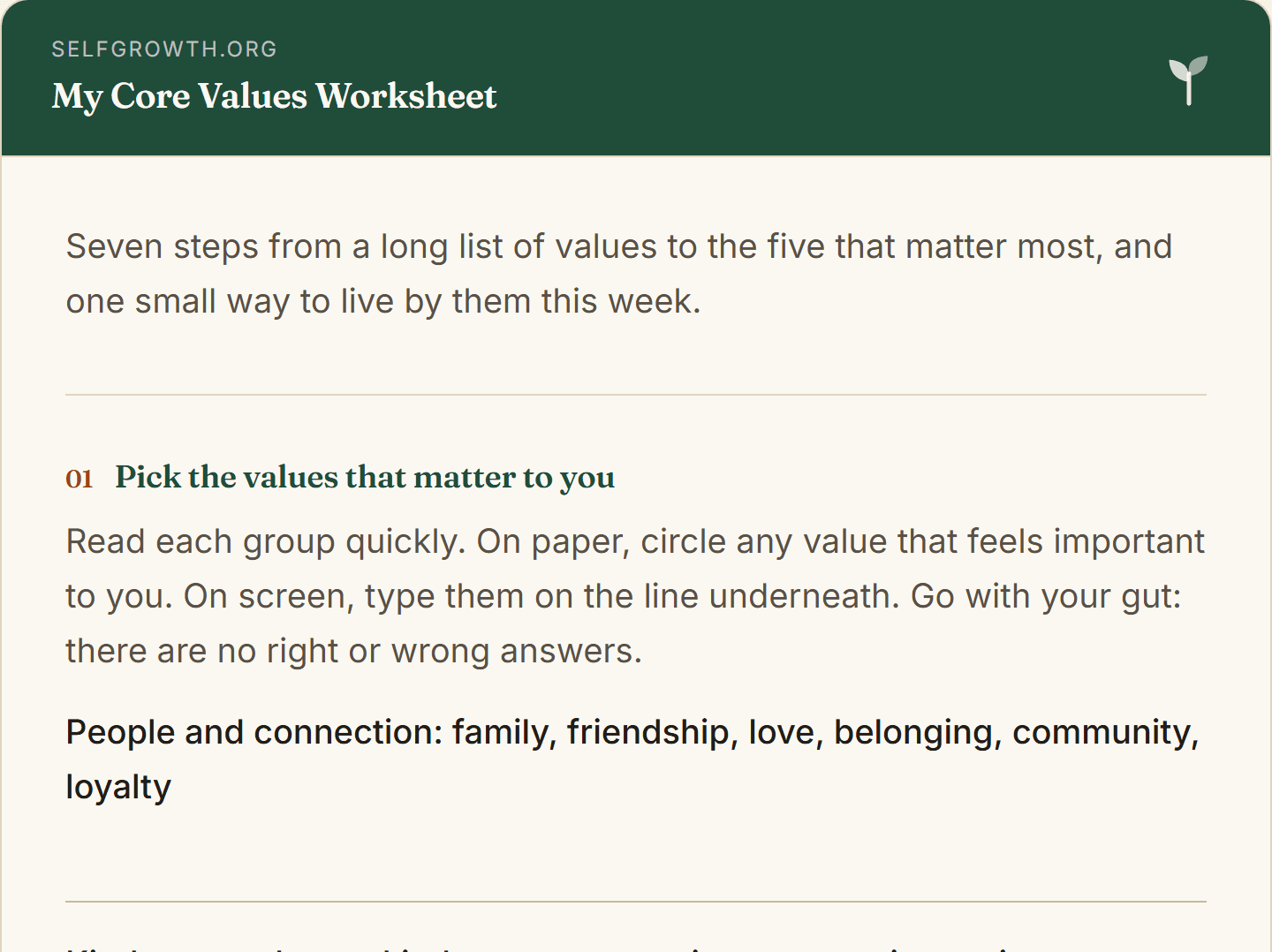
Core Values Worksheet
A free, printable core values worksheet: pick values from a list, narrow them to your top five, put them in your own words and plan one step to live by them.
Open worksheet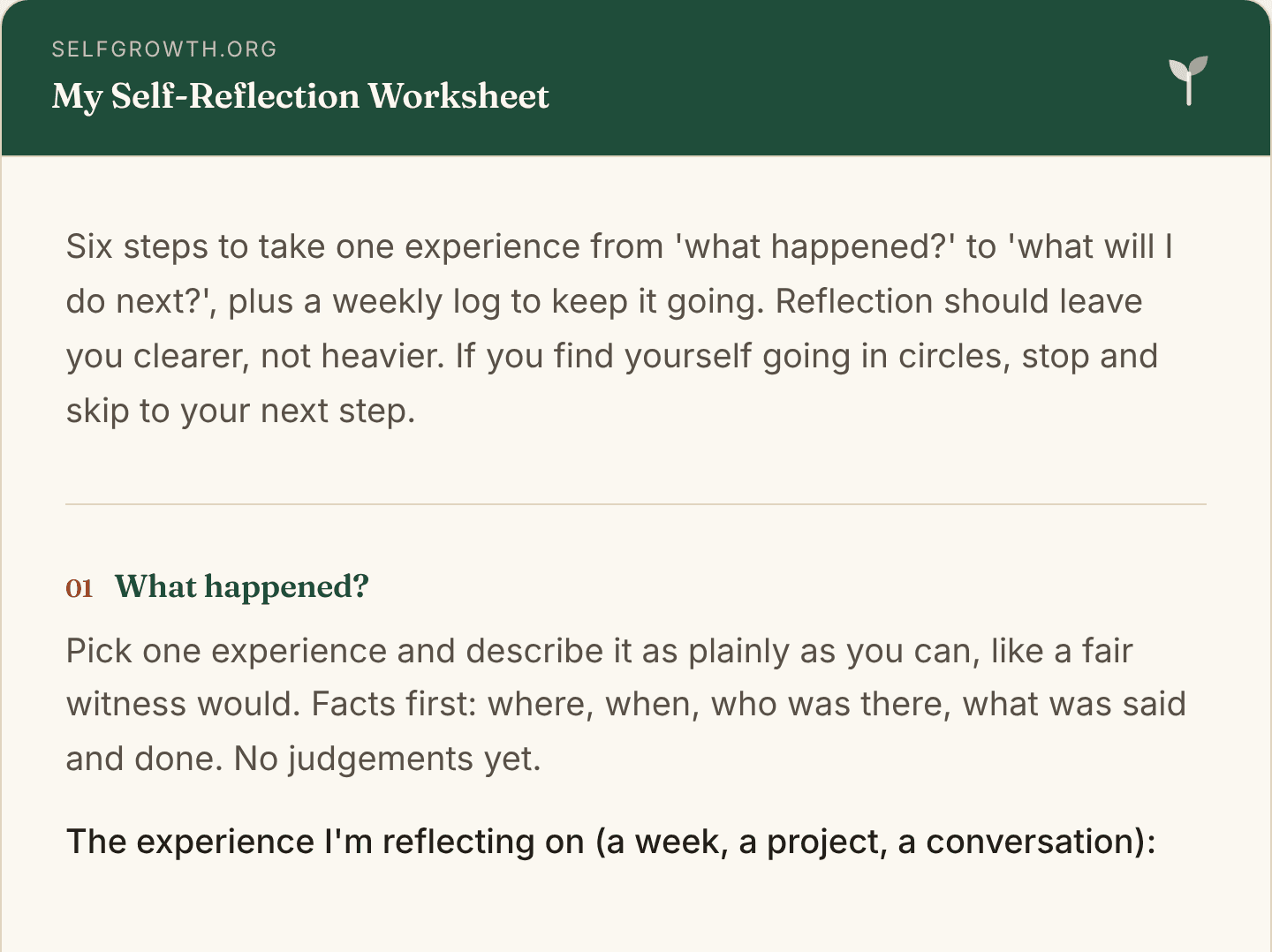
Self-Reflection Worksheet
A free, printable self-reflection worksheet: take one experience through Gibbs' reflective cycle, find your next step and keep a 10-minute weekly log.
Open worksheet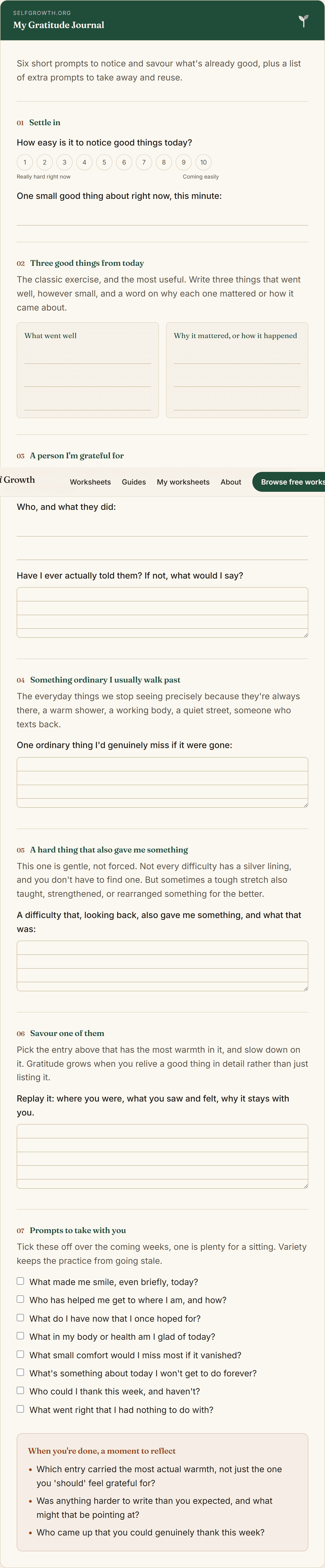
Gratitude Journal Prompts
Free, printable gratitude journal prompts: guided questions with space to write, plus a take-away list, to help you notice and savour what's already good.
Open worksheet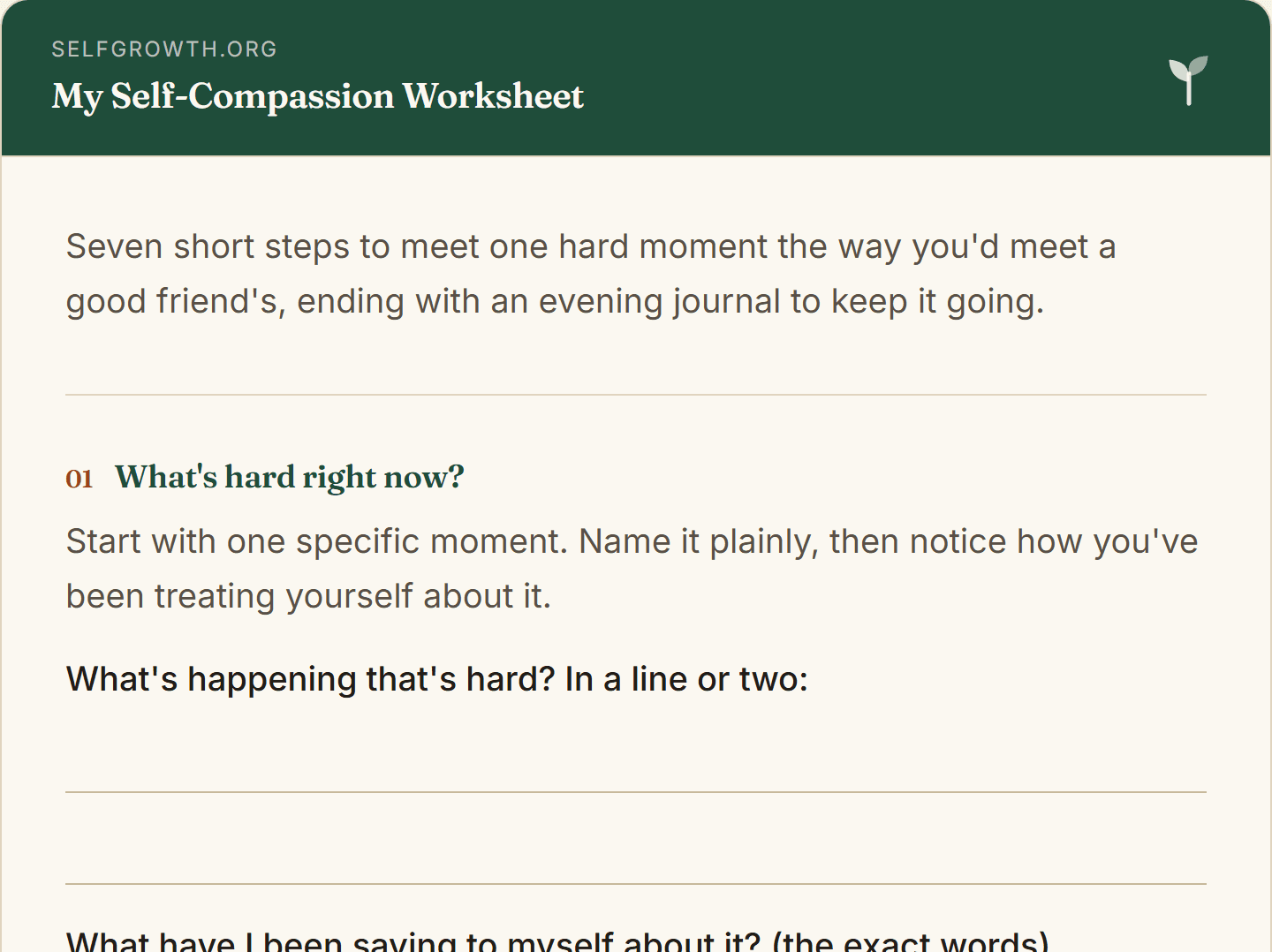
Self-Compassion Worksheet
A free, printable self-compassion worksheet: the self-compassion break, the friend test, a kind letter and journal prompts, based on Kristin Neff's research.
Open worksheetRelated guides
New worksheets, straight to your inbox
An occasional new worksheet or tool, sent only when there's something genuinely worth your time. No spam, no pressure, unsubscribe any time.