
Guide
Conflict resolution skills: how to resolve a conflict, step by step
Updated 25 October 2026 · 9 min read
Conflict resolution skills are habits that help you settle a disagreement without damaging the relationship: staying calm, listening, naming the problem rather than the person, finding what each side needs, and agreeing a next step. To resolve a conflict, pause if it is heated, listen first, then look for options you can both live with.
Drawn from everyday communication practice and negotiation writing · Part of relationships and communication
A disagreement with a partner, a parent, a housemate or a colleague can take up more room in your head than it deserves. You replay it in the shower. You rehearse what you should have said. You avoid the person, or you snap at them over something small.
Handling conflict is a set of skills, and skills can be learned. Below are six of them, then a step-by-step way to use them. If you want to work through your own disagreement on paper, the conflict resolution worksheet does that. For a single, planned talk, the difficult conversations guide covers how to start it.
This is a self-help guide, not therapy. It is for conflicts with people who are safe to disagree with.
What are conflict resolution skills?
Conflict resolution skills are the things you do that help two people get from 'we disagree' to 'we have a way forward'. They cover how you handle your own feelings, how you listen, how you speak, and how you reach an agreement.
Resolving a conflict does not always mean you both end up happy, or that you agree. Sometimes it means you understand each other, you settle on a plan, or you agree to leave it and stay on good terms. What matters is that the problem stops running your day.
Conflict resolution skills you can learn
You do not need all six at once. Pick the one that is hardest for you and practise that first.
- Staying calm: notice the first signs that you are heating up, such as a tight jaw, a fast heart or a sharp tone. Take a breath, or ask for a short break. It is hard to think clearly or listen well when you are flooded with anger or fear.
- Listening: let the other person finish, without planning your reply. Then say back what you heard, such as 'So you felt left out when I made the plans. Is that right?' The active listening worksheet gives you practice.
- Naming the problem, not the person: 'The bins have not gone out for a week' invites a fix. 'You are lazy' invites a fight. According to the Harvard Program on Negotiation, Fisher and Ury's book Getting to Yes, which is about negotiation, shares strategies for separating the people from the problem.
- Finding the interests underneath: a position is what someone asks for ('Turn the music down'). An interest is the reason behind it ('I need to sleep'). The Harvard Program on Negotiation describes focusing on interests and options as elements of principled negotiation. Here, that negotiation idea is borrowed for everyday disagreements. A useful question to try is 'What do you need here, and what do I need?'
- Generating options: before you settle, list several ways to solve it, without judging them yet. A longer list gives you more to choose from than the first idea.
- Agreeing and checking in: turn the choice into something small and clear: who does what, by when. Then set a date to see how it is going. A check-in date gives the plan a chance to be adjusted.
How to resolve a conflict: step by step
Use these in order. If you only get through the first two today, that is still a real step.
- 1Cool down first. If you or they are very angry, say 'I want to sort this out, and I need twenty minutes first.' Say when you will come back, so a break is not read as walking away.
- 2Work out what you want. Write one sentence on the problem, one on how it affects you, and one on what you would like to be different.
- 3Pick a good time and place. Somewhere private, with enough time, when neither of you is tired or in a rush.
- 4Start with the problem, not blame. Say what happened in plain facts, how it affects you, and that you want to fix it. For example: 'When the plans change at the last minute, I feel let down. Can we find a way that works for both of us?'
- 5Listen to their side. Ask what it looks like to them, let them finish, and say back what you heard before you answer.
- 6Find what each of you needs. Ask 'What matters most to you here?' and say what matters most to you. Look for the reasons behind the demands.
- 7List options together, then choose one. Aim for something you can both live with, even if neither of you gets everything.
- 8Agree the next step and a check-in. Write down who does what and by when, and pick a date to see how it is going.
The I-statements worksheet helps you put step 4 into your own words. The fair fighting rules worksheet is useful if rows tend to get personal.
Open the Conflict Resolution WorksheetOpen the I-Statements WorksheetConflict resolution at work
Work conflicts have extra layers: a boss's power, a team that has to keep working together, and sometimes formal rules about how a complaint is handled. The same steps apply. Keep to facts about the work, say how it affects the task, and ask for one clear change.
- With a colleague: start with the task, not the person. 'When the meeting notes arrive a day late, I cannot update my part. Could we agree to share them by the end of the same day?'
- With your manager: ask for a short meeting, bring one or two examples and one proposal. Write down what you agree afterwards.
- If you manage people: ask each person for their account separately before you bring them together. Keep the focus on the work and what needs to change, and follow up on what was agreed.
- Mediation: a mediator is a neutral person who helps both sides talk and reach their own agreement. If you are stuck, you can ask your manager or HR whether your workplace has a mediation process.
If the problem is bullying, harassment or discrimination, do not try to fix it alone in one conversation. Keep a note of what happened and when, and take it to HR, a manager above the person, or a union rep. The work boundaries guide can help if the conflict comes from taking on too much.
Conflict resolution in relationships and families
Close relationships carry history, so a small disagreement can feel like the same old fight. It can help to say so: 'I think we are having the old argument again. Can we stay with what happened today?'
- Stick to one issue at a time. Bringing up everything from the last year makes it harder for either of you to fix any of it.
- Say what you need, not what they are. 'I need more notice when you are going to be late' is easier to hear than 'You never think of me'.
- With family, you may not change how someone sees things. You can still agree what you will each do, such as how often you visit or who covers a cost.
- If a row has gone too far, an apology can reopen the door. The guide to apologising shows how.
If you and a partner want to practise talking, the couples communication exercises are one place to start.
When not to try to resolve it yourself
The advice here only suits someone who is safe to disagree with. If you are afraid of the other person, or they control, threaten or hurt you, do not negotiate and do not try to talk it through on your own. Staying quiet or choosing your moment can be the sensible thing to do. Your safety comes first.
In England, the National Domestic Abuse Helpline is free and open 24 hours on 0808 2000 247. In Scotland, call 0800 027 1234; in Wales, 0808 80 10 800; in Northern Ireland, 0808 802 1414. In the US, the National Domestic Violence Hotline is on 1-800-799-7233. If you are in immediate danger, call 999 in the UK or 911 in the US.
When to get more support
Some conflicts are too big or too old to sort out alone. If the same row keeps coming back, if dread of a person is affecting your sleep or mood, or if you have tried and nothing changes, you deserve real support. A GP is a good first step. A counsellor can help you practise what to say, and a mediator can help families or neighbours talk things through.
If you are struggling to cope or have thoughts of harming yourself, contact a crisis line now: Samaritans on 116 123 (UK and Ireland), 988 (US), or find a line in your country at findahelpline.com.
Sources and further reading
This is an educational self-reflection resource, not therapy or medical advice.
If you want to go deeper
- Fisher, R. & Ury, W. (1981). Getting to Yes. Later editions with B. Patton.
- Program on Negotiation, Harvard Law School. What is Getting to Yes? https://www.pon.harvard.edu/tag/getting-to-yes/
- National Domestic Abuse Helpline (nationaldahelpline.org.uk); National Domestic Violence Hotline (thehotline.org).
Your questions, answered
- What are the 5 conflict resolution skills?
- There is no official list of five. Six that help are staying calm, listening, naming the problem rather than the person, finding what each side needs, generating options, and agreeing a next step. Pick the one you find hardest and practise it first.
- How do you resolve a conflict step by step?
- Cool down, work out what you want, choose a good time, and open with the problem rather than blame. Listen to their side, find what each of you needs, list options, then agree a next step and a date to check in.
- How do you resolve a conflict with a coworker?
- Ask for a private time and start with the task, not the person. Describe what happened in plain facts, say how it affects the work, and ask for one clear change. If it is bullying or harassment, keep notes and go to HR or a manager above them.
- How do you calm down in an argument?
- Pause and take a few slow breaths. Ask for a break, and say when you will come back, such as 'I need twenty minutes, then let's talk.' Come back at that time.
- What is the difference between a position and an interest?
- A position is what someone asks for, such as 'Turn the music down'. An interest is the reason behind it, such as 'I need to sleep'. Looking at the interest can open up more ways to solve the problem than the position alone.
- Is there a conflict resolution worksheet PDF?
- Yes. The conflict resolution worksheet and the I-statements worksheet are free to use. Use the Download PDF button or Print, with no payment and no email needed. You can also fill them in on screen, and your answers save in your browser.
- Is this a substitute for therapy?
- No. This is a self-help tool, not therapy. If a conflict is affecting your mood, sleep or health, talk to your GP. If someone frightens or controls you, call a domestic abuse helpline instead (England 0808 2000 247, Scotland 0800 027 1234, Wales 0808 80 10 800, Northern Ireland 0808 802 1414, US 1-800-799-7233). If you ever feel unsafe or have thoughts of harming yourself, call Samaritans on 116 123 (UK and Ireland), 988 (US), or find a line at findahelpline.com.
Worksheets to do the work
Free to fill in online or print. No email needed.
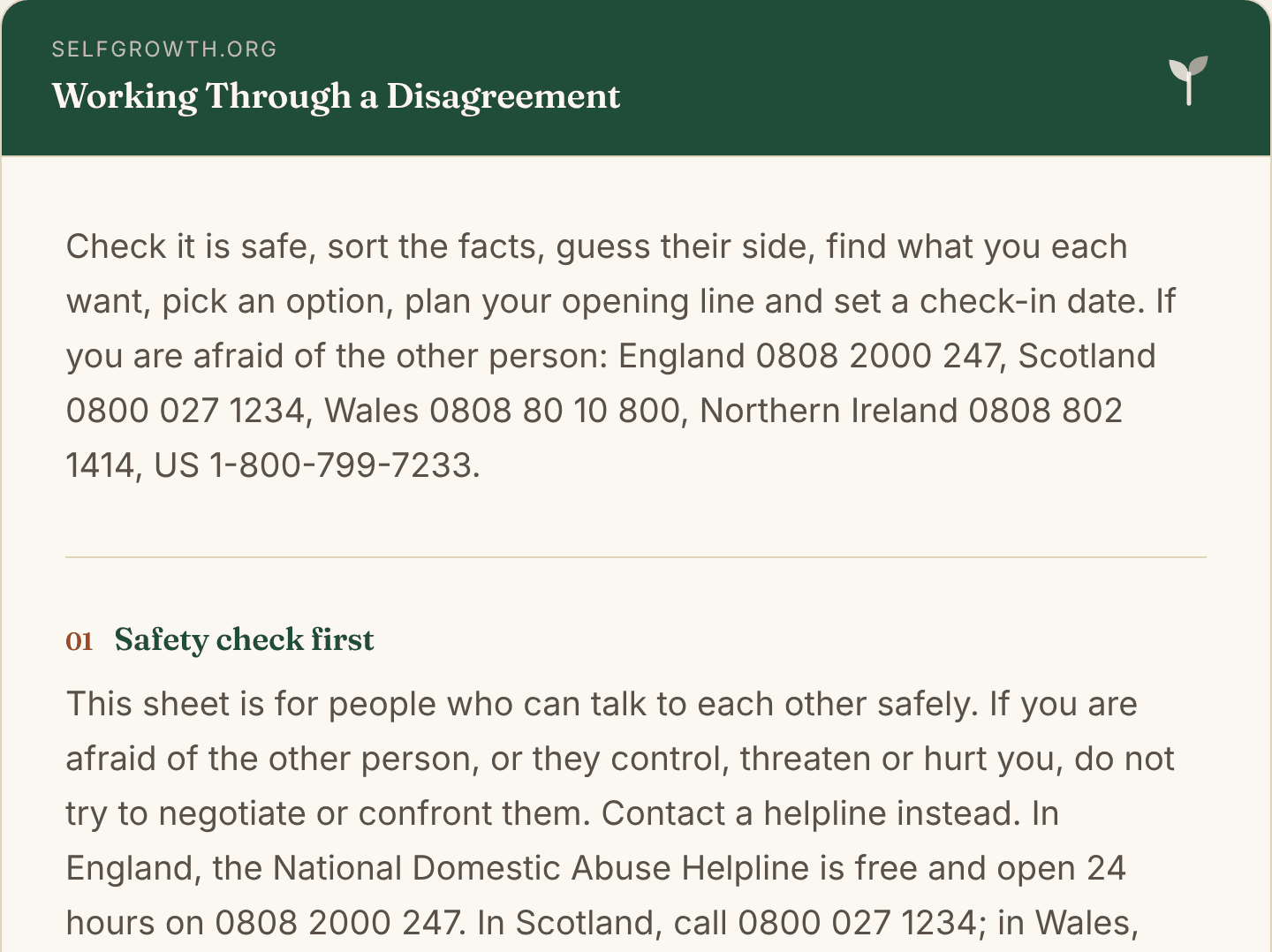
Conflict Resolution Worksheet
A free conflict resolution worksheet for a friend, family member, colleague or housemate: sort the facts, see their side, find what you both want and plan the talk.
Open worksheet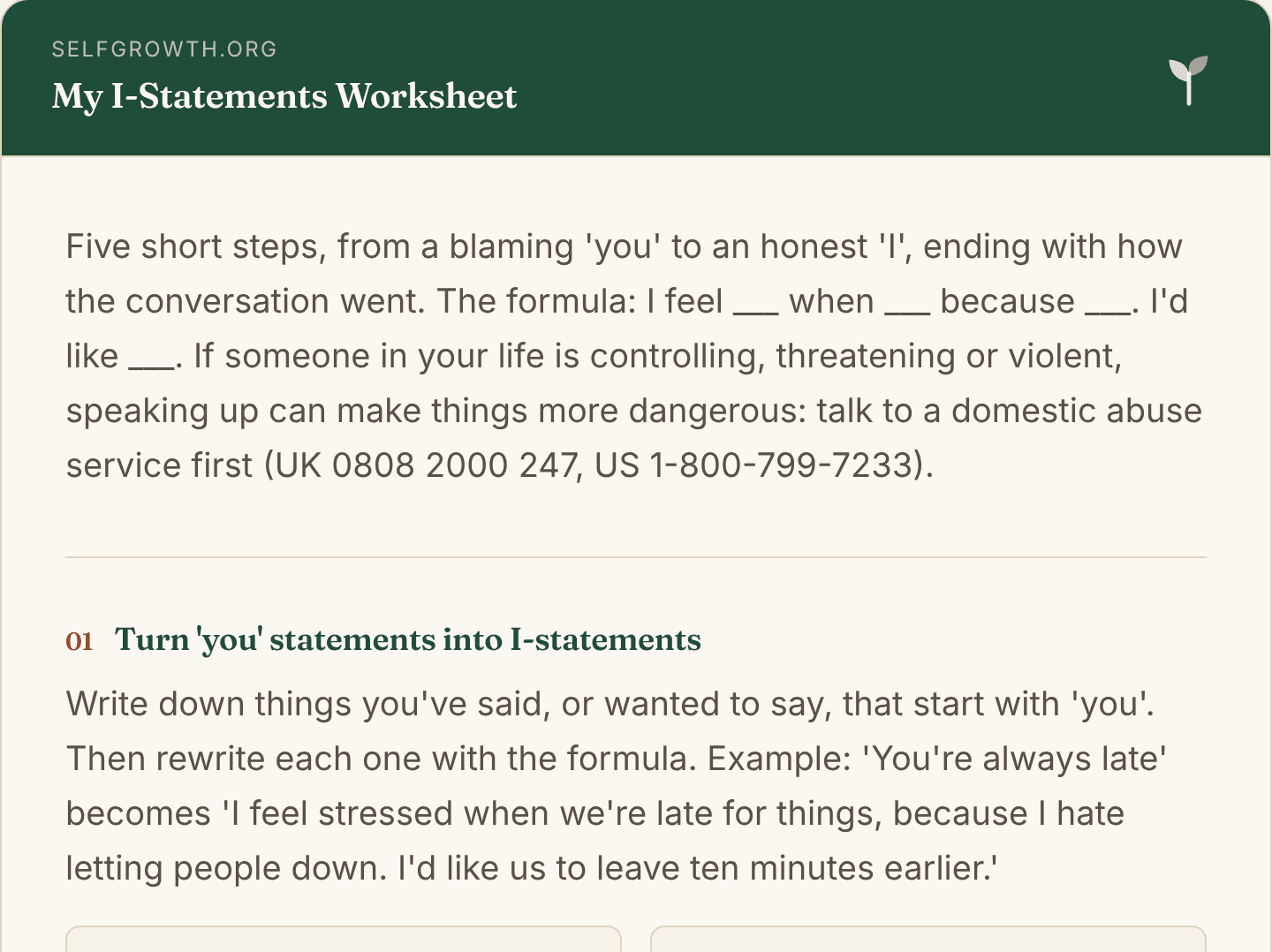
I-Statements Worksheet
A free, printable I-statements worksheet with I statement examples, the 'I feel... when... because...' formula, and space to plan one real conversation.
Open worksheet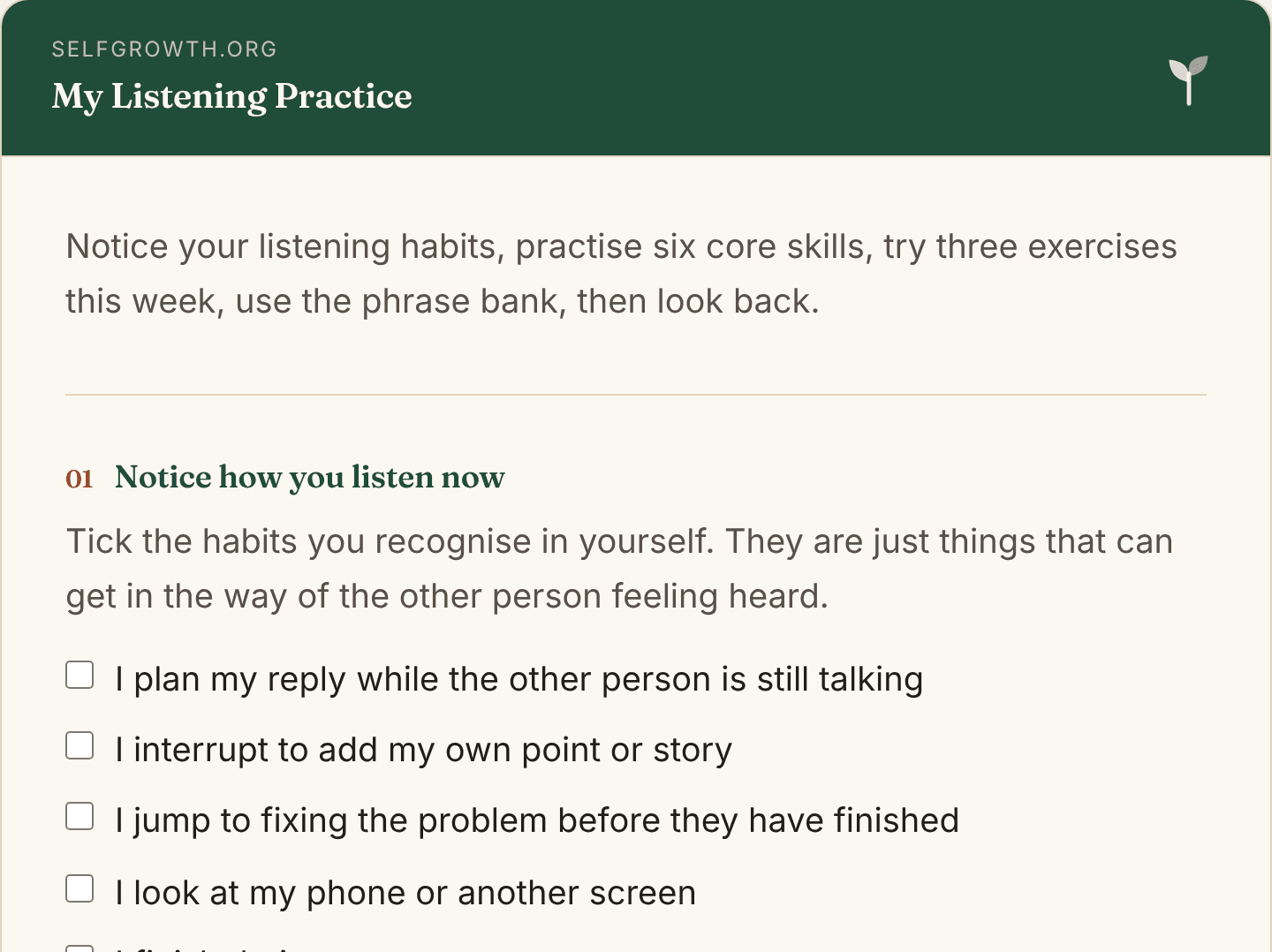
Active Listening Worksheet
A free active listening worksheet with exercises: spot your listening habits, practise six core skills, try three conversations this week and look back at what you noticed.
Open worksheet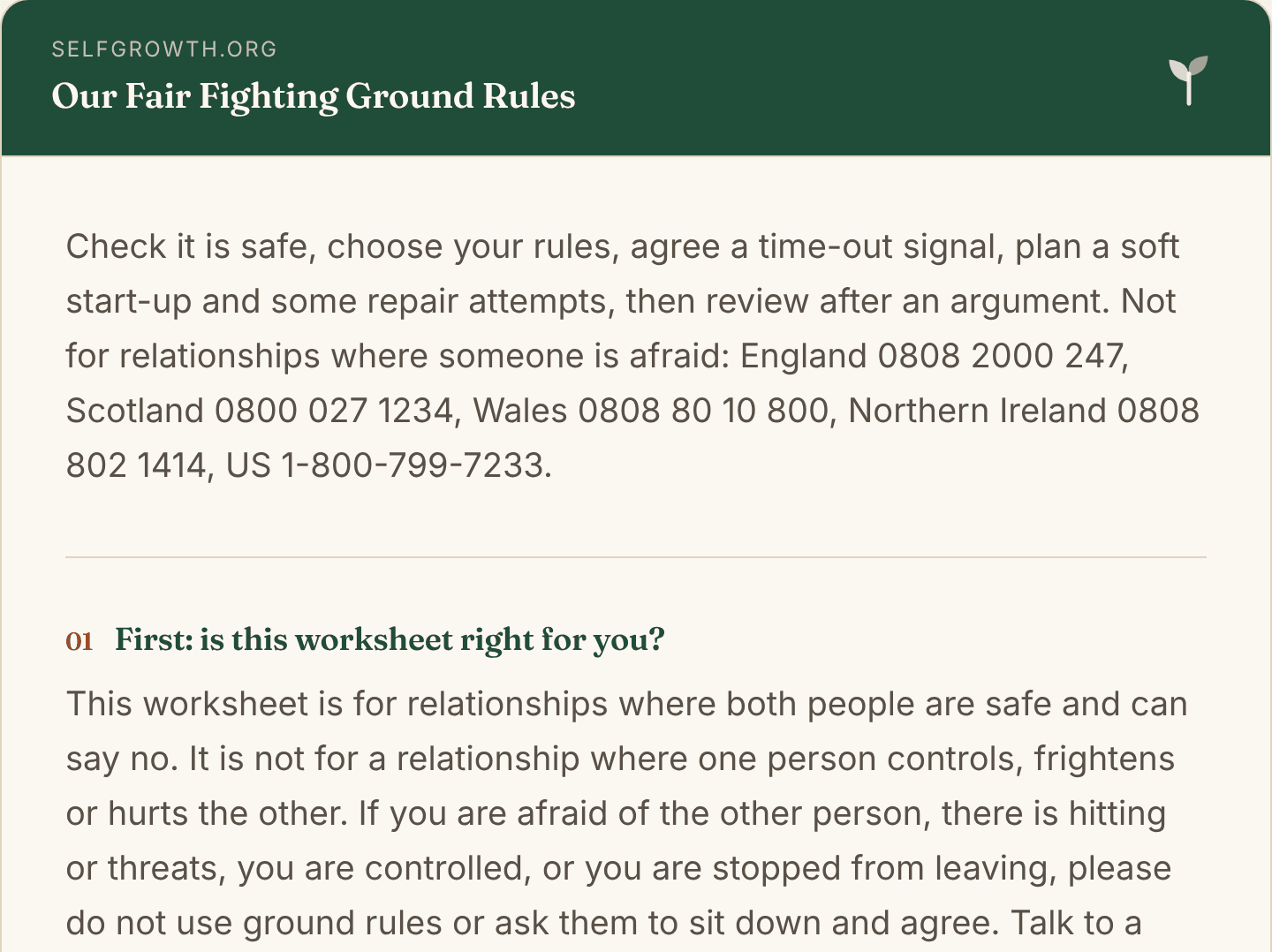
Fair Fighting Rules Worksheet
A free, printable fair fighting rules worksheet for couples, family or housemates: choose your rules, set a time-out signal, plan a soft start-up and review after.
Open worksheetRelated guides
New worksheets, straight to your inbox
An occasional new worksheet or tool, sent only when there's something genuinely worth your time. No spam, no pressure, unsubscribe any time.