
Guide
How to apologise (and mean it)
Updated 25 October 2026 · 8 min read
To apologise well, say what you did, own it without excuses, and say sorry for how it affected the other person. Then say what you will do differently, and ask if there is anything you can do to put it right. Keep it short, and give them room to respond in their own time.
Drawn from research on apologies and trust repair · Part of relationships and communication
You said something sharp. You forgot something that mattered. Or you let someone down, and now it sits in your chest every time you think of them. You know you owe an apology. You are just not sure how to make it land.
A good apology is simple, and you can learn it. Below you will find a plain step-by-step, short examples you can adapt, and a list of phrases to avoid. If you are carrying guilt that an apology cannot fix, the self-forgiveness worksheet is a place to start. This is self-help, not therapy.
What makes a good apology?
A good apology tells the other person that you understand what happened, you take responsibility, and you care how it affected them. It is about them, not about getting rid of your own bad feeling.
Researchers have looked at what makes an apology work. In a 2016 paper, Lewicki, Polin and Lount tested six components of an apology, shown on their own and in combination, in a scenario where trust had been broken. Apologies with more components were rated as more effective than apologies with fewer, and some components were rated as more important than others. Apologies after a breach of trust about competence (a failure of skill) were rated as more effective than those after a breach about integrity (a failure of character or principles, such as honesty).
That was a study of how people rated apologies described to them in a scenario, so it cannot tell you what will happen with your friend or your partner. It does fit common sense: a bare 'sorry' says less than an apology that shows you understand and will act.
How to apologise: step by step
Choose a moment when you are calm and the other person can listen. If you are still angry, wait until you are not. Then work through these steps. If you feel afraid of the person, skip this and see the safety note under 'What if they don't accept it?'.
- 1Get clear first. Ask yourself what you did, and what it cost the other person. Write it down if it helps.
- 2Say sorry plainly. 'I'm sorry' is the start. Do not bury it in a long speech.
- 3Name what you did. 'I'm sorry I shouted at you in front of the team.' Being specific shows you understand.
- 4Own it without excuses. Skip 'but'. You can explain later, if they ask, but explaining first can sound like defending.
- 5Acknowledge how it affected them. 'I can see that was embarrassing for you. Is that right?' Say it in your own words, and do not tell them how they felt.
- 6Say what you will do differently. Only promise what you will really do. 'Next time I'll ask you before I decide.'
- 7Offer to put it right, where you can. 'Is there anything I can do to fix this?' Then listen to the answer.
- 8Give them room. They may need time. Do not ask for forgiveness in the same breath. An apology is a gift, not a demand.
Apology examples
Use these as a starting point and change the words so they sound like you.
- Friend: 'I'm sorry I cancelled on you again. That's twice, and I know you were looking forward to it. I'll put the next one in my diary now. Can we pick a date?'
- Partner: 'I'm sorry I snapped at you last night. You didn't deserve that. Next time I'll take a breath and tell you what I need.'
- Colleague: 'I'm sorry I missed the deadline and left you to cover it. I should have told you earlier. I'll send you updates by Wednesday from now on.'
- Family: 'I'm sorry I wasn't there when you needed me. I let work come first, and I can see it hurt. I'd like to make time for you. Can I call on Sunday?'
- By text: 'I owe you an apology. I'm sorry I said that about your job. It was unkind and untrue. Can I call you later, or would you rather have some space?'
If the hurt was big, a text may feel too small. A call or a face-to-face talk, if they are willing, shows you took it seriously.
What not to say
Some phrases take back the apology as you say it. Watch for these:
- 'I'm sorry you feel that way.' This puts the problem in their feelings, not in what you did. Try 'I'm sorry I did that.'
- 'I'm sorry, but...' The 'but' cancels the sorry. Drop it, or say the reason separately and later.
- 'I'm sorry if I hurt you.' The 'if' casts doubt on whether you did. Say 'I'm sorry I hurt you.'
- A long explanation. Too much detail can sound like an excuse. Keep it brief.
- 'You're too sensitive' or 'It was only a joke.' These blame them for being upset.
- 'I said I was sorry, what more do you want?' An apology does not come with a deadline for them to be over it.
- Apologising to make the feeling stop. If the aim is to feel better yourself, you may sound more worried about you than about them.
What if they don't accept it?
You can control how you apologise. You cannot control how they respond. They may be hurt, angry or not ready to talk, and that is allowed.
- Say you understand, and that they can take the time they need. 'I get it. I'm here when you want to talk.'
- Do not push, repeat the apology or keep contacting them to get an answer.
- Show it in what you do next. Changed behaviour backs up your words.
- Check whether the apology was enough. If you left something out, you can add it later, once.
- Accept that some relationships take a long time to mend, and some do not. You can still have done the right thing.
If you were not wrong, or only partly wrong, you can say sorry for your part without taking the blame for everything. The fair fighting rules worksheet can help you work through a disagreement.
If someone has hurt, threatened or controlled you, you do not owe them an apology, and you do not have to raise it with them or sort it out on your own. Your safety comes first. In England, the National Domestic Abuse Helpline is free and open 24 hours on 0808 2000 247. In Scotland, call 0800 027 1234; in Wales, 0808 80 10 800; in Northern Ireland, 0808 802 1414. In the US, the National Domestic Violence Hotline is 1-800-799-7233. If you are in danger right now, call 999 (UK) or 911 (US). The help page lists more.
How to apologise to yourself
Sometimes the person you let down is you. Or the other person is gone, or will not speak to you, and you are left carrying it. Forgiving yourself does not mean saying it did not matter. It means taking responsibility, learning from it, and letting yourself move on.
Try this: say plainly what you did, say what you have learned, and say what you will do differently. Then speak to yourself the way you would speak to a friend in the same spot. The self-forgiveness worksheet walks you through it.
Open the Self-Forgiveness WorksheetWhen to get more support
Guilt and regret are part of being human. Think about talking to a GP if:
- Guilt or shame has stayed with you for weeks and is not easing.
- You feel low, empty or hopeless much of the time, or have lost interest in things you used to enjoy.
- You find yourself apologising all the time, or for things that are not your fault.
- A conflict or a loss is affecting your sleep, appetite, work or daily life.
A GP can talk it through and point you to support, which can include talking therapies. You can also call Samaritans free on 116 123 (UK and Ireland), at any time, just to talk. In the US, call or text 988. Elsewhere, findahelpline.com lists free, confidential lines.
If you feel you cannot see a way out, or you are thinking about ending your life or harming yourself, put your safety first: contact one of these lines now, or go to your nearest emergency department or call your local emergency number.
Sources and further reading
This is an educational self-reflection resource, not therapy or medical advice.
If you want to go deeper
- Lewicki, R. J., Polin, B. & Lount, R. B. Jr (2016). An exploration of the structure of effective apologies. Negotiation and Conflict Management Research, 9(2), 177-196.
Your questions, answered
- How do I apologise sincerely?
- Say sorry plainly, name what you did, and take responsibility without excuses. Acknowledge how it affected them, say what you will do differently, and offer to put it right. Keep it short and give them time to respond.
- What should I say in an apology?
- Something like: 'I'm sorry I [what you did]. I can see it made you feel [how it affected them]. I'll [what you will do differently]. Is there anything I can do to put it right?' Change the words so they sound like you.
- What should you not say in an apology?
- Avoid 'I'm sorry you feel that way', 'I'm sorry, but...' and 'I'm sorry if I hurt you'. They shift blame or cast doubt. Also skip long explanations and any pressure for them to forgive you.
- What if they won't forgive me?
- You can only control your own part. Say you understand, give them time and avoid pushing. Let your actions over the following weeks show you meant it. Some relationships mend slowly, and some do not.
- Is it okay to apologise by text?
- It can be, especially as a first step, or when the other person needs space. For a bigger hurt, a call or a face-to-face talk may show more care. Keep a text short, specific and free of excuses.
- Is there a how to apologise worksheet or PDF?
- Yes. The linked worksheets are free to use. Use the Download PDF button or Print, with no payment and no email needed. You can also fill them in on screen, and your answers save in your browser.
- Is this a substitute for therapy?
- No. This is a self-help tool, not therapy or medical advice. If guilt or conflict is weighing on you, talk to your GP. If you ever feel unsafe or have thoughts of harming yourself, call Samaritans on 116 123 (UK and Ireland), 988 (US), or find a line at findahelpline.com.
Worksheets to do the work
Free to fill in online or print. No email needed.
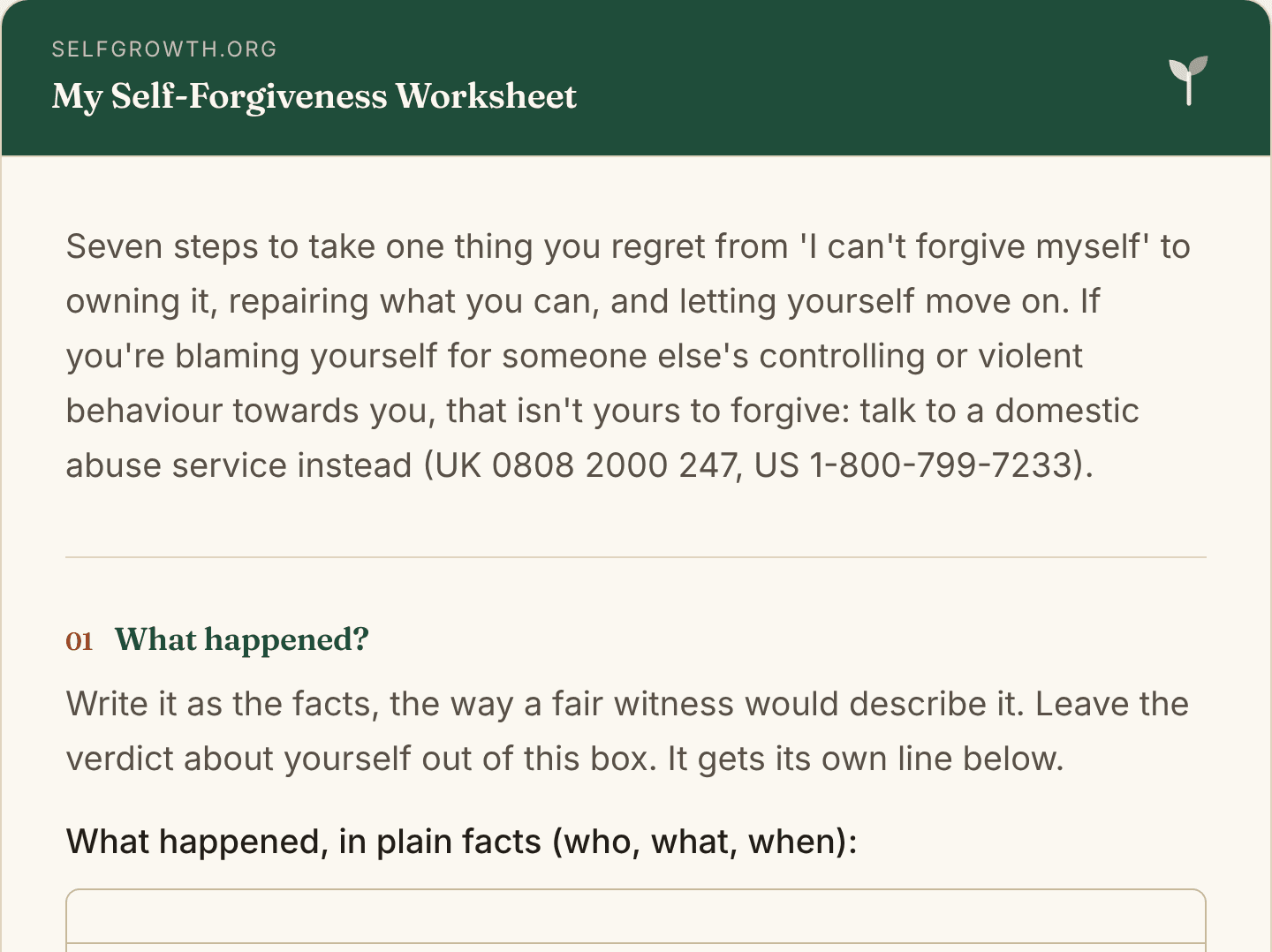
Self-Forgiveness Worksheet
A free, printable self-forgiveness worksheet for adults: own your part, tell guilt from shame, make amends where you can, and write a letter forgiving yourself.
Open worksheet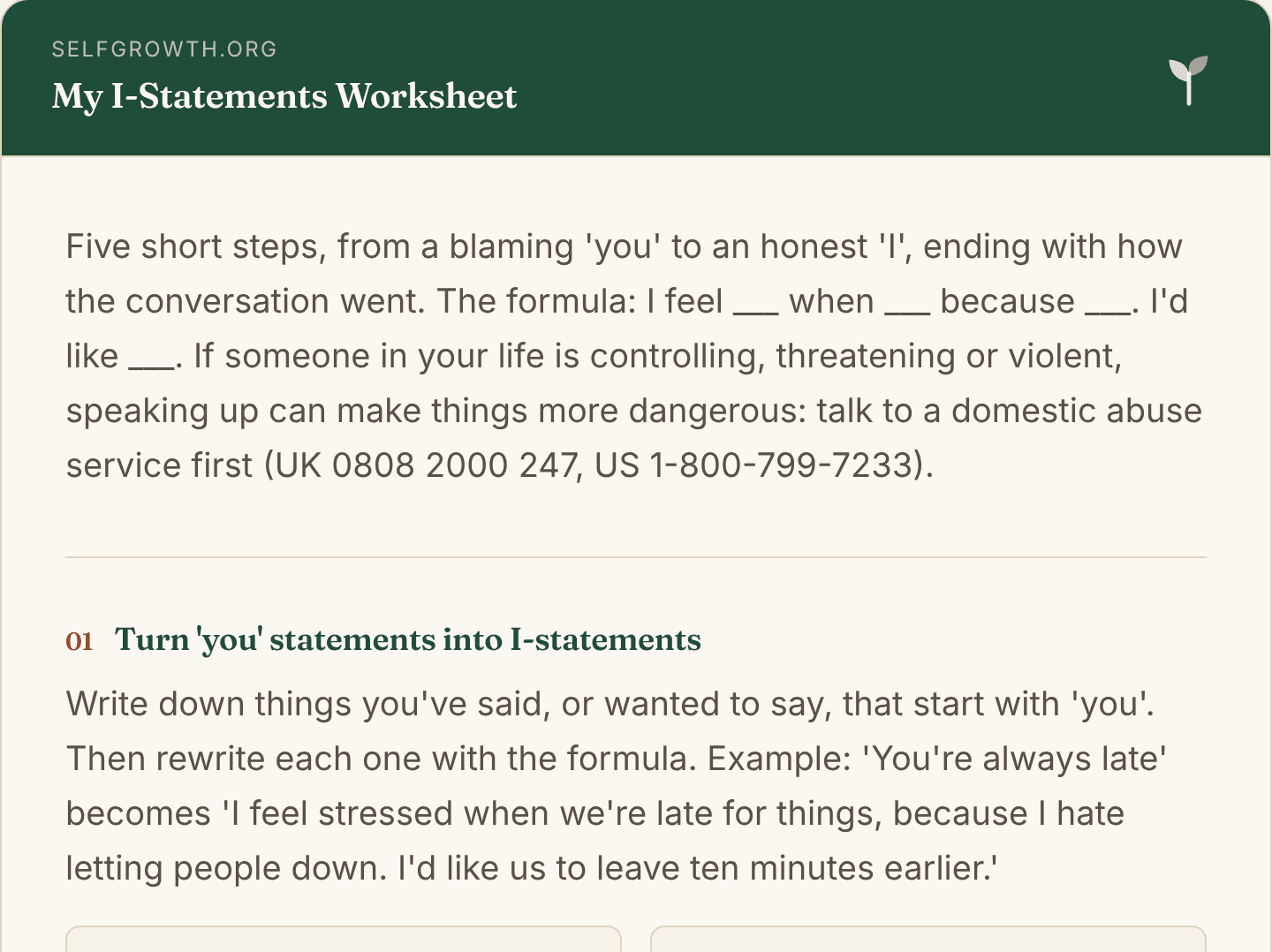
I-Statements Worksheet
A free, printable I-statements worksheet with I statement examples, the 'I feel... when... because...' formula, and space to plan one real conversation.
Open worksheet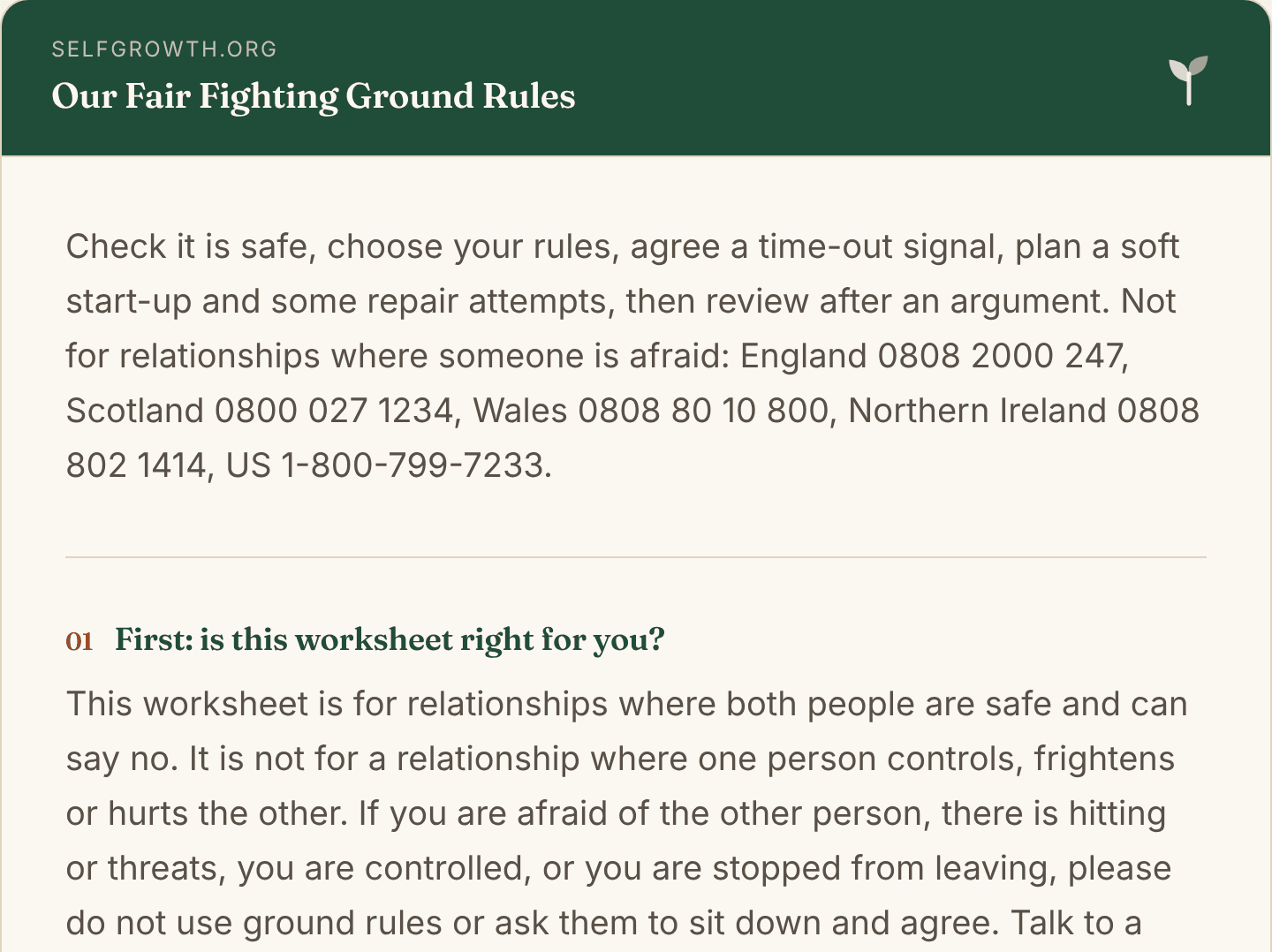
Fair Fighting Rules Worksheet
A free, printable fair fighting rules worksheet for couples, family or housemates: choose your rules, set a time-out signal, plan a soft start-up and review after.
Open worksheet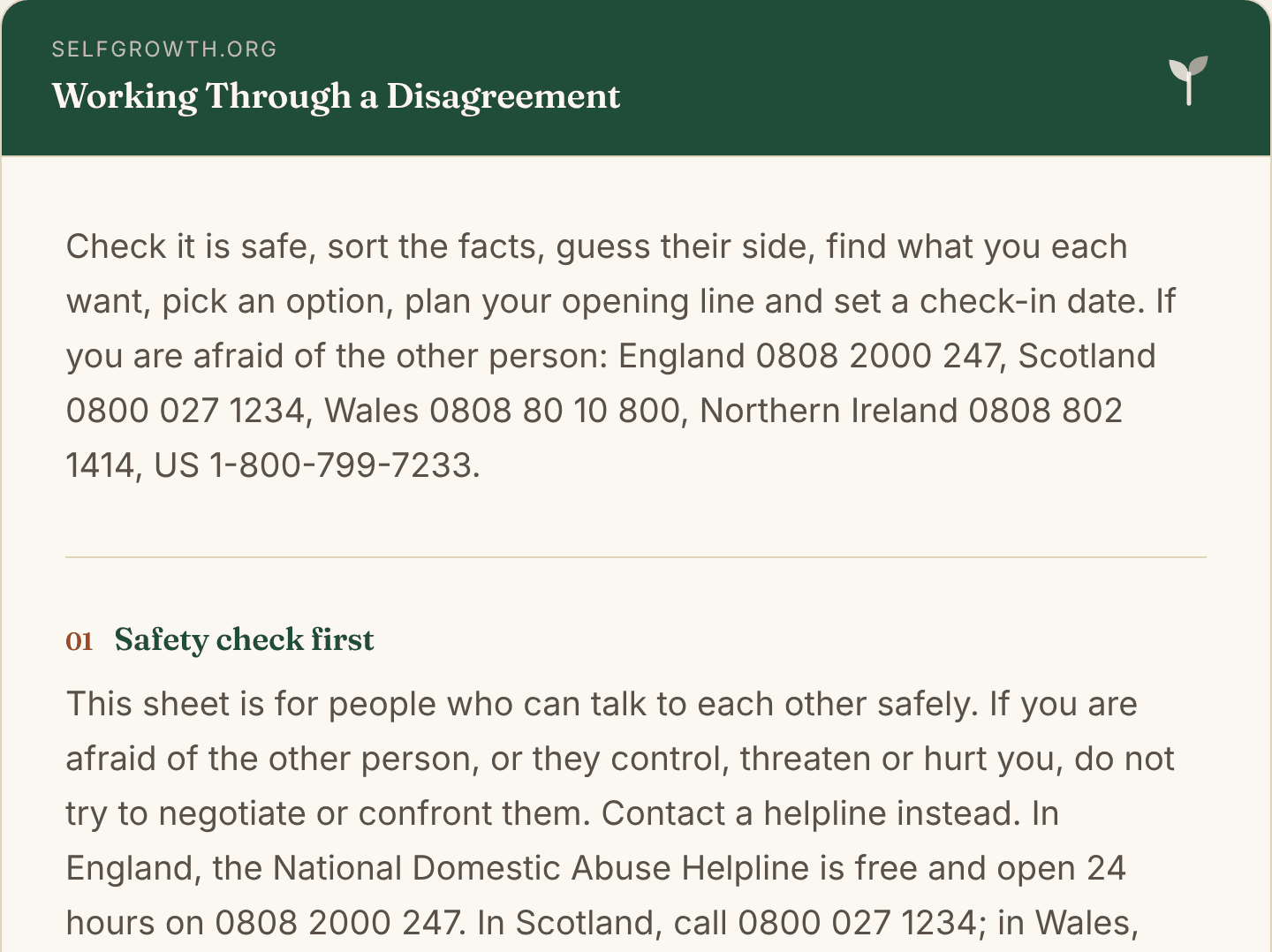
Conflict Resolution Worksheet
A free conflict resolution worksheet for a friend, family member, colleague or housemate: sort the facts, see their side, find what you both want and plan the talk.
Open worksheetRelated guides
New worksheets, straight to your inbox
An occasional new worksheet or tool, sent only when there's something genuinely worth your time. No spam, no pressure, unsubscribe any time.