
Communication
Conflict resolution worksheet: a free way to work through a disagreement with one person
Updated 25 October 2026 · 8 min read · Free to print
A conflict resolution worksheet helps you work through a disagreement before you talk. You check it is safe, write down the facts, guess the other person's side, and find what each of you wants. Then you list options, plan your opening line and set a check-in date.
A practical format, with the interests idea from negotiation research · Part of relationships and communication
Fill it in here (it saves in this browser, but not in a private window), print it, or download the PDF. Free, no sign-up.
A row with a friend, a relative, a colleague or a housemate can sit in your head for days. This sheet gives it a shape. You separate what happened from what you made of it, try to see the other side, and work out what you each actually want. Then you plan how to start the talk and how to agree what happens next.
It is for any two people who can talk safely. It is different from the fair fighting rules worksheet, which is about ground rules for couples and live-in arguments. Here the focus is one specific disagreement. If you need words for the opening line, the I-statements worksheet and the assertive communication guide help.
The layout is a practical format, not a tested programme. It is a self-help tool, not therapy, and it will not fix a relationship that is unsafe. If you are afraid of the other person, start with the first section and skip the rest.
How to use this worksheet
- 1Start with section 1. If any answer there is no, go to the support box and stop.
- 2Fill in your own side first, in your own words. Keep it to facts in section 2.
- 3Take your time with sections 3 and 4. They are the ones that change how the talk goes.
- 4Choose one option to try, plan your opening line, and set a check-in date before you talk.
The worksheet
selfgrowth.org
Working Through a Disagreement
Check it is safe, sort the facts, guess their side, find what you each want, pick an option, plan your opening line and set a check-in date. If you are afraid of the other person: England 0808 2000 247, Scotland 0800 027 1234, Wales 0808 80 10 800, Northern Ireland 0808 802 1414, US 1-800-799-7233.
01Safety check first
This sheet is for people who can talk to each other safely. If you are afraid of the other person, or they control, threaten or hurt you, do not try to negotiate or confront them. Contact a helpline instead. In England, the National Domestic Abuse Helpline is free and open 24 hours on 0808 2000 247. In Scotland, call 0800 027 1234; in Wales, 0808 80 10 800; in Northern Ireland, 0808 802 1414. US: National Domestic Violence Hotline 1-800-799-7233. In immediate danger, call 999 (UK) or 911 (US). At work, harassment or bullying is something to take to HR, a union rep or a manager above the person, not to sort out alone.
Who is the disagreement with, and what is it about, in one line?
02What happened
Write only what a camera would have caught: who said or did what, and when. Then, separately, what you felt and what you needed. Keep guesses about their motives for the next section.
Entry 1
Entry 2
Entry 3
Entry 4
A fact I have been treating as a certainty but cannot be sure of:
03Their side, as best I can guess
You may not agree with them. This is only about trying to see how it looks from where they stand. Mark what is a guess, and what you would need to ask.
If they told this story, how would it start?
What they might have been feeling or needing:
My part in it, even if it is small:
What I do not know, and could ask:
04What each of us wants underneath
A position is the thing you ask for: 'You have to stop leaving dishes out.' An interest is the reason behind it: 'I want to come home to a calm kitchen.' Two positions can clash while the interests sit side by side. Roger Fisher and William Ury's book Getting to Yes (first published 1981; Bruce Patton co-wrote later editions) is written about negotiation, and the Harvard Program on Negotiation describes focusing on interests and inventing options as part of its approach. Using it for an everyday disagreement is an extension of that idea.
Entry 1
Entry 2
Entry 3
Where our interests overlap or do not really conflict:
05Options that could work for both
List ideas before you judge any of them. Include odd ones. Then pick one to try for a short time. A trial is easier to agree to than a rule for ever.
Possible options:
- 1.
- 2.
- 3.
- 4.
- 5.
The option I will suggest trying:
06How I will open the conversation
The first line sets the tone. Start with your own experience and a clear request, not a verdict on them. The I-statements worksheet has more on this.
My opening: 'When ___ happened, I felt ___. What I need is ___. Could we find a way that works for both of us?'
A good time and place (private, not rushed, not when either of us is tired):
A question I will ask them, and then listen to the whole answer:
If it gets heated, I will say or do this:
07The agreement and a check-in date
Write what you agreed in plain words, so you both remember the same thing. Put a date to look at it again.
Entry 1
Entry 2
Entry 3
How we will know it is working:
08After: what worked
Fill this in after the talk or the check-in. It is for you, not a score.
How do I feel about where things stand now?
What worked in the conversation:
What I would do differently:
What still needs talking about, or support from someone else:
When you're done, a moment to reflect
- Which part of the facts was easiest to separate from your feelings, and which was hardest?
- What is the need underneath your request that you have not said out loud?
- What would the other person say you are not seeing?
- Is there a small step you could take first, without waiting for them to move?
- If the same argument keeps coming back, what is it really about?
Done for now?
Save today's answers as a dated entry. You can come back, fill it in again and compare the two side by side.
Where does 'interests, not positions' come from?
The idea of looking at interests instead of fixed positions comes from negotiation writing. Roger Fisher and William Ury wrote Getting to Yes, first published in 1981 (Bruce Patton co-wrote later editions), and the Harvard Program on Negotiation describes focusing on interests and inventing options as part of its approach. That work is about business, legal and political negotiation. Using it on a row with a friend or housemate is a reasonable borrowing, but it is not what the book was tested on.
The rest of the layout is a common self-help format: facts, feelings and needs, a guess at the other side, options, an opening line and a check-in. It is a way to think, not a tested method.
Some conflicts are not for a worksheet. Where there is fear, control, threats or violence, the safe step is support, not a talk. If a conflict is wearing you down, see your GP or a counsellor as well.
These are educational self-reflection tools, not therapy.
If you want to go deeper
- Fisher, R. & Ury, W. (1981). Getting to Yes. Later editions with B. Patton.
- Program on Negotiation, Harvard Law School. What is Getting to Yes? https://www.pon.harvard.edu/tag/getting-to-yes/
- National Domestic Abuse Helpline (nationaldahelpline.org.uk); National Domestic Violence Hotline (thehotline.org).
Your questions, answered
- What are the steps of conflict resolution?
- There is no single official list. A practical order is: check it is safe, separate facts from feelings, think about the other person's side, work out what each of you needs underneath, list options, pick one to try, open the talk gently and agree a date to check in. The sections on this sheet follow that order.
- How do I resolve a conflict with someone?
- Choose a calm time and start with your own experience and one clear request, not blame. Ask what the other person sees and listen to the full answer. Look for what you both need rather than who is right, and agree one small thing to try. The sheet helps you prepare each of these.
- What are good conflict resolution skills?
- Useful skills include describing facts without judging, naming your own feelings and needs, asking questions, listening, and being willing to try options. They can be practised. This sheet gives you a place to practise the thinking before the conversation.
- What is the difference between a position and an interest?
- A position is what you ask for. An interest is the reason you want it. 'I want the window open' is a position. 'I need fresh air to sleep' is an interest. Looking at interests can open up options that a stand-off over positions hides.
- What if the other person will not talk?
- You cannot make someone talk, but you can still do sections 2 to 4 for your own clarity and decide what you will do. You might send a short, calm message offering a time to talk. If they refuse, think about whether another person could help, such as a mutual friend, a manager or a mediation service.
- Is there a conflict resolution worksheet PDF?
- Yes. Use the Download PDF button for a clean, print-ready copy, or Print to print straight from the page. It is completely free, with no payment and no email needed. You can also fill it in on screen, and your answers save in your browser.
- Is this a substitute for therapy?
- No. It is a self-help tool, not therapy or mediation. If an ongoing conflict is affecting your sleep, mood or health, talk to a GP or a counsellor. If someone frightens or controls you, contact a domestic abuse helpline instead (England 0808 2000 247, Scotland 0800 027 1234, Wales 0808 80 10 800, Northern Ireland 0808 802 1414, US 1-800-799-7233). If you ever feel unsafe or have thoughts of harming yourself, call Samaritans on 116 123 (UK and Ireland), 988 (US), or find a line at findahelpline.com.
Keep going, related worksheets
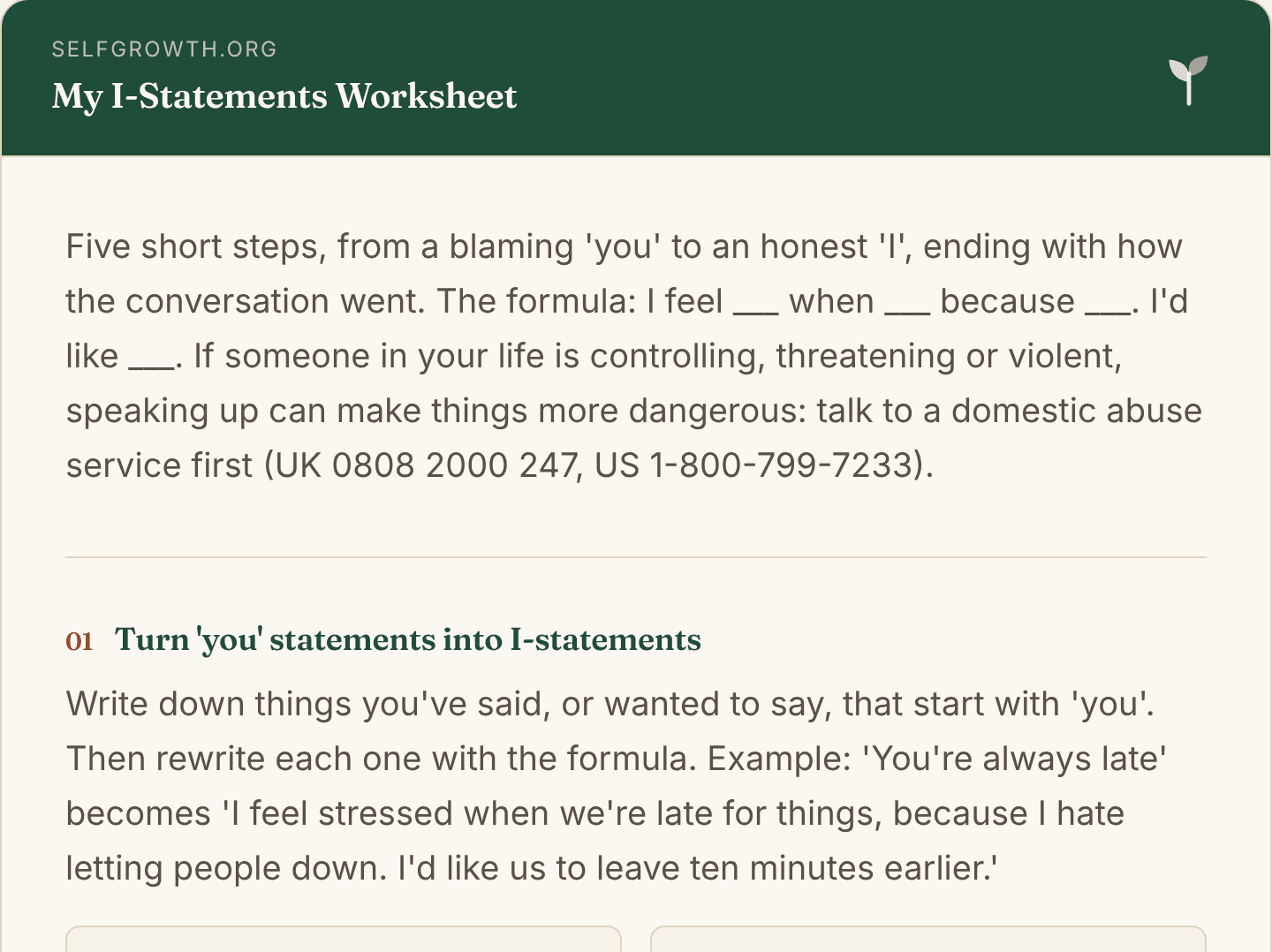
I-Statements Worksheet
A free, printable I-statements worksheet with I statement examples, the 'I feel... when... because...' formula, and space to plan one real conversation.
Open worksheet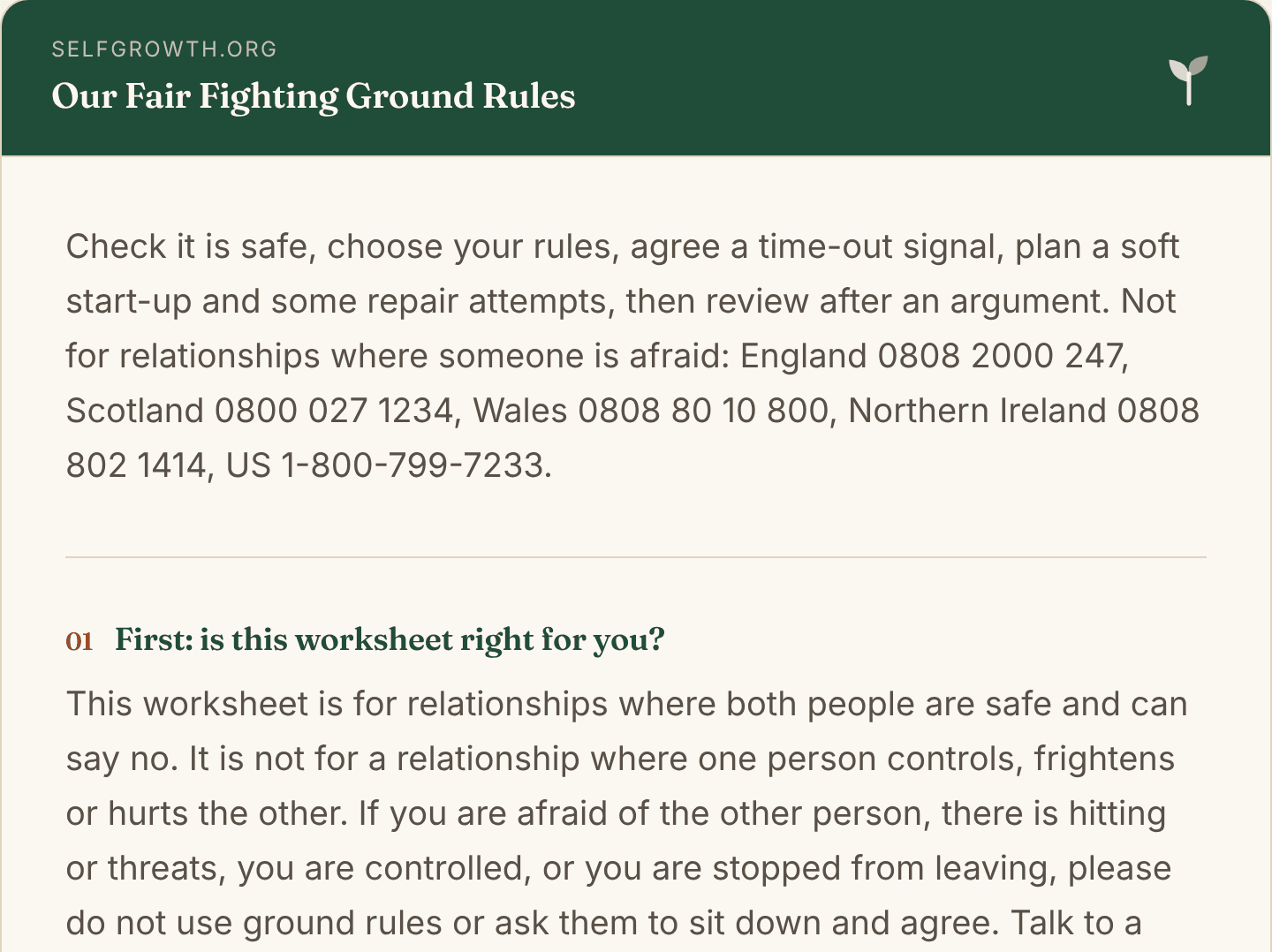
Fair Fighting Rules Worksheet
A free, printable fair fighting rules worksheet for couples, family or housemates: choose your rules, set a time-out signal, plan a soft start-up and review after.
Open worksheet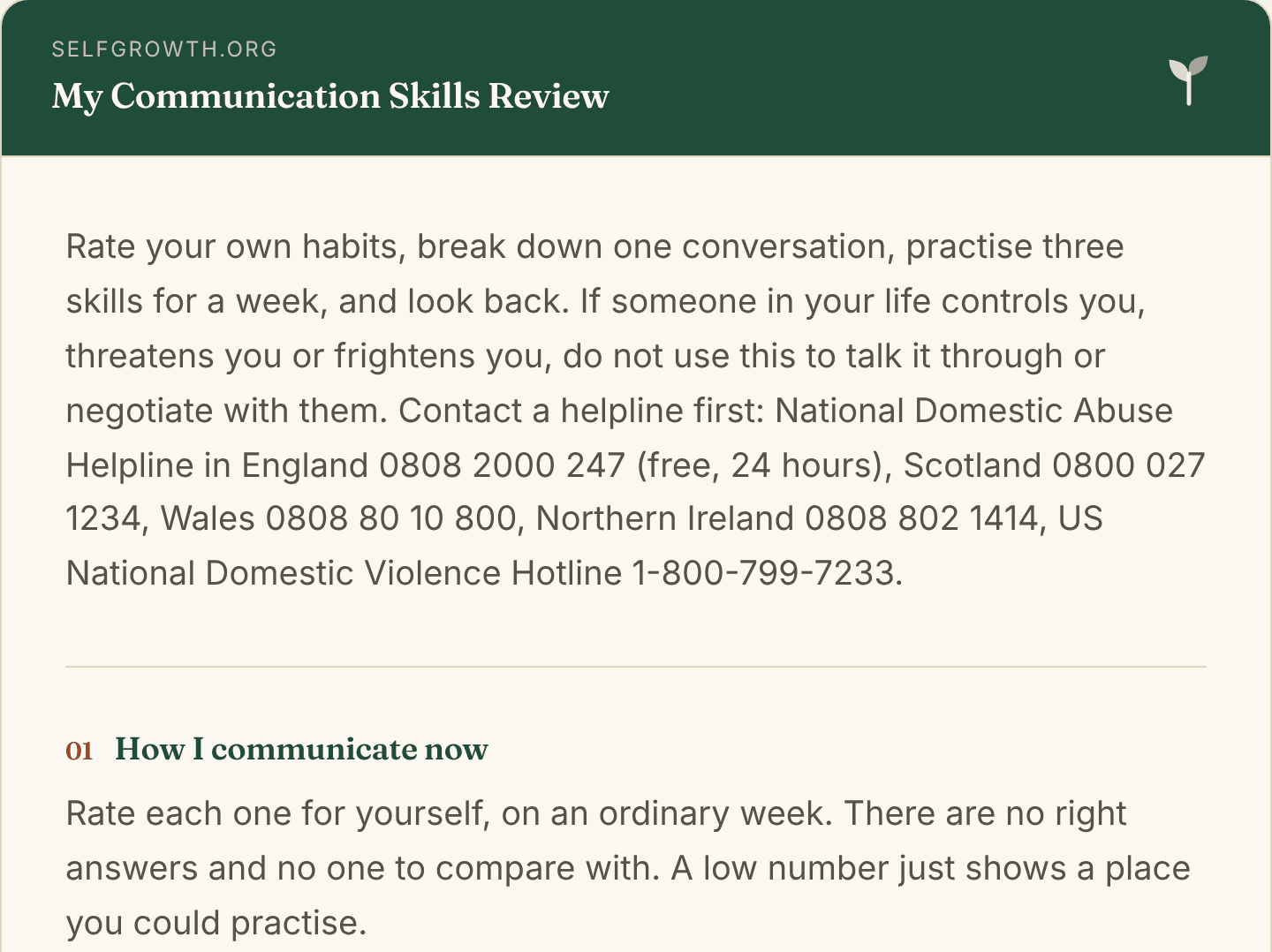
Communication Skills Worksheet
A free communication skills worksheet: rate your own habits, break down one hard conversation, practise three skills for a week, and use a phrase bank.
Open worksheetNew worksheets, straight to your inbox
An occasional new worksheet or tool, sent only when there's something genuinely worth your time. No spam, no pressure, unsubscribe any time.