
Guide
Active listening: what it is and how to practise it
Updated 25 October 2026 · 8 min read
Active listening means giving the other person your full attention and showing you have understood them. You put distractions away, ask open questions, say back what you heard, and notice feelings. You hold off on advice until they have finished. It is a skill you can practise in ordinary conversations.
A practice format linked to Carl Rogers and Richard Farson's work on listening · Part of relationships and communication
It is easy to think you listen well. Then you catch yourself planning a reply, glancing at a phone, or jumping in with a fix before the other person has finished.
Active listening is a set of small habits that help someone feel heard. You can practise them with a friend, a partner, a colleague or a child, and you do not need a special setting.
When you are ready to practise, the free active listening worksheet gives you exercises and space to look back.
What is active listening?
Active listening is listening on purpose. You pay attention to what the other person says, and how they say it, and you let them know you have understood. That is different from waiting for your turn to talk.
The term is linked to the work of the psychologist Carl Rogers and Richard Farson. The habits are ways of trying to understand someone, not a guaranteed fix, and you can see for yourself how the other person responds.
Active listening vs passive listening
Passive listening is hearing while your mind is elsewhere. You nod, you wait, you check your phone, you plan your answer. You can be silent in both kinds of listening. What differs is what your attention is doing.
- Passive: you stay quiet and wait for your turn. Active: you stay quiet and take in what they mean.
- Passive: you say 'Yeah, yeah' and move on. Active: you say back what you heard and check it.
Active listening skills
There is no single official list. These six are a good place to start, and you can begin with one or two.
- Attention: give the person your eyes and ears. Phone down, body turned towards them.
- Open questions: invite more than a yes or no, for example 'How did that go?'
- Reflecting: repeat the gist in your own words and let them put you right.
- Summarising: when there is a lull, gather up the main points and ask if that is right.
- Noticing feelings: offer a guess at what they feel, and be ready to be wrong.
- Pausing: let a short silence sit after they stop, because more may come.
Body language and tone when you listen
People read your face and voice as well as your words. A few small things show you are listening.
- Turn your body and face towards them, and keep your eyes soft rather than fixed.
- Keep your hands still and your phone out of reach.
- Nod now and then, but only when you mean it.
- Let your tone stay calm and warm, even if you disagree with what you hear.
- Leave a short pause before you answer, so they know you are not rushing them.
On a phone or video call, say a small 'mm' or 'I see' now and then, because they cannot always see you nod.
Active listening examples
Here is what a small change can sound like. Each example shows a common reply, then an active listening reply.
- Friend says she is dreading a family event. Instead of 'Just say no', try 'It sounds like you are not looking forward to it. What worries you most?'
- Partner says the week has been a lot. Instead of 'Mine was worse', try 'That sounds tiring. Do you want to tell me about it?'
- Colleague is stuck on a deadline. Instead of 'You should have started sooner', try 'So the main problem is the time. Have I got that right?'
- Child says nobody played with them at school. Instead of 'I am sure they did not mean it', try 'That sounds lonely. What happened?'
A few openers to keep ready, in your own words:
- To reflect: 'The gist seems to be...'
- To ask openly: 'What matters most here?'
- To check feelings: 'I might be wrong, but that sounds heavy.'
- To hold back advice: 'Would it help if I just listened for now?'
A short example conversation
This is an invented example to show the pattern. Sam is not a real person, and real talks will go their own way.
- Sam: 'I am so fed up with this project. Nothing is going right.'
- You: 'That sounds draining. What is going wrong most?'
- Sam: 'My manager keeps changing the plan, and I redo everything.'
- You: 'So the changing plan is the hardest part, more than the work itself. Have I got that right?'
- Sam: 'Yes. I just want to know what is final.'
- You: 'Do you want ideas for how to ask about that, or would you rather talk it through first?'
In the example above, you did not fix it, compare it to your own week, or tell Sam to cheer up.
How to practise active listening: step by step
- 1Choose a low-stakes conversation, not your hardest one.
- 2Put your phone away and turn towards the person.
- 3Let them finish. Count to two in your head before you speak.
- 4Ask one open question about what they said, before you share anything of your own.
- 5Say back what you heard in a sentence, starting with 'It sounds like...'
- 6Ask 'Have I got that right?' and listen to the correction.
- 7Afterwards, write down what you noticed and what you will try next time.
Active listening at work
At work, the same habits fit meetings, one-to-ones and feedback talks. Close your laptop, ask what outcome the person is hoping for, and sum up what was agreed before you part.
If you manage others, try asking 'Do you want my ideas, or do you want me to listen?' before you offer a fix. For the speaking side, see the I-statements worksheet.
Common mistakes
- Fixing too soon. Advice before the person feels heard can feel like being brushed off.
- Waiting to talk. If you are planning your reply, you are not listening yet.
- Fake nodding. Nodding and 'mm-hmm' without taking anything in is easy to spot.
- Saying 'I know exactly how you feel'. You may not, and it moves the talk onto you. Ask instead.
- Finishing their sentences. Let them find their own words.
Listening without judging
You can listen well to a view you do not share. Understanding what someone says is not the same as agreeing.
- Notice the urge to correct, and let it pass for now.
- Ask what they mean before you decide what you think.
If you disagree, you can say so afterwards. Listening well never means putting up with being put down, threatened or controlled. If you are afraid of the other person, you do not have to listen or reply: do not confront them, and see the support section below for a domestic abuse helpline.
When to get more support
Active listening is a self-help skill, not therapy. If low mood or stress makes it hard to listen or connect, talk to your GP. If you are afraid of the other person, do not confront them or try to talk it through on your own. Contact a domestic abuse helpline instead: in England 0808 2000 247 (free, 24 hours), Scotland 0800 027 1234, Wales 0808 80 10 800, Northern Ireland 0808 802 1414, or the US 1-800-799-7233. In danger, call 999 (UK) or 911 (US).
If you ever feel unsafe or have thoughts of harming yourself, call Samaritans on 116 123 (UK and Ireland), 988 (US), or find a line at findahelpline.com.
Sources and further reading
This is an educational self-reflection resource, not therapy or medical advice.
Your questions, answered
- What is active listening in simple terms?
- It is listening so the other person can tell you took in what they said. You focus on them, ask open questions and check you got it right before you offer a view.
- Why does active listening matter?
- It helps the other person feel heard, and it helps you understand what they mean before you reply.
- What is the difference between active and passive listening?
- In passive listening you hear the words while your mind is elsewhere. In active listening your attention stays on the person, and you say back what you heard to check it.
- Can you give an example of active listening?
- Yes. A friend says, 'I am dreading this weekend.' Instead of 'It will be fine', you say, 'Sounds like you are not looking forward to it. What worries you most?'
- How can I stop interrupting people?
- Count to two in your head after they stop speaking. Jot a quick note if you fear forgetting your point. Then ask a question before you add your own view.
- What if I just want to fix the problem?
- That urge is natural. Try asking, 'Do you want ideas, or do you want me to listen?' Then follow their answer.
- Is there an active listening worksheet PDF?
- Yes. Use the Download PDF button or Print on the worksheet page. It is free, with no payment and no email. You can fill it in on screen, and your answers save in your browser.
- Is this a substitute for therapy?
- No. It is a self-help tool, not therapy. If low mood or stress is what is getting in the way, talk to your GP. If you ever feel unsafe or have thoughts of harming yourself, call Samaritans on 116 123 (UK and Ireland), 988 (US), or find a line at findahelpline.com.
Worksheets to do the work
Free to fill in online or print. No email needed.
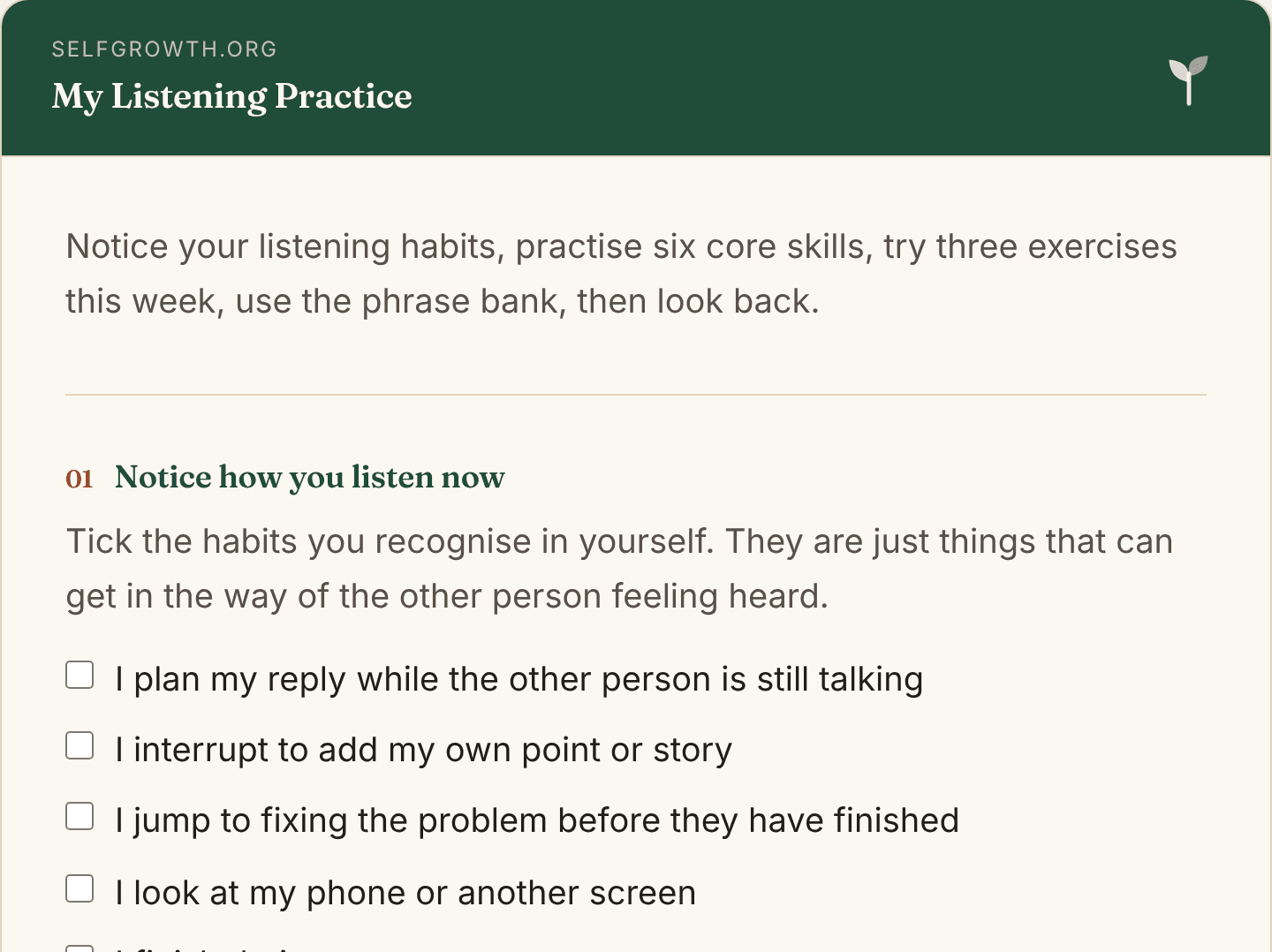
Active Listening Worksheet
A free active listening worksheet with exercises: spot your listening habits, practise six core skills, try three conversations this week and look back at what you noticed.
Open worksheet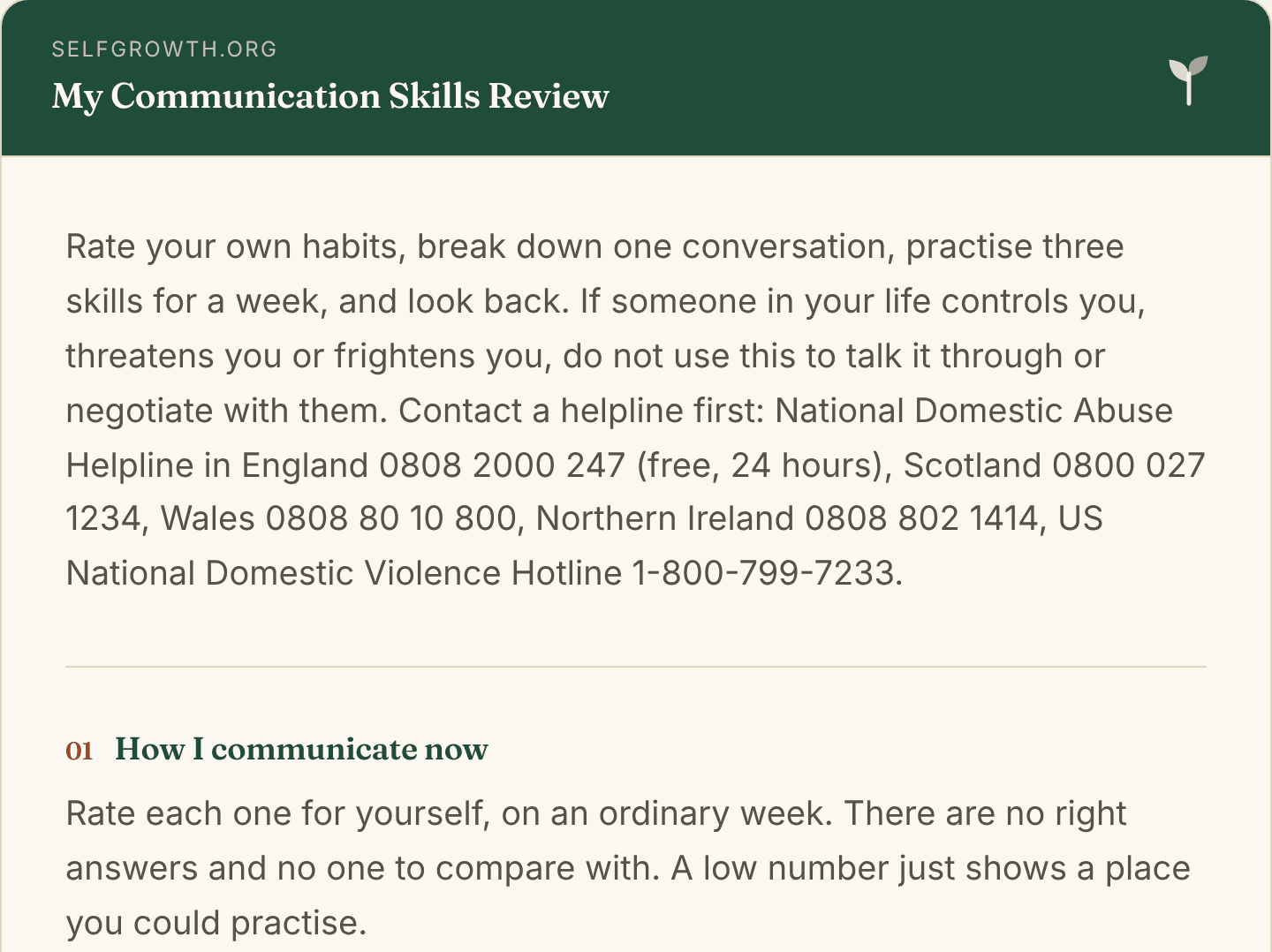
Communication Skills Worksheet
A free communication skills worksheet: rate your own habits, break down one hard conversation, practise three skills for a week, and use a phrase bank.
Open worksheet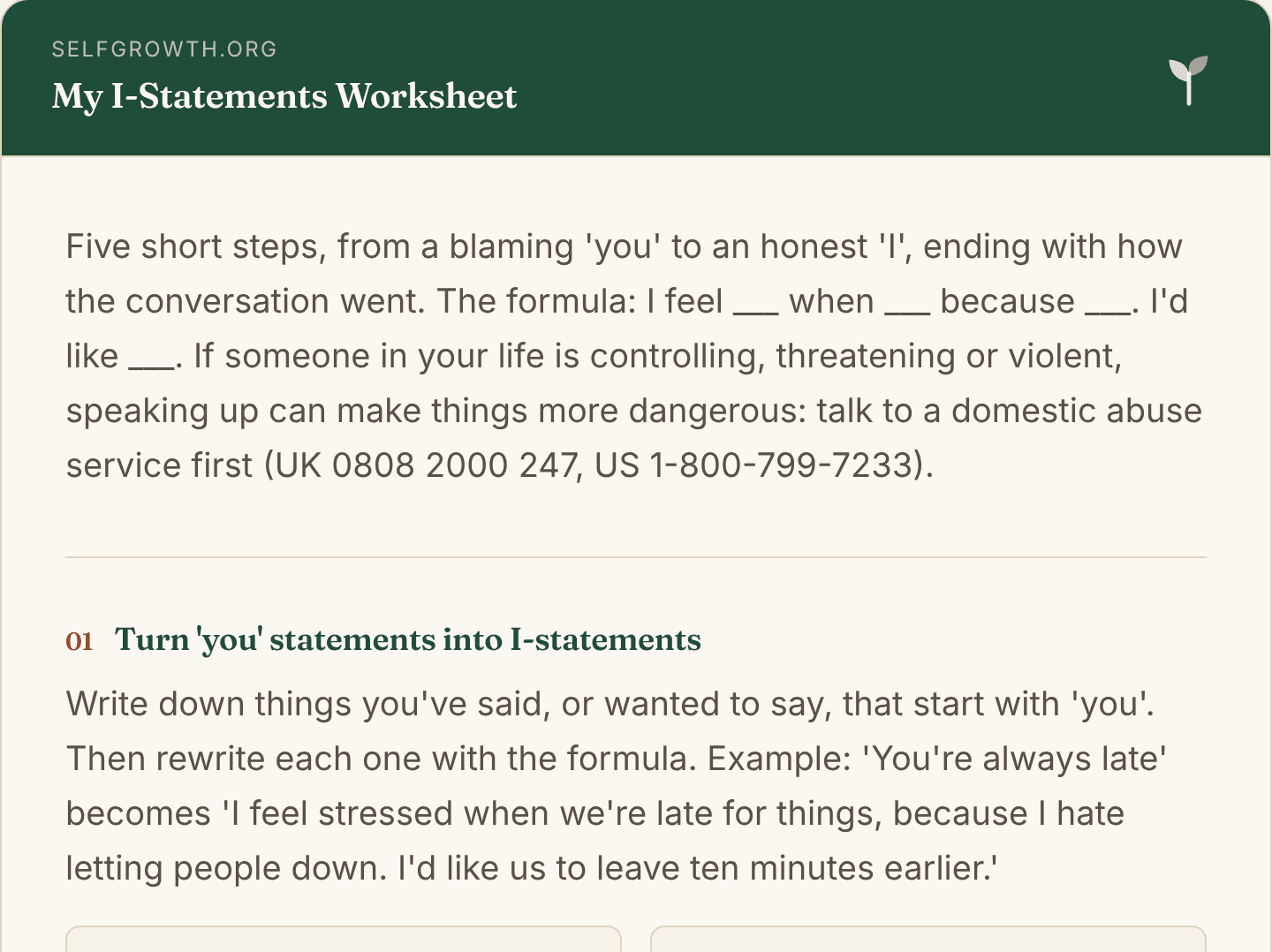
I-Statements Worksheet
A free, printable I-statements worksheet with I statement examples, the 'I feel... when... because...' formula, and space to plan one real conversation.
Open worksheet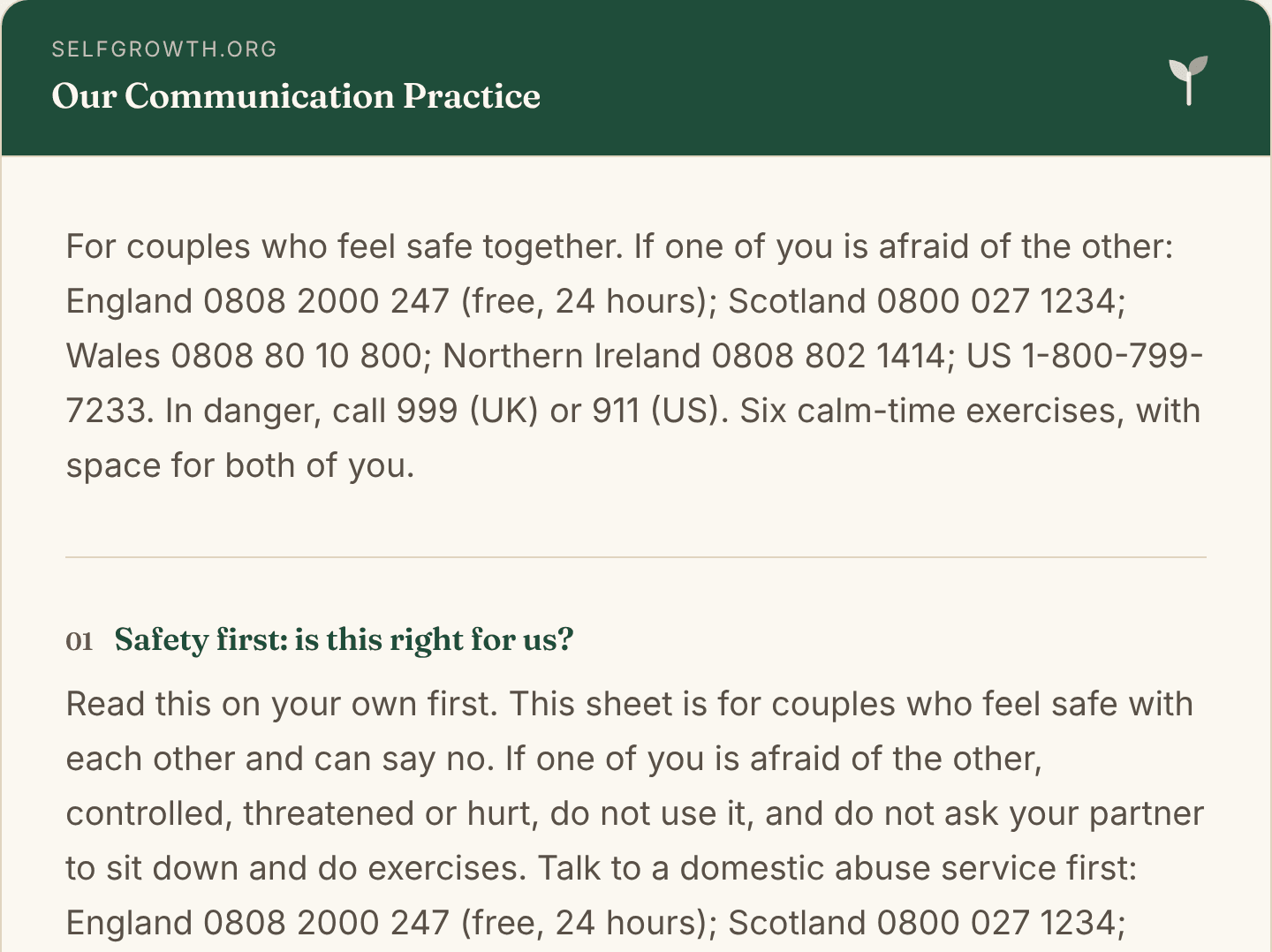
Couples Communication Exercises
Free printable communication exercises for couples: a daily check-in, taking turns to listen, appreciations, one wish, a weekly look and repair phrases.
Open worksheetRelated guides
New worksheets, straight to your inbox
An occasional new worksheet or tool, sent only when there's something genuinely worth your time. No spam, no pressure, unsubscribe any time.