
Communication
Active listening worksheet: free exercises to become a better listener
Updated 25 October 2026 · 7 min read · Free to print
An active listening worksheet helps you practise listening so the other person feels heard. You notice your current habits, practise six small skills, such as asking open questions and saying back what you heard. You try three short exercises in real conversations this week, then look back.
A practice format linked to Carl Rogers's work on listening · Part of relationships and communication
Fill it in here (it saves in this browser, but not in a private window), print it, or download the PDF. Free, no sign-up.
It is easy to think you listen well, then catch yourself planning your reply, reaching for the phone or jumping in with a fix. This sheet helps you notice what you do now, then practise a few small skills in real conversations.
You do not need a special setting. The three exercises fit into ordinary talks with a friend, a partner, a colleague or a relative. The skills pair well with the I-statements worksheet, which covers the speaking side, and the assertive communication guide.
The term 'active listening' is linked to the work of the psychologist Carl Rogers and Richard Farson. This sheet is a practice format, not a tested programme. It is a self-help tool, not therapy.
How to use this worksheet
- 1Fill in section 1 honestly. It is for you, so there is nothing to score.
- 2Read the six skills and pick one or two to practise first. Trying all six at once is too much.
- 3Choose three conversations this week, one for each exercise, and write who they are with before you start.
- 4Fill in what you noticed soon after each one, then do the weekly look back.
The worksheet
selfgrowth.org
My Listening Practice
Notice your listening habits, practise six core skills, try three exercises this week, use the phrase bank, then look back.
01Notice how you listen now
Tick the habits you recognise in yourself. They are just things that can get in the way of the other person feeling heard.
The habit I notice most in myself:
Who I find it hardest to listen to, and why:
How well do I feel I listen right now?
02The six core skills
Each skill is a small action, not a technique to perform. Read the idea, then write one line you could use. Pick one or two to start.
Attention: put the phone away, face the person, and keep your mind on what they are saying. My way to do this:
Open questions: ask things that need more than yes or no, such as 'What was that like?' A question I could ask:
Reflecting back: say in your own words what you heard, then let them correct you. 'So it sounds like...' My version:
Summarising: pull the main points together at a natural pause and check you have it right. My version:
Checking feelings: name the feeling you think you hear, as a guess, not a fact. 'You sound frustrated, is that right?' My version:
Staying quiet: leave a pause after they stop. They may add something more. How I will manage the silence:
03Three practice exercises for this week
Choose a low-stakes conversation for each, not your hardest one. Say what you are doing only if you want to. Fill in the last column soon afterwards.
Entry 1
Entry 1
Entry 1
04Phrases to reflect and summarise
Use these as they are or change them to sound like you. Tick the ones you would be comfortable saying, and add your own.
Phrases in my own words:
- 1.
- 2.
- 3.
05Weekly look back
A few minutes at the end of the week. It is for you, so keep it honest and kind.
A moment when I listened well:
A moment I slipped back into an old habit:
What the other person seemed to want from me:
How well do I feel I listened this week?
The one thing I will practise next week:
When you're done, a moment to reflect
- When someone really listened to you, what did they do?
- What makes it hard for you to stay quiet while someone else talks?
- Is there a person in your life you listen to less than you would like?
- What do you want to be true of how you listen in a year?
- If you did not need to fix anything, what would you do instead?
Done for now?
Save today's answers as a dated entry. You can come back, fill it in again and compare the two side by side.
Where active listening comes from
The term 'active listening' is linked to the work of the psychologist Carl Rogers and Richard Farson.
The six skills on this sheet are common practice ideas: pay attention, ask open questions, reflect back, summarise, check feelings and leave silence. They are described here in plain words.
Treat the exercises as small experiments. After each one, the 'what I noticed' column shows you what you did and how the other person responded. If listening is hard because of low mood or stress, see your GP as well.
These are educational self-reflection tools, not therapy.
If you want to go deeper
- Rogers, C. R. & Farson, R. E. Active Listening (listed on Open Library).
Your questions, answered
- What is active listening?
- It is listening with your full attention and showing the other person you have understood. That can mean asking open questions, saying back what you heard, summarising and checking feelings.
- How can I be a better listener?
- Start by noticing your habits, such as planning your reply or reaching for your phone. Then practise one skill at a time in ordinary conversations. Put the phone away, ask one more question, and say back what you heard before you share your own view.
- What are some active listening exercises?
- This sheet has three. Reflect before you reply, by saying back what you heard before you add your own point. Ask one question more than feels natural. And end a conversation with a short summary and a check that you got it right.
- What are the main active listening skills?
- There is no single official list. This sheet uses six: paying full attention, asking open questions, reflecting back, summarising, checking feelings and allowing silence.
- What should I do if I want to fix the problem?
- It is natural to want to help. Try asking 'Do you want ideas, or do you want me to listen?' If they want to be heard first, reflect back what you heard and leave the advice until they ask or the moment has passed.
- Is there an active listening worksheet PDF?
- Yes. Use the Download PDF button for a clean, print-ready copy, or Print to print straight from the page. It is completely free, with no payment and no email needed. You can also fill it in on screen, and your answers save in your browser.
- Is this a substitute for therapy?
- No. It is a self-help tool, not therapy. If low mood or stress is what is making it hard to listen or connect, talk to your GP. If you ever feel unsafe or have thoughts of harming yourself, call Samaritans on 116 123 (UK and Ireland), 988 (US), or find a line at findahelpline.com.
Keep going, related worksheets
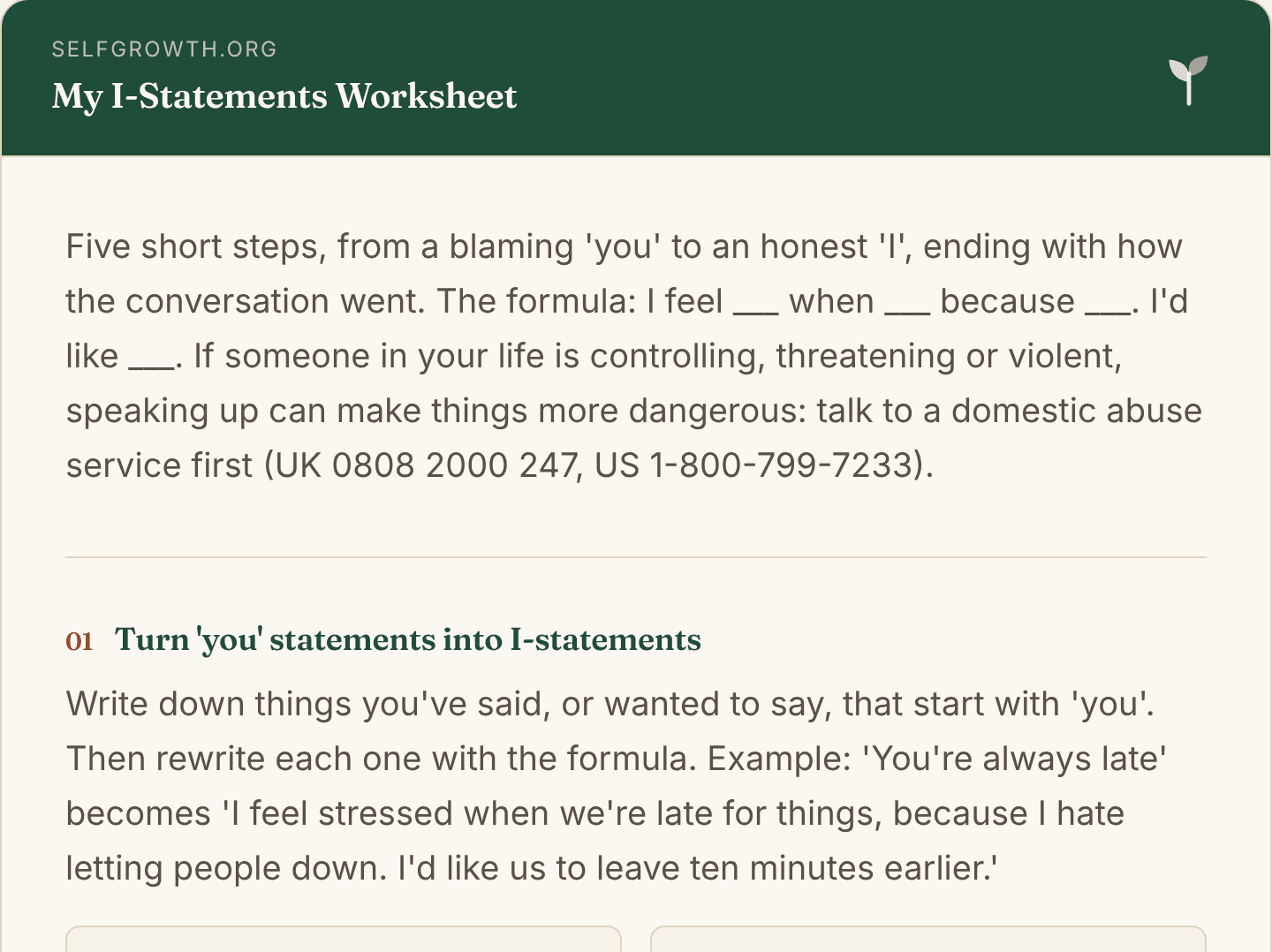
I-Statements Worksheet
A free, printable I-statements worksheet with I statement examples, the 'I feel... when... because...' formula, and space to plan one real conversation.
Open worksheet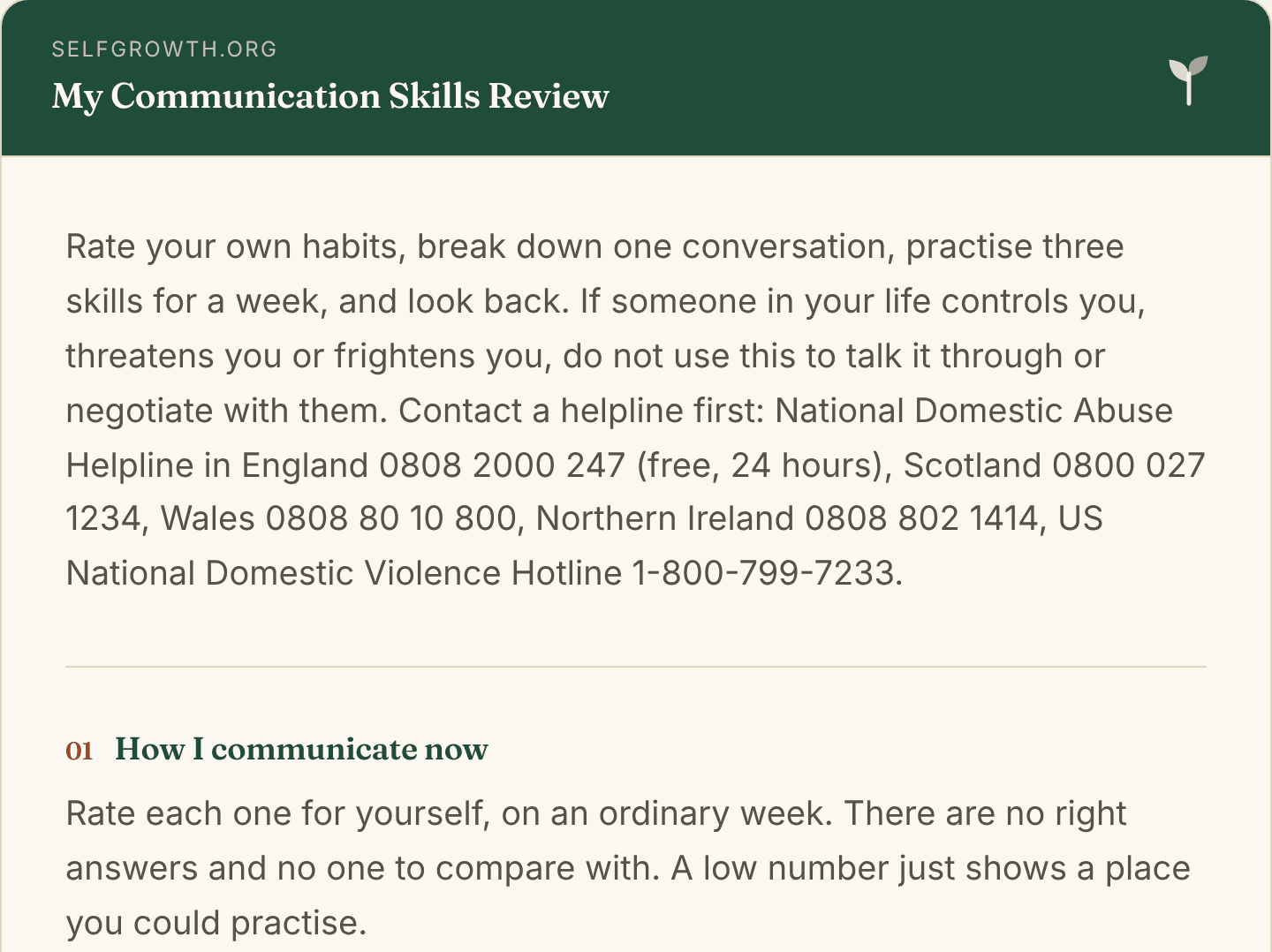
Communication Skills Worksheet
A free communication skills worksheet: rate your own habits, break down one hard conversation, practise three skills for a week, and use a phrase bank.
Open worksheet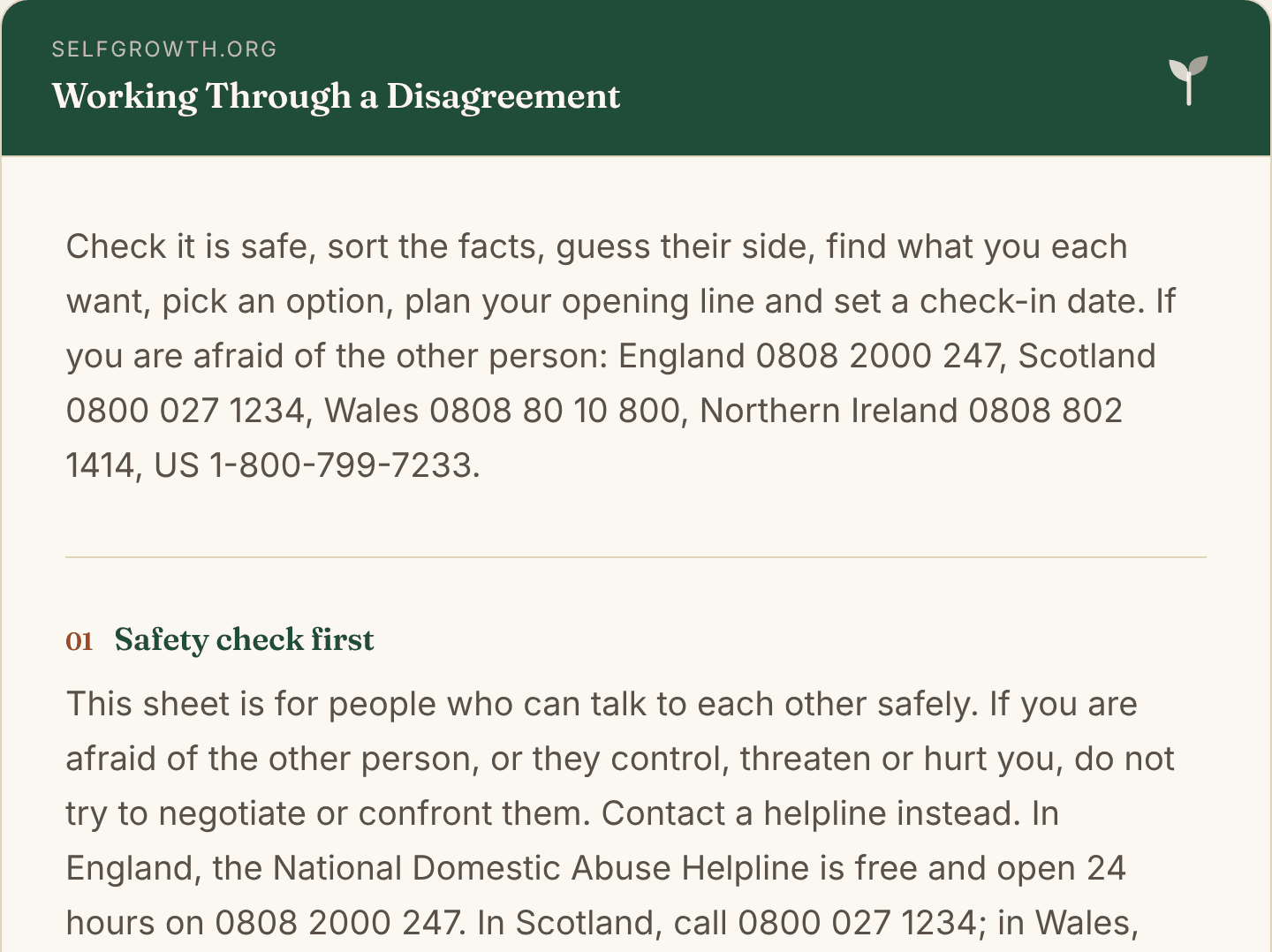
Conflict Resolution Worksheet
A free conflict resolution worksheet for a friend, family member, colleague or housemate: sort the facts, see their side, find what you both want and plan the talk.
Open worksheetNew worksheets, straight to your inbox
An occasional new worksheet or tool, sent only when there's something genuinely worth your time. No spam, no pressure, unsubscribe any time.