
Guide
Difficult conversations: how to have one, step by step
Updated 25 October 2026 · 10 min read
To have a difficult conversation, pick a calm time and place, work out what you want from it, and open with a short, kind first line. Say what you have seen and how it affects you, then listen to their side. Agree a next step, and pause if it gets too heated.
Drawn from everyday communication practice · Part of relationships and communication
Some talks sit in your stomach for days. Telling a friend they hurt you. Raising a worry with a parent. Saying to a partner that something has to change. Giving someone news they will not want. Putting it off feels easier, until the worry gets bigger than the talk would ever have been.
There is no trick that makes a hard talk easy. There is a way to get ready, a way to start, and a way to cope if it wobbles. It is self-help, not therapy, and it is for talks with someone who is safe to talk to.
What makes a conversation difficult?
A conversation is hard when something real is at stake and you cannot be sure how it will land. A few things tend to make it harder:
- You care about the person, and you do not want to hurt them or lose them.
- You are not sure how they will react.
- Strong feelings are in the mix: hurt, anger, fear, guilt or shame.
- You and they may remember what happened differently.
- There is a gap in power, such as a boss, a parent or an older relative.
- It touches something you each care about, like money, time, loyalty or how you want to be seen.
Feeling dread beforehand does not mean you are bad at this. It tells you the talk matters to you. The aim is not to feel calm. It is to say what you mean, in a way the other person can hear.
How to prepare for a difficult conversation
Ten minutes with a pen can help you get ready. Write short answers to these:
- What you want: the one thing you hope is different after this talk. A request, an apology, a decision, or simply to be heard.
- What you know and what you guess: what you saw or heard yourself, against what you are assuming about their reasons. Keep the facts for the talk. Hold the guesses lightly, or turn them into questions.
- Their likely view: how the same events might look from where they stand. You do not have to agree with it to picture it.
- Timing and place: somewhere private, with enough time, when neither of you is tired, hungry or rushing out. A serious talk is better face to face or on a call. A message can work to ask for a time to talk.
- Your opening line: write the first one or two sentences and say them out loud once. The start sets the tone.
The conflict resolution worksheet walks through these on paper, including the safety check.
Open the Conflict Resolution WorksheetHow to have a difficult conversation: step by step
Go at your own pace. If you only manage the first three steps today, that is a real start.
- 1Ask for a good time. 'Can we talk about something this weekend? It matters to me.' This gives them notice and avoids an ambush.
- 2Start with your purpose and your care. 'I want to talk about this because I value us.' A kind start makes it easier for them to stay and listen.
- 3Say what you have seen, in plain facts. 'The last three times we planned something, you cancelled on the day.' Leave out labels such as lazy, selfish or rude.
- 4Say how it affects you and what you would like. 'I feel let down, and I would like us to agree a plan we can both keep.' One feeling and one clear request is enough.
- 5Stop and listen. Ask 'How does it look to you?' and let them finish. Say back what you heard before you answer: 'So you have been stretched at work. Have I got that right?'
- 6Stay on the one issue. If old arguments creep in, say 'I would like to come back to that another time. Can we stay with this one?'
- 7Look for a next step you can both do. Make it small and specific: who does what, and by when.
- 8Close kindly and say when you will check in. 'Thanks for hearing me out. Shall we see how it is going in two weeks?'
A good talk does not have to end with you agreeing. Being heard, and hearing them, can be the result for now. The I-statements worksheet helps you turn steps 3 and 4 into your own words.
Open the I-Statements WorksheetWhat to say: opening lines and phrases
Change the words until they sound like you. Short is better than clever.
- Asking for a time: 'There is something I would like to talk through with you. When would suit?'
- With a friend: 'I have missed you, and I have felt a bit hurt about the last few weeks. Can I tell you how it looks from my side?'
- With a partner: 'I want us to be good, so I would like to talk about how we split the housework. Is now okay, or later?'
- With a parent or relative: 'I love you, and I am worried about how you have been lately. Can I tell you what I have noticed?'
- Giving bad news: 'I have some news that is hard to say. I am going to tell you straight, and then we can talk about it.'
- Raising a worry about someone: 'I have noticed you seem to be struggling, and I wanted to ask how you are.'
- When it gets tense: 'I want to get this right. Can we slow down for a moment?'
- When you do not know what to say: 'I need a minute to think about that.'
- To check you heard right: 'What I am hearing is that ___. Is that fair?'
- To close: 'I do not think we will sort it all today. Can we pick it up on ___?'
Notice what is left out: no 'you always', no 'you never', and no guessing at their motives. Those lines invite a fight. A plain 'I' and a clear ask invite a talk.
If it goes badly
Sometimes the talk goes wrong. They get angry, go silent, cry, leave the room, or you say something you did not mean. That does not mean you should not have tried.
- Pause. 'I think we are both upset. Can we stop for twenty minutes and come back to this?' Say when you will come back, so a pause is not read as walking away.
- Breathe out slowly and let your body settle before you speak again.
- If you said something unfair, say so: 'That came out harsher than I meant. I am sorry. What I meant was ___.' The guide to apologising has more.
- Come back to it later, in a calmer moment, or in writing if speaking is too hard.
- It is allowed to end it. If the talk has turned into shouting, insults or threats, you can say 'I am going to stop here' and leave. You do not have to finish a conversation that has stopped being safe or fair.
Afterwards, write down one thing that went as you wanted and one thing you would change. Then be kind to yourself. A hard talk that did not go well is still practice for the next one.
Difficult conversations at work
Work talks have extra layers: a boss's power over you, a team that has to keep working together, and sometimes rules about how a complaint must be handled. The same steps apply. Ask for a private time, stick to facts about the work, say the effect it has on you, and ask for one clear change.
- With a colleague: start with the task, not the person. 'When the files arrive after 5pm I cannot finish them. Could we agree a cut-off of 3pm?'
- With your manager: ask for a short meeting and bring one or two examples and one proposal. 'My workload has grown. Can we look at what to drop or move?'
- If you are the manager: be clear, specific and kind. Say what you have seen, what needs to change, and what support you will offer. Write down what was agreed.
If you keep ending up taking on too much, the guide to work boundaries can help you decide what to say. If the problem is bullying, harassment or discrimination, do not try to sort it out alone in one conversation. Keep a note of what happened and when, and take it to HR, a manager above the person, or a union rep.
When not to have the conversation
Everything above assumes the other person is safe to disagree with. If you are afraid of them, or they control you, threaten you or hurt you, do not confront them and do not try to talk it through on your own. Staying quiet or choosing your moment can be the sensible thing to do. Your safety comes first.
In England, the National Domestic Abuse Helpline is free and open 24 hours on 0808 2000 247. In Scotland, call 0800 027 1234; in Wales, 0808 80 10 800; in Northern Ireland, 0808 802 1414. In the US, the National Domestic Violence Hotline is on 1-800-799-7233. If you are in immediate danger, call 999 in the UK or 911 in the US.
A talk is also best left for another day if either of you is drunk or very angry, if there are other people listening, or if you want to talk only to win. Waiting a day is allowed.
When to get more support
Some conversations are too big to plan on your own. If a hard talk is wearing you down, if dread of one is affecting your sleep or mood, or if you keep having the same row with no way through, you deserve real support. A GP is a good first step. A counsellor can help you practise what to say, and a mediator can help families or neighbours talk things through.
If you are struggling to cope or have thoughts of harming yourself, contact a crisis line now: Samaritans on 116 123 (UK and Ireland), 988 (US), or find a line in your country at findahelpline.com.
Sources and further reading
This is an educational self-reflection resource, not therapy or medical advice.
If you want to go deeper
- Stone, D., Patton, B. & Heen, S. Difficult Conversations: How to Discuss What Matters Most.
- National Domestic Abuse Helpline (nationaldahelpline.org.uk); National Domestic Violence Hotline (thehotline.org).
Your questions, answered
- How do you start a difficult conversation?
- Ask for a good time, then open with why you are raising it and that you care about the person. For example: 'I want to talk about something because our friendship matters to me.' Keep the first line short and calm, and leave out blame.
- How do I prepare for a difficult conversation?
- Write down what you want from it, what you know against what you are guessing, how it might look from their side, a good time and place, and your first sentence. Say the first sentence out loud once. A few minutes of this can make the talk feel less daunting.
- What do you say in a difficult conversation?
- Say what you have seen in plain facts, how it affects you, and what you would like. Then ask for their view and listen. 'I felt hurt when the plans changed. Could we agree a plan we can both keep? How does it look to you?'
- What if the other person gets angry or shuts down?
- Slow down and name it gently: 'I can see this is hard. Shall we take a break and come back to it?' Agree a time to return. If they shout, insult or threaten you, you can end the talk. If you feel afraid of them, do not go back to it on your own.
- How do I have a difficult conversation with a family member?
- Pick a private, unhurried moment and start with care: 'I love you, and I want to talk about something.' Stick to one issue, use 'I' statements, and listen to their side. Family patterns run deep, so one talk may not settle it. A follow-up date can help.
- Is there a difficult conversations worksheet PDF?
- Yes. The conflict resolution worksheet and the I-statements worksheet are free to use. Use the Download PDF button or Print, with no payment and no email needed. You can also fill them in on screen, and your answers save in your browser.
- Is this a substitute for therapy?
- No. This is a self-help tool, not therapy. If dread of a conversation, or the relationship itself, is affecting your mood, sleep or health, talk to your GP. If someone frightens or controls you, call a domestic abuse helpline instead (England 0808 2000 247, Scotland 0800 027 1234, Wales 0808 80 10 800, Northern Ireland 0808 802 1414, US 1-800-799-7233). If you ever feel unsafe or have thoughts of harming yourself, call Samaritans on 116 123 (UK and Ireland), 988 (US), or find a line at findahelpline.com.
Worksheets to do the work
Free to fill in online or print. No email needed.
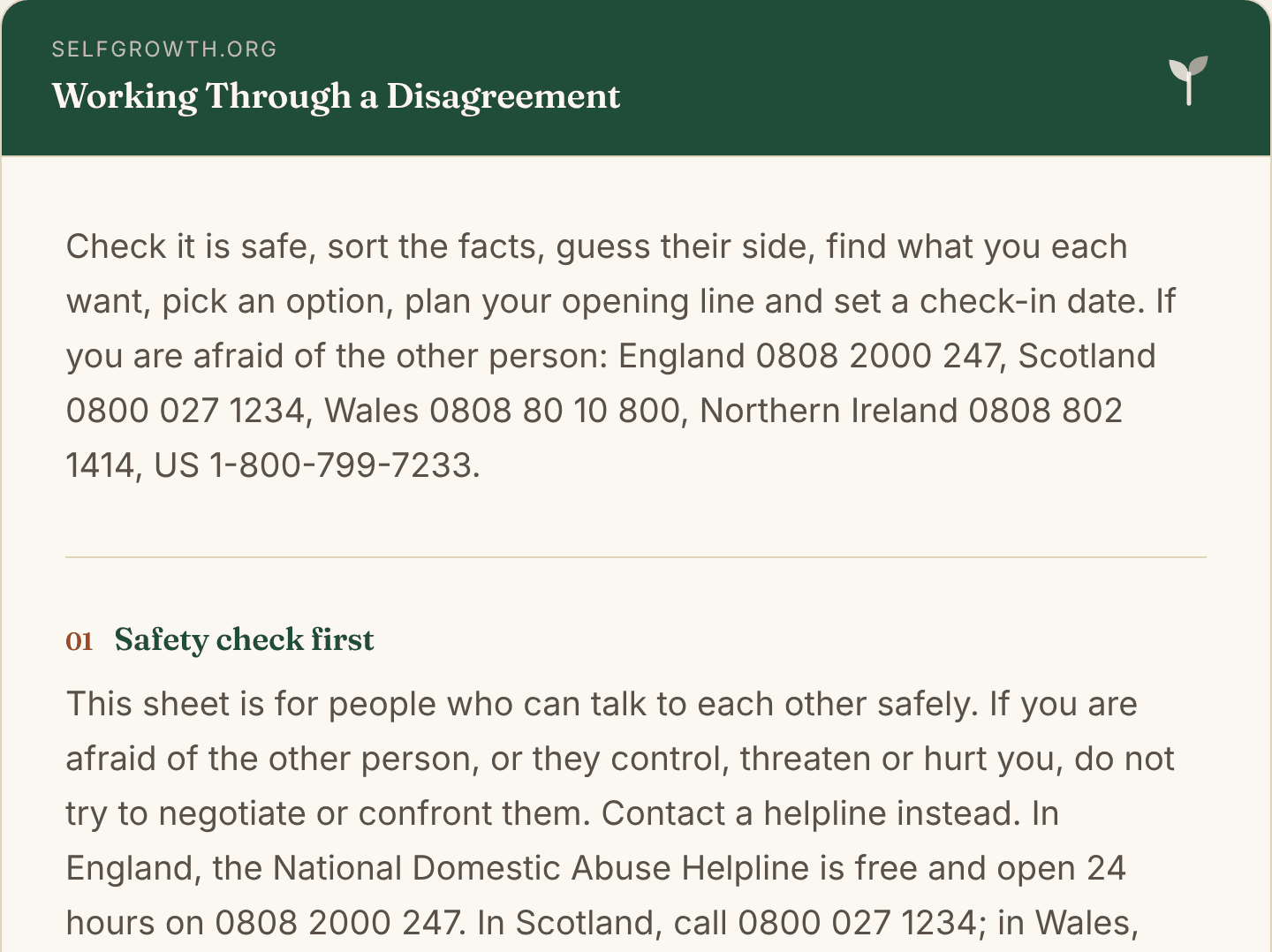
Conflict Resolution Worksheet
A free conflict resolution worksheet for a friend, family member, colleague or housemate: sort the facts, see their side, find what you both want and plan the talk.
Open worksheet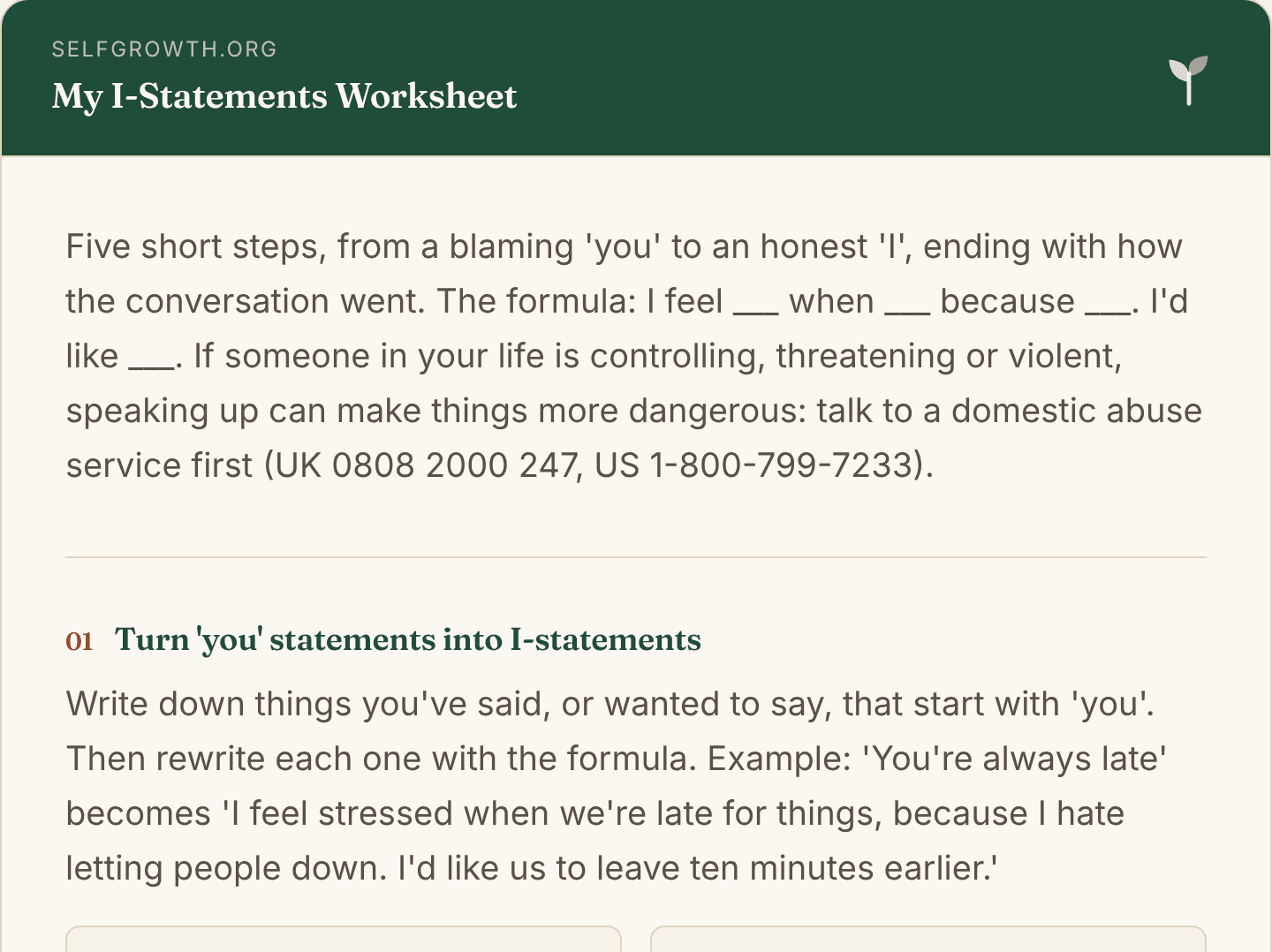
I-Statements Worksheet
A free, printable I-statements worksheet with I statement examples, the 'I feel... when... because...' formula, and space to plan one real conversation.
Open worksheet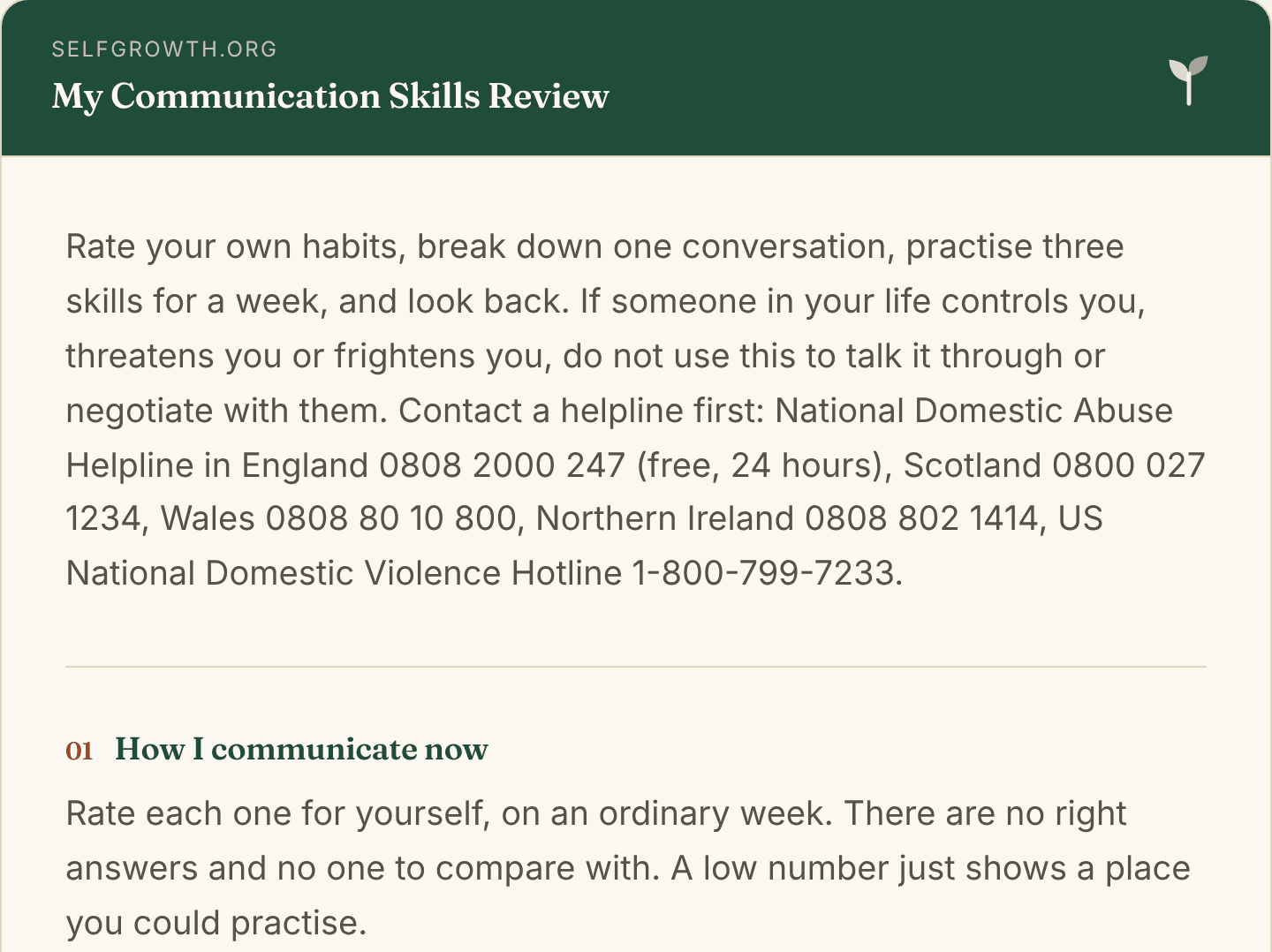
Communication Skills Worksheet
A free communication skills worksheet: rate your own habits, break down one hard conversation, practise three skills for a week, and use a phrase bank.
Open worksheet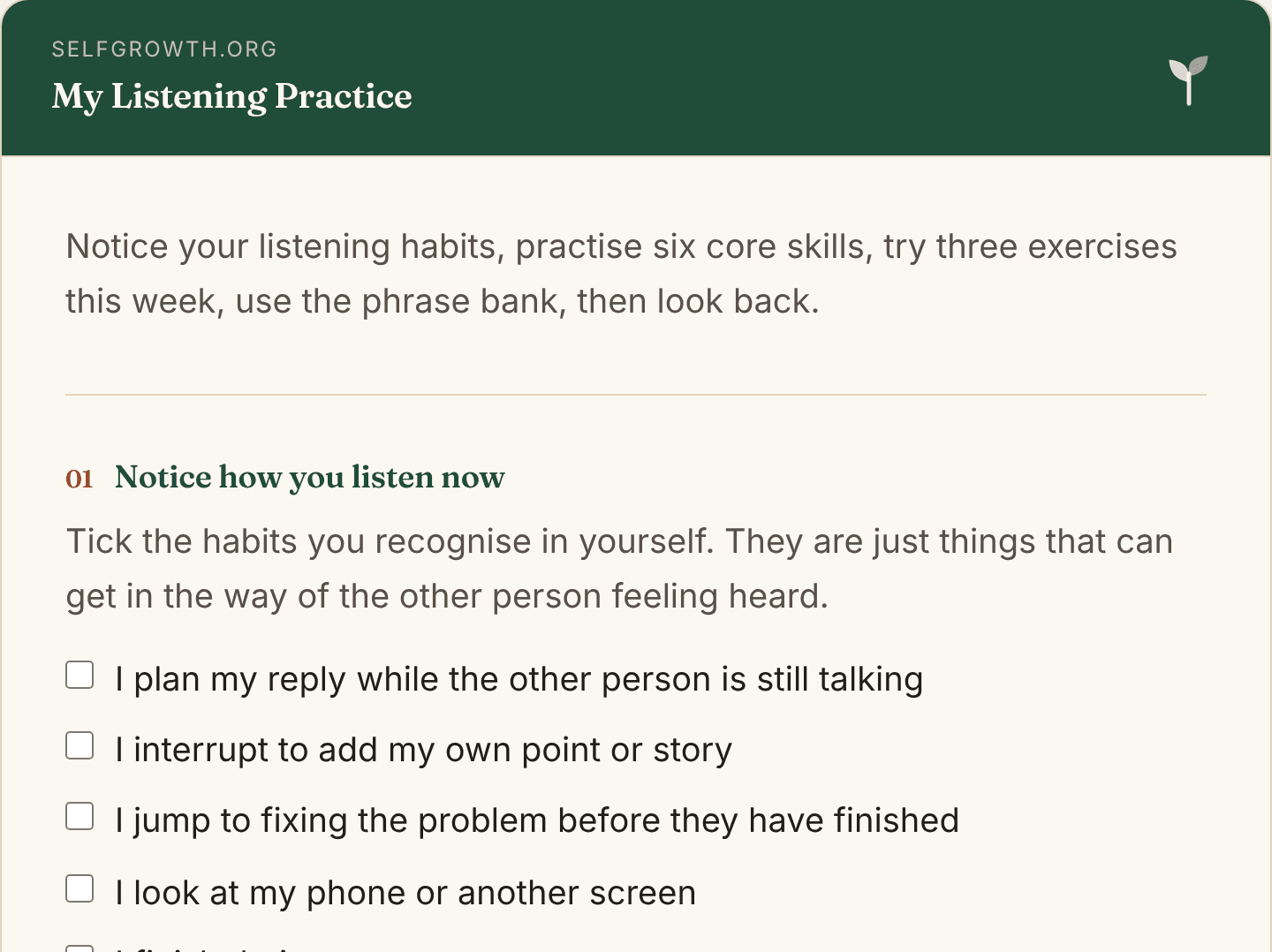
Active Listening Worksheet
A free active listening worksheet with exercises: spot your listening habits, practise six core skills, try three conversations this week and look back at what you noticed.
Open worksheetRelated guides
New worksheets, straight to your inbox
An occasional new worksheet or tool, sent only when there's something genuinely worth your time. No spam, no pressure, unsubscribe any time.