
Guide
Attachment styles: what the research does and doesn't show
Updated 17 October 2026 · 12 min read
Attachment theory says the bonds formed with caregivers shape how closeness feels. Mary Ainsworth's infant research described secure, avoidant and resistant (sometimes called ambivalent) patterns, and Hazan and Shaver applied them to adult love in 1987. Hazan and Shaver's adult styles came from questionnaires, later research favours dimensions over types, and styles can change. This explainer has no quiz.
By the Self Growth team · drawn from published attachment research, with no quiz or score · how we make these
Search for attachment styles and you'll find quizzes that sort you into a box: secure, anxious, avoidant. This page doesn't have one. It explains where the idea came from, what the research found, and, just as important, what it didn't find.
The short version is that attachment is a real research field, and the labels you see online are a simplified version of it. This is an explainer, not a test, not advice about your relationships, and not therapy.
What is attachment theory?
Attachment theory began with John Bowlby, who a recent review by 47 attachment researchers calls the originator of the theory. He looked at attachment through ethology, the study of animal and human behaviour in natural settings: the child who seeks care and protection when distressed, and who explores the world from a base of safety.
Two phrases from that tradition are worth knowing. A 'safe haven' is somewhere to go for comfort when you're distressed. A 'secure base' is a person you can set out from, and come back to. The same review, which is about young children and their caregivers, describes attachment as 'a component of a relationship, not an individual's trait'. In that work it means what happens between a child and a caregiver, not a fixed piece of the child's personality. Research on adults, covered below, measures people on scales, so the two pictures are not identical.
Bowlby's term 'inner working models' (mental models of yourself and other people, built from early experience) is the idea that Hazan and Shaver later used to link childhood to adult romantic love. We come to them below.
What did Mary Ainsworth find?
Mary Ainsworth, a colleague of Bowlby, is best known for the Strange Situation (as a 1997 interview with her puts it), a way of watching how infants behave with a caregiver. In the procedure, a child is observed in an unfamiliar room, with two brief separations from the caregiver and a stranger present. What the researchers look at most closely is what the child does when the caregiver comes back.
- Secure: the child gets comfort when distressed, then goes back to play.
- Avoidant: the child avoids the caregiver on reunion and focuses on exploring. These children can seem unaffected by the separation, yet, according to the 47-author review, behavioural and physiological measures indicate distress.
- Resistant (sometimes called ambivalent): the child's attention stays on the caregiver, even when exploring might be expected.
- Disorganized: the child may show mostly the same behaviours as the others, but with moments that don't fit any of the three, such as seeming fearful or freezing.
These are patterns of a child with one caregiver, observed in a lab. The review authors stress that the classifications are useful for studying group trends, and are 'not (currently) validated or intended to be used clinically at the individual level'. A 2023 meta-analysis of 97 samples of preschool and early-childhood children (8,186 children) found a spread across the four categories, and noted that 89% of the samples were from North America or Europe. So even the infant and child research describes a particular slice of the world.
What did Hazan and Shaver add in 1987?
In 1987, Cindy Hazan and Phillip Shaver published a paper asking whether romantic love might be an attachment process, a bond between adult lovers like the bond between infants and parents. They took the three infant patterns, secure, avoidant and anxious/ambivalent, and wrote them as descriptions of how an adult might experience love. Their abstract reports two questionnaire studies in which the three kinds of adult described their romantic love in different ways, and in which the styles were related to people's mental models of themselves and others and to the way they described their relationships with their parents.
Two things about that paper are worth keeping in mind. First, it's based on questionnaires: people described themselves, and no one watched them the way the Strange Situation watches infants. Second, the abstract itself ends by pointing to 'measurement problems' for future tests. Later research looked at how best to measure attachment, as the next sections show.
Are attachment styles fixed types, or a scale?
Hazan and Shaver's approach treated styles as categories. Later work found something different. In an overview of adult attachment research, the researcher Chris Fraley describes how Brennan, Clark and Shaver (1998) found two underlying dimensions: attachment-related anxiety and attachment-related avoidance. A secure adult, on that view, scores low on both. Fraley writes that most researchers now measure attachment dimensionally (as of 2018), and that attachment styles 'are things that vary in degree rather than kind'. That overview is a researcher's own summary, not a peer-reviewed paper.
A 2015 study by Fraley and colleagues tested this directly with a statistical method for telling categories from dimensions. In two samples, they found that individual differences looked more like a dimensional model than a categorical one, for general attachment and for attachment in specific relationships such as with parents and peers.
In plain terms, 'anxious' or 'avoidant' describes where someone sits on a scale. Researchers also study attachment in specific relationships, such as with parents or peers, as well as in general. It isn't a box you belong to. That's one reason the quiz format is a poor fit for what the research shows.
Can your attachment style change?
Research suggests attachment is not fixed, with caveats. A 2013 meta-analysis of 127 papers (21,072 attachments) looked at attachment to mothers and fathers from infancy to early adulthood, not at adult romantic styles. It found a moderate link (r = .39, where 0 is no link and 1 a perfect one) between attachment security at one time and another, no significant stability across intervals longer than 15 years, and higher stability over short intervals.
The 47-author review, which is about children, adds that childhood attachments are 'by no means fixed', and that classifications can change through new experiences, relationships or therapeutic interventions.
So the research doesn't back the idea that your early years have sealed your relationships, and it doesn't back the idea that change is quick or easy. It also doesn't tell us whether reading a guide or filling in a worksheet changes anything, and we know of no study that does.
Where do adult attachment styles come from?
A 2019 review by Chris Fraley and Glenn Roisman, of longitudinal research (studies that follow the same people over time) on where adult attachment styles come from, adds three points. Adult attachment appears to have origins in early caregiving, but those links are 'weak and inconsistent across measurement domains'. In plain words, the connection between early care and adult styles looked small, and it didn't show up the same way on every kind of measure. Styles appear more malleable in childhood and adolescence than in adulthood. And early experiences do not determine adult outcomes.
Does an 'insecure' attachment style mean something is wrong?
For children, not necessarily. The 47-author review, which is about young children, says insecure classifications can represent adaptive strategies to cope with a specific context, and do not necessarily predict negative outcomes. It says research supports only small-to-moderate associations between a child's attachment classification and later developmental outcomes. It also notes that insecure or disorganized attachment is not a formal diagnosis. That review does not tell us how this applies to adults.
The link to how people feel is not simple either. A 2021 paper pulling together four large meta-analyses calls the evidence on insecure attachment and internalising symptoms (such as low mood and anxiety) 'divergent'. In children, elevated symptoms were found with deactivating (avoidant) patterns but not hyperactivating (resistant) ones. In adolescents and adults it was the other way round: elevated symptoms with hyperactivating (preoccupied) classifications but not deactivating (dismissing) ones. The authors suggest the age group studied explains at least part of the difference, and put forward a theory they say still needs testing. These findings are about research groups, not about you, and they don't show that an attachment style causes anything.
Why is there no attachment style quiz on this page?
You may have come here for a quiz. Here is why one wouldn't tell you much.
- A quiz would sort you into a category, but researchers' own tests suggest attachment is better described as a scale.
- A quiz measures what you say about yourself, on one day. Researchers measure attachment in general and in specific relationships, and the research above suggests it can change.
- The 47-author review warns that overemphasising classifications 'leads to trait and typological thinking' and can lead to 'stigmatizing labels, leading to self-fulfilling prophecies'. The authors are writing about children's classifications in clinical practice. Applying the caution to a web quiz is our judgement, but we think it travels.
- We can't check how any particular online quiz was built.
If you've taken a quiz and the result rings true, that's fine. Treat it as a prompt to notice something, not a diagnosis or a fixed fact about who you are.
How to use the idea without a label
You can use the idea of attachment as a way of noticing, with no score at all. These are questions to think about for a few minutes, for one relationship at a time. They aren't a test, and there are no right answers. If any answer makes you feel afraid of this person, stop. That is not about your attachment style: see 'When to get more support' below.
- 1When I feel close to this person, what do I want from them? What do I do?
- 2When I feel distant from them, what do I do? What do I hope they will do?
- 3What helps me feel safe with them? What makes me feel unsafe?
- 4Is it different with other people in my life? What does that tell me?
- 5What is one thing I'd like to be able to say to them, and what would help me say it?
If you'd like to put something into words to a partner or friend, the I-statements worksheet can help. The guide to setting boundaries and the assertive communication guide cover how to ask for what you need. If putting others first has become a habit, the people-pleasing worksheet is there. And the guide to practising self-compassion is for the harsh voice that can follow a rocky patch in a relationship. These are not for use with someone who frightens or controls you.
Open the I-Statements WorksheetWhen to get more support
This guide is an explainer, not therapy, and it doesn't diagnose anything or treat anxiety, depression or any other condition. It's worth talking to your GP or another qualified professional if a relationship is affecting your sleep, work or health, if feeling low or anxious is getting in the way of your life, or you're worried about how long it has lasted. In England you can refer yourself to NHS Talking Therapies for anxiety and depression support without seeing a GP first (you need to be registered with a GP and aged 18 or over, or 16 or over in some areas). Relate lists relationship counselling and individual counselling on its website. Our helplines and therapist directory lists routes in other countries too.
If a partner or family member controls what you do, who you see or your money, or you feel afraid of them or find yourself 'walking on eggshells', that is not about your attachment style, and it is not your fault. In the UK, the National Domestic Abuse Helpline is free and confidential on 0808 2000 247, 24 hours a day (it supports women), and the Men's Advice Line is on 0808 801 0327, Monday to Friday, 10am to 5pm. In the US, call the National Domestic Violence Hotline on 1-800-799-7233, or text START to 88788. If someone might be monitoring your devices, use a safe device. In an emergency, call 999 (UK) or 911 (US). The helplines page lists more.
If you ever have thoughts of harming yourself, please reach out straight away: in the UK and Ireland, call Samaritans on 116 123; in the US, call or text 988; elsewhere, findahelpline.com lists free, confidential lines. You deserve real support, not just a page to read.
How we put this together
How we put this together: from the abstracts of the research papers named below, one open-access review and one researcher's overview, all read on the day we wrote the page. We have not read Bowlby's or Ainsworth's own books, and there is no quiz or score on this page by design. We know of no study of whether this guide changes anything. It's an educational self-reflection resource, not therapy or medical advice, see our editorial standards.
If you want to go deeper
- Opie, J. E., Waters, E., Duschinsky, R., et al. (2026). Practitioner review: clinical insights from attachment theory and research for professionals working with young children and their families. Journal of Child Psychology and Psychiatry, 723-739.
- Rudnytsky, P. L. (1997). The personal origins of attachment theory: an interview with Mary Salter Ainsworth. Psychoanalytic Study of the Child, 52, 386-405.
- Hazan, C. & Shaver, P. (1987). Romantic love conceptualized as an attachment process. Journal of Personality and Social Psychology, 511-524.
- Fraley, R. C., Hudson, N. W., Heffernan, M. E. & Segal, N. (2015). Are adult attachment styles categorical or dimensional? A taxometric analysis of general and relationship-specific attachment orientations. Journal of Personality and Social Psychology, 354-368.
- Fraley, R. C. (2018). Adult attachment theory and research: a brief overview. Web essay, University of Illinois (labs.psychology.illinois.edu, Fraley lab pages).
- Pinquart, M., Feussner, C. & Ahnert, L. (2013). Meta-analytic evidence for stability in attachments from infancy to early adulthood. Attachment & Human Development, 189-218.
- Fraley, R. C. & Roisman, G. I. (2019). The development of adult attachment styles: four lessons. Current Opinion in Psychology, 26-30.
- Dagan, O., Groh, A. M., Madigan, S. & Bernard, K. (2021). A lifespan development theory of insecure attachment and internalizing symptoms. Brain Sciences, 1226.
- Deneault, A.-A., Bureau, J.-F., Duschinsky, R., Fearon, P. & Madigan, S. (2023). A meta-analysis of the distribution of preschool and early childhood attachment as assessed in the Strange Situation Procedure and its modified versions. Attachment & Human Development, 322-351.
- NHS. NHS Talking Therapies, last reviewed 5 November 2025. nhs.uk. Relate, relate.org.uk. National Domestic Abuse Helpline (nationaldahelpline.org.uk); Men's Advice Line (mensadviceline.org.uk); National Domestic Violence Hotline (thehotline.org).
Your questions, answered
- What are the attachment styles?
- It depends on the model. Mary Ainsworth's infant research described secure, avoidant and resistant (ambivalent) patterns, and a fourth, disorganized, pattern is now also used for children. In 1987, Hazan and Shaver described three adult romantic styles: secure, avoidant and anxious/ambivalent. Later research found two dimensions, anxiety and avoidance, fit better than types.
- How many attachment styles are there?
- There's no single number. Children's attachment has been classified into three or four patterns, and Hazan and Shaver used three for adults. Fraley writes that most researchers now (as of 2018) measure two dimensions, attachment anxiety and attachment avoidance, rather than sorting people into boxes. A 2015 study found adult differences looked dimensional rather than categorical.
- What is my attachment style?
- We can't tell you, and this page has no quiz on purpose. Research suggests attachment is better described as a scale than a type, that it can differ between relationships, and that it can change. If a quiz result felt true, treat it as something to notice rather than a fixed label.
- Can attachment styles change?
- Research suggests they can, though less easily in adulthood than in childhood. A 2013 meta-analysis of attachment to parents, from infancy to early adulthood, found a moderate link between attachment security at different times, and no significant stability over intervals longer than 15 years. A 2019 review concluded that early experiences do not determine adult outcomes. Change is not promised to be quick or easy, and we know of no study showing that a guide changes it.
- Is an insecure attachment style a mental illness?
- No. A recent review by 47 attachment researchers says insecure or disorganized attachment is not a formal diagnosis, and that insecure patterns can be adaptive strategies in a particular context. That review is about children's classifications. If your relationships are affecting your health, talk to your GP.
- Where does attachment theory come from?
- John Bowlby developed attachment theory, taking a view from ethology. Mary Ainsworth developed the Strange Situation to observe infants with caregivers. In 1987, Cindy Hazan and Phillip Shaver proposed that romantic love is an attachment process. We read the abstracts of the later papers and a 2026 review, but have not read Bowlby's own books.
- Is this guide free, and is it therapy?
- It's free, with no payment and no email needed. It's an explainer, not therapy, and it can't diagnose anything. If you're struggling, speak to your GP. If a partner controls you or you're afraid of them, contact a domestic abuse helpline from a safe device. If you ever have thoughts of harming yourself, contact a crisis line straight away.
Worksheets to do the work
Free to fill in online or print. No email needed.
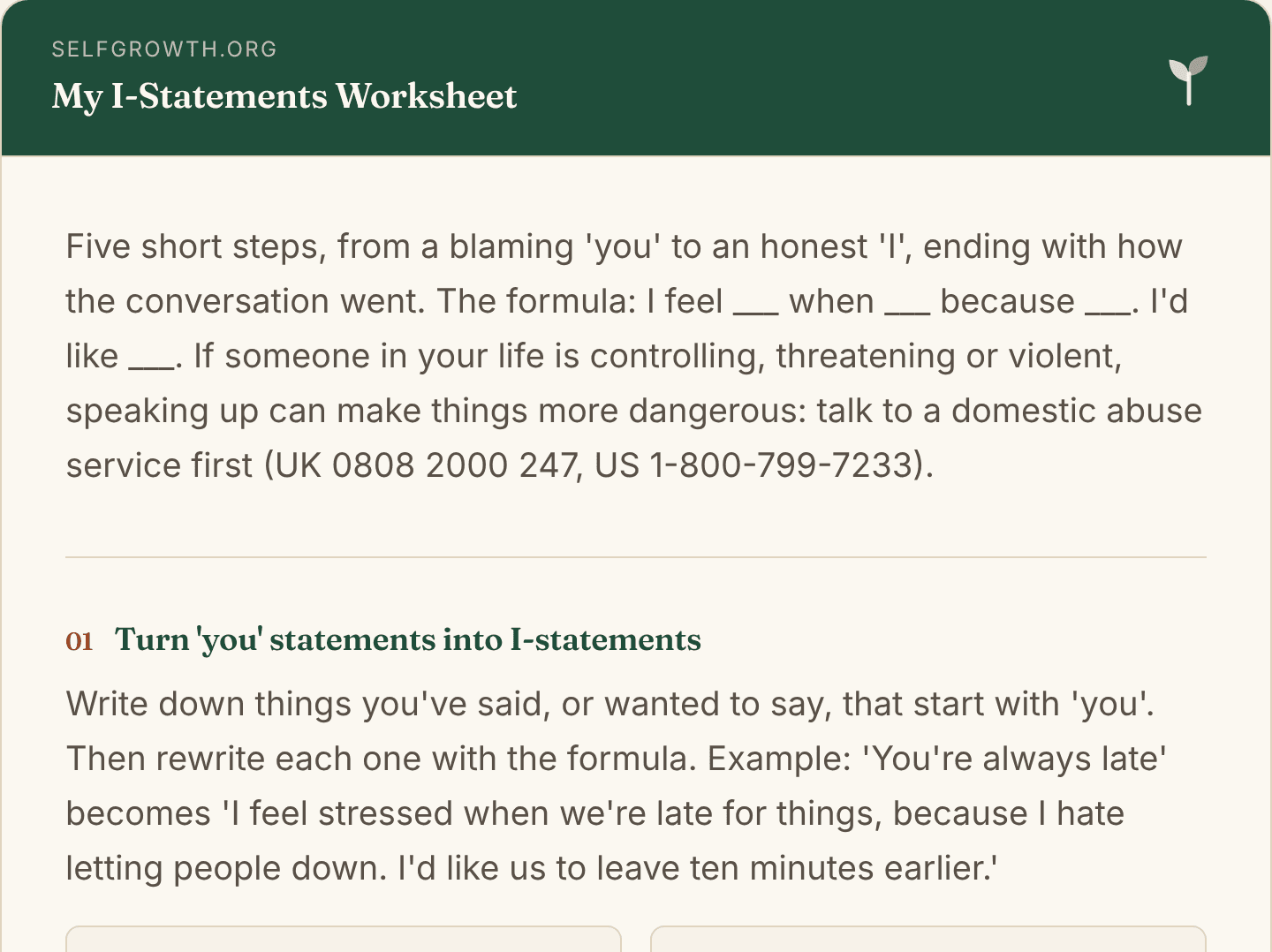
I-Statements Worksheet
A free, printable I-statements worksheet with I statement examples, the 'I feel... when... because...' formula, and space to plan one real conversation.
Open worksheet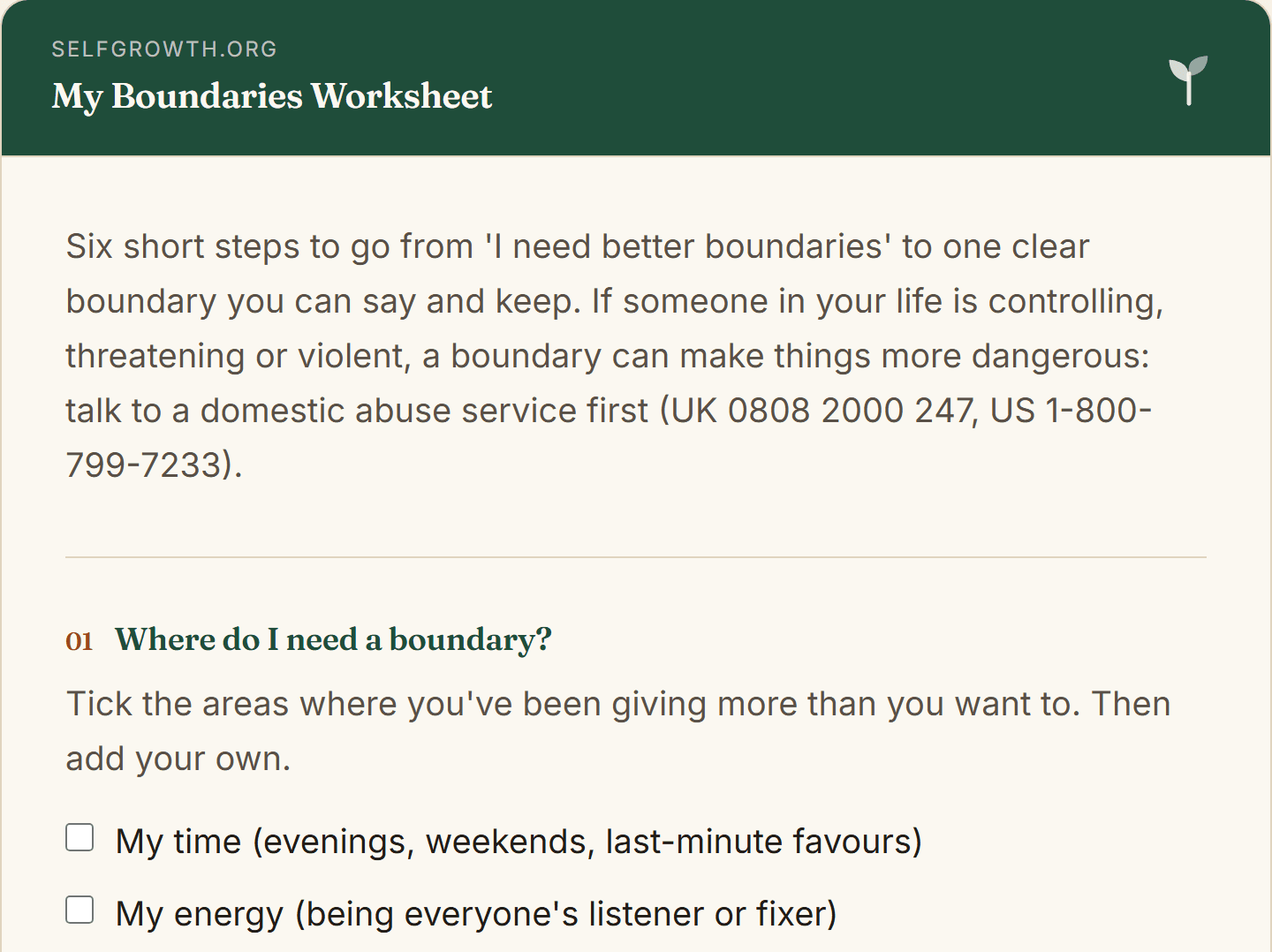
Boundaries Worksheet
A free, printable boundaries worksheet: spot where you need a limit, write it as something you'll do, plan the exact words, and decide what you'll do if it's crossed.
Open worksheet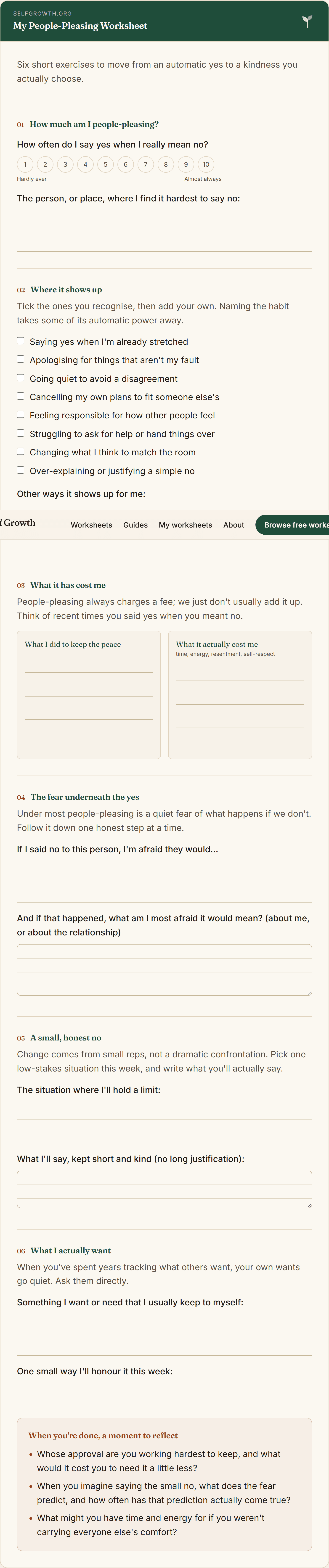
People-Pleasing Worksheet
A free, printable people-pleasing worksheet: see where you over-give, name the fear underneath, count the real cost, and practise one small, honest no.
Open worksheet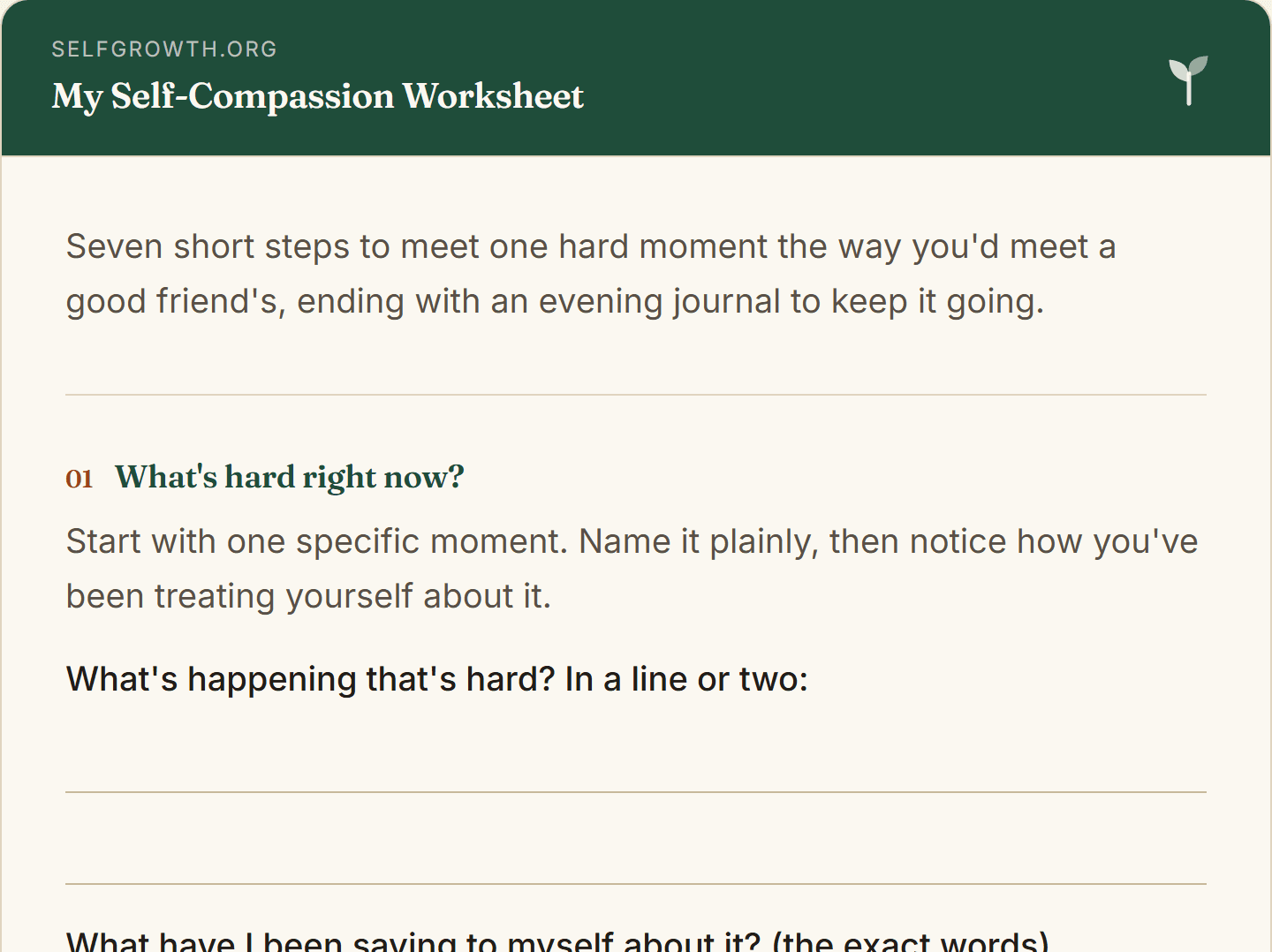
Self-Compassion Worksheet
A free, printable self-compassion worksheet: the self-compassion break, the friend test, a kind letter and journal prompts, based on Kristin Neff's research.
Open worksheetRelated guides
New worksheets, straight to your inbox
An occasional new worksheet or tool, sent only when there's something genuinely worth your time. No spam, no pressure, unsubscribe any time.