
Guide
Signs of codependency: what they look like and what helps
Updated 23 October 2026 · 8 min read
Signs of codependency include people-pleasing, feeling responsible for other people's feelings, struggling to say no, losing track of your own needs and a strong fear of being left. Codependency is a popular term, not a clinical diagnosis, and definitions differ. If someone controls, threatens or hurts you, that is abuse, not a pattern to work on.
Drawn from cognitive behavioural therapy & self-compassion research · Part of relationships and communication
Maybe someone called you codependent. Maybe you read a list online and recognised yourself in a line or two. Either way, you may be wondering what the word actually means, and whether it applies to you.
Below are the signs one at a time, what the word can and cannot tell you, and small things to try. It is a self-help guide, not therapy, and it cannot tell you whether you 'have' anything.
What does codependency mean?
Codependency is a word for a pattern in how you relate to other people: giving so much attention to someone else's needs, moods or problems that your own fade out of view. It is used about partners, parents, friends and grown-up children.
It is a popular term, not a clinical diagnosis, and people define it differently. The word began in substance abuse treatment, in descriptions of the partners of people who drink heavily. It then spread widely as a general description of an unhelpful way of relating to others. A 2001 paper by Stafford in Issues in Mental Health Nursing questions how well the idea is defined.
So the word is better used as a handle for noticing a pattern than as a label to carry around. Recognising yourself in the signs below does not mean something is wrong with you.
What are the signs of codependency?
These are plain-language signs people use when they talk about this pattern. You might see yourself in some, none or all of them, and they can show up in one relationship and not in others.
- People-pleasing: you say yes to keep the peace, and agree before you know what you think.
- Over-responsibility for other people's feelings: if someone is upset or struggling, you feel it is yours to fix, or that you caused it.
- Difficulty saying no: a refusal feels rude, selfish or risky, so you over-explain or give in.
- Losing track of your own needs: when asked what you want, you are not sure, or you answer with what the other person wants.
- Fear of being left: you work hard to be needed, and worry that if you stop, the relationship ends.
- Your mood follows theirs: your day goes well or badly depending on how they are.
The first signs overlap with people-pleasing. If the automatic yes is the biggest part for you, the guide to stopping people-pleasing goes into that in detail.
What causes codependency?
Codependency has no single cause. Nothing here blames you or your parents. Some ideas people find useful to think about:
- Early lessons about being useful. If being helpful or easy was how you stayed close to a parent, a friend or any other relationship, you may have carried that into later ones.
- Living with someone else's crisis. When a person close to you has an illness, an addiction or a volatile mood, keeping them steady may become a full-time job.
- Worry about being left. How you tend to bond with people may shape how threatening a disagreement feels. The attachment styles guide explores this.
- Not much practice at noticing your own wants. If nobody asked, the skill may simply be new.
These are possibilities to be curious about, not findings about you. If you want to think about how your sense of worth fits in, the self-worth worksheets are a place to start.
What helps if you recognise these signs?
If you recognise these signs, small, repeated steps may be easier to keep going than a big decision. None of these is a cure, and none needs the other person to change first.
- 1Pause before you answer. 'Let me think about it and get back to you' gives you time to find out what you want.
- 2Write your own needs list. Put down what you need this week for sleep, food, time alone, money and people you enjoy. Start with just two or three.
- 3Only if it feels safe. If you are afraid of the person, skip to the section on abuse and control.
- 4Try one small boundary. Choose a low-risk situation, such as ending a call at a set time, and see how it goes.
- 5Notice whose problem it is. Before you step in, ask whether the person has asked for help, and whether they could handle it themselves.
- 6Keep one thing that is only yours: a walk, a class, a friend who has nothing to do with this relationship.
- 7Talk to someone outside the situation, such as a friend you trust, a GP or a counsellor.
The codependency worksheet lets you look at one relationship on paper. The boundaries worksheet and the types of boundaries worksheet help you plan what to say, and the people-pleasing worksheet covers the automatic yes. The guide to setting boundaries explains the steps in more detail.
Open the Codependency WorksheetSome people also find support groups useful. Co-Dependents Anonymous (CoDA) is a fellowship of men and women, and on its website says its only requirement for membership is a desire for healthy and loving relationships. It is a peer group, not therapy, and it is not for everyone. You can look at coda.org to see whether it suits you.
If someone close to you drinks heavily, Al-Anon Family Groups is for people affected by someone else's drinking. In the UK, its helpline is 0800 0086 811 (free, 7 days a week); in the US, see al-anon.org.
When is it not codependency? Abuse and control
If someone controls what you do, who you see or how you spend money, threatens you, or hurts you, that is not a pattern for you to work on. It is abuse, and it is not your fault. Boundary exercises and 'working on yourself' are not the answer, and trying to set a boundary could make you less safe.
If you are afraid of the other person, there is hitting or threats, you are controlled, or you are stopped from leaving, please talk to a domestic abuse service first. In England, the National Domestic Abuse Helpline is free and open 24 hours on 0808 2000 247. In Scotland, call 0800 027 1234; in Wales, 0808 80 10 800; in Northern Ireland, 0808 802 1414. US: National Domestic Violence Hotline 1-800-799-7233. In immediate danger, call 999 (UK) or 911 (US) or your local emergency number. The helplines page at selfgrowth.org/help lists more. If someone might see your device, use a safe one.
When to get more support
Consider talking to a GP or a counsellor if the pattern is wearing you down, your low mood or anxiety is not easing, or you feel stuck. You do not need to wait until it is bad enough. Seeing a professional can help you make sense of it with someone who knows your situation, which a guide cannot do.
If you are thinking about harming yourself or ending your life, that is serious: call Samaritans on 116 123 (UK and Ireland), call or text 988 (US), or find a line at findahelpline.com. More routes: selfgrowth.org/help. If you have chest pain, trouble breathing or fainting, call 999 (UK) or 911 (US) or your local emergency number; use NHS 111 if you are unsure.
Sources and further reading
This is an educational self-reflection resource, not therapy or medical advice.
If you want to go deeper
- Stafford, L. (2001). Is codependency a meaningful concept? Issues in Mental Health Nursing, 22(3), 273-286.
- Co-Dependents Anonymous. coda.org
- Al-Anon Family Groups UK & Eire. al-anonuk.org.uk; Al-Anon Family Groups (US). al-anon.org
- National Domestic Abuse Helpline (nationaldahelpline.org.uk); National Domestic Violence Hotline (thehotline.org).
Your questions, answered
- What are the signs of codependency?
- Common descriptions include people-pleasing, feeling responsible for other people's feelings, finding it hard to say no, losing track of your own needs and fearing being left. Codependency is a popular term, not a clinical diagnosis, so these are signs of a pattern to notice, not a test.
- Is codependency a mental illness?
- Codependency is a popular term, not a clinical diagnosis, and definitions of the word differ. A 2001 paper in Issues in Mental Health Nursing reviews the competing definitions and questions how meaningful the concept is. Treat it as a way of describing a pattern, not as an illness you have.
- What causes codependency?
- There is no single agreed cause. Early lessons about being useful, living with someone else's crisis, worry about being left and little practice at noticing your own wants are ideas people explore. They are possibilities, not findings about you, and you do not have to blame anyone.
- How do I stop being codependent?
- Small steps may help: pause before answering, write down your own needs, try one low-risk boundary and keep something that is only yours. A GP or counsellor can help you go further. There is no quick fix, and you do not need the other person to change first.
- What is the difference between codependency and people-pleasing?
- People-pleasing is the habit of saying yes and smoothing things over to avoid upsetting others. Codependency is used for a wider pattern in a relationship, including feeling responsible for someone's feelings and losing track of your own needs. They overlap, and neither word is a diagnosis.
- Is a codependent relationship the same as an abusive one?
- No. If a person controls, threatens or hurts you, that is abuse and not a pattern for you to fix. Contact a domestic abuse service: England 0808 2000 247, Scotland 0800 027 1234, Wales 0808 80 10 800, Northern Ireland 0808 802 1414, US 1-800-799-7233. In immediate danger, call 999 (UK) or 911 (US) or your local emergency number.
- Is this therapy, and is it a substitute for it?
- No. It is a free self-help guide, not therapy or medical advice, and it cannot diagnose you. For personal support, speak to a GP or counsellor. If you are thinking about harming yourself or ending your life, that is serious: call Samaritans on 116 123 (UK and Ireland), call or text 988 (US), or find a line at findahelpline.com. More routes: selfgrowth.org/help. For chest pain, trouble breathing or fainting, call 999 (UK) or 911 (US) or your local emergency number; use NHS 111 if you are unsure.
Worksheets to do the work
Free to fill in online or print. No email needed.
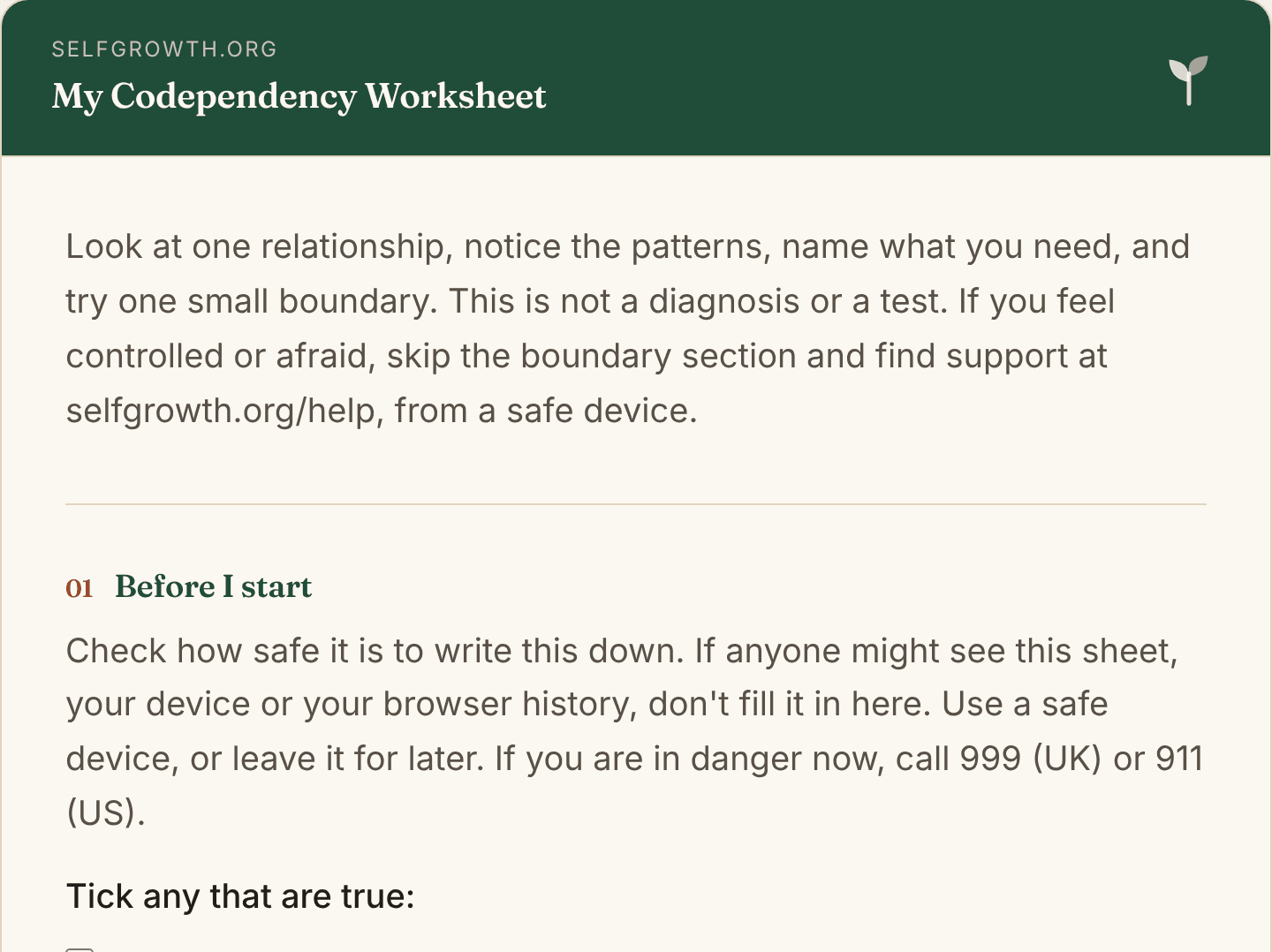
Codependency Worksheet
A free codependency worksheet: look at patterns in one relationship, name your own needs and try one small boundary. Not a diagnosis. Free printable PDF.
Open worksheet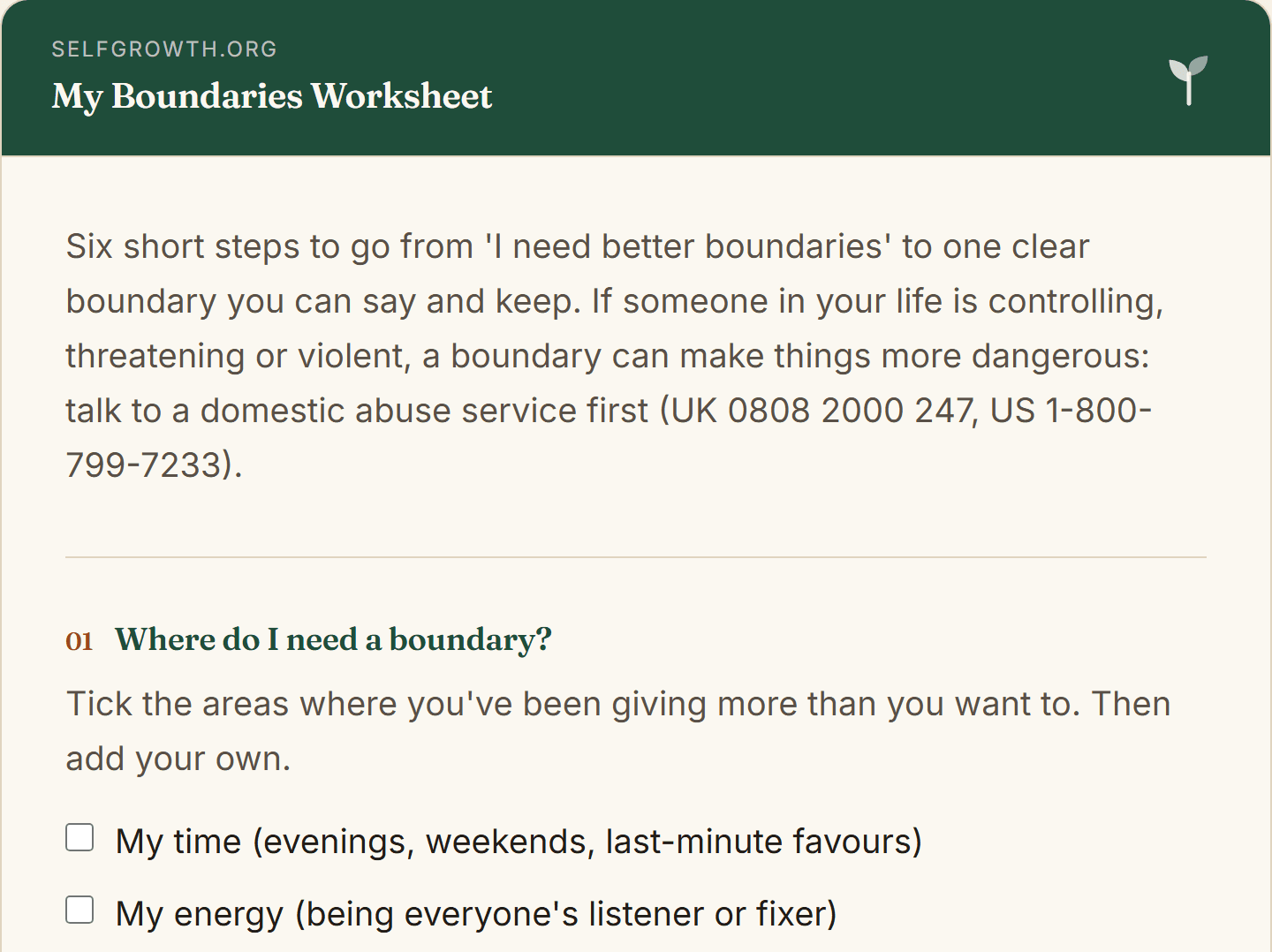
Boundaries Worksheet
A free, printable boundaries worksheet: spot where you need a limit, write it as something you'll do, plan the exact words, and decide what you'll do if it's crossed.
Open worksheet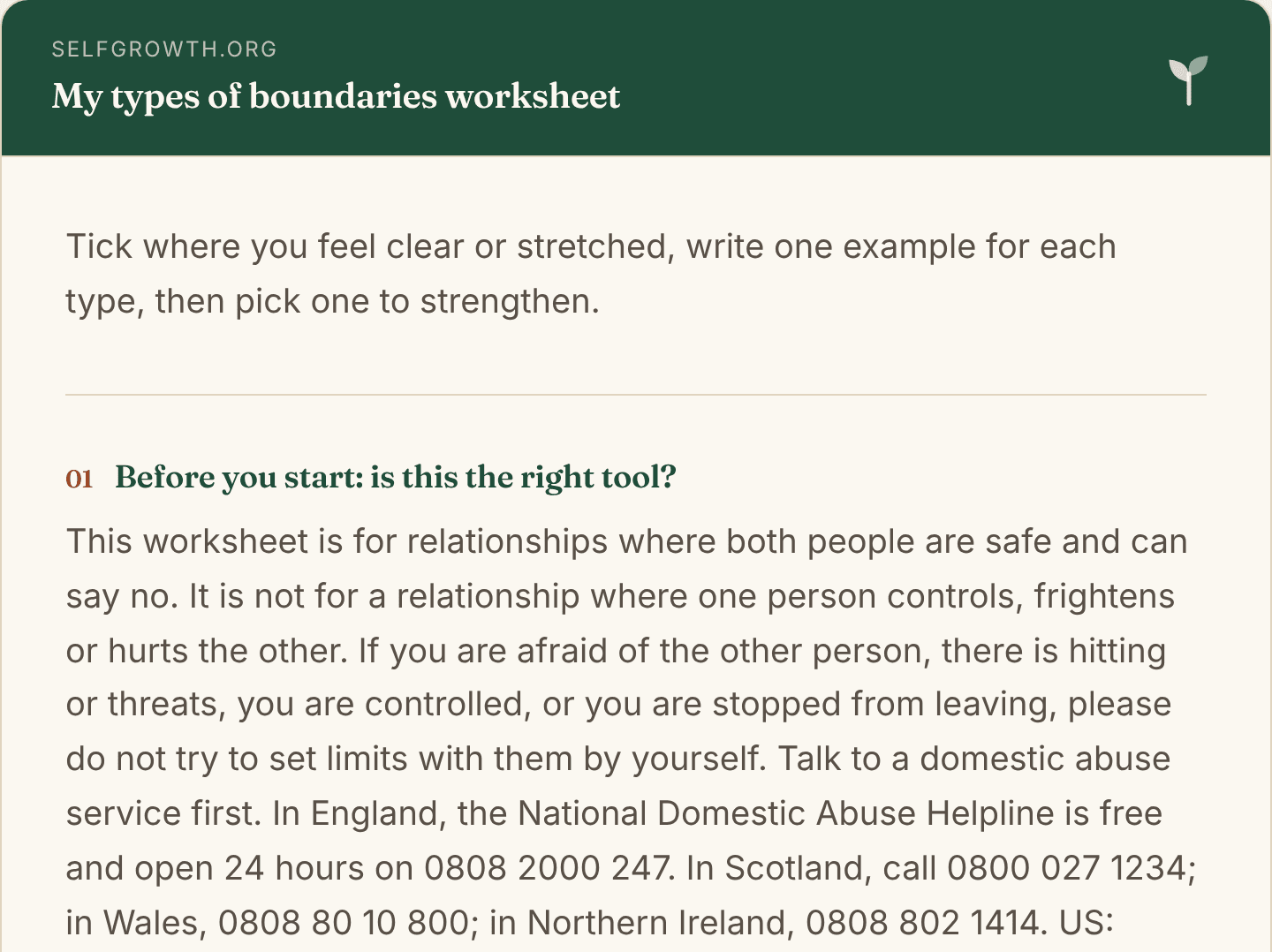
Types of Boundaries Worksheet
A free, printable types of boundaries worksheet: physical, emotional, time, material, digital and mental. Tick where you feel clear or stretched and pick one to strengthen.
Open worksheet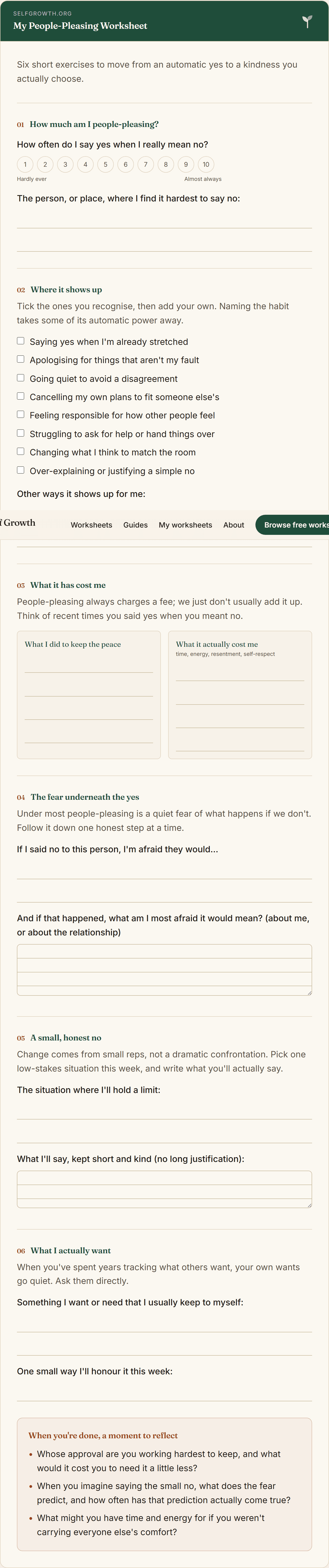
People-Pleasing Worksheet
A free, printable people-pleasing worksheet: see where you over-give, name the fear underneath, count the real cost, and practise one small, honest no.
Open worksheet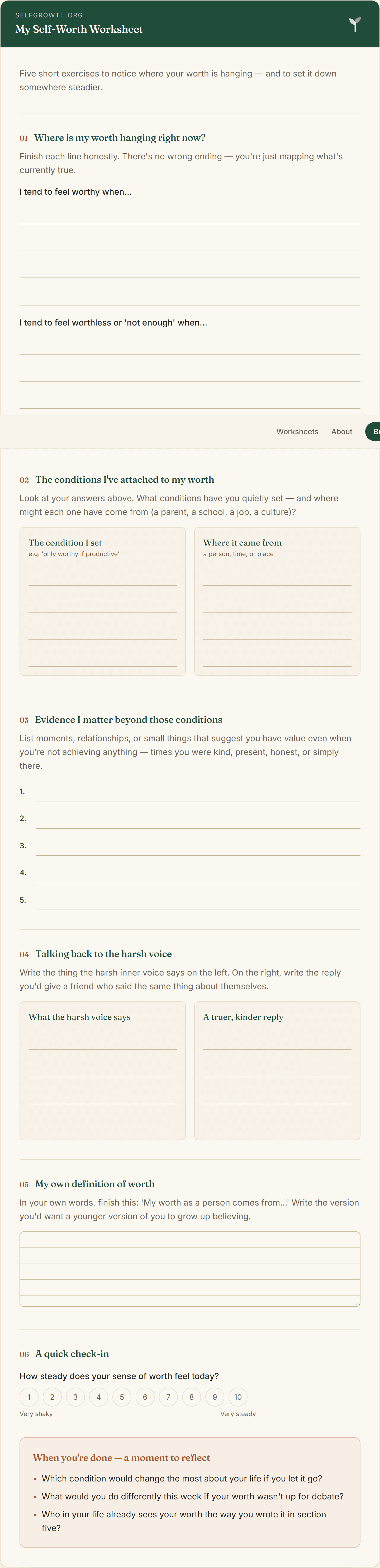
Self-Worth Worksheet
Free printable self-worth worksheets (PDF): find the conditions you've tied your worth to, see where they came from, and write a steadier definition.
Open worksheetRelated guides
New worksheets, straight to your inbox
An occasional new worksheet or tool, sent only when there's something genuinely worth your time. No spam, no pressure, unsubscribe any time.