
Boundaries
Codependency worksheet: a free printable to look at a relationship pattern
Updated 17 October 2026 · 9 min read · Free to print
A codependency worksheet helps you look at patterns in one relationship, such as putting someone else's needs well above your own. Codependency is not a formal diagnosis, and a 2026 review of 30 studies calls it a contested construct. This free printable helps you spot the patterns, name what you need and try one small boundary. It is not therapy.
By the Self Growth team · drawn from research on codependency as a contested label, and boundary-setting · how we make these
Fill it in here (it saves in this browser, but not in a private window), print it, or download the PDF. Free, no sign-up.
'Codependent' is a word for a pattern you might notice in a relationship: giving so much to someone else that your own needs, feelings and decisions get lost. It might be a partner, a parent, a friend or a grown-up child.
It is not a formal diagnosis. A 2026 review of 30 studies in Clinical Psychology & Psychotherapy calls co-dependency 'a contested construct'. Healthline's guide (reviewed by a registered nurse) adds that it isn't a personality disorder under the DSM-5 (the DSM-5 is the manual clinicians use). Researchers have questioned the label itself (see below). So treat the word as a handle for noticing a pattern, not as something you have or don't have.
That's what this worksheet is for. You'll look at one relationship, tick any patterns you recognise, write down what you need, and try one small, safe boundary. There's no score, and ticking a box doesn't mean anything is wrong with you. The people-pleasing worksheet and the boundaries worksheet cover related ground.
Please read this first. If the other person controls what you do, who you see, or how you spend money, or you feel afraid of them, that is not a worksheet problem and it is not your fault. The National Domestic Abuse Helpline names feeling controlled, isolated or 'walking on eggshells' among its warning signs. In the UK, call it free on 0808 2000 247, 24 hours a day (it supports women), or call the Men's Advice Line on 0808 8010327 (Monday to Friday, 10am to 5pm). In the US, call the National Domestic Violence Hotline on 1-800-799-7233, or text START to 88788. In an emergency call 999 (UK) or 911 (US). If someone might see your device or this printout, use a safe device and don't leave it where they can find it. Our helplines page (selfgrowth.org/help) lists more.
This is a self-reflection tool, not therapy. If you're in crisis, call Samaritans on 116 123 (UK and Ireland), call or text 988 (US), or find a helpline at findahelpline.com.
How to use this worksheet
- 1Pick one relationship to look at. It's easier to be honest about one than about everyone.
- 2Work through the sections in order, in one sitting or over a few days. Take as long as you need. Nobody else needs to read it.
- 3Skip the boundary section if the other person is controlling, or you're afraid of how they'd react. Talk to one of the helplines above first.
- 4Don't fill this in anywhere the other person could find it if that might put you at risk.
The worksheet
selfgrowth.org
My Codependency Worksheet
Look at one relationship, notice the patterns, name what you need, and try one small boundary. This is not a diagnosis or a test. If you feel controlled or afraid, skip the boundary section and find support at selfgrowth.org/help, from a safe device.
01Before I start
Check how safe it is to write this down. If anyone might see this sheet, your device or your browser history, don't fill it in here. Use a safe device, or leave it for later. If you are in danger now, call 999 (UK) or 911 (US).
Tick any that are true:
If I ticked any of the first four, I'll contact a helpline or someone I trust first. The one I'll try is:
02The relationship I'm looking at
Who it is (a name, or just 'my partner', 'my mum'):
What is good about this relationship?
What worries me about it, or about how I act in it?
03Patterns I recognise
These are patterns that get described as codependent, drawn from the Healthline guide. There's no scoring and no number that means anything. Tick what sounds like you in this relationship.
The pattern that stands out most, and what it looks like in a real week:
04A recent moment
Pick one recent moment that shows the pattern. Slow it down.
Entry 1
Entry 2
Entry 3
What did I fear would happen if I'd done something different?
05What I need
Needs are allowed. Write them even if they feel selfish.
Entry 1
Entry 2
Entry 3
Entry 4
Something I used to enjoy or care about that has slipped:
06Whose is it?
Sort what you've been carrying. Some things are yours. Some belong to the other person, or are shared.
Entry 1
Entry 2
Entry 3
Entry 4
One thing I've been carrying that I could put down:
07One small boundary
Only do this section if it feels safe. Skip it, and find support at selfgrowth.org/help, from a safe device, if the other person is controlling or you're afraid of their reaction. Choose something small and low-risk for a start.
The small boundary I'd like to try:
What I'll say or do, in plain words:
How I think they might react, and what I'll do if they react that way:
Who I could tell, or go to afterwards, for support:
08Support for me
You don't have to work this out alone.
Tick any I'll look into:
One thing I'll do for myself this week:
09Check back in a week
Look at what happened without judging yourself.
Entry 1
Entry 2
Entry 3
How hard was it?
Next time, I'll try:
When you're done, a moment to reflect
- When did I last do something just because I wanted to?
- Whose approval am I trying to keep, and what do I fear if I lose it?
- What would I want a friend in this situation to do?
- Which part of this is mine to change, and which isn't?
Is there research behind a codependency worksheet?
Honestly, we don't know of a trial of this worksheet, and a worksheet isn't a treatment. The sheet is built from what we could verify, and from the doubts about the word itself.
The patterns checklist comes from the Healthline guide 'Is a Codependent Personality a Disorder?', written by Eleesha Lockett and reviewed by Francis Kuehnle, MSN, RN-BC (18 March 2024). It says codependency describes a set of behaviours and isn't a personality disorder under the DSM-5, and it lists patterns such as difficulty identifying your own feelings, trouble making decisions and putting people-pleasing ahead of your own needs. We reworded the list in the first person. That guide is a popular-health article, not a clinical trial.
The research literature we read is more cautious. A 2026 integrative review in Clinical Psychology & Psychotherapy (30 studies) begins its abstract: 'Co-dependency is a contested construct'. Stafford's 2001 review in Issues in Mental Health Nursing covers definitions, whether the concept holds up, and how it has been measured. Its abstract says the term was first developed in substance abuse treatment, and has been used 'almost generically' since. Anderson's 1994 critique in Social Work questions treating the way people relate to each other as an addiction or a disease, and warns that identity can be lost in the label. That's why the worksheet asks you to look at a relationship and your own needs, and doesn't ask you to decide whether you 'are' something.
The boundary section and the 'whose is it?' sort are our own exercises. Boundaries and people-pleasing are covered in more depth in the boundaries worksheet and the people-pleasing worksheet. If a relationship involves control or fear, a helpline is the right place to start, not this page.
These are educational self-reflection tools, not therapy. See our editorial standards.
If you want to go deeper
- Co-Dependency Revisited: An Integrative Review of Conceptualisations and Mental Health Outcomes (2026). Clinical Psychology & Psychotherapy. doi:10.1002/cpp.70265. PMID 41958380.
- Lockett, E. (reviewed by F. Kuehnle, MSN, RN-BC, 18 March 2024). Codependent Personality Disorder: Does It Exist? Healthline. https://www.healthline.com/health/mental-health/codependent-personality-disorder.
- Stafford, L. L. (2001). Is codependency a meaningful concept? Issues in Mental Health Nursing, 22(3), 273-286.
- Anderson, S. C. (1994). A critical analysis of the concept of codependency. Social Work, 39(6), 677-685.
- National Domestic Abuse Helpline (nationaldahelpline.org.uk); Men's Advice Line (mensadviceline.org.uk); National Domestic Violence Hotline (thehotline.org).
Your questions, answered
- What is codependency?
- 'Codependency' is a label for a pattern in which someone puts another person's needs so far above their own that their own needs get lost. It is not a formal diagnosis. A 2001 review by Stafford says the term began in substance abuse treatment and has more recently been used 'almost generically' to describe a dysfunctional style of relating to others. Healthline's guide, reviewed by a registered nurse, describes it as a set of behaviours.
- What are the signs of codependency?
- The Healthline guide lists patterns such as difficulty knowing your own feelings, trouble making decisions, finding it hard to ask for what you need, seeking approval, putting people-pleasing ahead of your own needs, trying to control others, and feeling that all responsibility rests on you. It also lists staying in unhealthy or even abusive relationships. These aren't a test, and recognising some of them doesn't mean you 'are' codependent. The worksheet's checklist uses them.
- Is codependency a mental illness?
- Codependency is not a formal diagnosis. A 2026 review of 30 studies calls it 'a contested construct', and Healthline's guide says it isn't a personality disorder under the DSM-5. That doesn't mean what you're feeling isn't real, or that you can't get help. If the pattern comes with low mood, anxiety or a relationship that feels unsafe, speak to your GP or a qualified professional.
- What causes codependency?
- We don't have a reliable source that says. The label itself is contested, so this page doesn't claim a cause. It asks what you notice in one relationship.
- How do I stop being codependent?
- We can't offer a cure, and there's no research behind this worksheet. What you can do is notice the pattern, name what you need, sort what is yours to handle from what isn't, and try one small boundary. The Healthline guide says talk therapy and support from a mental health professional can help. Start small and stop if it feels unsafe.
- What if the relationship is abusive or controlling?
- Then please contact a helpline before trying a boundary. In the UK, the National Domestic Abuse Helpline is free on 0808 2000 247, 24 hours a day (it supports women), and the Men's Advice Line is on 0808 8010327, Monday to Friday 10am to 5pm. In the US, the National Domestic Violence Hotline is 1-800-799-7233, or text START to 88788. Their sites advise using a safe device if someone may be monitoring yours. In an emergency call 999 (UK) or 911 (US). Our helplines page (selfgrowth.org/help) lists more.
- Is this worksheet free, and is it a substitute for therapy?
- It is free, with no payment and no email needed. Use Download PDF for a print-ready copy, or fill it in on screen (answers save in the browser on that device, so only do this on a device only you use). It's an educational self-reflection tool, not therapy or medical advice. If a relationship is affecting your health, please speak to your GP. In a crisis, call Samaritans on 116 123 (UK and Ireland), call or text 988 (US), or find a helpline at findahelpline.com.
Keep going, related worksheets
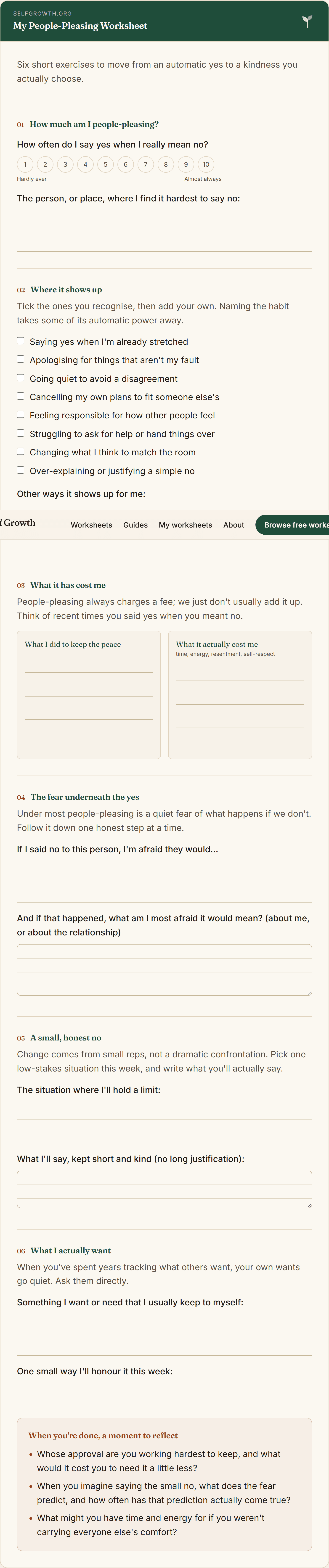
People-Pleasing Worksheet
A free, printable people-pleasing worksheet: see where you over-give, name the fear underneath, count the real cost, and practise one small, honest no.
Open worksheet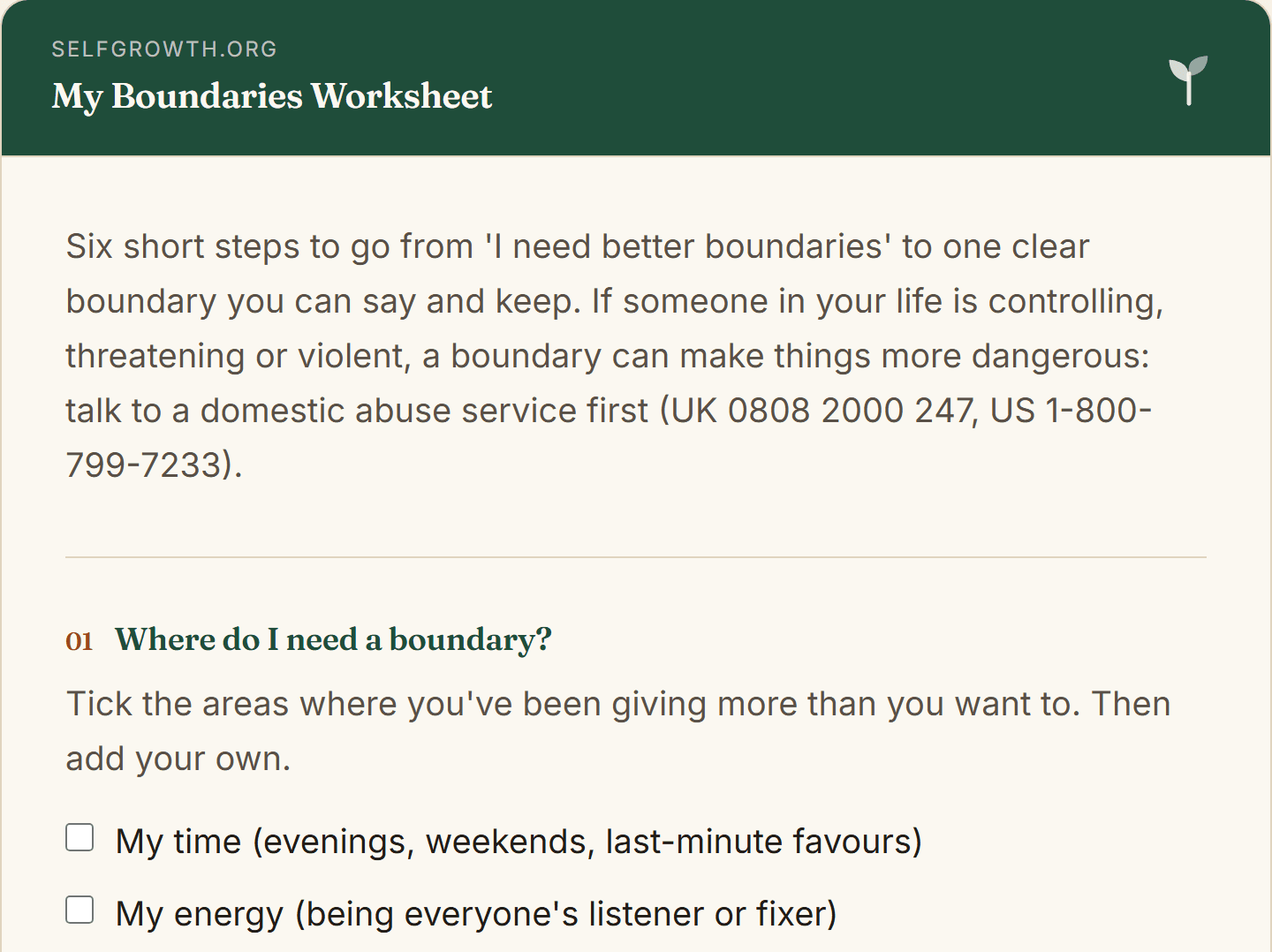
Boundaries Worksheet
A free, printable boundaries worksheet: spot where you need a limit, write it as something you'll do, plan the exact words, and decide what you'll do if it's crossed.
Open worksheet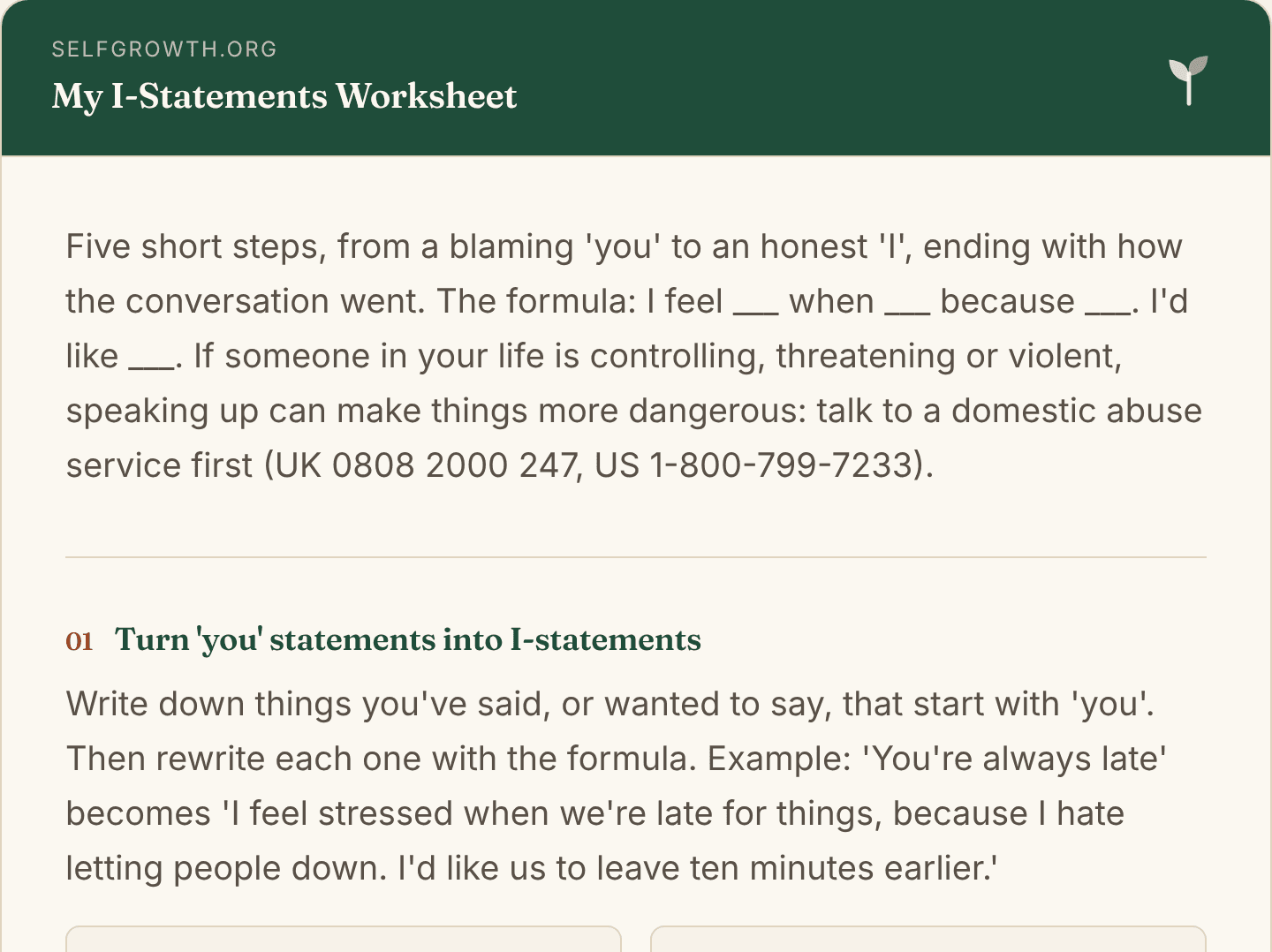
I-Statements Worksheet
A free, printable I-statements worksheet with I statement examples, the 'I feel... when... because...' formula, and space to plan one real conversation.
Open worksheetNew worksheets, straight to your inbox
An occasional new worksheet or tool, sent only when there's something genuinely worth your time. No spam, no pressure, unsubscribe any time.