
Guide
Personal development plan: what it is, examples and how to write one
Updated 25 October 2026 · 10 min read
A personal development plan is a written plan for how you want to grow, covering your whole life, not only work. A simple one covers where you are now, what you want, the skills to build, the actions and support that get you there, and a date to review it. One page is enough.
A plain planning format, with goal-setting research on specific goals · Part of goals and life balance
You may have been asked for a personal development plan, or you may just feel you are drifting and want something to hold on to. Either way, the idea is simple: write down where you are, where you would like to be, and the small steps between the two.
A personal development plan, often shortened to PDP, is about you as a whole person. It can cover confidence, friendships, health, learning and money as well as your job. It is also called a personal growth plan.
A PDP is a planning format, not a tested treatment, and there is no single official layout. Use the parts that help and drop the rest.
What is a personal development plan?
A personal development plan is a short document that says what you want to change or learn, how you will go about it, who or what will help, and when you will look back to see how it is going. It turns a loose wish like 'I want to be more confident' into a few things you can actually do next week.
The word 'personal' matters. A plan for your whole life can include goals that no employer would ask about: speaking up more, sleeping better, calling your family, learning to cook. If you want the wider idea behind this, the guide to what self-growth is covers it.
If a tutor or employer has asked you for one, follow their layout and use these ideas to think it through first.
The parts of a personal development plan
You can build a plan from six parts. You can write each one in a sentence or two.
- Where I am now. A short, honest picture of your starting point, including what already works.
- What I want. One to three goals, written as something you could do, not a mood you hope to feel.
- Skills or habits to build. What you would need to be able to do for the goal to happen.
- Actions. The first small steps, each with a when and a where.
- Support. People, tools, courses or books that make it easier, and what you will ask of them.
- A date. When you want to have made progress, and when you will review the plan.
Keep it small. One to three goals at a time is plenty, and a plan you can read in a minute is a plan you will actually look at. To check your starting point across the whole of life, the wheel of life worksheet is a quick place to begin.
Personal development plan examples
These three are short on purpose. They are examples to borrow wording from, not plans to copy. Yours should sound like you.
Example 1, a student:
- Goal: hand in my essays two days before the deadline, not on the day.
- Skills: breaking a task into stages, and starting before I feel ready.
- Actions: split each essay into four parts, and book a two-hour slot for part one on the day it is set.
- Support: ask my tutor for feedback on one plan, and study alongside a friend once a week.
- Date: in place for the next term's essays.
- Review: at the end of each term, I look at which essays were early and what helped.
Example 2, someone changing careers:
- Goal: find out whether project work in a new field suits me before I leave my job.
- Skills: the basics of the tools used in that field, and how to explain my current experience in its terms.
- Actions: take a short beginner course, and talk to two people who do the work now.
- Support: a friend who changed career, plus my manager if I can be open with them.
- Date: a decision about next steps in six months.
- Review: once a month, I note what I enjoyed, what I did not, and whether the plan still fits.
Example 3, someone working on confidence:
- Goal: say what I think in one meeting a week.
- Skills: preparing one point beforehand, and speaking even when my voice feels shaky.
- Actions: write down one point before each meeting, and say it in the first ten minutes.
- Support: tell one colleague my plan, and ask how it came across.
- Date: try it for eight weeks.
- Review: every Friday I write down what I said and how it went, and each month I choose whether to make the goal bigger.
Notice what they share. Each goal is something you can see yourself doing, each action has a time attached, and each one says when it will be looked at again. For more ideas to start from, see the self-growth goals guide.
How to write a personal development plan
Set aside an hour with a pen or a blank page. You do not need to do it all in one go.
- 1Check where you are now. Write a few lines on what is going well and what you would like to change. A quick look at each area of life helps you see the whole picture.
- 2Choose one to three goals. Pick the ones that matter to you, not the ones you think you should want. Write each as something you could do.
- 3Make each goal specific. Say what you will do, how much, and by when. 'Get better at public speaking' becomes 'give a five-minute talk to my team'.
- 4List the skills or habits it needs. Ask what you would have to learn or practise for the goal to happen.
- 5Write the first small actions. Give each one a day and a place, and keep the first one under ten minutes.
- 6Add your support. Name the people, tools or courses that would help, and one thing you will ask each of them for.
- 7Pick a review date. Choose when you will look at the plan again, and put it in your calendar before you put the page down.
Making goals specific is the part with some research behind it. In a 2002 review of 35 years of goal-setting research, Edwin Locke and Gary Latham report that specific, difficult goals led to higher performance than being told to 'do your best'. That research is mostly on work tasks, so treat it as a good reason to be clear, not as proof that every personal goal works the same way.
The free self-growth plan takes you through these steps for your whole life, with space to write each part.
Open the Self-Growth PlanPersonal development plan vs professional development plan
A personal development plan covers your whole life. A professional development plan covers your work: the skills, roles and experience you want to build in your career. The two overlap, and your personal goals may well feed your career ones, for example confidence or time management.
If you want to plan your next year at work, with skills, support, evidence of progress and check-ins, the professional development plan template is built for that. You could write the personal plan first, then pull out the parts that touch work.
Open the Professional Development Plan TemplateHow often should you review it?
There is no set rule for how often to review, so pick a date that suits you. Monthly works for a plan with small weekly actions. Once a term or season may suit a bigger goal. Choose a rhythm you can keep and write the first date on the plan.
At each review, ask three things. What did I do? What got in the way? What do I want to change in the plan? It is fine to drop a goal that is no longer yours. A plan that changes as you do is working.
To make the steps easier to start, the SMART goals worksheet helps you sharpen one goal, and the life plan template looks further ahead.
When to get more support
This is a self-help tool, not therapy or advice from a professional. If low mood, stress or worry is what is really in the way of your plan, or you feel stuck in a way a page cannot fix, your GP is a good first step. A tutor, manager, mentor or careers adviser can help with the practical side.
If you ever feel unsafe or have thoughts of harming yourself, call Samaritans on 116 123 (UK and Ireland), 988 (US), or find a line at findahelpline.com.
Sources and further reading
This is an educational self-reflection resource, not therapy or medical advice.
If you want to go deeper
- Locke, E. A. & Latham, G. P. (2002). Building a practically useful theory of goal setting and task motivation: A 35-year odyssey. American Psychologist, 57(9), 705-717.
Your questions, answered
- What is a personal development plan?
- It is a short written plan for how you want to grow. It says where you are now, what you want to change or learn, the actions you will take, who or what will support you, and when you will review it. It can cover any part of life, not only work.
- What should a personal development plan include?
- Where you are now, one to three goals, the skills or habits those goals need, small first actions with a time attached, the support you will use, and a date to review it. A plan you can read in a minute is easier to keep using.
- What is the difference between a personal and a professional development plan?
- A personal development plan covers your whole life, including confidence, health, relationships and learning. A professional development plan is about your work and career. The two overlap, so you can write one and borrow from it for the other.
- How do I write a personal development plan for work or university?
- Follow any format your employer or university gives you, and use the same steps: check where you are, choose one to three goals, make them specific, list the skills, add small actions, name your support and set a review date. Planning on a blank page first can make the official form easier.
- How often should I update my personal development plan?
- There is no set rule. Pick a review date that suits you, for example monthly or each term, and put it in your calendar. Change the plan whenever a goal stops being yours.
- Is there a free personal development plan template?
- Yes. The self-growth plan is free to fill in on screen or print, with no payment and no email needed. Your answers save in your browser. For a plan about work, there is also a professional development plan template.
- Is this a substitute for therapy?
- No. It is a self-help tool, not therapy. If low mood or stress is what is really in your way, talk to your GP. If you ever feel unsafe or have thoughts of harming yourself, call Samaritans on 116 123 (UK and Ireland), 988 (US), or find a line at findahelpline.com.
Worksheets to do the work
Free to fill in online or print. No email needed.
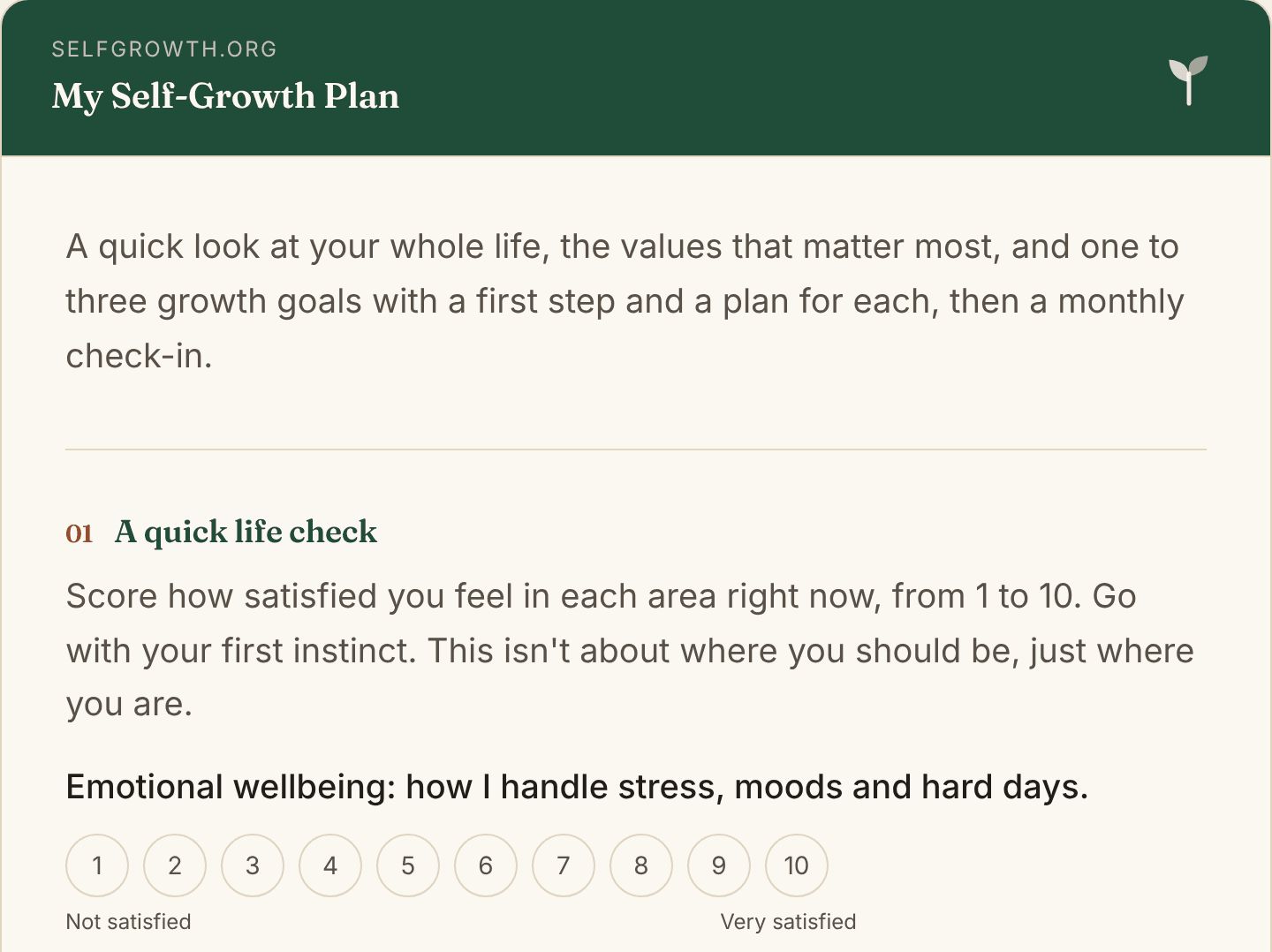
Self-Growth Plan
A free, printable self-growth plan template: check in on six areas of life, pick three values, choose one to three goals, plan a first step and review monthly.
Open worksheet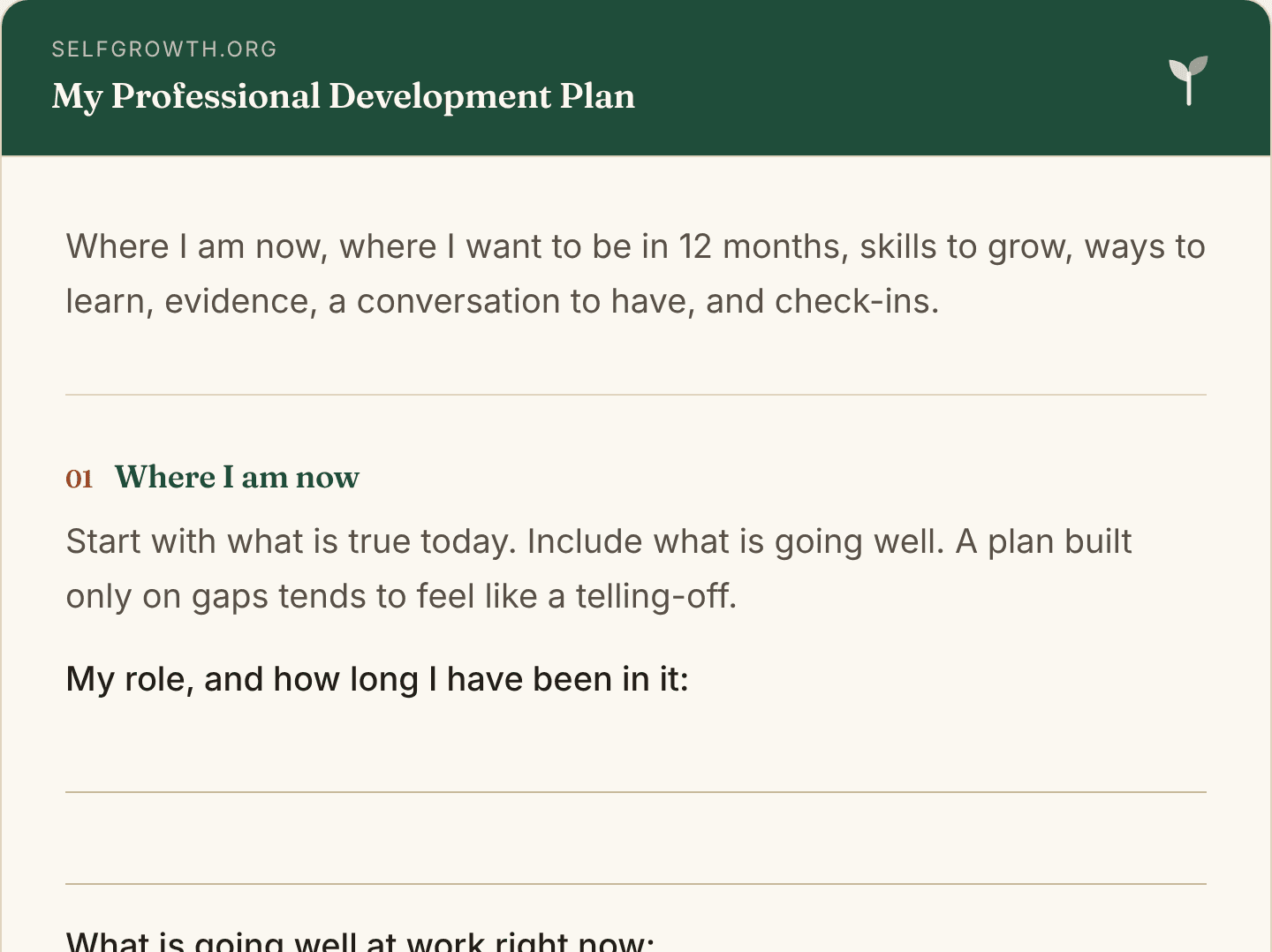
Professional Development Plan Template
A free printable professional development plan template: where you are now, 12-month aims, skills to grow, support, evidence and quarterly check-ins.
Open worksheet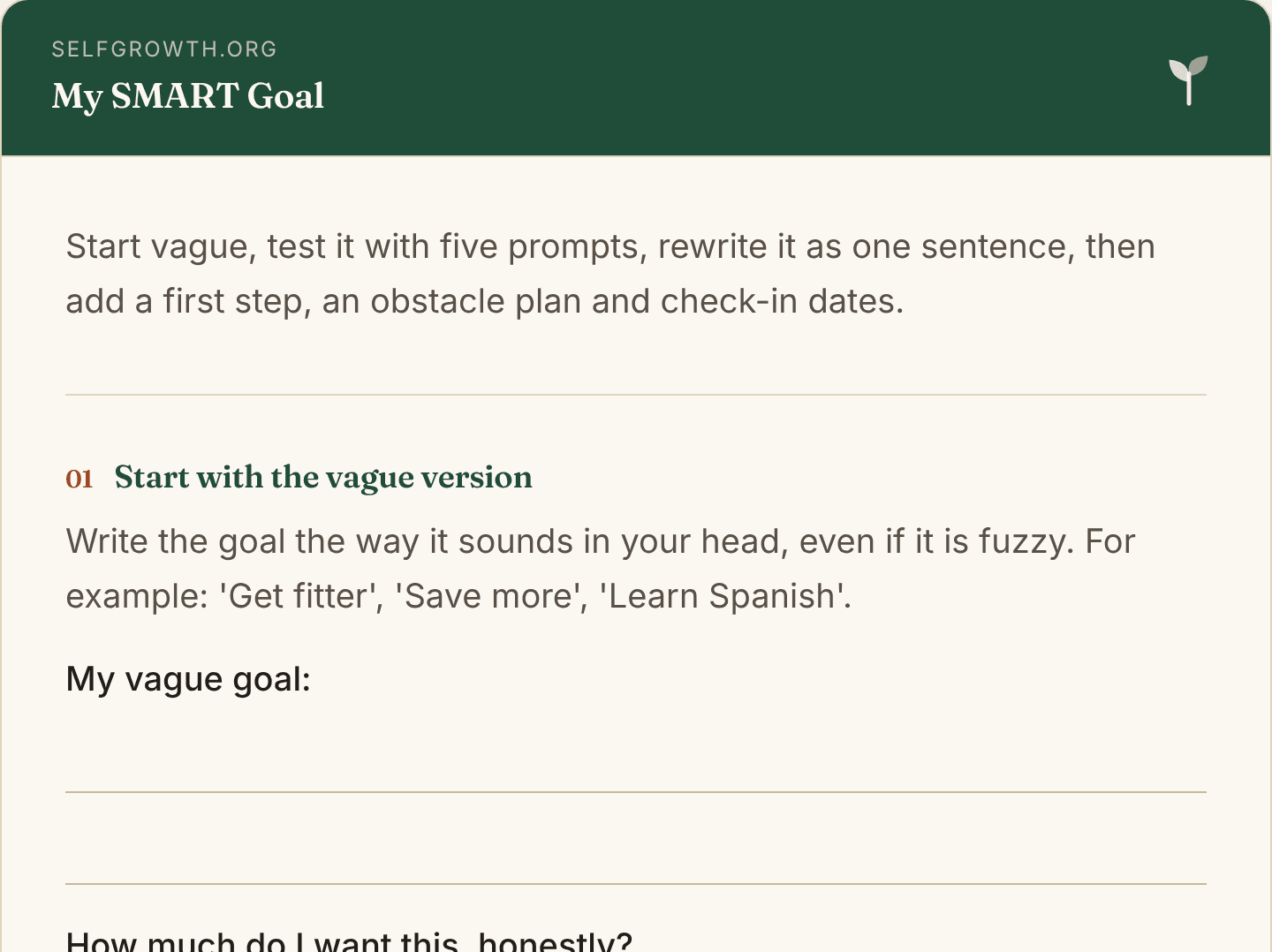
SMART Goals Worksheet
A free, printable SMART goals worksheet: start with one vague goal, answer five prompts with examples, rewrite it as one sentence, then add a first step and check-in dates.
Open worksheet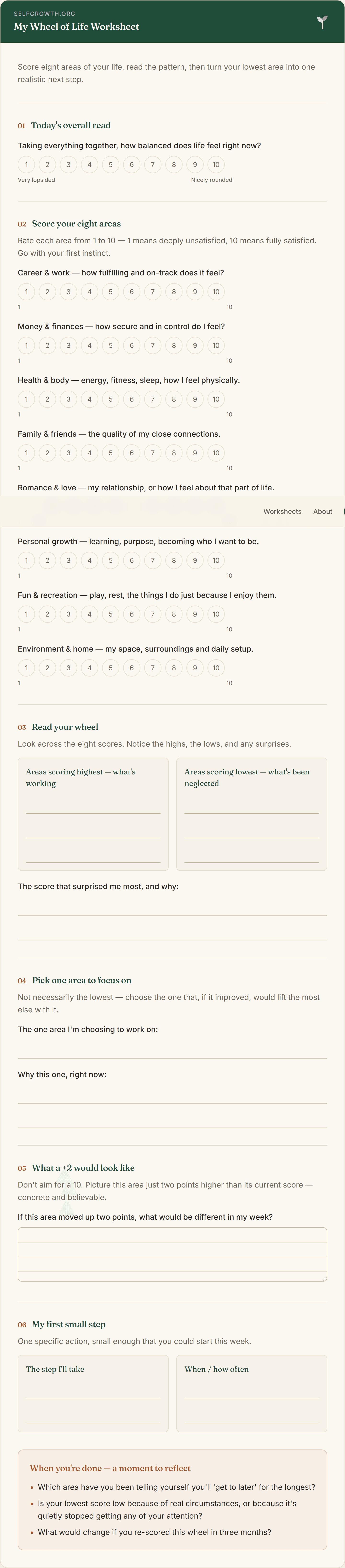
Wheel of Life Worksheet
A free printable PDF Wheel of Life exercise. Score each area of your life out of ten, see where you're out of balance, and pick one to work on next.
Open worksheet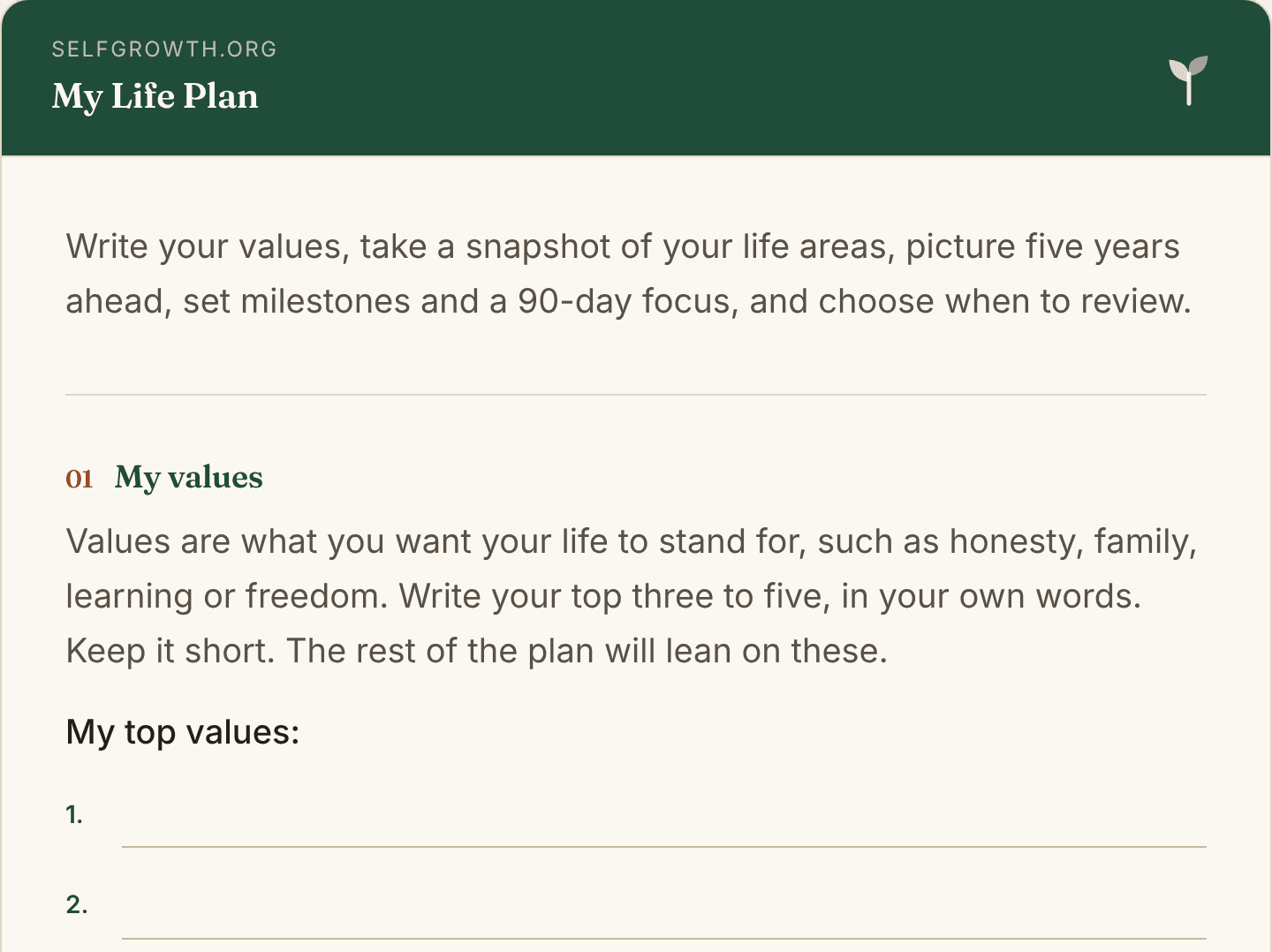
Life Plan Template
A free life plan template: write your values, see where each life area stands, picture five years ahead, set milestones and a 90-day plan, then pick a review.
Open worksheetRelated guides
New worksheets, straight to your inbox
An occasional new worksheet or tool, sent only when there's something genuinely worth your time. No spam, no pressure, unsubscribe any time.