
Goal-setting
Life plan template: a free printable way to plan the next five years without boxing yourself in
Updated 25 October 2026 · 9 min read · Free to print
A life plan template is a set of pages for working out where you want your life to go, without locking it in. You write your top values, take a snapshot of each life area, describe where you would like to be in five years, set one-year milestones, plan the next 90 days, and choose how often to review.
Drawn from goal-setting and future-self writing research · Part of goals and life balance
Fill it in here (it saves in this browser, but not in a private window), print it, or download the PDF. Free, no sign-up.
'How do I plan my life?' is a big question to type at night. A life plan does not have to be a blueprint. Think of it as a rough map. It shows the direction you want to head, the next few steps, and what you might need to say no to. You can redraw it whenever it stops fitting.
This sheet starts with your values, so the plan is built on what matters to you and not on what you think you should want. If you want a longer look at that, the core values worksheet is a good first step. You then look at each area of life as it is now and where you would like it to be in five years. If you want a quick picture of how satisfied you are in each area first, the wheel of life worksheet gives you one. To make the future feel more real, the vision board template is a gentler way in.
Then the plan gets small. You pick one-year milestones and a 90-day focus, plus what you will stop doing and what might get in the way. It is a self-help planning tool, not therapy. If low mood or stress is what is making the future hard to picture, see your GP.
How to use this worksheet
- 1Give yourself an unhurried hour. You can do the sheet in two sittings.
- 2Write quickly and honestly. Rough answers are fine, and you can cross things out later.
- 3Skip any life area that does not matter to you right now. A plan with four areas is still a plan.
- 4Finish with the review section and put the date in your calendar.
The worksheet
selfgrowth.org
My Life Plan
Write your values, take a snapshot of your life areas, picture five years ahead, set milestones and a 90-day focus, and choose when to review.
01My values
Values are what you want your life to stand for, such as honesty, family, learning or freedom. Write your top three to five, in your own words. Keep it short. The rest of the plan will lean on these.
My top values:
- 1.
- 2.
- 3.
- 4.
- 5.
Where do I already live by these? Where am I not?
02My life areas now
For each area, write one or two lines on how things are today. Not how they should be. Just how they are. Skip an area if it does not apply, and add your own if one is missing.
Entry 1
Entry 2
Entry 3
Entry 4
Entry 5
Entry 6
Entry 7
Areas to think about: work or study, money, health, relationships, family, friends, home, learning, fun, meaning.
03Where I would like to be in five years
Picture a good, realistic day in five years' time. Then, for each area that matters, write what would be different from now and why it matters to you. A reason helps when the plan gets hard. Short answers are fine.
Entry 1
Entry 2
Entry 3
Entry 4
Entry 5
Entry 6
A good ordinary day in five years: where am I, who is there, what am I doing?
04One-year milestones
Look at your five-year picture and ask what would need to be true a year from now for it to be on track. Choose a few milestones, not one for every area. Make each one clear enough that you would know whether it had happened.
Entry 1
Entry 2
Entry 3
Entry 4
Entry 5
05The next 90 days
Pick the one to three milestones that matter most and break them down into steps for the next three months. Smaller is better. If a step feels vague, ask what the first thing to do would be on Monday.
Entry 1
Entry 2
Entry 3
Entry 4
Entry 5
What I need to make this work (time, money, help, a conversation):
06What to stop or say no to
A plan needs room. Each yes costs time or energy, so a plan often needs a no. List what you will drop, say no to or do less of, so your 90 days have space to happen.
What I will stop, drop or say no to:
- 1.
- 2.
- 3.
- 4.
What makes saying no hard, and what could I say instead?
07Risks and if-then plans
Think about what is most likely to knock you off course. Then write an 'if-then' plan for each: 'If [this happens], then I will [do this].' It is easier to decide now than in the moment.
Entry 1
Entry 2
Entry 3
Entry 4
08How often I will review, and a note on change
Plans change, because life does. That is not failing, it is how plans work. Choose how often to look again. You might pick every month, every season or once a year. Pick what you will actually do.
I will review this plan every (you choose):
My first review date:
When I look back, I will ask: what is working, what has changed, and what do I want to keep?
A reminder to myself:
When you're done, a moment to reflect
- Which values showed up again and again in your answers?
- Which area surprised you when you wrote it down, good or bad?
- Is your five-year picture yours, or partly what others expect of you?
- What is one thing on your 90-day list you are looking forward to?
- What would you tell a friend who showed you this plan?
Done for now?
Save today's answers as a dated entry. You can come back, fill it in again and compare the two side by side.
Does a life plan work?
This layout is a planning format. No study has tested this sheet or a five-year plan like it. It puts together a few ideas that have some research behind them, and leaves the rest to you.
The first idea is that clear goals help. Edwin Locke and Gary Latham reviewed 35 years of goal-setting research in 2002. They report that specific, difficult goals led to higher performance than telling people to do their best. That research is mostly on work tasks, so it is a reason to make your milestones and 90-day steps specific, not proof that a five-year plan will work.
The second idea is writing about your future. In a 2001 study, Laura King asked 81 undergraduates to write for 20 minutes a day for four days. They were randomly assigned to write about their best possible future self, a traumatic event, both, or a neutral topic. Writing about life goals was less upsetting than writing about trauma, and was linked to a significant increase in well-being three weeks later. It was a small study of undergraduates, so it is a hint and not a promise. The rest of the layout is a way to turn a picture into steps.
These are educational self-reflection tools, not therapy.
If you want to go deeper
- Locke, E. A. & Latham, G. P. (2002). Building a practically useful theory of goal setting and task motivation: A 35-year odyssey. American Psychologist, 57(9), 705-717.
- King, L. A. (2001). The health benefits of writing about life goals. Personality and Social Psychology Bulletin, 27(7), 798-807.
Your questions, answered
- What is a life plan?
- A life plan is a written picture of where you would like your life to go, with the steps to move in that direction. It does not have to be fixed. This one starts with your values, looks at each life area, sets a five-year picture, one-year milestones and a 90-day focus, and leaves room to change course.
- How do I plan my life?
- Start with what matters to you, then look at how each area of life is now. Describe where you would like to be in five years, then work back to what a good year and the next three months would look like. Add what to stop doing and what might get in the way, and set a time to review.
- How do I make a five year plan?
- Write a few lines for each life area on where you would like to be in five years, and why it matters. Then step back to the next year, choosing a few milestones you can check. Keep it loose. A five-year plan is a direction to head in, and you can change it at your reviews.
- Does writing about the future help?
- There is a little research. In a 2001 study by Laura King, 81 undergraduates were randomly assigned to write for 20 minutes a day for four days about their best possible future self, a traumatic event, both, or a neutral topic. Writing about life goals was less upsetting than writing about trauma and was linked to a rise in well-being three weeks later. It was a small study of students, so treat it as a hint.
- What if my plan changes?
- Then you change the plan. Plans are drafts, and life will give you new information, new people and new priorities. Use your review date to ask what has changed and what you still want. Updating a plan because you have learned something is a good use of it.
- Is there a life plan template PDF?
- Yes. Use the Download PDF button for a clean, print-ready copy, or Print to print straight from the page. It is completely free, with no payment and no email needed. You can also fill it in on screen, and your answers save in your browser.
- Is this a substitute for therapy?
- No. It is a self-help planning tool, not therapy or medical advice. If low mood, anxiety or a hard life situation is what is really in the way, a GP can point you to support. If you ever feel unsafe or have thoughts of harming yourself, call Samaritans on 116 123 (UK and Ireland), 988 (US), or find a line at findahelpline.com.
Keep going, related worksheets
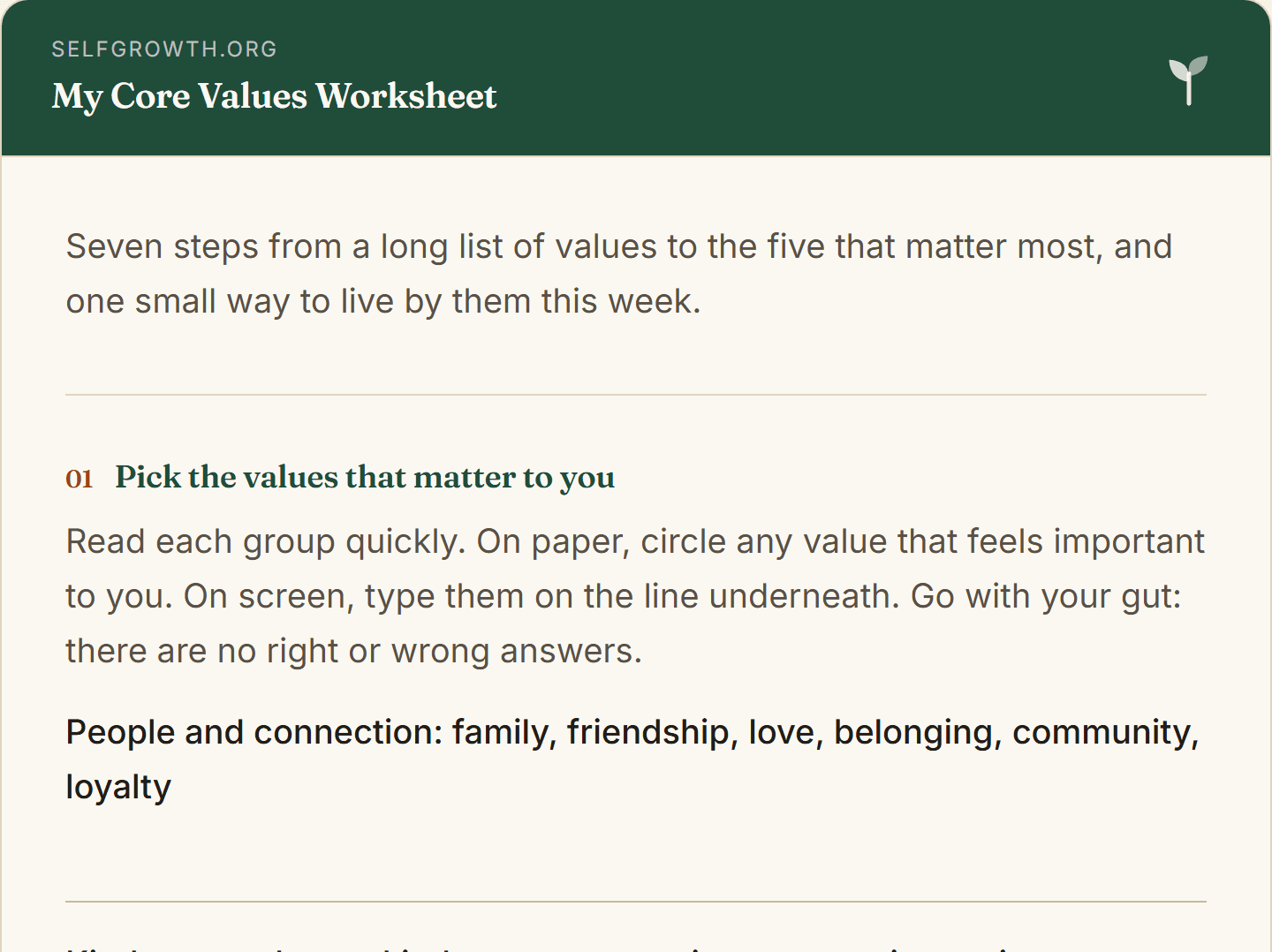
Core Values Worksheet
A free, printable core values worksheet: pick values from a list, narrow them to your top five, put them in your own words and plan one step to live by them.
Open worksheet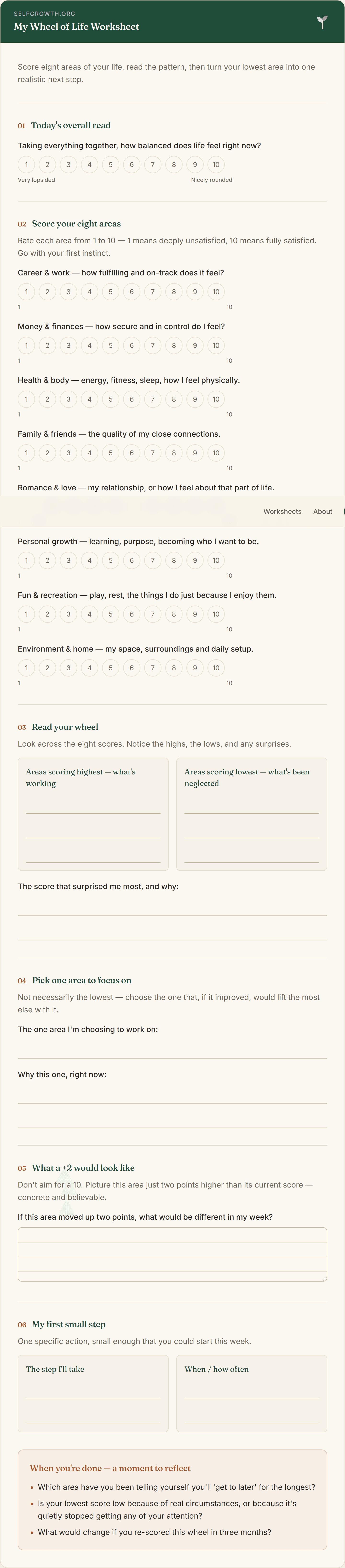
Wheel of Life Worksheet
A free printable PDF Wheel of Life exercise. Score each area of your life out of ten, see where you're out of balance, and pick one to work on next.
Open worksheet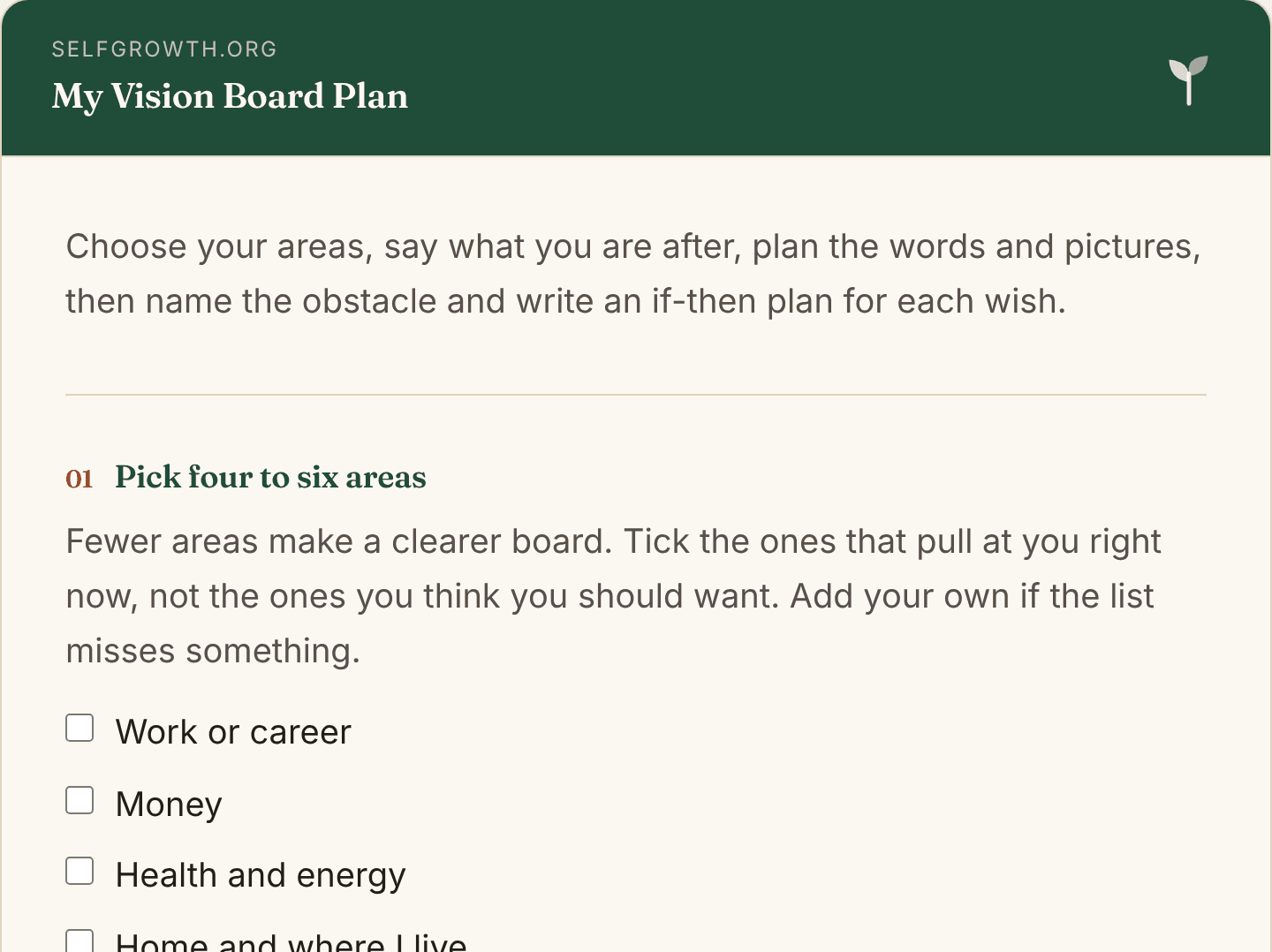
Vision Board Template
A free, printable vision board template: pick 4 to 6 life areas, plan your words and pictures, then add what boards skip: a plan for what might get in the way.
Open worksheetNew worksheets, straight to your inbox
An occasional new worksheet or tool, sent only when there's something genuinely worth your time. No spam, no pressure, unsubscribe any time.