
Goal-setting
Vision board template: a free printable planner for a board that leads to action
Updated 25 October 2026 · 7 min read · Free to print
A vision board template helps you pick four to six areas of your life, collect words and pictures for each, and say what each would look like. This printable adds the step most boards skip: naming the main inner obstacle for each wish and writing an if-then plan, so the board points to action.
Drawn from research on mental contrasting and if-then planning · Part of goals and life balance
Fill it in here (it saves in this browser, but not in a private window), print it, or download the PDF. Free, no sign-up.
A vision board is a collage of words and pictures that show what you want more of. Making one can be calming and clarifying. It can also be a lovely hour with scissors and old magazines. This sheet is the planning page you fill in first, so the board is not just a pretty wall of wishes.
You pick four to six areas, jot down what each one would look like, and choose one small step for each. Then comes the honest part. For each wish you name the thing inside you that is most likely to get in the way, and write an if-then plan for it. If you are not sure which areas matter, a quick wheel of life can show you. To turn one wish into a clear goal, use the SMART goals worksheet.
One plain note. A vision board does not make things happen by itself, and looking at it is not a plan. This is a self-help planning tool, not therapy. If low mood or stress is what is really in the way, a GP is a good place to start.
How to use this worksheet
- 1Print the page, or type straight onto it. Give yourself about 45 minutes with a drink and no phone.
- 2Fill in the planning sections first. Do the pictures and glue after, not before.
- 3Do the obstacle section even if it feels less fun. It is the part the research points to.
- 4Put your board somewhere you will see it, and book your first look in your calendar.
The worksheet
selfgrowth.org
My Vision Board Plan
Choose your areas, say what you are after, plan the words and pictures, then name the obstacle and write an if-then plan for each wish.
01Pick four to six areas
Fewer areas make a clearer board. Tick the ones that pull at you right now, not the ones you think you should want. Add your own if the list misses something.
Anything else I want on my board:
02The feeling I am after
Pictures work best when they stand for a feeling, not just a thing. Think about how you want ordinary days to feel, for example calm, free, strong, close to people, or proud. Then write one sentence for the middle of your board.
Three words for how I want my days to feel:
My centre statement (one sentence, in my own words):
For example: 'A calm, steady life with time for the people I love.'
03Words, pictures and one small step for each area
One row per area. Add words or picture ideas, then describe what it would look like on a normal Tuesday. 'What it would look like' is the part that keeps a board from being vague. Finish with one small step you could take this month.
Entry 1
Entry 2
Entry 3
Entry 4
Entry 5
Entry 6
04Where to find your pictures
You do not need to spend anything. Tick the sources you will use. Your own photos and your own drawings often work best, because they are about your life and not someone else's.
What I already have at home that could go on the board:
05The honest part: what might get in the way
Wishing alone can feel good and still leave you where you started. Researchers call the fix mental contrasting: picture the good outcome, then look straight at the obstacle in the way, then make a plan. One well known version is called WOOP (Wish, Outcome, Obstacle, Plan). Pick your top three wishes from the board. For each, name the main obstacle that is inside you, such as a habit, a worry or a feeling. Then write an if-then plan.
Entry 1
Entry 2
Entry 3
How much do I believe I can do my first small step this month?
If that number is low: what would make the step smaller, or what should I let go of?
06Where the board goes, and when I look at it
A board in a drawer does nothing. Put it where your eyes land at a calm moment, and decide when you will look at it. Looking is not the work. Use it to remind yourself of your steps and your if-then plans.
Where I will put my board :
When I will look at it (for example, Sunday evening with a cup of tea):
When I will check my small steps and update the board:
07Check back in
After a few weeks, come back to this page. Keep what still feels true. Take down what does not. Changing your mind is not failing.
Entry 1
Entry 2
Entry 3
Entry 4
When you're done, a moment to reflect
- Which picture or word on your board gave you a small lift as you chose it? What does that say about what you want?
- Is anything on your board there because you think you should want it? What would you put there instead?
- Which obstacle did you write that you have met many times before? What has helped even a little in the past?
- What is one step on this page you could do in the next two days?
- How do you want to feel when you look at the finished board: pushed, or steadied?
Done for now?
Save today's answers as a dated entry. You can come back, fill it in again and compare the two side by side.
Do vision boards work?
No one has shown that a vision board, as a craft project, helps you reach what is on it, and no one has shown the opposite. What there is, is research on the thinking behind it. In 2002 Gabriele Oettingen and Doris Mayer followed four groups: graduates job-hunting, students with a crush, students facing an exam and patients having hip surgery. They checked effort and results weeks to up to two years later. People who judged a good outcome as likely did better. People who mainly enjoyed positive daydreams about it put in less effort and did worse.
Oettingen's 2012 review explains the fix. It is called mental contrasting: picture the wish, then look at what stands in your way. She describes it as leading to active effort when you think success is likely, and to letting go when you do not. That is the order of the honest-part section above. The if-then wording comes from Peter Gollwitzer's work on implementation intentions, which Gollwitzer and Paschal Sheeran pooled in a 2006 review.
Limits matter here. Most of this research tests the thinking exercise, not a physical board. Results from job-hunters and patients may not carry over to every wish. Treat this sheet as a sensible way to plan, not a promise. It is educational, not therapy.
These are educational self-reflection tools, not therapy.
If you want to go deeper
- Oettingen, G. & Mayer, D. (2002). The motivating function of thinking about the future: Expectations versus fantasies. Journal of Personality and Social Psychology, 83(5), 1198-1212.
- Oettingen, G. (2012). Future thought and behaviour change. European Review of Social Psychology, 23(1), 1-63.
- Gollwitzer, P. M. & Sheeran, P. (2006). Implementation intentions and goal achievement: A meta-analysis of effects and processes. Advances in Experimental Social Psychology, 38, 69-119.
Your questions, answered
- What is a vision board template?
- It is a planning page you fill in before you make the board. You choose a few life areas, note words and pictures for each, and describe what each would look like. This one also asks for a small step and an if-then plan, so the board links to things you can do.
- How do I make a vision board that works?
- Start with a few areas, not twenty. Say what each would look like in daily life, pick one small step, and name what might get in the way. Then plan what you will do when it does. Put the board where you will see it. The board is a reminder. The steps are what move things.
- Do vision boards actually work?
- There is no good evidence that a board alone makes things happen. Gabriele Oettingen and Doris Mayer (2002) found that positive daydreams about a wished-for future, such as a new job or recovery after surgery, predicted less effort and worse results, while judging that future as likely predicted more effort and better results. Oettingen's later work says to picture the wish and then the obstacle. That is why this sheet has an obstacle step.
- What is the difference between a vision board and the law of attraction?
- A vision board is just a collage you make to clarify what you want. The law of attraction is the belief that thinking about something brings it to you. This page does not rely on that belief. It treats the board as a prompt for planning, and the research behind it points the other way: wishing alone can lower effort.
- How many areas or goals should a vision board have?
- Four to six is a good range. More tends to make the board busy and the steps vague. If you want a way to choose, a wheel of life shows which areas feel emptiest right now. You can always make a second board later.
- Is there a vision board template PDF?
- Yes. Use the Download PDF button for a clean, print-ready copy, or Print to print straight from the page. It is completely free, with no payment and no email needed. You can also fill it in on screen, and your answers save in your browser.
- Is this a substitute for therapy?
- No. It is a self-help planning tool, not therapy or medical advice. If low mood, stress or a hard life situation is what is really in the way, a GP can point you to support. If you ever feel unsafe or have thoughts of harming yourself, call Samaritans on 116 123 (UK and Ireland), 988 (US), or find a line at findahelpline.com.
Keep going, related worksheets
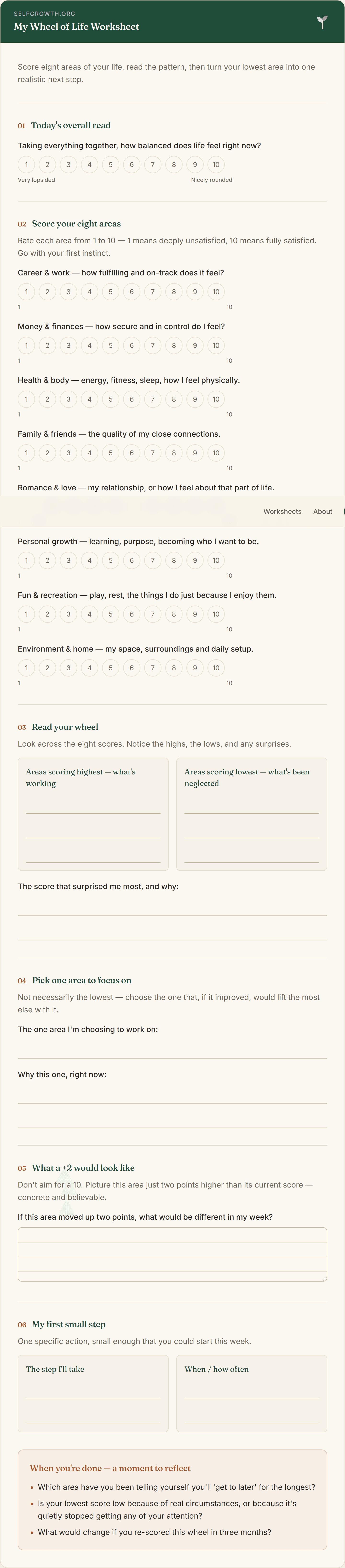
Wheel of Life Worksheet
A free printable PDF Wheel of Life exercise. Score each area of your life out of ten, see where you're out of balance, and pick one to work on next.
Open worksheet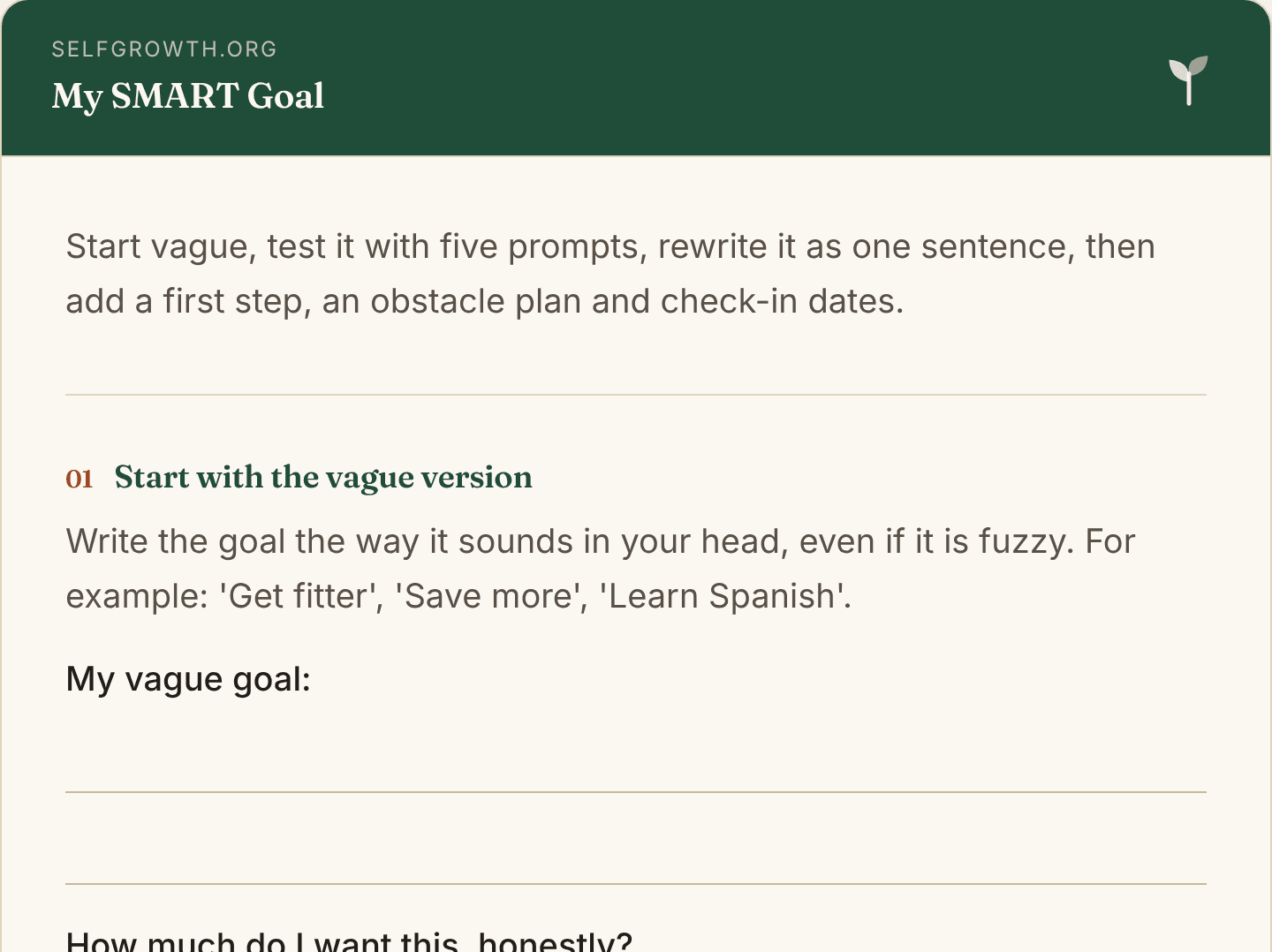
SMART Goals Worksheet
A free, printable SMART goals worksheet: start with one vague goal, answer five prompts with examples, rewrite it as one sentence, then add a first step and check-in dates.
Open worksheet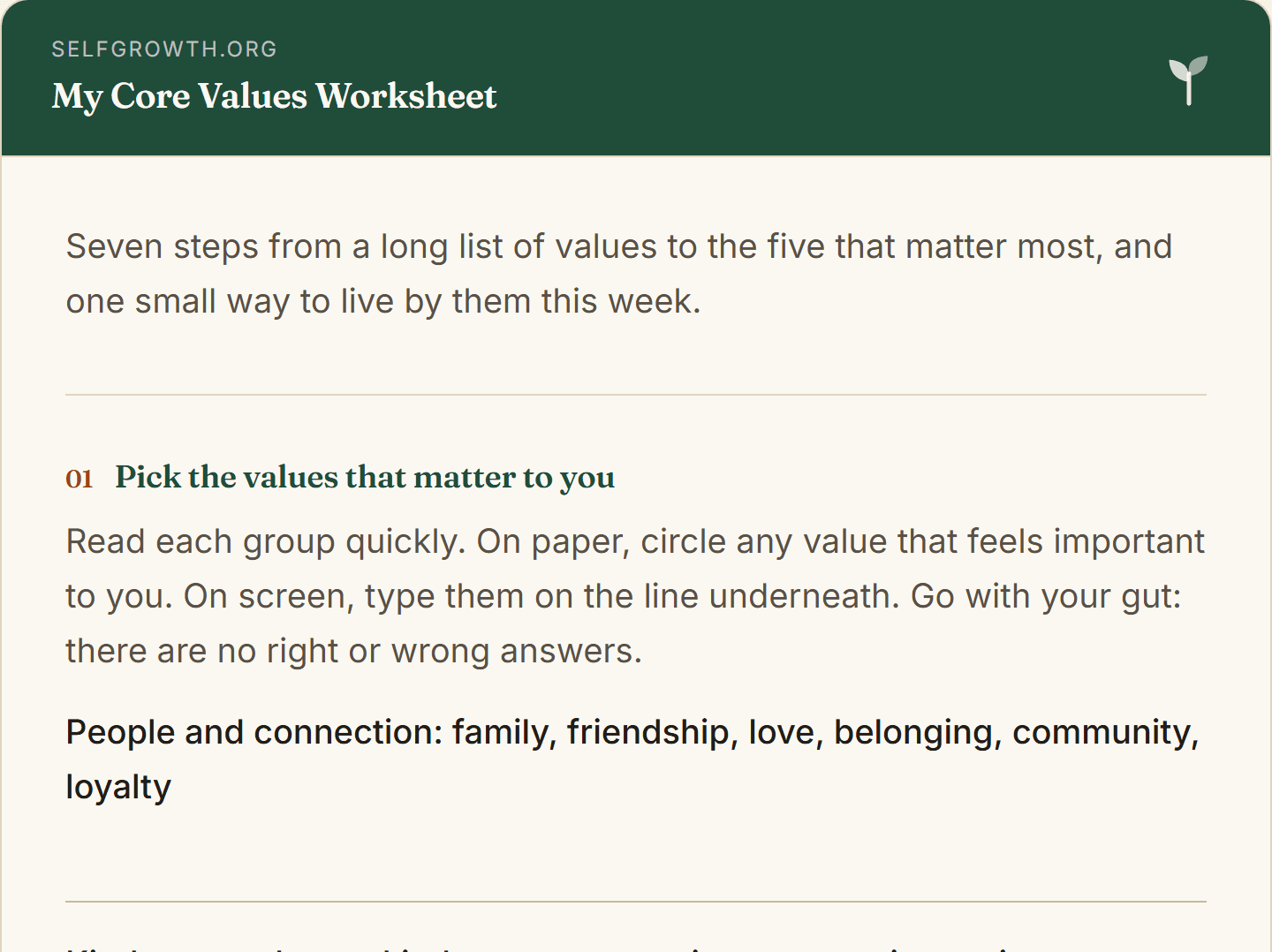
Core Values Worksheet
A free, printable core values worksheet: pick values from a list, narrow them to your top five, put them in your own words and plan one step to live by them.
Open worksheetNew worksheets, straight to your inbox
An occasional new worksheet or tool, sent only when there's something genuinely worth your time. No spam, no pressure, unsubscribe any time.